
mailed April 15
Dear Indywood,
Enclosed find my rewards returned for backing your project on Kickstarter. I also ask that you remove my name from your list of supporters. The idea of a downtown movie house was very appealing to me when I read your request for support as the clock was ticking down on your campaign and so I backed it. I was pleased by your enthusiasm for the idea and for your location. However, I’d like to register my displeasure with your recent actions by returning my rewards and withdrawing my visible support.
When I read about the robbery at your shop, I was sorry and sad for your troubles but assumed that your impulse would be to reach out to the neighborhood to help construct a community that could look out for each other and one that might also begin to consider the effect that so much concentrated development is having on a previously diverse and vibrant street. That maybe the best response you could have to random violence being visited on your place of business would be to assume it was happening to others and to knock on doors and to offer some help to the neighborhoods on both sides of St. Claude.
Instead, I was directed to posts and vlogs authored by the Indywood team and found your newfound shock about street lights near your place being out and your statements about installing buzzers and “lots and lots of lights, ignoring the neighbor/HDLC” (sic) agreements and lofty talk of being on the edge of gentrification (I hear that it had originally been written as on the “forefront of gentrification” please tell me you thought you were joking with that).
I am very sorry that you had this happen to you, but to act as if it only happens to you is the first sign of privilege. The second is the immediate talk about securing property with things that will separate you physically and socially from your neighbors. The third is to advertise that St. Claude is not safe as if this crime has made it so, rather than the already existing and growing divide of richer and poorer that your (our) investment has contributed to it being ever more hardened into long-term reality. The fourth is the shock and hurt over you seem to have in being called out on it via social media.
Let me be frank: like you, I gain from white privilege. Everywhere I go in America, I am welcome and can reasonably assume I will not be randomly stopped for driving or walking anywhere simply because I am white. I can walk into any employment situation and at least get a fair(ish, I am a woman after all) screening based on my actual credentials. I can dream of owning a house in any parish if I so desire. I was afforded a pretty good free education that suggests I can operate behind a desk or even manage others. It has taken me many years to truly understand how those and many other benefits are not evenly offered to everyone.
I live here in New Orleans partly because my culture is not the dominant culture, or at least it wasn’t when I moved here over 30 years ago from an entirely white suburb of a shrinking Midwestern city. That point is very important; what I mean is that I was able to see my unequal position as a white person in terms of the continuing colonial imperialism that I profit from but also to have the chance to live here at a time (well at the waning end it seems) when the African-American community still had real prominence in government and in the culture. I had the luck to work and live in a majority African-American U.S. city during a time when it hosted a true renaissance in music, dance, photography, organizing among many other areas that brought the adoration of the world to us. And in lieu of blue, pink and white-collared white people being around to teach me, I learned from those people of color who were still here. I went to St. Claude Avenue to talk with repairmen who knew everything about the machines brought to them. I had all African-American teachers and principals at my high school. At every workplace, I knew to ask to be trained by those matronly ladies who work hard in every city; the thing is by my time here, they were almost all women of color.
I must share that I was surprised by the grace and the lack of recrimination my neighbors had when talking with me, so very often willing to meet me more than halfway and to patiently show me how my unfair edge had made the world seem a certain way when in fact it was actually not that way at all.
So, we muddled through for a few decades, sometimes getting closer to each other and sometimes further from each other. And then, as we say, Katrina happened.
The destruction of the physical space was hard but the ongoing destruction of that enduring culture was and is worse.
The number of longtime residents who cannot return is enough to populate a medium city, with almost all of them African-Americans.
The neighborhoods that they had held together through the generations of segregation and separated levels of economic opportunity were then either ignored or sold off.
Suddenly, it seemed we were moving back to the time when people of color had to offer white people an explanation for being pissed off at inequities, at hearing daily language that is woefully ignorant. The difference is that now it is not said overtly in terms of color but rather, in code words of class and opportunity as if everyone was being offered the same.
And so if it needs to be said to you, I’ll say it: it is not the same. The opportunities are not equal. They have never been but over the last few years, the astonishing blitheness of the easy takeover of every cultural treasure long created through community and artistic expression is overwhelming. The neighborhoods being transformed into versions of how whites (newly arrived mostly, but to be fair, not always) want to see New Orleans, all done with ironic detachment is painful.
So your hard work to create your thing on St. Claude is real and you should be respected for that, but it is not fair. The opportunity to get that liberal arts education and to be “white kids from Colorado” who can pick up and move to a city and have the skills and connections to open businesses is not because you have run the same course as your 7th ward neighbor and then beat him to it fair and square.
The crime that happened to you did not just happen to you. The crime in our city is overwhelmingly directed at people of color and includes some from authority figures too, the type of crime which white people largely get to avoid.
The idea you had is great but it now feels a little like you see it as a playhouse for you and your friends ambitions and less like a community place (think about it: once you get that buzzer, what would happen when a couple of African-American kids used it at 8 o’clock at night?) This is why I cannot support Indywood at all until some real change happens.
Why I wrote this tiresome long letter is because I want you to have that same opportunity I had when I came here so many years ago: to truly learn from this place and to change. I’ll still hope for you to be successful, but I’ll more fervently hope that you understand how that is made possible and that you’ll do your best when it happens to lift every boat and not just lock yours nice and tight.
I wish you both good luck. More recent news make it seem as if you are taking the lessons to be learned more seriously than before realizing that you, like all of us, have some prejudices to unlearn. If that is the case, I applaud it.
Here is the same idea but said clearly here by local activist Kenny Francis: If you’re thinking about an issue and your identity is not the one that is being threatened or harmed, your role should be to listen, to understand the privilege you have in not being affected by that issue, and to listen to those who are and what they are saying they need. That’s how you be an effective ally, that’s how you bridge divides.
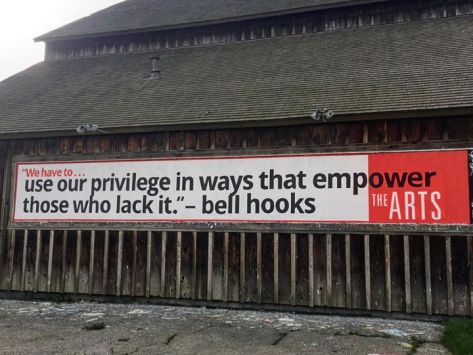
Or, we can just listen to bell hooks:



 French Quarter block by block
You must be logged in to post a comment.