
Flint makes us think about lead poisoning. Beyonce about New Orleans history.
A few years ago I made a map about both of them called Lead and Lies (in Unfathomable City: A New Orleans Atlas; the shading here indicates lead concentrations; the texts overlaid are a lineage of lies in NOLA):
We pretend truth is a solid continent, but untruth is marshy territory. There are myths and legends—about the birth of jazz, for example, which the great jazz scholar Bruce Raeburn points out did not emerge neatly out of Storyville, New Orleans’s brothel district, as people say it did. There are harmless lies, about whether my roux is as good as your grandmother’s; and there are noble lies—“we saw no fugitives pass this way”—and truths told by other means. New Orleans’s most famous jazzman, Louis Armstrong, changed his birthday to the Fourth of July 1900, to make his identity and that of his country somehow consonant—and they are, even though he was born August 4, 1901. More than a hundred years later, poor New Orleanians who said the levees had been dynamited during Hurricane Katrina were wrong in fact but right in that the callous disregard and institutional failure that lay behind some of the 2005 catastrophe had real kinship with the 1927 flood, when levees were indeed dynamited by the powerful.
There are harmful lies, too: both the ambient lies, about racial inferiority or the causes of the Civil War, and particular lies in particular mouths. New Orleans always had scoundrels and flamboyant figures who invented themselves—one of the privileges newcomers always claimed in the New World—and early on, it was populated by smugglers, pirates, renegade slaves, native people lying low, and many people marrying, making love, and creating a Creole population across color lines. Law didn’t always get much respect from these people, and there are times when lying to power is admirable.
When power tells lies to the people, though, it’s another thing altogether. New Orleans and Louisiana have been much afflicted with greedy and dishonest politicians who created a culture of corruption and cronyism (and those who take bribes are lying to the public they swore to serve). Sometimes the level of corruption is staggering: in 1991 the main choices for Louisiana governor were a Klu Klux Klan Grand Wizard spreading racial lies and a longtime politician whose supporters used the slogan “Vote for the Crook. It’s Important.” The crook won and later did ten years in prison for racketeering, mail fraud, and money laundering.
That slavery was generally conducted in a humane or civilized manner was another lie, one that women abolitionists sometimes addressed directly by speaking of the sexual abuse of enslaved women by plantation men, to which wives were required to turn a blind eye. (Conservatives sometimes still produce textbooks in which slavery is benign paternalism.) In antebellum New Orleans, the double life of a wealthy man with a white wife and a placage arrangement with a free woman of color had no equivalent for women. The thriving brothel district of Storyville was another zone through which men moved freely without surrendering their status (and contemporary conservative sex scandals echo that double standard). Women’s lives generally had no such latitude for doubling, though middle class white women did go out masked during carnival to ballrooms they might otherwise not enter. But this is only to say that there are liars and there are the lied-to, and the latter didn’t always believe what they heard, but often they were obliged to pretend that a lie was a truth.
Sometimes they didn’t and testified with consequences—more than once they died for telling the truth, as did Kim Marie Groves, who bore witness to police brutality and died for it. She left three orphans; the hired hitman also left behind three children when he went to prison without chance of parole. New Orleans has had for decades the most corrupt and incompetent police department in the country, one with absurdly low rates of capturing murderers or preventing violence and a terrifyingly high rate of police homicide, framed individuals, and false testimony. Several policemen went to jail for those crimes post-Katrina, and the New Orleans police department was taken over by the federal government in 2012 for its ongoing failure to protect and serve its city.
New Orleans also registers unusually high levels of lead, both from pre-1978 paint and pre-1986 leaded gasoline, though the amounts of lead are not evenly distributed. Lead is a heavy, malleable metal, easily made into objects and mixed with other substances. For much of the twentieth century, it was added to gasoline, to make the gasoline burn better and to reduce wear and tear on engines, and to paint of many types, to increase its durability and moisture-resistance and enhance its color. The far-away scientists who were asked to study lead were themselves induced to lie about the dangers lead posed, and so for half a century vast quantities were added to gasoline and circulated in air, food, and environment. That lies have a lasting legacy is as real as the contaminated soils of the central city, more than a quarter century after the phase-out of the heavy metal.
Lead is a versatile but vicious substance. It accumulates slowly and subtly, rarely detected until the dose is damaging—though children in New Orleans are routinely tested now, when their parents are motivated and financially equipped to do so. When ingested or absorbed, lead is extremely damaging to children’s nervous systems and can have profound emotional and intellectual consequences. Some, including Tulane University professor Howard Mielke, whose lead map is reproduced here, see a correlation between high lead levels and high crime levels in New Orleans.
The substance is a calcium analog—that is, lead impersonates calcium, lying to the body about what it is and insinuating itself into places where benign calcium belongs. Like a lie in words, it gets its victim to accept harm by disguising it. This is what lead and lies have in common: they are destroyers that remain unseen and are more destructive because of their invisibility.
 This year’s theme is presented both in English (“Royal Gardens”) and in Latin (“Horti Regis”), emphasizing the timeless significance of gardens. The desire to be surrounded by beauty is as old as mankind itself. In every time and culture artists have arranged natural elements into gardens to please all of the senses. Emperors and Kings assured that their gardens were planned with as much care as their castles, and some of these gardens were counted among the wonders of the world. The 2016 Rex Procession takes us to splendid gardens known only from ancient illustrations and descriptions, and to others still providing beautiful sights to those who visit them. In the best tradition of Rex artistic design, watch for a parade filled with colorful flowers, historic figures, and colorful costumes.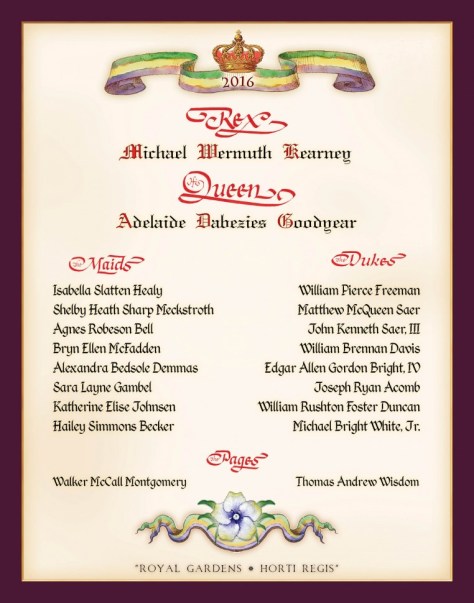


You must be logged in to post a comment.