(This post is from a few years back, but as new developments, planning changes and streetcars come online in both cities, I thought I’d repost it.)
As I roamed the streets of Cincinnati’s historic downtown neighborhood Over-The-Rhine this week and read Michael Morgan’s excellent book on the brewery history of OTR, I noted the many similarities to the French Quarter, as well as some instructive differences.
About the same physical size, both are adjacent to skyscraper-filled downtowns, they each have notable repositories of pre-Civil War historical buildings with richly designed churches and lots of gentrification aches and pains.
In the mid-1800s, OTR had 45,000 (mostly German) residents, twice the population as the French Quarter at its most crowded (in the 1920s), when it was full of old family Creoles and Sicilians. That OTR number is staggering, as any pre-war photo of the FQ shows families crammed into small apartments with laundry stretched across the courtyards. Interestingly, the 2010 Census counted the OTR residents at around 7,000 which is still about twice that of the current French Quarter population (3, 888 in the 2010 Census).
——-
Both are home to their city’s remaining public markets, although Cincinnati’s Findlay Market is already well on its way to a renaissance of local food and friendly festival-type space. Popular restaurants, wine, and wheatgrass bars are filling the retail spots nearby in Cinci, and indoors you can shop the redesigned space alongside locals for meat, produce, and baked goods. A real farmers market operates in the open shed a few days each week and attracts some of the premier direct marketing farms to town.
Of course, the French Market has retail galore, with Cafe Du Monde still operating there near to newer tenants like the local artists’ cooperative Dutch Alley. Local food or farm goods are not available and the French Market’s daily flea market at its Barracks end has largely defined the unfavorable public perception of the French Market for the last 30 years.
Some other thoughts:
The French Quarter has, as its center, Bourbon Street, which is both its greatest street and its guiltiest pleasure. Random violence, prostitution, and hustling have had as much of a spot there as jazz, seafood joints, and burlesque. Even though upper Bourbon is full of girlie bar barkers and “huge ass” drinks, by the middle blocks, it flowers as the center of the city’s vibrant gay bar population and then becomes a quiet, mostly residential area from St. Philip to Esplanade with residential hotels, B&Bs, and services like a postal outlet, a laundromat, and a deli.
The energetic and conflicted span of Bourbon is certainly a production center of noise and crime but also one of entrepreneurial and neighborly zeal. That zeal spreads into the surrounding blocks and as it does, changes slightly to match the grander Royal and Chartres and the less ostentatious Dauphine and Burgundy. It is important to note that it is not newly arrived entrepreneurs or even up and coming developers that carve their empire here; most of these business people are those that arrived at least a generation or two earlier or have a much less culturally edgy plan for their businesses. The newly arrived and hipster-style businesses that are busy buying up the entire Bywater and MidCity corridor might even be repelled from the French Quarter because of Bourbon Street!
For OTR, Vine Street seems like its middle, even though Main Street two blocks parallel is also a contender. Yet, the mix is less successful at this stage, and attracting the numbers and diversity of visitors and locals that Bourbon does is unlikely, -although not that a Bourbon Street vibe is its likely aim.
The OTR area is currently a study in opposites: shiny restaurants and offices at street level with trendy names and flyers of upcoming events taped to the windows with other blocks with fronts boarded up with vines climbing the back without windows or walls. In the early part of the day, the streets are full of African-American residents constantly going in and out of the few convenience stores or the Kroger grocery store. When a white person enters one of these outlets, some tension is apparent in the sudden stoppage of conversation. Groups populate the corners and man stoops all day and into the evening on the streets with outlets that cater to their needs.
Before 10 am, parking meters are widely available but, by midday, young urbanites on bikes and in smart cars and by evening thirty-somethings and older take the last few open spots on the street for dinner or to hear the music.
Parking
Parking is always difficult in the French Quarter and many New Orleanians never venture there because of complicated parking rules and traffic snarls. Pedestrians and bicyclists are regular users of the Quarter and must be encouraged even more to reduce pollution and issues of noise and damage from too many buses and large trucks. The small streets make walking deeply enjoyable. Permanent bike parking is being added by the city in spots that are regularly used as illegal parking spaces; this increases the places to park a bike safely and reduces the traffic issue when parked cars block lines of sight or crosswalks.
The OTR parking was getting tricky while I was there, and signs about not leaving any valuables in sight had begun to pop up throughout the neighborhood (in the Quarter we just assume you know that crime will follow any opportunity). Still, my local friends still felt it was possible to drive down to OTR and park on the street at a meter for a quick shop visit; the parking lot at Washington Park seemed like a good alternative, especially for a market visit, although I have always found parking in the lot or on the street outside of Findlay when popping in for a market visit.
Gentrification/Development
OTR still has not rid itself of all of its diversity. The French Quarter, however, squeezed the last African-American families and working-class neighbors from its edges by the late 1990s and diversity remain only in the work areas when every 8-10 hours the shift changes bring another set of workers, their rides and their buddies to hang on the streets for the next round.
-Another difference is the presence in OTR of the entity, the Cincinnati Center City Development Corporation, commonly known as 3CDC. Their work is clearly spelled out on their website: to assist in redesigning the historic city center and to act as a development force and management of public space and events which allows the city government to step away from that directly. They are known for their work in public spaces including the recently redesigned Washington Park and Fountain Square (and still produce their events), the land banking of properties to reduce the loss of the historic buildings in OTR when necessary, and acting as a commercial developer throughout the OTR. More recently they also began building and managing residential properties, some to include affordable housing.
Scuttlebutt picked up here and there tells me that I could easily find detractors of 3CDC and its leadership, but partly because of its intensive work in safeguarding and revitalizing downtown living and working, there is at least agreement among most Cincinnatians as to the importance of the OTR to the city’s future. The divide seemed wide between development advocates and those that work on behalf of the homeless and the low-income residential community, but the agreements must be hammered out as clearly development will not be stopped and the at-risk population remains (for now). For the French Quarter, I’d rather have this sort of entity than the hodgepodge of private developers bullying a city government without the skills to design or lead these integrated projects.
Crime
Crime remains an issue in both areas. Recent months have seen an uptick of armed robberies in the French Quarter, and although the streets of OTR are considered generally safer than before, you are constantly reminded to be careful and to take items out of your car before leaving. From a WCPO story:
“Between January 1 and July 21 of 2013, there were 494 total serious crimes reported in Over-the-Rhine to Cincinnati police: Three homicides, three rapes, 90 robberies, 46 aggravated assaults, 69 burglaries, 261 thefts and 22 auto thefts. Between January 1 and July 21 of 2012, there were 472 total serious crimes reported to police, according to the Cincinnati Police Department.”
While from a New Orleans realtor site (as real crime stats are not easy to find for New Orleans):
“French Quarter has 62% more property crime than New Orleans and is 199% above the nation’s average. French Quarter, has 109% more personal crime than New Orleans and when compared to that of United States, French Quarter is 547% above the national average.”
Streetcars
Another parallel: Streetcars. Late in 2013, popular Cincinnati Councilperson and Vice Mayor Roxanne Qualls was defeated in her bid for mayor by voters in the outlying areas of the city who instead picked a wealthy anti-streetcar candidate. It seemed to signal the voters’ displeasure with the upcoming downtown streetcar, although anti-rail initiatives had been voted down twice. In the days after the election, OTR activists were able to rally support once again to successfully continue the construction of the streetcar over the objections of the incoming mayor and anti-rail council members. Many believe it is vital to connecting OTR (and the Findlay Market) to the other nearby areas and to serve as an invitation for businesses searching for their next storefront.
That issue follows the ebb and flow of streetcars in New Orleans: the first new streetcar installed in the city in a half-century was put alongside the Mississippi River in the French Quarter in the 1990s, accompanied by jeers and hoots of cronyism and finger-pointing. Who needs a streetcar to go 25 blocks? Yet, that streetcar begat the popular Canal Streetcar which gets a rider all the way to City Park and close to the edge of town which then begat the Loyola Streetcar which allows people to go to Union Station, the Superdome, City Hall from Canal Street, and that little line then begat the St.Claude Streetcar.
As I head back to my own historic place and leave the Cincinnati version, I hope I can convince FQ activists and city officials to look at OTR’s work and use it to discuss the issues of gentrification, preservation versus new retail, socioeconomic diversity, renter rights, homeowner rights and so on.
2018 article in Food and Wine about OTR
Findlay Market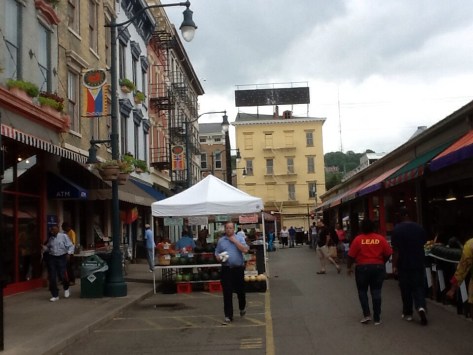
OTR has the largest collection of Italianate architecture in the U.S. 
Main Street business
side street trees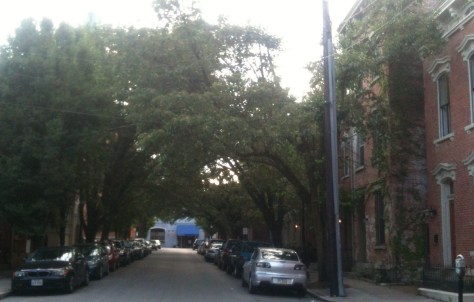
old and new side by side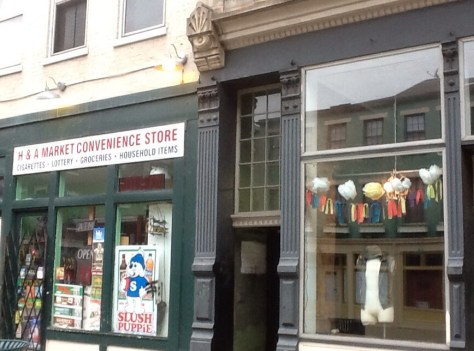
OTR mural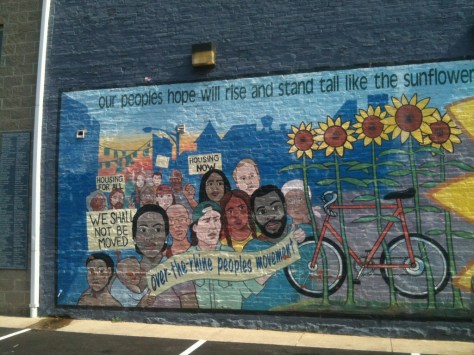
The parade typically starts on time at 7 sharp and makes 3 pauses for a bit of medieval pageantry:




 French Quarter block by block
You must be logged in to post a comment.