Two days of Tennessee

In no particular order:

  1. I go to the Tennessee Williams Literary Festival every year, except when there is a cruel twist of fate and one of my work trips must come then. I think that has only happened once or twice in the last 20 years, but it seemed like a betrayal to my own spring routine. Clearly I never forgot it.
  2. I often pay for a panel pass but just as often I volunteer (and know to expect excellent volunteer supervision from Karissa) which means I get that pass for my (few) hours of work, which is so very much appreciated. I’d like to see the volunteer numbers beefed up a bit and some experienced folks given titled jobs ( I see some of the same people each year). And maybe volunteers can get free theater tickets or a panel pass to encourage those with different interests?
  3. One time I purchased a more expensive  pass that gave me access to the Master Classes which just seemed like more panels, except held on Thursday. However, I often also purchase a single ticket to a theater offering or a special event; this year, I would have gone to see Poppy Tooker, but her event sold out early. Honestly, I think getting the panel pass and individual tickets  is the only way to go, unless you rich or need to get your name on the thank you list.
  4. I often skip the Stella Yella (think its actually called the Stella Yell Off) on Jackson Square ‘cuz the crowd is HUGE now and unless you are on a balcony or camped out for hours, you cannot see it. And also,  sometimes the yelling intensity is frightening and I start to get concerned for the actors. (Is there an ambulance nearby in case someone pops a vessel?)
  5. When I first started to attend the Fest (around 2000), I knew no one and happily sat there invisibly, listening, daydreaming and taking notes. Now, I know many of the attendees as my neighbors, and others from doing civic work around the city. I’m not sure I prefer one mode over the other; my time as a observer was sweet and now my time as a chatterer in the hallways is fine too. I just never want to be one of those people who only talk to each other. You know who they are.
  6. Williams Center @ HNOC has been a great addition to the venues. I think Kenneth Holditch’s Walking Tours have attracted new people to the Fest.
  7. Over the years, the effort to add new voices and different perspectives has worked reasonably well. The attention to POC and gender-fluid writers and performers has definitely grown and is treated with dignity and thoughtfulness. However,  some panel topics have worn a bit thin (isn’t there a better way of offering indy publishing perspective than that one 3-person panel?) and yet the stuff about Tennessee and his work seem to be constantly updating and offering some new perspectives.
  8. What happened to the literary world panels? Am I wrong in thinking there used to be more literary agents, editors etc discussing the book publishing world?
  9. Why not more on simply the world of theater, either here in New Orleans or across the US?
  10. I do like the contests (one-act, poetry etc) , but think we can learn hear more about the process and the contestants during the regular panels.
  11. The Saints and Sinners programming is a welcome addition to supporting writers of more genres.
  12. Suggestions: I’d like to see some more (gasp!) TWO person panels or even straight interviews with one author/playwright. And why not show Streetcar each year in the Quarter on the last night, maybe projected in the Square?
  13. Master Class as actual classes? More programming outside of this weekend? theater offerings at schools? TW short story book club at area libraries? (although a shout out to the WriteNow program held during the fest is necessary…)
  14. More used books for sale? How about giving our front line folks (i.e. booksellers at the bookshops around town) a few free tickets to a single panel? so many of them are working writers and of course talk to many literate folks every day and so can spread the word about TWLF.
  15. and this is sort of self-serving, but I think TWLF should encourage more bloggers, tweeters, occasional writers to participate and to write about those on the panels, their works and the entire deal.

Still, in a hurried world of shouting candidates and Kardashians, Tennessee reminds us to care for our sensitive souls. So, knowing there is one more day is a pleasant way to end today:
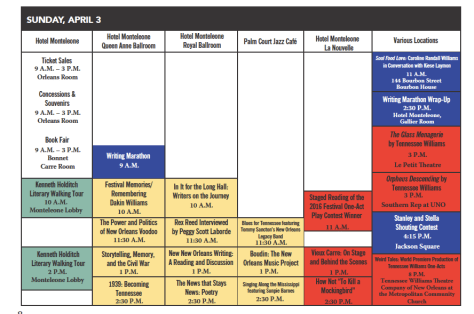
TWLF16Sun

 Cabrini to gain off leash dog park

Preliminary plans for the dog park determine that about 1/4 of the park space would be fenced off for dogs to run off leash.

Some community members gave their feedback that this space would be too small for the numbers of dogs expected to show up in the area. Judge Williams indicated that NORDC may be open to designating a larger portion of the park for dogs — specifically, what is now the planter/ former wading pool which would possibly be good for use as a small dog area. This would relieve potential space issues in the larger dog area.

He also indicated that the Cabrini Dog Park is a project in progress — that he wants NORDC to finish this first stage soon (before summer 2016) and that if it’s determined that an abundance of dogs are using the park, the space can possibly be expanded in the future. 

Source: Share Cabrini

Slightly different passion in Quarter this week

“When TV cameras descend on New Orleans Palm Sunday, it won’t be for a religious service but rather for a live Fox musical event. On March 20th, the network will air The Passion, a modern-day musical retelling of the Jesus of Nazareth story, as he presides over the Last Supper and then is betrayed by Judas, put on trial by Pontius Pilate, convicted, crucified and resurrected. The event, produced by Fox with Dick Clark Productions, Eye2Eye Media and Anders Media, will include a procession of hundreds of people carrying an illuminated, 20-foot cross from Champion Square outside the Mercedes-Benz Superdome to a stage to be constructed at Woldenburg Park on the riverfront….The classic tale, which will be told through the music of Whitney Houston, Imagine Dragons and others, will unfold live over two hours at some of New Orleans’ most iconic locations.Perry will be hosting and narrating the two-hour live special. Seal is Pontious Pilate. Daughtry is playing Judas. Yearwood is Mary, mother of Jesus.”


French Market St. Joseph’s Day Altar activities

On Saturday (March 19), visitors to the French Market on North Peters Street in the French Quarter can stop by a St. Joseph’s Altar and learn more about the feast day and tradition. Along with viewing the altar, visitors can learn about New Orleans Sicilian heritage, listen to music and watch performances.

Here is a lineup of the day’s events:

    • 10:30 a.m. – Rosanna Giacona, a Beauregard-Keyes Historic House tour guide, will talk about her Sicilian heritage, and the Sicilian heritage of New Orleans.
    • 11-12:15 p.m. – Oompah D’Italia will feature Julie Council playing traditional Italian music.
    • 12:30 p.m. – During, “St. Joseph’s Day Altars – Then and Now,” attendees can listen to Liz Williams director of the Southern Food and Beverage Museum talk about the history of the altars.

N.O. St. Joseph Day altars pop up in the oddest places

N.O. St. Joseph Day altars pop up in the oddest places

On March 19, the faithful and the curious go on pilgrimages, visiting altars at homes, churches and Catholic schools. Some of those pilgrimages, however, will bring folks to decidedly nontraditional sites.

  • 1 p.m. – “Sicilian Roots at the French Market,” will feature a conversation with the Portera Sisters, who built the markets altar.
  • 2-3:30 p.m. – Palermo Import/Export Band will perform.
  • 3-3:30 p.m. – The Muff-a-Lottas will perform.

Molly’s At the Market 2016 Parade

12804738_10153756694010865_7833584989432312321_n.jpg

Oldest building, newest activity for this Quarterite

On a bright and lively Friday, I headed down to Nine Roses for lunch in Exchange Alley  to catch up with my MidCity pal and meet her visiting NY friends. After a delicious Vietnamese lunch (I recommend the Cheagan = Cheating Vegan Pho and the coffee Bubble Tea),  we then took a mosey around the Quarter.  We ended up doing an activity that I have never done over my 35 + years here: going into the Old Ursuline Convent Museum which, as anyone knows who spends more than a day here, is the oldest existing building in the city and actually predates any in the entire Mississippi Valley. According to the National Parks Service, “This is the finest surviving example of French Colonial public architecture in the country, Louis XV in style, formal and symmetrical, with restrained ornament. It was constructed between 1748 and 1752 for nuns whose mission was to nurse the poor and teach young girls.” The Ursuline Nuns staffed the first hospital in the vast Louisiana Territory that stretched from the Gulf of Mexico to Canada, and from the Appalachians to the Rocky Mountains.  In this same facility were established the first convent in what is now the territory of the United States, the first day nursery, the first orphanage, and the first institution of Catholic charities.


The docents are dedicated, full of fascinating details and should be commended for their  pleasant natures, considering how many times a day they say the same thing.

You enter into the tiny gift shop where you buy tickets and hear about Our Lady of Prompt Succor, patroness of New Orleans, who every good New Orleanian knows, protects us from bad winds of hurricanes and more.

After purchasing tickets (thanks to our generous visitors) you are free to head into the courtyard, then into the main building. The docent there directs you to the tour of the church to your left, which was built in the 1840s on the site of the original Ursuline chapel as the Archbishops Chapel.  That turn of events was possible because of the 1820s move of  the Ursulines up to what is now known as Jefferson Avenue where they remain today (whenever I hear someone talking about that, I hear The Jefferson’s television show theme “Movin On Up”). A lovely church, only open for special events and musical concerts such as during the French Quarter Fest. Of course, we all notice the statue of the saint with a skull in her hand and ask the docent about it who is used to the question: it is Saint Rosalia of Palermo, made for St. Mary’s during the time when it served as the Italian community’s church. The story below taken from Wikipedia was  told to us in almost exactly the same words by the docent, EXCEPT for the last sentence:

Rosalia was born of a Norman noble family that claimed descent from Charlemagne. Devoutly religious, she retired to live as a hermit in a cave on Mount Pellegrino, where she died alone in 1166. Tradition says that she was led to the cave by two angels. On the cave wall she wrote “I, Rosalia, daughter of Sinibald, Lord of Roses, and Quisquina, have taken the resolution to live in this cave for the love of my Lord, Jesus Christ.” The feast of Saint Rosalia is on September 4th. [1]In 1624, a plague beset Palermo. During this hardship Saint Rosalia appeared first to a sick woman, then to a hunter, to whom she indicated where her remains were to be found. She ordered him to bring her bones to Palermo and have them carried in procession through the city.

The hunter climbed the mountain and found her bones in the cave as described. He did what she had asked in the apparition. After her remains were carried around the city three times, the plague ceased. After this Saint Rosalia was venerated as the patron saint of Palermo, and a sanctuary was built in the cave where her remains were discovered.[2] 

Upon examination by a renowned geologist and palaeontologist, William Buckland, the bones of St Rosalia were thought to be those of a goat.[3]

We see the National St. Lazarus order shrine in the hallway and the docent tells us a great “only in New Orleans” story: the building had termites and needed money to treat. The society of St. Lazarus was given this hallway in 1980 to build a permanent shrine in return for their financial assistance and in regard for their respected order which is over a thousand years old; you may know it as the Knights Templar, or as the Knights of the Crusades. The docent tells us that the order gathers at  the shrine every October.

The next area of the museum takes you through the history of the order in New Orleans, which is worth spending some time reading, including Thomas Jefferson’s agreement as to the order’s rights to be held separate from civil authority. His letter was written as a response to their request for autonomy at the time of the American takeover of New Orleans during the Louisiana Purchase:

To the Soeur Therese de St. Xavier farjon Superior, and the Nuns of the order of St. Ursula at New Orleans

I have recieved, holy sisters, the letter you have written me wherein you express anxiety for the property vested in your institution by the former governments of Louisiana. the principles of the constitution and government of the United states are a sure guarantee to you that it will be preserved to you sacred and inviolate, and that your institution will be permitted to govern itself according to it’s own voluntary rules, without interference from the civil authority. whatever diversity of shade may appear in the religious opinions of our fellow citizens, the charitable objects of your institution cannot be indifferent to any; and it’s furtherance of the wholesome purposes of society, by training up it’s younger members in the way they should go, cannot fail to ensure it the patronage of the government it is under. be assured it will meet all the protection which my office can give it.

I salute you, holy sisters, with friendship & respect.

Th: Jefferson

After that room, take a minute to view the graceful clock in the hall, still with its the original clock face  that was brought with the nuns when they first arrived in New Orleans in the 1720s. That clock later survived the Galveston hurricane which killed those nuns who had left the New Orleans area to set up an order there. The clock was returned to New Orleans and still strikes every 15 minutes (or so).

Then, check out some history of Catholic New Orleans in the other rooms, and finally take some time in the orderly back garden. The temporary exhibit there now is of six people who spent time here who are either saints or on their way to sainthood (“Ordinary People, Extraordinary Gifts: The Road To Sainthood”). The statues are very pleasing  and are set at human height to allow for close inspection. (After reading a bit online  about Cornelia Peacock Connelly, I can see why she deserved to be venerated by the church!)

The last welcome sight was of the rubber tree that I had grown to enjoy for many years as a passerby, and used to hang heavily over the convent wall. After a hard freeze a few years back (an unlikely occurrence in the city but it does happen) the rubber tree had disappeared from view. I had hoped that it had not been taken out entirely and had kept my eye out for its return on top of that wall for some years- how cheery to note  from an inside vantage point that it is just about ready to be seen by the outside world again.


Make House Into a Mardi Gras Float by Levy Easterly – GoFundMe

This house is the single best “costumed”place in the city, every year. Be a part of the fun and help Levy out. If you do, when you go take that picture in front of their house that everyone does, you can say, “I helped!” when you post it to your Snapchat, Instagram, Facebook and Twitter accounts…

Source: Make House Into a Mardi Gras Float by Levy Easterly – GoFundMe