TIMES PICAYUNE
February 28, 1935
Louisiana Purchase, Completed in Cabildo, Stands as Greatest Realty Deal in History
Every other real estate deal in history fades into insignificance when compared with the Louisiana Purchase.
For $15,000,000, France turned over to the United States all of what is now known as Arkansas, Iowa, Kansas, Missouri, Nebraska and Oklahoma; three-quarters of Louisiana, Colorado, Montana and Wyoming; half of Minnesota and North Dakota; a quarter of New Mexico and small parts of Mississippi, Idaho and Texas. And Napoleon Bonaparte made up his mind to make that sale while he was mad as a hornet in his bathtub!
The date was December 20, 1803. Louisiana had been French from the discoverers to 1769, then Spanish until November 30, 1803, French again for 20 days, and now was to become American.
Up there in the Sala Capitular of the Cabildo, the second-story room on the corner of St. Peter and Chartres streets today, the great valley empire of the Louisiana Purchase was to be transferred with pompous formality to the United States of America.
In the Sala Capitular the dignified gentlemen were exchanging credentials. Pierre Clement Laussat, colonial prefect of Louisiana, who for 20 days had ruled the huge province for Napoleon Bonaparte, first consul of France; William C.C. Claiborne, first American governor of Louisiana; General James Wilkinson of the United States army.
Laussat was preparing to turn over to Claiborne and Wilkinson the vast territory Napoleon Bonaparte had sold for $15,000,000 in the name of the republic of France to President Thomas Jefferson in the name of the United States of America.
The 10,000 population of New Orleans, streaming toward the Place d’Armes, packed inside of it, couldn’t have dreamed of all that. Nor the 50,000 population of the great empire up the valley. All they knew was that the flags and the ground rules were changing again. Most of them hated the change. They had been successively subjects of Spain, citizens of the republic of France, citizens of the United States of America, all within 22 days.
The spectators watched the troops march into the square and take up their positions, in even ranks. There was the New Orleans militia under Colonel Belle-chasse. There were United States army regulars in the tight knee-breeches and tailcoats, their criss-cross white belts, their heavy smooth-bore muskets. Here in a group stood the “Kaintocks” – Kentucky flatboatmen, many in Indian buckskin and coonskin caps. Some carried the long Kentucky rifles on the arms, were belted with hunting knife and Indian tomahawk.
Inside the Cabildo the dignified gentlemen had accepted the others’ credentials. Clerks had droned through the lenghty wording of international documents. The gentlemen rose and solemnly shook hands. Governor Claiborne produced his first proclamation of this vast new land he ruled. It was in three languages – English, French and Spanish. Claiborne, Wilkinson and Laussat advanced to the second-story windows of the Cabildo. The proclamation was to be read in all three languages. The United States of America notified the world thereby that Louisiana was now American. Some cheers rose.
Stars and Stripes Hoisted
Then an armed color guard marched to the flagpole in the middle of the Place d’Armes. Solemnly they hauled down the flag of France. Solemnly they hoisted to the top of the pole the Stars and Stripes. And the United States army regulars at the sharp command of an officer raised their muskets and fired a salute to the flag that, with added stars, floats over Louisiana yet. Then the Claiborne proclamation was read.
Americans began pouring into New Orleans from that day. The 1810 census, seven years later, shows 17,242 population for the city, 76,556 population for Louisiana. New Orleans was launched on her career as the greatest city of the South.
Incredible today sounds the welter of motives and circumstances that led to that transfer of Louisiana. They didn’t even know many of the details, then , those folks who feasted and danced and drank deep at the banquets and the brilliant ball given in New Orleans that night of December 20, 1803. Documents then buried in private and secret archives have come to light since that day. Now the almost unbelievable picture is clear.
First of all, Napoleon Bonaparte literally made up his mind to sell Louisiana in a fit of rage while he was in his hot bath. It was a strangely shaped copper tub with its own charcoal stove attached. Napoleon’s circulation was poor. He awoke cold. He would sit an hour in that simmering, soapy, perfumed water. Such a tub stands in the Cabildo today.
Two Americans in Paris
In Paris, then , were two Americans, Robert R. Livingston, brilliant New York lawyer (who never saw the Louisiana he helped buy for his nation). and James Monroe, later president of the United States. They came with President Thomas Jefferson’s proposal to buy Louisiana. Napoleon delegated to deal with them Barbe Marbois, “peer of France.” Actually, Robert R. Livingston and Barbe Marbois did about 90 per cent of the negotitating. Monroe arrived late; was sick in bed most of the time.
Napoleon Needed Money
Napoleon was planning to invade the British Isles and conquer his worst foes in their homeland. He needed money for army and fleet. But he hadn’t made up his mind yet to sell Louisiana.
A letter to his brother, Joseph Bonaparte, tells how he did make up his mind in his bath. Joseph and Jerome, two of his brothers, called on him that morning. Jerome was brilliant in a new uniform of light blue and silver. Napoleon’s valet admitted them. Napoleon, neck-deep in hot water, his brothers standing near the tub, suggested it might be a good thing to sell Louisiana. The brothers fought the idea hotly. Their language angered Napoleon. Suddenly, as the three screamed at each other, quarrelling, excited Corsicans all in the midst of a family battle, Napoleon leaped to his feet. A wave of soapy water deluged Jerome Bonaparte, ruined his costly new uniform. Their high, shrill voices alarmed the servant. He came running from the ante-room, thought he saw the brothers about to fight each other, and fainted with fear and excitement. Napoleon, naked, leaped from the tub. The three brothers bent over the unconscious servant, reviving him.
But Napoleon’s last defiance of his brothers: “Who rules France? You or I? If I want to sell Louisiana, I will!” became his fixed determination.
United States AFTER Louisiana Purchase.
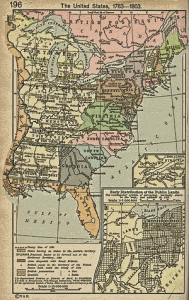
US after 1803 purchase
Americans Delighted
Livingston and Monroe learned to their delight that Napoleon would sell. After long haggling, the price was fixed at $15,000,000, a tremendous sum in those days. The treaty was signed at last by Livingston, Monroe, and Barbe Marbois. A letter from Livingston and Monroe to Rufus King, then American minister to England (first of the long line of what became ambassadors to St. James), was the first notification to anyone that the treaty was signed. The treaty was signed and sealed in triplicate.
Thomas Jefferson admitted he “strained his power until it cracked” making that $15,000,000 purchase. He had to borrow the money. And the lender was the London banking house of the Barings – the great English financial firm of the day!
It sounds incredible that an English banking firm lent the money to the United States, England’s recent victorious enemy, to pay Napoleon Bonaparte for Louisiana when England wanted Louisiana, anyway, and it was Europe’s open secret that Napoleon planned to invade England and was seeking desperately to finance the proposed expedition. But they did.
Money for Army and Fleet
Napoleon spent the money on army and fleet, the fleet that never sailed from Boulogne to land that army on English soil. The adverse winds, the stormy channel crossing, saved England that invasion.
And, as the War of 1812 and the Packenham expedition that failed a the Battle of New Orleans in 1815 revealed, England had planned to take Louisiana by force, anyway. But that was all in the remote future, undreamed by those crowds in New Orleans that fateful day of December 20, 1803. Some of them cheered, some complained. A lot of them went to sleep to wake with headaches caused by anything from champagne and madeira, port and sherry, to Monongahela whiskey and West Indian rum. And with the ceremonies all over, Governor Claiborne started out the next day to solve problems practically unsolvable, to govern in American fashion, as American citizens made overnight, a population of some 60,000 that language of most of whom he didn’t even understand!


 French Quarter block by block
You must be logged in to post a comment.