Cabrini Park is for sale. The one shared green space for residents, happy dogs and schoolkids alike is now waiting for a developer. Clearly, the neighborhood associations in the surrounding areas need a Martha Robinson-level activist with time and access to fight for this. How wonderful if the outcome of this is that we could have a first-rate green space led by the citizens much like Dufferin Grove Park in Toronto or People’s Park in Berkeley, both that I have made pilgrimage to during my organizing work. Proposed sale of park worries F.Q. residents.
Battle of the Battlefield
Important history from writer Eve Abrams on preservation and home, race and privilege as we celebrate the 200 year anniversary of the Battle of New Orleans:
About 30 families lived in Fazendeville, and all, like the Cagers, went back generations—perhaps to its beginning around 1870, when Jean Pierre Fazende, a free man of color, New Orleans grocer, and opera lover began subdividing the slim tract of land he’d inherited from his father—also named Jean Pierre Fazende—and selling off parcels to recently freed slaves.
————————————————————————-
In the mid 1800s, local citizens organized to erect a monument in honor of their ancestors’ sacrifice and Andrew Jackson’s victory. Dwindling funds and the Civil War stalled construction, but by the 1890s, the Louisiana Society of the United States Daughters of 1776 and 1812 passionately took up the cause.
The National Park Service had powerful allies. Among them was the Chalmette Chapter of the U.S. Daughters of 1812, headed by Mrs. Edwin X. de Verges, as well as her dear friend Martha Robinson, New Orleans’ grand dame of preservation, who headed the Louisiana Landmarks Society. –
…Wielding influence and tenacity, she (Robinson) convinced both the railroad and the previously intractable Kaiser Aluminum to donate valuable acreage. Protecting a chapter of history was clearly at the forefront of Robinson’s agenda, yet dispossessing a community was the next, necessary step. “Rather than get tangled up with Martha Robinson,” write Abbye A. Gorin and Wilbur E. Meneray, “politicians considered an alternate course.” Several of these politicians—Congressman F. Edward Hebert, Senators Russell B. Long and Allen J. Ellender—took up Robinson’s cause. They introduced legislation in Congress to purchase land for the park in time for the Battle’s 150th anniversary. The resolution passed, and President Kennedy signed it into law just months before he was assassinated.
“The government did eminent domain on us in 1964,” explains Valerie Lindsey Schxnayder, whose father was the last to leave Fazendeville. He moved his entire home —by trailer—to Reynes Street in the Lower Ninth Ward, where it was flooded the following year in Hurricane Betsy, and swept down the block in Katrina. In the mid-1960s, the market price for a new home in St. Bernard was around $16,000; residents of Fazendeville received around $6,000 per home. With Lindsey and the other citizens of Fazendeville gone, The Village was wiped away.
See more at: http://www.louisianaculturalvistas.org/defeat-fazendeville/#sthash.XAS9Bgam.dpuf
– See more at: http://www.louisianaculturalvistas.org/defeat-fazendeville/#sthash.XAS9Bgam.dpuf
Streetcar meeting January 7 in Treme
One of the first of several public forums on a new streetcar line along North Rampart Street along the French Quarter will take place Jan. 7
Officials with the Regional Transit Authority have scheduled the meeting next week beginning at 6 p.m. at the Joseph A. Craig School, located on St. Philip Street.
According to the RTA, the new line will run from Canal Street up Rampart along the edge of the Quarter. It will end at Elysian Fields Avenue, connecting the new line to the existing Canal Streetcar line and the Union Passenger Terminal on Loyola Avenue.
Welcome Carnival 2015
Today we begin OUR holiday season-Carnival. It starts today with the celebration of the Feast of the Epiphany and Joan of Arc’s birthday and ends on Fat Tuesday aka Mardi Gras, the day before Ash Wednesday (Lent). I will celebrate with the first slice of king cake and maybe seeing two parades in this first Carnival day. Phunny Phorty Phellows-A little nonsense now and then is relished by the best of men! truly kicks off the season with their streetcar parade and then the Joan of Arc parade really shows what we do best with their walking (trotting?) French Quarter celebration. Not only is it great to be able to hit 2 parades (one within an easy bike ride of my neighborhood and the other here in the Quarter) but when in a late search of a small traditional king cake, I can hit 3 or 4 bakers or shops within a few blocks of my home and find one:


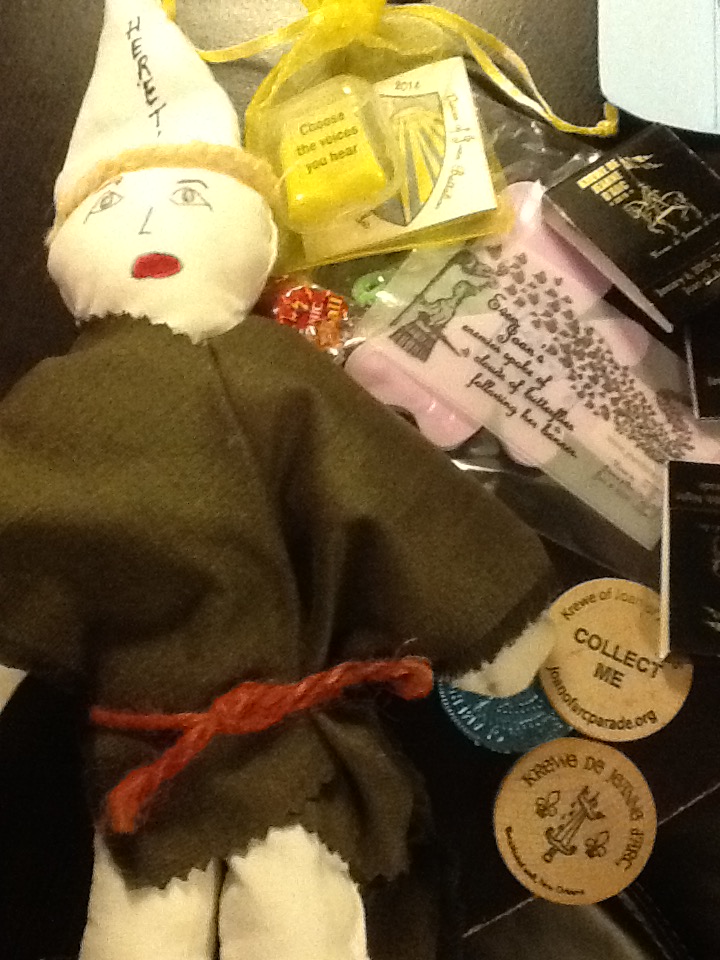
First throws of the 2015 season, including Joan of Arc matches and my very own Heretic Doll
History of a New Orleans friend
Recently, we lost one of the great guys of New Orleans, Michael Mizell-Nelson. A well-loved UNO professor and a historian of New Orleans, he was considered the expert on the history of the po-boy and its blue-collared underpinnings. Always interested in real history and in real people, Michael will never be forgotten by those that love New Orleans or those who admire the people bringing light and knowledge. R.I.P Michael.
He helped develop the Hurricane Digital Memory Bank, an online archive of more than 25,000 photos and oral histories from hurricanes Katrina and Rita.
Take a look at this site that he and his colleagues built with stories from our city:
New Orleans Historical
and listen to Poppy Tooker’s great interview and remembrance of Michael
Walking, French Quarter style 101, Part One
One of the reasons that I started this particular blog was to help decipher what makes the Quarter special enough to be studied for designing cities in the future. No question that living here allows me to see some details up close that might be missed even by frequent visits.
Here is one:
How people walk on city streets runs the gamut from “savvy New Yorker” to “Wyoming cowboy” to “Ohio suburban family” and beyond and let me tell you, these do not always mesh well.
I’ll say firmly at the outset I am not using any of those terms in a derogatory manner. Each style has their reason for existing and their appropriate place. I’m just saying that it is amazing to watch them all coexist on the tiny streets of the Quarter over a New Year’s Eve/Sugar Bowl weekend.
First, here’s some background on me and walking. I grew up first in a walkable town outside of Cleveland that recently won praise as one of the few places where kids still walk to school and, that the city of 52,000 has 9,000 residents per square mile, which (according to some) makes it the most densely populated town between Chicago and New York City. That news was a a happy surprise to me.
However, once I started to travel around the US in the 1980s, I did pick up on the fact that my hometown was definitely different. So, I tell you all of that to stress that I had walked miles daily as a kid and if not on foot, was on bike or skateboard (i.e. human power) maybe 90% of the time and therefore, was not a novice to walking as a primary mode of transportation.
Even so, when I moved to the Quarter with my New Orleans mom, it immediately became clear that I needed to “up my game.” Honestly, it felt like I was dropped into a horse race without blinders or was a salmon swimming upstream for the first few months. Whew! I still remember navigating Royal and Bourbon sidestepping drunks, tourists while slowly making friends with the buskers and workers and realizing I was on display too.
I learned. I learned the hard way, by being pushed off the sidewalk by a tourist suddenly making a veer to the left and I learned from being accosted more than once by The Bead Lady or the Chicken Man, two of our many street characters because I did not see them coming and ended up right in front of them.
or being cursed up and down by Ruthie the Duck Lady as I jumped into her lane as she skated by (I once saw her gaily sing, “MOTHERfucker, MOTHERfucker, MOTHERfucker” with ducks in tow for about 3-4 blocks at the top of her lungs to the horror of the passersby.)
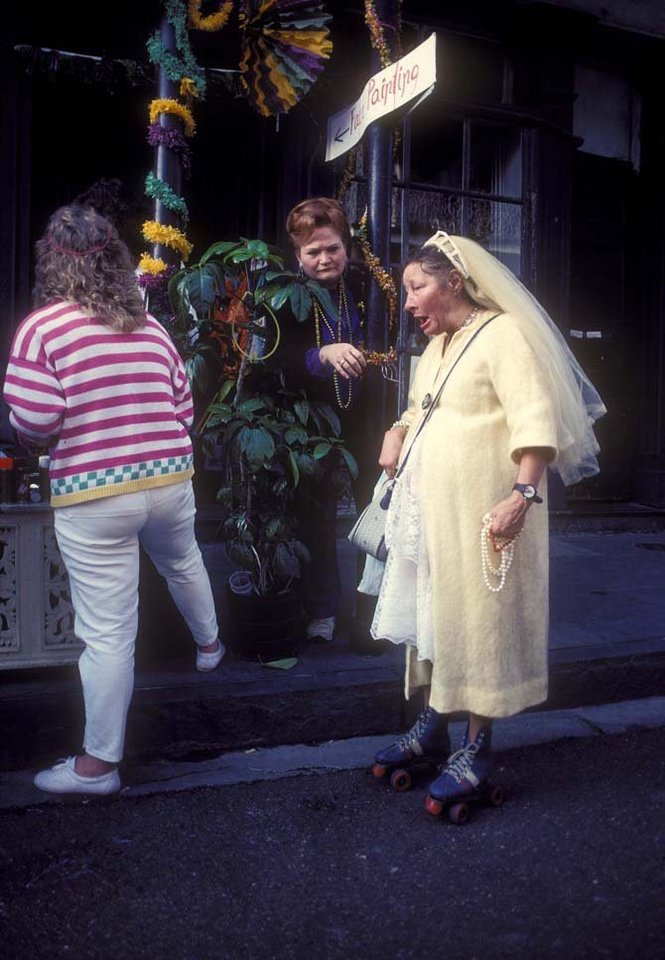
Umm. this is NOT a vintage picture of me stepping in Ruthie’s way, although this woman has a strong Midwestern vibe…
By the 3rd month, I had almost perfected the route through the Quarter which allowed me to move FAST and yet to see my neighbors and pals on my way to school in the CBD. Let me see, it went:
OUT of the door in the 900 block of St. Philip, stay on the Uptown side to skip the smells from Matassa’s bar
STAY on the Uptown side for the next block to escape the hard looks from the nuns at the Mother Cabrini Day Nursery in the 800 block of St. Philip
SWING over to the downtown side for a block to walk along the McDonogh 15 schoolyard (as seen in King Creole, Elvis’ best movie by the way.)
TURN right down Royal and walk on the lake side to look into the bookstore windows and waste too much time on this
MAKE a right on Orleans (checking the St. Louis Cathedral clock first to my left) to get the advantage of the widest street and see the feral cat population before
HANGING a left on Bourbon to take advantage of the cleanest sidewalks as each business had a guy come and hose the sidewalk first thing and then a
MEANDER to the left at St. Louis to see my pals who worked at the hotels on either side of the street and a
RIGHT on Royal to pass by Sloppy Jim’s on the left and Keil’s Antiques on the right to wave to the bartenders/early am regulars and to Jill respectively.
Bending against the wind on upper Royal, avoiding the grumpy doormen at Monteleone (their peers at the Royal Orleans and Royal Sonesta were chattier) and to see Tony the Grey Line Tours guy out front of the Walgreen’s at Iberville for a daily handshake
CROSS Canal,follow St. Charles to Poydras, firmly holding my piece of the concrete against the businessmen who want the entire seersuckin’ street to finally go
LEFT on Carondelet to L.E. Rabouin High School.
On the way home, mostly I veered off Bourbon in the Conti block and headed down Burgundy to see all of the old people on their stoops along the way. Boy do I miss them.
Let me say that I got so good at moving through (head down and a few extra hops to get ahead when moving back to the sidewalk from the street) that I actually have walked past my own mom heading the other way with HER head down and her keys in hand and only knew I had done it when friends with me said, “hey wasn’t that your mom back there?”
So all of that to lay the groundwork for why this three-part post about walking on city streets.
Here are the generalities in no particular order:
•There is a difference from walking in the Quarter on any weekday from any weekend. The amount of truck traffic during the week is so much higher and I have noticed that the presence of trucks tend to push people to the wall side of the sidewalk. They also watch the street crossings a little more carefully. AND since the number of mule-drawn buggies is exponentially increased on weekends, it also has the impact of slowing traffic and encouraging too many people to walk in the still auto-trafficked streets and puts them in danger.
•Europeans are never surprised when you pass them from the side.
•Many people do not take in account the barriers they will have on a sidewalk until the very last moment.
•Amateur photographers are uneasy when you pause on the sidewalk to let them take the photo and often will stop taking pictures when you motion for them to continue, even as you explain you don’t mind waiting for a minute. In fact, they often grow resentful-that is, except for many Japanese tourists; they appreciate it and wave or nod in thanks when done.
•A point shared by my neighbor and pal Evelyn-smart phone photography has encouraged endless indiscriminate photography and has seriously amped up the people standing in the middle of the block looking at the balcony through their electronic eye.
•Additionally, smart phone mapping has reduced the number of people who ask for directions or who orient themselves before heading out to tour and added to that clump of people on every street corner, looking down at their electronic mother. Honestly, I think all hotel and retail folks should be trained to encourage people to come in and ask questions and to use their smart phones in there rather than risk robbery on the street.
•The Segway tours are (mercifully) coming to an end it seems and we have returned en force to walking tours with gallant guides who remind their charges to leave room for passersby. Good- because those Segways were just accidents waitin to happen.
•Bicyclists riding the wrong way for more than a half of a block are a menace to everyone.
•We need to add permanent signs for drivers saying “leave 3 feet to the right” for cyclists and to stop at intersections only when a red octagonal sign signals you to stop.
•No one in Louisiana knows to stop when someone is in a crosswalk.
•People’s inability to navigate city streets can be foretold in their line-forming talent (or lack of it) in stores or in their level of parallel parking skill. (Walking is really about firm decision-making and spatial perception, in other words.)
•The idea of closing Royal during the day and Bourbon at night is very good and should be increased. Get delivery trucks in before 10 am and expand the pedestrian only streets to a few Uptown/Downtown streets. I truly doubt that any of the businesses on either have
suffered because of lack of auto traffic, and would say they actually see a significant benefit. •Wilkinson should be Busker Alley for the evenings as my pal, the Grand Duchess has suggested, and maybe even add Decatur between Bienville and Iberville as another busker area in the evening. Close them, paint musical symbols on the street and allow performers to work for 4 hours before moving to another spot. Allow some street food too on those streets, get rid of the few parking spots and add permanent stools for perching and maybe even some garden beds there.
• They should have more street-facing short benches on Royal and Chartres for people to take a breather. Put markings that they cannot be taken over by buskers or they will incur a 100 dollar fine.
• Add slightly elevated wood lifeguard style chairs on some corners for cops to sit in during evening hours. Incentivize homeowners to add cameras and connect them to Project Nola.
• Add some shade trees in large buckets every few blocks on either side of streets.
• Give awards to those businesses that offer dog bowls, outside seating or that take off the “don’t” signs on their gallery posts. And those with embedded spikes on their steps-shame on you. Just put a strong light or flower pots there instead or, even better, SIT there in the evening and then just hose them off in the morning.
Part 2: What William Whyte and Jane Jacobs taught me about city streets.

 French Quarter block by block
You must be logged in to post a comment.