Poppy’s Drag Brunch Heats Up

On Thursday August 9, I packed up my truck for my usual trip to Ohio. I started to pack it around 6:15 a.m. to try to beat the heat and the street parade of hustlers eyeing my stuff. Even with that, the sweat that ran down my back and arms from the humidity and baked in heat of the asphalt made it clear that there would be no relief. As for the guy who threw trash into my truck bed, I told him off and even though he ambled off the block with a finger raised over his head, I felt better.  As Walt Whitman said, agitation is the most important factor of all.

That heat, the fact that I work from a laptop at home, and have a sister who has a generous nature and a comfortable home on the shores of one of the Great Lakes, means the pull to leave for a while is too great for me to resist.

But even though I am gone-pecan until the true fall arrives sometime in Mid-November with its wonderful slate of outdoor events and the arrival of citrus season, it doesn’t mean that New Orleans is ever far from my mind. I’ll continue to post about events and issues and have momentary pangs of homesickness too.

This is one event that I am sorry to miss:
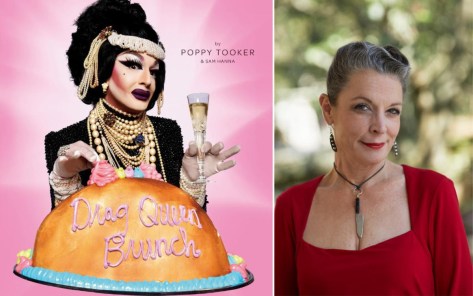
Book signing with author Poppy Tooker
August 31, 2019 | 11 a.m. – 1 p.m.
The Shop at The Collection, 520 Royal Street
Admission to the event is free. The book retails for $29.99
and supports Crescent Care.
Join radio personality, author, and culinary activist Poppy Tooker as she and some special guests sign copies of her forthcoming book Drag Queen Brunch on Saturday, August 31, from 11 a.m. to 1 p.m. at The Shop at The Collection, the museum shop of The Historic New Orleans Collection.
Drag Queen Brunch (Rainbow Road Press, 2019) features gorgeous colorful photography by Sam Hanna of dishes (both ladies and recipes) in some of New Orleans’s most iconic restaurants and courtyards. With every turn of the page, Drag Queen Brunch brings readers to the next stop of an unforgettable time with Tooker and a bevy of rollicking drag queens. 
The event is free, and coincides with Southern Decadence. The book will be available for $29.99. Refreshments from SoBou will be available for guests ages 21 and older. 
A portion of the proceeds from Drag Queen Brunch benefit Crescent Care, a healthcare initiative established by the NO/AIDS Task Force and the Lazarus House.
The Shop at The Collection — which has expanded to nearly 2,000 square feet — is located in THNOC’s new exhibition center at 520 Royal Street and is open Tuesday – Saturday, 9:30 a.m. – 4:30 p.m. and Sunday, 10:30 a.m. – 4:30 p.m. Customers may also shop online at www.hnoc.org/shop.

Poppy is my dear friend but even if that weren’t true, I’d surely tell you to go to her talks, buy her books, and generally listen in on whatever is in her ever-so practical, generous, slightly dangerous New Orleans mind.  She WILL make you feel better about the two-showers a day temps and help you once again love the diverse creativity of our place.

Her commitment to the LGBTQ community has been so steadfast for decades  you can be sure that her book and the brunches are both celebratory and deeply insightful to why the drag community deserves to be lionized as true artists. As for me, their work to bring glamour back to everyday life,  living ones personal life in line with the political, and their constant education on behalf of the LGBTQ community are some of why I’d say drag deserves the big table. I am sure Poppy will have more.

I’ll be writing at the site below while I am gone in case you are interested.
https://thestateofthebuckeye.wordpress.com/

River is remembering

“You know, they straightened out the Mississippi River in places, to make room for houses and livable acreage. Occasionally the river floods these places. “Floods” is the word they use, but in fact it is not flooding; it is remembering. Remembering where it used to be. All water has a perfect memory and is forever trying to get back to where it was. Writers are like that: remembering where we were, that valley we ran through, what the banks were like, the light that was there and the route back to our original place. It is emotional memory–what the nerves and the skin remember as well as how it appeared. And a rush of imagination is our “flooding.” –Toni Morrison

Margee Green for La Agriculture & Forestry Commissioner

Hello neighbors and friends
I hope you are finding some relief this hot and confounding summer, in some shady spot, on a beach, or (like me) if you are lucky enough to have friends’ pools and quiet porches offered to you here and there. Maybe like me, you also get out of the tropics for a bit; as some of you know, I spend much of the summer on the road, checking out farmers markets across the northern part of the US and seeing what other food systems are doing, while relying on my big sister’s hospitality and patience for my long stay. All of that self-care and the different examples allow me to maintain some optimism and excitement around food and farming even though I also see and hear a lot that is discouraging: the lack of farm land available for new and young farmers, the rapid and multiple effects of climate change on established farms, the number of health concerns among farmers (always in top 10 of the most dangerous professions and fishers are even higher -meaning worse- in that ranking), the attempt by the current administration to dismantle policy gains that benefit small farmers, and much more can make this stuff seem quixotic to say the least.
But I do have hope. My go-to writer/activist Rebecca Solnit has explained how we can have hope. She says: “It is important to say what hope is not: it is not the belief that everything was, is or will be fine. Hope is an embrace of the unknown and the unknowable, an alternative to the certainty of both optimists and pessimists. Optimists think it will all be fine without our involvement; pessimists adopt the opposite position; both excuse themselves from acting. (Hope) is the belief that what we do matters even though how and when it may matter, who and what it may impact, are not things we can know beforehand.”
Today I sat for a few quiet hours on one of those borrowed porches with a young woman I know only slightly, and found more reason for hope. Her name is Margee Green, and she is running for Agriculture & Forestry Commissioner in Louisiana. Now you might think that is a pretty huge idea (and you are right) and maybe even think it’s nigh impossible for her to win, but let’s leave that for her to resolve and not start off by killing the hope. Instead let’s focus on how this state has still not figured out how to support a regional farming culture.
How true innovators like Grant and Kate Estrade of Local Cooling Farms, and Graison Gill from Bellegarde Bakery are not only NOT lauded by our elected officials for their incredible work, but instead are often labeled as troublemakers and their path made more difficult.
How farmers markets still have to fight to keep their name from being co-opted by other retail outlets who do none of things that farmers markets do every week and yet our agency does nothing to stop them.
How other states are growing the number of young or beginning farmers (Alaska had a 30 percent increase between 2012-17), or using US Ag Census data to show how some states are seeing real gains in committed purchasing for locally made goods; guess who is near the bottom?
Yeah, we have a lot to fix in how we view and talk about and how we organize around food here. But we can fix it, by learning from our neighbors and from each other and by building policies that benefit those direct relationships and those sustainable practices that reclaim the local food culture and may help save or delay our state from sinking into the gulf. I think one way to start is by asking for changes at the very top of our system: starting with our Department of Ag.  Asking OUR department to see and act as if the community food system is as at least as important as the commodity system that has been in place since the Company of the Indies tried  (and failed) to grow tobacco. And let’s ask them to calculate how that antiquated system has relied on devaluing land and labor and personage to produce those commodities.
One sure way to do that, to make them aware we won’t keep allowing business as usual, is to support Marguerite Green. So I hope you take a break from whatever stresses you these days and check out her page and see what you think. Go talk to her at the local events and markets where she can be easily found. Maybe it will offer you some relief. And maybe it will have an impact.

Can the French Market be “saved”? (Part 2)

It was reported recently that our energetic and active mayor has decided to do something about the French Market. As a 20-year activist in food systems with a 40-year family residency in the French Quarter, I was certainly excited to hear that, although I think the setting has already been improved a great deal in recent years.The main reason this seems opportune is 1) the  limited availability of any public spaces in the city to try small, discrete pilots that center around cultural connections and entrepreneurial zeal means that this might be a unique moment, and 2) also because the current FM Director has been quietly impressive.

Part 2 (Part 1 here) of my four part post:

then Katrina happened:

By September of 2005 while still in exile, we (meaning the parent org of the Crescent City Farmers Market, then known as ECOnomics Institute) created an online bulletin board and chat room for our vendors and for customers of the Crescent City Farmers Market to keep in touch and to tell us when and where they wanted the markets reopened.

Once we knew that we could come back and reopen farmers markets in New Orleans ( because enough producers had product, enough consumers wanted fresh food, and we had places to live) we began to discuss where to put them. Because the “sliver by the river” area of town had not flooded, we knew it would be one of those areas. This was not to ignore the flooded areas, but since any and all space for construction drop off or house demo had to come first,  a pop up market was simply in the way in those early days.  The Girod Street market location had some damage, so that was out. That left the French Market and Uptown Square as the two locations under consideration, but we quickly realized that the French Market was barely functioning.

Even so,  we were still trying to help them by meeting with its director in those early days. I remember that we had dinner with him in early October, discussing how to use the French Market to help rebuild the city. We suggested that they allow Red Cross to use it as a station, and to have city departments set up there. Unfortunately, none of that happened for various reasons, probably most due to the inertia of the complicated system that the French Market was and is managed under.  It is important to point out that the public-private partnership it operates under is hard enough, and then one must take in its multiple roles:

  • the largest manager of city-owned historic property which stretches from Jackson Square (and includes the upper Pontalba building) down to Esplanade (and that was before the Crescent Park opened);
  • the retail manager of all of the storefronts included in those properties;
  • the manager of the parking lots bordering the river and those on Elysian Fields;
  • the operator and manager of the 2 open sheds at the end of the French Market, including its hundreds of itinerant, permanent vendors;
  • one of the primary event creators and managers in the lower river section of the Quarter.

The reason I bring up the post Katrina era (and the earlier revival era that I wrote about in  Part 1) is because the future of this venerable place has a lot of baggage to carry with it, and also has some hard truths of the surrounding area that cannot be denied before we can discuss what to do. And the city is almost a completely different one that what existed on August 28, 2005. I’d like to see that history really analyzed, much more than I have done here, and make that analysis public.

For example, for any of us here at the time and now, it is clear that the post Katrina era gave the French Quarter some new life. Residents who still had property moved back in while they redid their own houses, others grabbed every rental available (which because there was no damage did not see its prices tripled as many other areas have done which was great cuz rents for larger, redone apartments there were already on the highest end of the spectrum), and -AND- the great luck of still having a walkable, vibrant area with public space, groceries, and cheery nightlife on the inner edge of the grey, sad, often toxic other 80% of our city was a comfort to all. So it became boom town for a little while and today, it still has an increase in renters and homeowners from the low population numbers it had a few decades previously.  The Homer Plessy Community School is livening up the corner of St. Philip and Royal,  a number of creative and unique shops are doing well (altho commercial space is at a premium), and a whole lot of activism and street life is still happening here. Interestingly though, still many locals repeat the old story about the French Quarter being “over” as a neighborhood when it is far from that.

That is another issue.

But in any case, the French Market didn’t capitalize on that boom. And unfortunately, lost great anchors such as Horst Pfeiffer’s Bella Luna who grew tired of waiting for his building’s roof to be repaired.

It simply didn’t have the structure or even the mandate to do capitalize. Instead, it remained an gentle afterthought in a booming Quarter, Marigny, Bywater which were (are) full of millennials terrified of being seen as participants in any setting that lacked an ironic twist or didn’t include a new take on an old place.

The French Market did however, add some very interesting counter restaurants in the sheds who continue to animate that very difficult space. And it also moved community radio station WWOZ into the Red Store building.  And the Dutch Alley Artists Co-op continues to attract local artists willing to operate the storefront as a collective. How do those additions change it is the question. Do they?  Are they as important to this French Market as Cafe du Monde and the Creole Tomato Festival were to earlier users?

And how does the new New Orleans (shudder) and the new life in the Quarter affect what is or should happen at the French Market?


-Part 3 will focus on the flea market on the end of the French Market, which must be dealt with, even though its history and its activity is not all as horrible as some residents make it out to be. As a place to show off the diversity of the entrepreneurial community new and venerable, it wears that well. The question is if newly arrived residents are still able to access the French Quarter?  The shift in population for immigrant communities moving away from the city center and to the suburbs and even rural areas seems to make the idea of a French Market business a little less ideal for those communities. The answer may be found in some sort of a organized incubator for those business at the French Market or even assistance in product development that may even cater to residents as well as visitors…