Can the French Market be “saved”? (Part 2)

It was reported recently that our energetic and active mayor has decided to do something about the French Market. As a 20-year activist in food systems with a 40-year family residency in the French Quarter, I was certainly excited to hear that, although I think the setting has already been improved a great deal in recent years.The main reason this seems opportune is 1) the  limited availability of any public spaces in the city to try small, discrete pilots that center around cultural connections and entrepreneurial zeal means that this might be a unique moment, and 2) also because the current FM Director has been quietly impressive.

Part 2 (Part 1 here) of my four part post:

then Katrina happened:

By September of 2005 while still in exile, we (meaning the parent org of the Crescent City Farmers Market, then known as ECOnomics Institute) created an online bulletin board and chat room for our vendors and for customers of the Crescent City Farmers Market to keep in touch and to tell us when and where they wanted the markets reopened.

Once we knew that we could come back and reopen farmers markets in New Orleans ( because enough producers had product, enough consumers wanted fresh food, and we had places to live) we began to discuss where to put them. Because the “sliver by the river” area of town had not flooded, we knew it would be one of those areas. This was not to ignore the flooded areas, but since any and all space for construction drop off or house demo had to come first,  a pop up market was simply in the way in those early days.  The Girod Street market location had some damage, so that was out. That left the French Market and Uptown Square as the two locations under consideration, but we quickly realized that the French Market was barely functioning.

Even so,  we were still trying to help them by meeting with its director in those early days. I remember that we had dinner with him in early October, discussing how to use the French Market to help rebuild the city. We suggested that they allow Red Cross to use it as a station, and to have city departments set up there. Unfortunately, none of that happened for various reasons, probably most due to the inertia of the complicated system that the French Market was and is managed under.  It is important to point out that the public-private partnership it operates under is hard enough, and then one must take in its multiple roles:

  • the largest manager of city-owned historic property which stretches from Jackson Square (and includes the upper Pontalba building) down to Esplanade (and that was before the Crescent Park opened);
  • the retail manager of all of the storefronts included in those properties;
  • the manager of the parking lots bordering the river and those on Elysian Fields;
  • the operator and manager of the 2 open sheds at the end of the French Market, including its hundreds of itinerant, permanent vendors;
  • one of the primary event creators and managers in the lower river section of the Quarter.

The reason I bring up the post Katrina era (and the earlier revival era that I wrote about in  Part 1) is because the future of this venerable place has a lot of baggage to carry with it, and also has some hard truths of the surrounding area that cannot be denied before we can discuss what to do. And the city is almost a completely different one that what existed on August 28, 2005. I’d like to see that history really analyzed, much more than I have done here, and make that analysis public.

For example, for any of us here at the time and now, it is clear that the post Katrina era gave the French Quarter some new life. Residents who still had property moved back in while they redid their own houses, others grabbed every rental available (which because there was no damage did not see its prices tripled as many other areas have done which was great cuz rents for larger, redone apartments there were already on the highest end of the spectrum), and -AND- the great luck of still having a walkable, vibrant area with public space, groceries, and cheery nightlife on the inner edge of the grey, sad, often toxic other 80% of our city was a comfort to all. So it became boom town for a little while and today, it still has an increase in renters and homeowners from the low population numbers it had a few decades previously.  The Homer Plessy Community School is livening up the corner of St. Philip and Royal,  a number of creative and unique shops are doing well (altho commercial space is at a premium), and a whole lot of activism and street life is still happening here. Interestingly though, still many locals repeat the old story about the French Quarter being “over” as a neighborhood when it is far from that.

That is another issue.

But in any case, the French Market didn’t capitalize on that boom. And unfortunately, lost great anchors such as Horst Pfeiffer’s Bella Luna who grew tired of waiting for his building’s roof to be repaired.

It simply didn’t have the structure or even the mandate to do capitalize. Instead, it remained an gentle afterthought in a booming Quarter, Marigny, Bywater which were (are) full of millennials terrified of being seen as participants in any setting that lacked an ironic twist or didn’t include a new take on an old place.

The French Market did however, add some very interesting counter restaurants in the sheds who continue to animate that very difficult space. And it also moved community radio station WWOZ into the Red Store building.  And the Dutch Alley Artists Co-op continues to attract local artists willing to operate the storefront as a collective. How do those additions change it is the question. Do they?  Are they as important to this French Market as Cafe du Monde and the Creole Tomato Festival were to earlier users?

And how does the new New Orleans (shudder) and the new life in the Quarter affect what is or should happen at the French Market?


-Part 3 will focus on the flea market on the end of the French Market, which must be dealt with, even though its history and its activity is not all as horrible as some residents make it out to be. As a place to show off the diversity of the entrepreneurial community new and venerable, it wears that well. The question is if newly arrived residents are still able to access the French Quarter?  The shift in population for immigrant communities moving away from the city center and to the suburbs and even rural areas seems to make the idea of a French Market business a little less ideal for those communities. The answer may be found in some sort of a organized incubator for those business at the French Market or even assistance in product development that may even cater to residents as well as visitors…


Poet Laureate Joy Harjo’s “New Orleans”

The Poet Laureate Consultant in Poetry to the Library of Congress began in 1937, and was formerly known as the Consultant in Poetry to the Library of Congress.  The present title was devised and authorized by an Act of Congress in 1985. The Poet Laureate’s office is administered by the Center for the Book.The Poet Laureate Consultant in Poetry is appointed annually by the Librarian of the United States Congress and serves from October to May. In making the appointment, the Librarian consults with current and former laureates and other distinguished personalities in the field.
 “New Orleans”  by Joy Harjo
This is the south. I look for evidence
of other Creeks, for remnants of voices,
or for tobacco brown bones to come wandering
down Conti Street, Royal, or Decatur.
Near the French Market I see a blue horse
caught frozen in stone in the middle of
a square. Brought in by the Spanish on
an endless ocean voyage he became mad
and crazy. They caught him in blue
rock, said
don’t talk.
I know it wasn’t just a horse
that went crazy.
Nearby is a shop with ivory and knives.
There are red rocks. The man behind the
counter has no idea that he is inside
magic stones. He should find out before
they destroy him. These things
have memory,
you know.
I have a memory.
It swims deep in blood,
a delta in the skin. It swims out of Oklahoma,
deep the Mississippi River. It carries my
feet to these places: the French Quarter,
stale rooms, the sun behind thick and moist
clouds, and I hear boats hauling themselves up
and down the river.
My spirit comes here to drink.
Blood is the undercurrent.
There are voices buried in the Mississippi mud.
There are ancestors and future children
buried beneath the currents stirred up by
pleasure boats going up and down.
There are stories here made of memory.
I remember DeSoto. He is buried somewhere in
this river, his bones sunk like the golden
treasure he traveled half the earth to find,
came looking for gold cities, for shining streets
of beaten gold to dance on with silk ladies.
He should have stayed home.
(Creeks knew of him for miles
before he came into town.
Dreamed of silver blades
and crosses.)
And knew he was one of the ones who yearned
for something his heart wasn’t big enough
to handle.
(And DeSoto thought it was gold.)
The Creeks lived in earth towns,
not gold,
spun children, not gold.
That’s not what DeSoto thought he wanted to see.
The Creeks knew it, and drowned him in
the Mississippi River
so he wouldn’t have to drown himself.
Maybe his body is what I am looking for
as evidence. To know in another way
that my memory is alive.
But he must have got away, somehow,
because I have seen New Orleans,
the lace and silk buildings,
trolley cars on beaten silver paths,
graves that rise up out of soft earth in the rain,
shops that sell black mammy dolls
holding white babies.
And I know I have seen DeSoto,
having a drink on Bourbon Street,
mad and crazy
dancing with a woman as gold
as the river bottom.


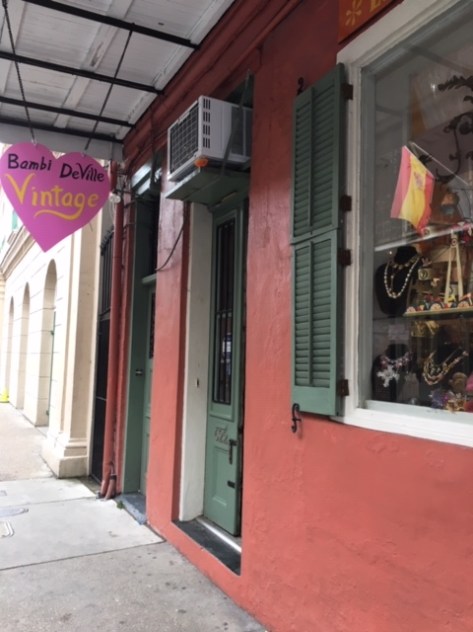
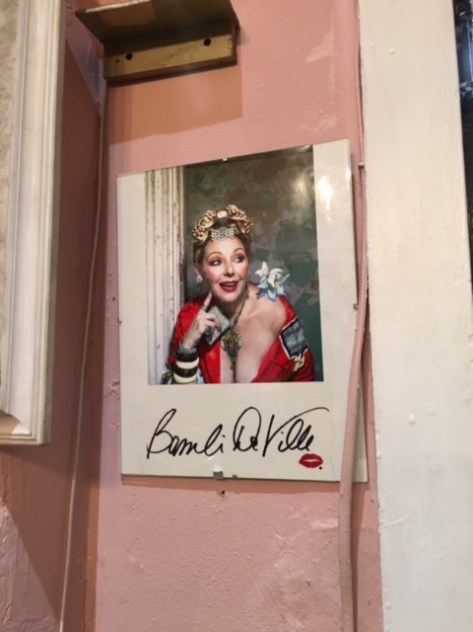
Bambi DeVille comes to Saint Ann

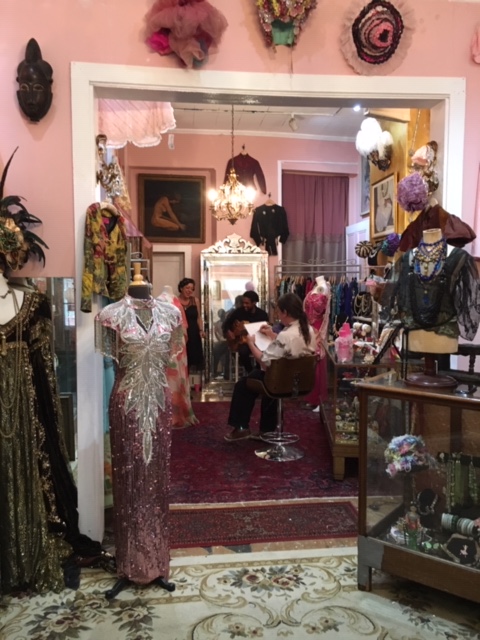
Saint Ann is thrilled to have a personality and entrepreneur like Bambi DeVille on the 600 lock. Bambi has been an actress, artist, entrepreneur, antiques dealer and collector for over 30 years. She is known as the Bakelite Lady by those in the know, and by those who know her father – and her uncle too.

I remember her shop on the lakeside of Royal before she moved across the street.  Now she is in the last shop before the Square, directly behind the Presbytère and  across from the other fabulous neighbor, the Place d’Armes Hotel.

Creative energy like hers used to be constant among shopkeepers in the Quarter led by the likes of Martha Westfeldt’s Green Shutter/Free French Shop, Zula Frick’s Button Shop, or even my dear friend Roger Simonson’s A Better Mousetrap. In the last few years, we have seen a slight uptick of lovely places joining Bambi such as Papier PlumeGallery Orange,  the new HNOC gift shop at the The Seignouret-Brulatour House and and the endearing and well-merchandised Cocoally (“Clothing Boutique for People Big And Small”) just 2 doors down from Bambi.

Come see.


Her other shop is at 1925 Sophie Wright Pl. in the lower Garden District.

Covenant House becomes Curfew House for the summer

At the request of the NOPD Chief and Mayor LaToya Cantrell, Covenant House has been asked to open a curfew/prevention center this summer for at-risk youth, ages 10-16.

“I think the police are going to come across young people who don’t know where they’re at or where they’re going, and could be on the verge of getting themselves in trouble, and they’re going to bring them here. We will feed them just like any Mother would. And along the way, we’ll try and find out if there’s any issues; why are they out late at night and no one knows about it?” – Jim Kelly, Executive Director

And the other viewpoint:

City curfew marginalizes kids it pretends to ‘protect’


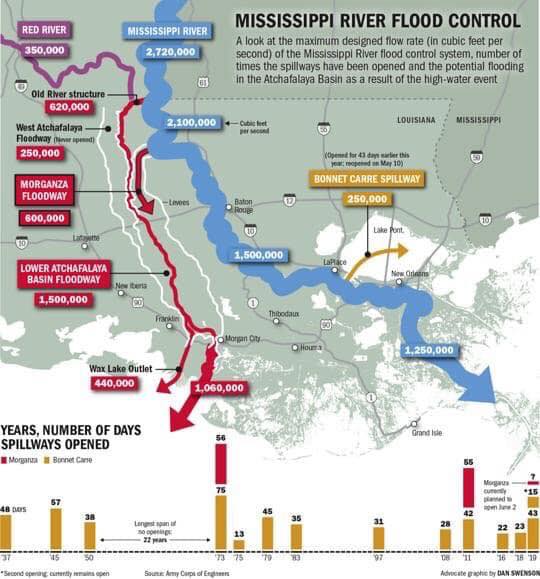
Gulf marine life in great danger from diversion of flood levels of Mississippi River

As an unprecedented amount of floodwater makes its way down the Mississippi River, the U.S. Army Corps of Engineers opened the Bonnet Carre Spillway at New Orleans for the second time this year.

Corps officials try to limit spillway openings to minimize the impact of invasive freshwater species entering Lake Pontchartrain, as one of those impacts could be harming marine life. St. Bernard Parish President Guy McInnis says they have documented 26 dolphin deaths in the past two months, and most of the animals had freshwater lesions. Though Louisiana Wildlife and Fisheries officials have not made a direct link to the influx of fresh river water, officials in coastal Mississippi have after conducting a number of dolphin necropsies.

For oystermen, the opening of the spillway is always a cause for concern because it leads to plummeting water salinity levels as the freshwater suddenly dilutes the estuary’s brackish waters, which can kill the oysters they harvest.

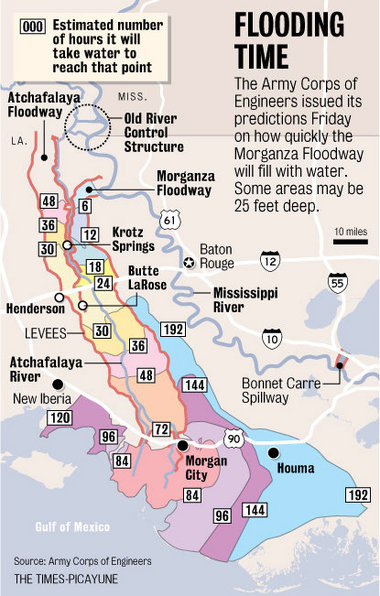
As of June 6, 2019, the news is that our other spillway will open to reduce pressure on the levees. Most folks in New Orleans are largely unaware of the Morganza Spillway, including where it is!


So, here is some good information on the Morganza Spillway:


Morganza Spillway


Maspero’s founder passes

Once upon a time Cafe Maspero was one of most locals’ favorite places both in its original location on Chartres, and then its Decatur Street location. I remember many fine sandwiches there always paired with excellent service – that is, until it was sold a few years back.

An article about Maspero’s and Charlie that  was first published in The Community Standard magazine in Volume 1, No. 4, February 1975.

Is there a way to “control” tourism?

A thought-provoking article about cities like ours that are in danger of being submerged by a new level and type of tourism:

“You could say quality tourism people travel because they’re inquisitive and want to learn,” says Stephen Hodes, founder of local tourism think tank Amsterdam in Progress. “Unfortunately, that kind of tourism is on the downward trend. The new tourists are the status seekers, who travel because it’s good for the way other people perceive them. They’re people who go to sites, take a selfie first to show they’ve have been there, and otherwise aren’t interested.”

This might be annoying, but you can’t legislate against disinterest. What you can do, Udo says, is channel and distribute people more effectively. Even people who say they want an authentic local experience can fall unwittingly into a tourist rut. People who want to be responsible can, for example, cause hold-ups by riding bikes during morning rush hour.

“If you look at factual data, people behave very much alike,” she says. “Many people go to the Van Gogh Museum in the morning, and on a canal boat in the afternoon. That puts pressure on the city at certain places in certain moments, which can end up creating collisions with the locals.”

The city is thus in the process of tailoring its “I Amsterdam” app to match suggestions to visitors’ tastes, and recommend activities at times when they’re not normally full of people.

This idea is one that I have floated in the past for New Orleans. For example, why not a tourist pass for streetcars that operate every 15 minutes with guides, music, and selfie opportunities to alleviate the pressure on the other cars needed for locals?

It’s time that New Orleans begin to direct this non-stop rush of people into better organized events in the French Market area for those tourists who want to eat and drink in a festival space, reward business with special signs and other incentives in FQ, Treme, and Marigny that are willing to offer detailed assistance for visitors , add hotel-based education videos in lobbies and elevators of hotels warning of fines for tourists who engage in casual vandalism, noise at late hours or litter*.

and one more thing: Allow locals to do  “mystery shops” on tour guides with loss of license as the punishment for continued historical inaccuracies with and assigned online classes to keep one’s license.


  • there also needs to be cardboard trash containers added every 2 blocks on Fri-Sun in the FQ, Marigny Triangle, and CBD.

https://www.citylab.com/life/2019/05/amsterdam-tourism-travel-tips-vacation-cruise-hotels-airbnb/590221/


Latest news from our mayor: She has put a stop to the ridiculous idea of one of our newer, (actually pretty good) all-woman parades who wanted to have a “bridge from one Mardi Gras to the next” by adding a JULY parade.

Hey Nyx- We ain’t buying your bridge. Nice try though. 


Tour Guide advice on how to behave in our cemeteries. Sad that this needs to be said, but it does.