Welcome Homer A. Plessy Community School

Our new charter school at 721 St. Philip St. To assist this school, contact them for moving assistance, school volunteering opportunities or donate funds to build this community school at their new location.

On June 7, 1892, Homer Adolf Plessy Purchased A First Class Railroad Ticket, Boarded The Train, And Was Arrested Two Blocks Later At The Corner Of Press And Royal Streets. He Was Charged With Violating The Separate Car Act, Which Mandated Separate Accommodations For Black And White Railroad Passengers.

The result was the landmark Plessy v Ferguson Supreme Court case, which made “Separate but Equal” the law of the land until the ruling was overturned in Brown v Board of Education in 1954.

We draw inspiration every day from Homer Plessy and the Citizens’ Committee — for their bravery, their ingenuity, their sense of community, and their commitment to justice

This seemingly simple act w, in fact, t the result of meticulous planning by a group called the Citizens’ Committee. Their creative and highly sophisticated work was designed with a Supreme Court challenge in mind, intending to stem the tide of segregation that was taking over post-Reconstruction America.

History Of The School

Back in 2009, a community of educators, families, and advocates began to come together around a simple idea: we saw a need for an excellent elementary school in downtown New Orleans. Through door-to-door campaigns and hundreds of small-group meetings in homes and church halls, a vision came together of a school that placed that a high value of critical thinking, creativity, diversity and citizenship. Today that is the Homer A. Plessy Community School.

In 2012, the Plessy School’s Type 1 Charter Application was approved by the Orleans Parish School Board. Plessy opened its doors in the fall of 2013, serving children in grades Pre-K-2 with an arts-integrated, project-based curriculum. The school will grow by one grade level each year to serve children in grades Pre-K through 8.

The Plessy calls itself a community school but it could even more accurately be called a family school. Every member of the Plessy family is highly valued, and together we work to provide a top quality education for all of our young people.


Homer A. Plessy Community School

Love Letters: New Orleans

My post from Huffington Post. I did fix some stuff on this posting that needed it.


By Love Letters

THE BLOG

11/20/2013

Dar Wolnik is a blogger, activist and Girl Friday to her city of New Orleans. She lives downtown and is mostly seen on one of her three bikes or scooter, but also travels widely to work with community food systems across the U.S. as a consultant.
Dear New Orleans,

My confession starts this letter. As you know my lovely Crescent City, I found you only as a teenager. My first home and childlike love — the city of Cleveland in my heart — but not as you do.I often try to find similarities between the two cities, to understand why I love them both. Besides water, I cannot find any other shared qualities.
When I came to live here with my New Orleans mother thankfully, gratefully returning home after 20 years away, my own welcome was deep and magical. Old women on stoops and shopkeepers alike beckoned me over, asked for my teenaged story and warmly welcomed me home. It’s true. That happened again and again. How did you know that I needed you?

And for the first time in my young life, I connected to a place, to a set of smells, sounds, and sights that seemed overwhelmingly pleasing and joyful. I know now that city life appeals to me, but that it must be a place that is not too much of a bustling one, only busy with business or building new or bigger.

Your constantly decaying greenery, unique architecture and many hues and ages of people using public space freely gave me the specifications for a scale that remains how I compare all other cities.Aging is a delicate problem for all females and I know that you struggle with how to remain appealing and relevant. Those who love you attempt to shield you from some of the worst criticisms leveled at you because of your age. Well, to be completely truthful, some of that criticism comes because of your troubling past, which is linked to some of the most difficult days in our country’s history and your present status as a city of recovery, yet again. We shield you and protect you, even as we try to strengthen you.

Your cultural attributes are world renowned but to limit you to only the delights of the dance hall girl is to miss your deep work ethic and political savvy. That work ethic can be seen in your shipping port for one. A port that remains one of the busiest in the world and vitally important to the health of the people in this country. You can be found morning and night, toiling valiantly at the unsexy work in bringing and sending the food and goods needed to be traded in a hemisphere of our size. Dance-hall girl only indeed.

The river. The great Mississippi River, our American Nile. That river is of course, why we are here with you; the explorers Bienville and Iberville came to find the mouth of it to give France control of the commerce that would surely flow in this New World. Oh, it’s a beautiful thing and its work to keep flooding from those upriver and shipping flowing all along its course is remarkable. You have every right to be proud of it.

But sometimes, I think that you miss that what makes those attributes old-fashioned in the minds of Americans.  They seem anachronistic in a country with east-west tendencies and speeding highways and planes. The dance-hall girl is fun and so they search only for that, found through your jazz and brass bands and cuisine. That freewheeling attitude has and will bring you many short-term loves, but it is not enough of a reason for them to love you in bad times too. And bad times are part of the deal. From the yellow fever days, through slave commerce and the 20th-century fight over the integration of schools and up to and including the levee breaks of 2005 and the BP oil spill of 2010. Those are the times when we know who really loves you by those willing to pick you up and carry you for a little while you heal.

It would be wrong to say that you welcomed us at first- sickness and swamps were your opening salvo but lucky for us, enough Old World ne’er-do-wells, second sons, and brave little nuns stayed. I know that you grew to love the type of people sent to you and that also makes you special; your love of your people and acceptance of their quirks. That love is reciprocated in how many people believe that hurricanes will never make direct landfall on the city or in how we willingly leave places with much more efficient infrastructure behind to be with you. That willingness was mighty evident in the hundreds of thousands of your people that quickly returned in 2005/2006. The deep love that we have for you was so apparent in those days; I’m sure that you felt it, even as you lay in tatters and pieces, shocked and ignored by others. People living in cars and ten to a room rebuilt this place, finding joy in your slow recovery.

We respect your ideas about multiculturalism and how they were built by the wide diversity of people that you accepted here, even as we angrily fight with you over your wrong ideas too that bar many from realizing full citizenship. It’s true that we feel your warmth but also your brutality too.  We do our best to use joy and togetherness to reduce that side of you, hoping for the day it is no longer part of your personality.

So, I think of you not as my first love, full of overwrought and inaccurate ideas but as my mature love, aware of flaws and inconsistencies, but still appreciative.


http://www.huffingtonpost.com/love-letters/love-letters-new-orleans_b_4219236.html

“the smallest possible gesture”

This is what a friend wrote today, as Lee is removed from his place on our city streets, the last of the 4 main monuments defiling our public streets that were placed to strengthen the white supremacy movement in the decades after the Civil War. (There are, however, 3 more Confederate statues of much less prominence that still need removal. Still, as my pal says beautifully here: we are beginning to approach the truth.)

…Black children can expect and, by every measure, will receive, substantially worse treatment than their white peers within the educational system, the healthcare system, the policing and justice systems, the housing and financial markets, in terms of their prospective employment and earnings. Hell, they will have a harder time on Tinder and Grinder.
Parents of black children already get to explain why this is and try their best to prepare their children to navigate these evidence-based realities.
One less white supremacist being honored in the street is actually the smallest possible gesture available that we can bestow on these children.

One less statue doesn’t change these realities. But it begins to approach the truth. There has never been truth and reconciliation in this country, so we keep recycling white supremacy into different iterations, instead of dismantling it (Jim Crow! Mass Incarceration!).

We can’t begin to face white supremacy without truth telling. And most Americans (of all backgrounds) are not taught the fullness of the truth about the founding of this country or how it prospered. Most aren’t taught what slavery entailed, or how it persists in different forms today. Taking down Lee is simply acknowledging these truths.

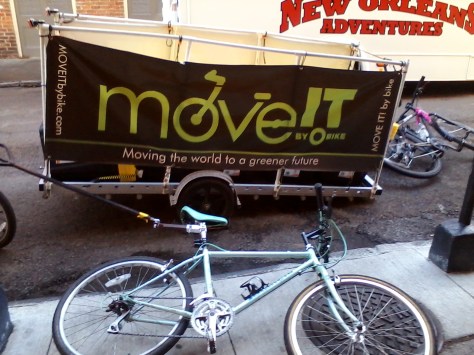
MoveIt

Watched these guys move my neighbor very professionally and smoothly. What a great idea for our flat city but especially for the French Quarter !


http://moveitbybike.com/

We transport and move with bike and trailer up to 600 lbs. per load.  MOVE IT! by bike offers eco-friendly, inexpensive and city smart transport by bicycle and trailer in the New Orleans area.


0501170841-000501170842-00

Scandinavian Jazz Church and Cultural Center

Remember the old Norwegian Church on Prytania that almost closed? It was saved at the last moment and reborn as the Scandinavian Jazz Church and Cultural Center. Well here is a great upcoming event to go back and celebrate its new life:
May 21, All Day
Norwegian National Day

10:00 Raising of the flag and sing the Norwegian national anthem –Ja vi elskerdettelandet!
10:15 Parade around the block. Make sure to bring your flag and singing voice.
11:00 Celebration Service with Pastor Torhild Viste from The Seamen’s church in Houston. Lars Edegran will be joining us on the piano for the service.
12:00 Games for children and adults held outside if the weather permits. You can also bring your swimsuit and enjoy the pool. There will also be served hot-dogs and ice cream at this point.
2:00 Dinner will be served
6:00 Concert by Miriam’s Fleur De Lys orchestra

The cost for everything that happens before 2:00 is $ 5.
The dinner will be $ 30 per person, $ 10 for children under 6, and we are serving baked salmon with sides. The price also includes coffee and dessert.

Please RSVP for the dinner: 504 525 3602
Or email: astrid@jazzchurch.us


Turtle Parade

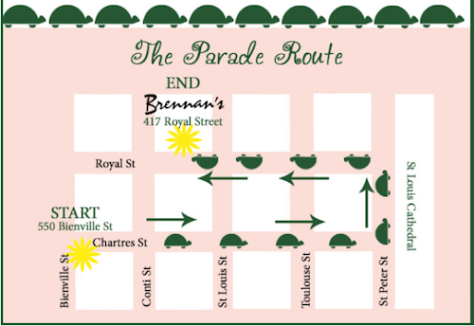
This Saturday (5.13) the turtles that live in the Brennan’s courtyard on Royal street will parade through the Vieux Carré to mark the start of spring.
The ten turtles that live at Brennan’s have become something of local celebrities (complete with their own Twitter account, @BrennansTurtles). They are named “The Muthas and the Othas.” The former references the five reptiles named after classic, French mother sauces like Béchamel, Espagnole, Hollandaise, Tomate, Velouté, while the “others” refer to the turtles named for NOLA’s own classics like Remoulade, Ravigote, Bordelaise, Mignonette, and Cocktail.

The parade begins at 10:30AM at 550 Bienville Street, continuing down Chartres Street to St. Peter Street, then onto Royal Street to bring the krewe to Brennan’s (417 Royal Street) for the reception, which starts at 11AM. The route map is below. f2ab04e6-1409-4b30-8721-56e4d0fb253c.png

Don’t underestimate our resolve to change and don’t excuse yourself either.

18199294_10156128207808761_6745629308151966361_n.jpg

NOLa may be “Confederacy Statue Central” right now but it is now and has long been a public hotbed around ensuring the civil rights of people of color. If you know the why of the streets names of A.P. Tureaud or Oretha Castle Haley among others, or remember the fight by Dorothy Mae Taylor who was the first African-American woman to serve in the Louisiana House of Representatives who (when serving as on N.O. City Council) insisted that those using public amenities for their parades had to sign a pledge that they did not discriminate on grounds of “race, gender, handicap or sexual orientation.” then you know what has been done here. (Believe it or not, a few century-old krewes stopped parading instead of affirming their belief in equality which showed the need for her pledge.)  Or if you have talked to those who have been on the front lines since at least  Father Twomey was around, you know the subject is lit and has been for generations here.

If you doubt that, here are some signs of it. This is a collection of different things people here have done or said, so choose the stories that are helpful to you:

_________________________________________________________

• Go to Treme and view the cross made of shackles put up in 2004 at the church of St. Augustine built in the 1840s by free people of color. Read about the 19th century War of the Pews where whites and FPOC duked it out to see who would have prominence in this church. The FPOC won by purchasing 3 pews for every one a white person bought and even bought pews so slaves could attend services.

jat4qe959uje4z3jbtbxlrggtll.JPG

The grim, rusting monument standing outside the church honors those countless slaves who perished uncounted and unnamed. As the bronze plaque affixed to the wall behind the shrine explains, the monument was primarily inspired by the number of unmarked graves that have been unearthed in the city over the years, but is also dedicated to all of those who died ignominious fates during the American slave trade.

 _________________________________________________________

• Or read the piece in Playboy  which includes my favorite new image of these statues from someone I already admired: a local writer who is described by the author of the Playboy piece as “Maurice Ruffin, a native son who’s a lawyer, restaurateur, and novelist rolled into one—a NOLA combo for the ages. He scoffed at the idea that there could be any doubt about the preponderant local sentiment, and not only among his fellow African Americans. “Does anyone think that most people in this city want to keep those horcruxes up? “ he asks. “Of course not. That’s why the pro-monuments people are mostly out-of-towners.”

_________________________________________________________


• If you still doubt our resolve to find and share the truth, search out the telling of the real history now happening on social media, in person and in close quarters in family homes. This quote below was in response to one of those posts by someone who thinks of themselves as the keeper of the history but who was just quoting fake propaganda taught in our schools circa 1880s-1950s:

Actually, 143 years ago a minority calling itself the White League, whose primary goal was sustaining white political power in Louisiana, overthrew the local government, and forcibly disarmed and disbanded the black state militia. The monument, erected in 1891 and honored with wreath-laying ceremonies by children of White League veterans until the 1930’s, went up at the time Jim Crow laws were widely passed (for example, the 1890 law barring black and white Louisianians from riding together in railroad cars.) Today the monuments are being defended, with threats of violence, largely by white supremacists.
Which long-ago time did you wish to honor here?

Dozens and dozens of these calm explanations from New Orleanians to other misguided Southerners and adherents to the White Cause movement exist.

_________________________________________________________

• I also like this comment below by a friend of a friend on FB, that mirrors my experience up north too. I remember the neighbors of my parents’ generation laughing about how there was a code used on police scanners to indicate a person of color had crossed into my lily-white suburb. The car would be stopped, likely ticketed for some minor or non-existent traffic offense, and turned around to the Cleveland border. Yeah, I’m looking at you, Lakewood Ohio.

As to the underlying racism of “just between us” moments, in the nearly 30 years since I moved here, I have always found my hometown of Chicago to be much more racist than New Orleans, if for no other reason than that, in Chicago, black culture is considered sub-culture and in New Orleans, it is the culture. Growing up in Chicago, you could, as a white person, go your whole life not encountering black people in social settings, if you wanted to live that way (yuck!). Here, that would be next to impossible, except in the highest economic brackets.

What’s also important about that one is it is been my experience that those without family ties to this place, or more correctly, those with some family ties and time away someplace else- are often the ones who have a hard time with the removals and who favor some unlikely “middle ground” of the statues remaining but with a plaque. That has always seemed to me the definition of the old phrase about putting lipstick on a pig. These folks are often very forgiving of all of the oddities of the place and become expert in telling stories about New Orleans to outsiders in a way that shows the charm of it all and hides the shame. Yet, it is time that they also confront the statues of Jim Crow and like the lady above, truly become a local by saying it is time for some of that shit to go.

_________________________________________________________

• What a favorite writer with one of the keenest eyes for modern American farce, Joan Didion  said almost 50 years ago about why she came to the South:

…that for some years the South and particularly the Gulf Coast had been for America what people were still saying California was, and what California seemed to me not to be: the future, the secret source of malevolent and benevolent energy, the psychic center.”    (2017). South and West. Alfred A. Knopf

Malevolent and benevolent energy. I think I’ll steal that forthwith. But sadly she was right- the South’s lack of self-awareness about it’s own energy was this country’s future in 2016+. Writer Nathaniel Rich wrote in the foreword to Didion’s book:

How could the hidebound South, with its perpetual disintegration and defiant decadence, at the same time represent the future? Didion admits the idea seems oxymoronic, but she is onto something. Part of the answer, she suspects, lies in the bluntness with which Southerners confront race, class, and heritage–“distinctions which the frontier ethic teaches western children to deny, and to leave deliberately unmentioned.” In the South, such distinctions are visible, rigid, and the subject of frank conversations.

_________________________________________________________

• A drum roll, please. The next two worthy statements about what is happening here (good and bad), one from a native New Orleanian and the other from a decades-long resident who has extended the culture through his contributions:

CW Cannon: Memo to liberal media: New Orleans hasn’t just ‘joined’ movement against white supremacy

Michael Tisserand: In New Orleans racism is harder than stone

So come on. Learn along with us and explore YOUR own area’s history of inequity and confront your own privilege. Because it is there.

I do that daily in a city with a majority African-American population who have given the world so much culture and indigenous knowledge and community that is hilariously and evidentially so wrong when those with pointy heads here say they are superior. Still, the subjugation of the majority of people (or in those areas where they are a minority, it doesn’t matter) continues and it is time for us to truthfully see our country as not entirely made by Daniel Boone or John Wayne but also by millions of hard-working and creative people who are not identified by monuments and are not white and not men. America was not made only by white people and yet remains a place where going to the better schools in any town or the nicest suburb, or the corporate meeting will offer mostly whiteness. And going to the prison or the changing room in the hotel employee area will show the opposite.

This does not ask whites to hate themselves or their own history but instead asks them to see themselves as part of a larger humanitarian future where the color of skin should not offer any advantage. To see the evidence of institutional racism that we benefit from in a thousand tiny ways and too often don’t spend any energy to rid our places of it.


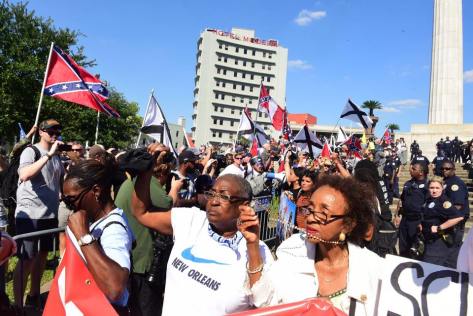
As I wrote that last part,  I stopped to read this post by native Cheryl Gerber, which is a thoughtful and heartfelt outpouring:
18423999_10156140909268761_1526295210909244867_n

Photo by Cheryl Gerber 2017

This particular photo haunts me.

There have been a handful of events in my life that have really shaken my complacency. Like the time in my early 20s when I did jury duty in a murder case and I was the only white juror and the only juror who believed the policeman’s testimony. That really opened my eyes. I didn’t know better, but I do now.

And when the planes struck the towers. I convinced myself that no one could have seen that coming but the signs were there.

And when the levees broke. For my entire life I had been told that our city could drown, but I didn’t believe it. Not even when the cat five storm was barreling straight toward us. I should’ve known. I do now.

And when we elected you-know-who. Didn’t see that coming, but I should have.

And now I am equally, if not more perplexed by my community who wants to keep the Confederate monuments up. Even while they have drawn hate groups from across the country. Even while our African-American neighbors have been complaining and marching for decades.

This photo of Pastor Marie Galatas, who ran for mayor in 2006, really shook me out of my complacency. I have seen her march and preach for decades. And while I never thought she was a joke, I never really took her as seriously as I should have — not until I saw her holding up her cross and bravely marching past KKK members hurling the N-word toward her. I can’t believe she still has to march! She and others have been trying to tell us for years that racism is our city’s biggest issue. While I haven’t been blind to racism in our fair city, I have been guilty of wearing rose-colored glasses. Now I see clearly.

Yeah Cheryl.

It is also important for all of us here to remember that we do this work on our own biases in a city that can have an impressive history of different races and ethnicities respecting and honoring each other. The Italians and Creoles living together in the Quarter for 100 years; the Vietnamese being cheered as heroes when they stood up to City Hall post-Katrina; the black and white faces of ACORN/A Community Voice fighting for minimum wage hikes, to stop the sell off of the public water system, the intrusion of a industrial truck corridor in their shared neighborhood in 2017; and last but not least, the multi-generational sea supporting the city’s takedown of these concrete nooses held tight by our ancestors’ post-Reconstruction Jim Crow attitudes.


Latest: Wynton Marsalis weighs in on the takedown and the racism of his hometown.