Mardi Gras Brunch at Meauxbar

Went last year for Lundi Gras and am glad to be returning. A lovely way to kick off the final two days…

Brunch at Meauxbar features a prix fixe menu that will change weekly to highlight the best seasonal and local ingredients. Our cocktail menu offers an Unlimited Mimosa Set Up for $18 with local citrus and additional shrubs, bitters, & tinctures for personal flavoring. Brunch also features our House-Made Seasonal Pimm’s series, House-Made Bloody Mary, specialty cocktails & an extensive wine list. Reservations recommended, walk-ins welcome.

2016 __________________________________________________

 Mardi Gras Weekend Brunch will run from Friday, Feb. 5th until Monday, Feb. 8th.

 Friday / Saturday brunch will be 10:30am-2:30pm

Sunday / Monday brunch will be 10:30am-3:30pm

MENU

FOR THE TABLE

King Cake Scones . louisiana strawberry jam .

FIRST COURSE

Gumbo z’Herbes . sweet potato salad .

or

Smoked Drum Rilette . pickled vegetables . crisps .

or

Beef Carpaccio . crispy bacon . fried egg aïoli . everything bagel crumbs .

SECOND COURSE

Confit Chicken & Red Beans . housemade mustard . braised greens .

or

Louisiana Shrimp & Grits . rice grits . green onions .

or

Ham & Cheese Croissant . fried egg . dijon mustard .

THIRD COURSE

Galette de Rois . brandy crème anglaise .

or

Louisiana Strawberry Mont Blanc . almond macaron .

or

Sweet Potato Beignets . french truck espresso mousseline .

Short-term rental (STR) rules need tweaking


Short-term rental public hearings continue at the city level. I just watched the city planning commission’s latest public hearings, this since the recent commission study commissioned by the city has been released.

As readers of my blog know, I am in favor of STRs being allowed, albeit with STRONG provisions including increasing public profile sites, neighbor reviews, and data sharing between sites.

After reading quickly through the long report (will read more thoroughly over the next weeks), it is clear to me that there are some flaws that need to be addressed including taxation and data sharing.

(by the way, I don’t appreciate how many residents of other neighborhoods when testifying feel the need to dismiss the French Quarter and state that it is not a neighborhood; we are and remain the classic version of the mixed-use neighborhood with residential, commercial, short-term and entertainment districts. Even the NOCVB feels the need to oversimplify the requests of visitors looking for “authentic New Orleans” and things to do outside of the FQ; let’s be clear that the Quarter is authentic New Orleans and that many of those visitors ask about other areas after they have visited previously, using the Quarter primarily.  I believe QoL enforcement is likely higher in our neighborhood by our residents who are hyper-vigilant in watching their block and larger area. So stop dismissing us as a neighborhood.)

As a matter of fact, the French Quarter knows best what STRs can do well and what they can do badly. Because of that, a few owner-occupied rentals should be allowed but fined at a high rate in the Quarter.

•As Meg Lousteau pointed out in her 2 minutes, why not require data from sharing sites instead of shrugging and saying it is impossible to regulate this industry?

•I also disagree with opponents who stated that this is a commercial use with residential impacts; I think that the best and most use of STRs is the opposite and should be regulated as such.

•If the current regulations for rentals require two months in the French Quarter and one month at a minimum elsewhere in city, then why not cap STR at that numeric level? so 6 for year in the Quarter and 12 elsewhere per rental?

•I’d suggest changing the renewals to every 18 months and not every 3 years; since this is for SHORT TERM uses, everyone should have to reconsider the use of their property every 18 months.

•I do agree with the proponent who pointed out that since the largest STR site offered to start to collect taxes on their site, we should at least consider it as the potential taxing entity, rather than immediately going to the state to increase sales tax.  That taxation plus fees in the permitting stage and in fines can assist with the functionality of this oversight; most of the taxes and fees should go to managing this set of regulations, but 10% of the fees should go back to the neighborhoods each year to be used for QoL improvements. The amount given to each neighborhood should be based on the percentage of permits it includes.

•First out of the box permitting is not the best idea; I agree with the CPC commissioner that this will benefit the biggest STRs and those most active which is not the right use.

It might be better to ask for online registration of permitting requests and spend time researching STR sites and asking for plans (how often they hope to rent, how many nights they will require, other rules of the house which will be listed on the STR sites) from each applicant which must include pictures and description of the site. The initial permits would then be offered to those who provide the most information and based on the permits available. Additionally, once the permitting begins, renewals should be partly based on the neighbors’ reviews and the online profile.

•All of the enforcement should include reviews and written online input by neighbors (that input should require leases, utility payments or primary residence property in Orleans parish to allow that input) along with a special STR commission that meets every 6 months to mediate immediate issues. Anytime a property owner is brought to the mediation process, that record should be added to the public profile of the STR.

Reviews by neighbors abutting should be included in the STR public reviews.

The online profile should be reviewed by STR staff at least once every year, with notes added to that file.

The conditional use process is probably the right process for allowing FQ STR permits except for owner-occupied rentals.

•What is termed as MG rentals of a total 30 days or of 4 rentals per year need special rules and should require re-permitting yearly.

•6 people should be allowed in any STR with 1200 sf or less, 9 people for 1201-2000 s.f. with a cap at 9 people at these rentals. 3 max for less than 600 sf. Nothing under 80 s.f. in rental space should be allowed.

•I agree with Dana Eness of Urban Conservancy that the STR parking requirements are counter to the water management goals of the city and parish.

•All STRs should be listed on sites under the formal leasee or property owner and linked to their city property tax rolls, and not allowed to be listed under other accounts.

•The online system should show a real time map of permitted STRs AND un-permitted STRs listed on online sites. That map and set of listings should be used for every permit and renewing permit.

Thank you for the CPC staff Rivers for pointing out that density is a constantly-changing reality in every neighborhood; He pointed out that density has decreased in the Marigny over the last 40 years because of duplexes and fourplexes turning back to single homes. That density has to be considered in the present day, which is often not the case with opponents arguments on STR. Density changes and with that, uses change, but simply because your residence has changed to a single-family residence does not mean the entire neighborhood has as well.

Thank you to the commissioner (chair?) for pointing out that different densities offer different privacy shields and that it may be best that the historic corridor have different requirements because of that fact.

Thank you to Commissioner Marshall who asked for causality on the assertion that the in-demand neighborhoods are going to see higher rents because of STRs, rather that in-demand neighborhoods have always had higher rents  and that the market of development has driven the skyrocketing rents (and I’ll add THAT  the lack of affordability in every neighborhood should be addressed by City Council separately and immediately and with as much attention as the STR fight has been given.)
 

Why Can’t We Stop Talking About New York in the Late 1970s? – The New York Times

I love the comments on this more than the story. D’ya remember that game mix and match? Well, match the characters in italics to the quotes below (hint: there are no right or wrong answers)

Bike messenger with a very expensive education

Sardonic retail clerk who visited NYC once in the 1990s

Stayed out all night in the Village, once sitting in a Chinese restaurant. has never stopped talking about it

Adopts every slogan and attitude shared on FB by 1960s TV character memes from the comfort of a 3 BR ranch house

Funny, resilient New Yorker

————————————–

Dirty, gritty, a place where adults could be adults, from Studio 54 to the Village, the city was alive in the 70s. Now, it just feels like a showcase for corporate logos and boring rich people.

70’s NYC… the piss, the blood, the fear, the desperation, the art and so on. It was something else. And it was a beautiful thing. No smoke and mirrors. No ifs, ands, butts or maybes. You could hold your own our your ass was out of gas. Now it’s like everywhere else in a sense. Gentrified, sterilized and full of fuckstick soft ass transplants and politically correct crybabies and hipsters. But still the most amazing place in this fading republic.

Hey, “The Warriors” is on Amazon Prime! You can relive it in the comfort of your suburban home!

That was the best time ever! New York was fun, exciting and innovative. And had so much character!

I prefer talking about Rome in the AD 70s. Those were rocking times. Rent was like 8 cents a month. Shitty dental practices though.

Source: Why Can’t We Stop Talking About New York in the Late 1970s? – The New York Times

what is now, was then

It sure does it feel like we’re fending off a concerted attack around here for the last decade. Mayor hunkered down deep in City Hall as he talks only through his figurehead deputies and condescending brief chats on live TV, sheriff building a huge prison that he fought to be as big as it is to make a profit in taking in others prisoners even while it has low marks for safety and usability, charter schools busing every kid all over  the city and failing still, crime random and brutal as always, streets falling apart even while they detour us daily for mythical repairs… And even as we worry about the next decade, we argue on facebookistan about what makes the place unique and how native each of us are. This myopia is sweet but also dangerous.

What keeps floating up in my mind during these “this is not my city any longer” claims is that the uniqueness of New Orleans has been under attack forever and can not or should not be viewed as a new problem.

(To be quite clear though: I do NOT include the takedown of the white supremacy monuments as part of the uniqueness that should be defended. Some shit should just go away and that includes the false narrative and the warping of history by those (at least 4) statues. That b.s doesn’t help us and isn’t a serious representation of this cosmopolitan, diverse city, but of its segregationist public sliver. But absolutely, keep the statues somewhere with some real history attached for when we forget. Because we will.)

What has helped me get some perspective on the ever changing history of our little port city are two books that illustrate that this issue has been ongoing from our earliest times. One focuses on the 20th century and has the unfortunate title of “Madame Vieux Carre: The French Quarter in the Twentieth Century”and the other has another confounding but intriguing title: “Building the Devil’s Empire: French Colonial New Orleans.”

The first is chockfull of tidbits of twists and turns of recent history that even locals have forgotten about: as an example, one event included a name I am familiar with so I emailed my pal of the same name, asking about this event decades before. He replied immediately that this was about his father and was a story that he had never been told.

Quotes will tell you a familiar story such as “as property values rose sharply from the beginning of the decade, low income people were being forced out”; that decade was the 1960s. Or as you read about the bitter fight put up by preservationist Elizabeth Werlein to keep Pat O’Brien’s from their new location mid-block because of noise and trash concerns, you’d have to double check to remember they are talking about the mid 1940s. This book also talks about the precipitous drop in population to 5,200 by the 1970s, with a short hike to 5,600 during the oil boom of the late 1970s.

I’d like to note that the current population of the Quarter has climbed a bit to be a little under 4,000 which is not that far off from this time, a time that many of my contemporaries see as some of the most vibrant days of the FQ. So maybe it’s worth a second look?

The second book is a researcher’s theory of rogue colonialism well argued. Details of the French plans for the area and how it failed are little understood in our Lyle Saxon boosterist-style history lessons. Additionally, the author cleverly aligns that time with the post-K colonial era, without pushing the point. Finding history that focuses entirely on the French colonial period and its extractive nature is helpful to understand our present situation with its post-Katrina economy limping along. The author points out that France largely ignored the colony by the 1730s when its use as a successful tobacco and indigo colony seemed unlikely. That left New Orleans as a struggling small port that was a drain on its mother country  and one that did not increase its population significantly until the the Spanish takeover and the cultural changes that came with the Haitian revolution.

So my point is in this present time, some comparable historic data exists that might suggest that the FQ and New Orleans could in fact rebound from its influx of new. And I believe that we can DO something about this “fait accompli” by fighting the oversimplified presentation of these issues that divide us.

Seriously folks; what we cannot do is sit back and talk about the loss of culture without realizing it has been ongoing since the French gave up the idea of tobacco exports. Yet I will vehemently agree that there is a very real purposeful shredding of the dominant culture that has existed for all of the second part of the 20th c in New Orleans and that most of that shredding is negatively impacting people of color and the remaining white blue collar community, which is very small indeed since the white flight of the 1960s but is certainly feeling left out of any “recovery.” THAT is what we should be concerned with, and not the presumption of the fake Confederacy as seen in those monuments or in our homeowners letting their extra room or apartment  to visitors.

And that as with all things changing at system level, there are positive impacts that also may untie some of the snarls of the institutional racism that has been acceptable for far too long in New Orleans or may attract funding not tied to extreme capitalism such as affordable housing initiatives or real neighborhood schools. The problem is the good and bad of it is difficult to see and since our government is spending all of its efforts and time in simply trying to manage its own mess of bureaucracy and inertia, it has no time to lead us to a more equitable future.

Our despair cannot stop us from trying or from being realistic about all of the effects of the post-FEMA economy with its brand new medical district (for me, VA hospital= good, loss of Charity= totally and criminally unnecessary), improved sewerage (someDAY… )and thriving restaurant sphere (lots of b.s. but some good healthy local inspiration too), no matter what we think of any of it as it looks today. One such effect are new residents, some of whom will be good neighbors and others who will not. To lump all new people as bad is wrong, as it would have been when my family moved to the city from Lafourche Parish  in the beginning of the 20th century. We were a boon to the city, but we sure weren’t Creoles or city folk. Some of them even lived in subsidized housing -gasp! and yet all of them grew to love their city. I think of the tacked up photo of the Superdome in my grandparents living room or the black and white pictures of their rental on Marengo where my mother and aunt grew up: what they appreciated was not necessarily what others of generations before them did, but they all contributed. And when I came from Ohio in the 70s, I sure wasn’t Creole or even a Lafourche Parish Barrios born and bred. But I contribute too.

In other words, maybe we can learn from past colonizations.  Maybe some of it is good. Maybe we can still avoid being an American city and remain a Caribbean capital. Maybe we should just consider it all a bit more before we decree it is lost.


Breakfast  by Everette Maddox

Oh hush up

about the

Future: one

morning it

will appear

right there on

your breakfast

plate, and you’ll

yell, “Take it

back,”pounding

the table.

But there won’t

be any

waiters.


First book  and second.


Mystic Krewe of Barkus this Sunday @ 2 pm

Join the Mystic Krewe of Barkus and experience the #1 dog parade in America during Mardi Gras in New Orleans.

Politics is definitely going to the dogs with the Mystic Krewe of Barkus, the only officially licensed Mardi Gras Krewe for canines, with the theme “2016: From the Dog House to the White House.” Countless canine candidates are expected to emerge as possible leaders of the most powerful country on Earth as they parade on Sunday, January 31, 2016.

While some dream of curling up on a couch in the Oval Office like Howllary Clinton or Donald the Dog Trump, others might want to embody any of many political pundits sniffing out the obvious such as James Pawville, Sean Hannitail or Glenn Bark. Of course, the political media will be celebrated in honor of all the dirt they dig up with the likes of Judy Woodruffruff, Chuck Waggin’ Todd and Wolf Wuff Blizter.

The bi-ped world of Washington is soon to include the wonderful wags of the formerly under represented canine population. No matter what the polls might say, the next head of state might be a that of a Lab, Poodle, Pug or previously homeless mutt. It will no longer matter if you know who your parents are or if you have any formal education, much less Ivy League, to be elected. It is certain to be the most street small pack ever in power.

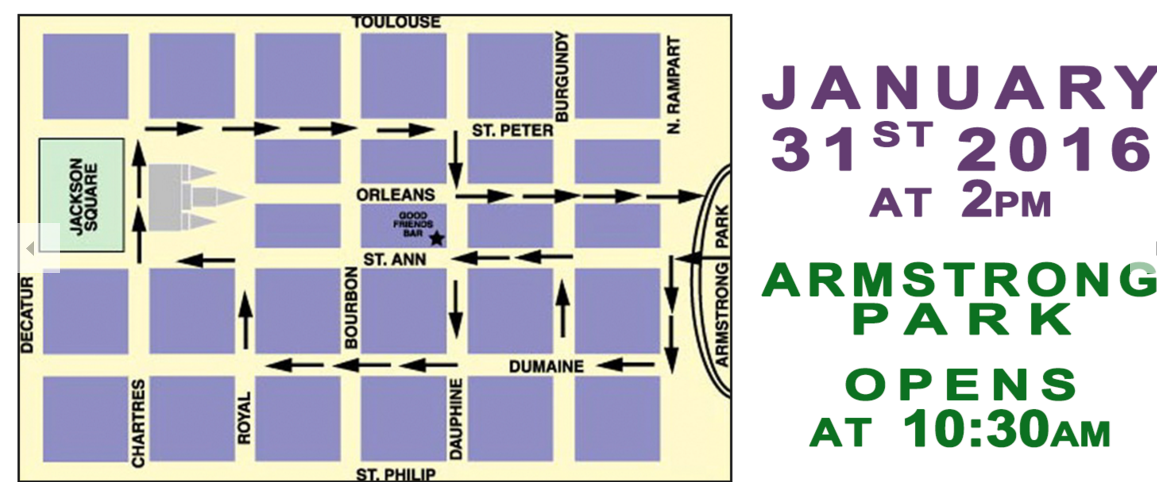
Dogs who want to be members of the krewe should get their humans to register on line at http://www.barkus.org. On parade day, we will be staging the parade, pre-pawty parade and post-pawty parade at Armstrong Park starting at 10:30am. The parade starts promptly at 2pm and follows a 15-block route through the Vieux Carré, stopping at the VIP Reviewing Stand at Good Friends Bar, corner Dauphine and St. Ann, where VIPs (and those who desire to be VIPs) will toast the Royal Court. Curious observers are welcome to come watch the parade.

All proceeds from Barkus, a non-profit organization founded by Wood Enterprises, benefit animal organizations in New Orleans and the Gulf South area. For more information, visit http://www.barkus.org or e-mail info@barkus.org.

http://www.barkus.org/

Screen Shot 2016-01-29 at 8.24.17 AM

Krewe of Cork 3 p.m. today

I’d put their route but they seem to not care to share it on their site. Seems more important to have all of their party pictures front and center.  And that they take all forms of credit cards. Priorities, after all…
Generally, it goes up Chartres crossing to Royal at Iberville and at Saint Ann to get back to Chartres.

No Big Deal…’tit Rәx returns

Oh my favorite parade is coming up and although I want some of you to come to it, I don’t want all of you to try to make it. don’t take it personally.

Cuz one of the best things about the walking parades is their scale. That scale allows for interaction with its members and allows their sly humor and satirical displays to be front and center. The “super”krewes -super only in size to me-are flashy, loud and often just too much. Since almost all of them have been moved to the Uptown route (except that one that is seriously loud  and often delayed for hours and full of frat attitude along the viewer lines; it does have good neighborhood parties though) the work to get a good spot is difficult. In contrast, I remember riding my bike to work years ago on the non-parade side of Canal and veering over to grab some moonpies tossed from the Krewe of Carrollton (or was it another parade? who gave out moonpies?) and how the folks on the float cheered my great catch.

Okay, back to present day… Many of my pals are in ‘titR and so that is how I found it in its first year, way up there in the 9th ward… I remember laughing at the tiny floats and having time to walk along in the dark and really check out the work done. I have made it to this parade every year, except for the year I was out of town for work- almost did that again this year, but decided to postpone that trip partly to be in person.

The nod to the history of New Orleans schoolchildren making shoebox floats is a lesser known part of the embedded history of this krewe and also makes it special. Additionally, the krewe is maxed at a certain number of floats and so it has reduced the possibility of one serious issue in parades: thematic drift. This happens when anyone is allowed to join a parade, adding a never ending succession of borrowed floats and masks or costumes or throw design not being done well.

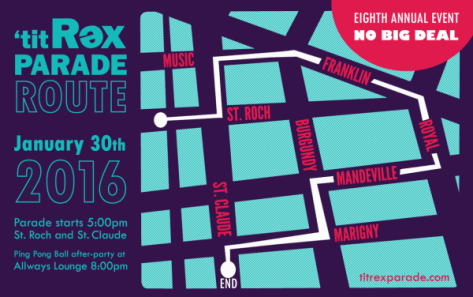
2016_tREXmap-600x376.png

I’ll see if I can find a pic of my previous years loot; I keep the best in a tiny little display which includes tiny coconuts, tiny beads, tiny books (Hail Caesar Meadows!), tiny spears, tiny stickers, tiny shoes, well you get the point.

So, don’t crowd me and don’t expect massive throws. I’ll see you by the tiny ladders and tiny viewer parties (yes they do exist) and I’ll expect a tiny wave.


2016 floats:

http://c.brightcove.com/services/viewer/federated_f9?isVid=1&isUI=1