Jazz in the Park searching for vendors

Jazz in the Park is calling all interested food and craft vendors to be a part of Season 9 of Jazz in the Park! if you are interested in becoming a food or craft vendor, please visit our website and complete the vendor form and email it to vend@armstrongpark.org or call Chris at 504-258-2444.

Frequently asked questions:

What is the load in time?
Load in time is from 12:00 to 2:30pm, all food vendors are required to be completely set up by 3:00.  All trucks must be cleared from the loading lanes by the required time.

How big is the booth?
Booth size is 10X10 but can be expanded with permission of the Jazz in the Park Vendor Coordinator.

What kind of menu/prices do the other vendors offer?
All food vendors set their own prices for their approved menu items.  No menu items are to be sold without prior approval of the Jazz in the Park Vendor Coordinator.  All violators will be subject to fine.

Do you have an idea of sales volume, how much, how many days, etc.?
Sales volume varies per menu items but popular items such as: barbecue, tacos, hamburgers, crawfish bread, charbroil oysters, hot dogs consistently grossed $1500-2000 a week.  But the short answer is if you have good food, product and presentation you will do really well at Jazz in the Park.

What is provided by the festival; tenting/canopy/signage/tables, etc.?
Jazz in the Park provides prime spaces to vendors and also covers the cost of the fire marshal.  Signage is available for a reasonable fee.  All vendors are responsible for their own tents (White), tables, chairs, generators, and signage and/or anything they need to be successful.

Will all sales go to Jazz in the Park, or is there opportunity for revenue?
Food vendors pay their vendor fees to Jazz in the Park Vendor Coordinator and after fees are received by the vendor coordinator a space will be given and all revenue generated is the food vendor profits.

Will there be electricity and water?
Water is on site but typically all vendors should be self-sufficient, meaning vendors are responsible for the things that they need.  Electricity is on site but is limited to stage production staff ONLY.

What cooking mediums are allowed; fire, frying, etc.?
An onsite fire-marshal will be on site to monitor cooking and frying from burners, grills, and open flams. If you are cooking on site you must place plywood under your cooking utensils to capture remnants, grease, oil and etc. It is mandatory to clean up any stains prior to departing. If any stains are left you will be fined $150.00.

Can I sell drinks to my customers?
Selling of drinks, such as water, cold drinks or any adult beverages is strictly prohibited unless special permission is giving which is hardly ever. Jazz in the Park is responsible for all drink sales.

Will I be on all Jazz in the Park paid advertisement?
Yes for a minimal fee, you can get on all our 75,000 fliers, billboards and website.

All funds are due March 15, 2016, PAID IN FULL ONLY, if you do not pay in full , then you space will not be secured. MONEY ORDERS OR CASHIERS CHECKS ONLY, made payable to People United for Armstrong Park. NO EXCEPTION

Send your Company Bio’s so we can included your company’s bio in our e-blasts and display it on our website and social media sites.
Crescent City Books moves to 124 Baronne

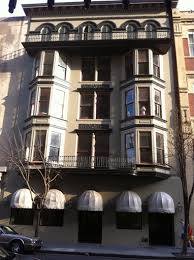
Spread the word. Crescent City Books will be moving to 124 Baronne St. (across the street from The Roosevelt Hotel/Domenica Restaurant). Will reopen by, if not before, March 1st.


12642504_1133546353325023_6145099781280656047_n.jpg

El Libre

I am a fan of this little place on Dumaine right near Decatur. Run by a group of service industry pros, the attention to customers is award-winning and is closely followed by the best rum drinks and right behind that, some seriously good and cheap food.

The picture is of the vegetarian bowl which is absolutely the best deal in  the Quarter at 5 bucks. Their drinks are made to order and according to authentic recipes with some nice little touches thrown in to give you a drink that you will linger over. I am partial to the mojito (seen above) and the Hemingway, but really, all of the drinks are excellent. I hear they have excellent coffee and breakfast too.


Solnit on lead and lies

Rebecca Solnit's photo.
Rebecca Solnit

Flint makes us think about lead poisoning. Beyonce about New Orleans history.

A few years ago I made a map about both of them called Lead and Lies (in Unfathomable City: A New Orleans Atlas; the shading here indicates lead concentrations; the texts overlaid are a lineage of lies in NOLA):

We pretend truth is a solid continent, but untruth is marshy territory. There are myths and legends—about the birth of jazz, for example, which the great jazz scholar Bruce Raeburn points out did not emerge neatly out of Storyville, New Orleans’s brothel district, as people say it did. There are harmless lies, about whether my roux is as good as your grandmother’s; and there are noble lies—“we saw no fugitives pass this way”—and truths told by other means. New Orleans’s most famous jazzman, Louis Armstrong, changed his birthday to the Fourth of July 1900, to make his identity and that of his country somehow consonant—and they are, even though he was born August 4, 1901. More than a hundred years later, poor New Orleanians who said the levees had been dynamited during Hurricane Katrina were wrong in fact but right in that the callous disregard and institutional failure that lay behind some of the 2005 catastrophe had real kinship with the 1927 flood, when levees were indeed dynamited by the powerful.

There are harmful lies, too: both the ambient lies, about racial inferiority or the causes of the Civil War, and particular lies in particular mouths. New Orleans always had scoundrels and flamboyant figures who invented themselves—one of the privileges newcomers always claimed in the New World—and early on, it was populated by smugglers, pirates, renegade slaves, native people lying low, and many people marrying, making love, and creating a Creole population across color lines. Law didn’t always get much respect from these people, and there are times when lying to power is admirable.

When power tells lies to the people, though, it’s another thing altogether. New Orleans and Louisiana have been much afflicted with greedy and dishonest politicians who created a culture of corruption and cronyism (and those who take bribes are lying to the public they swore to serve). Sometimes the level of corruption is staggering: in 1991 the main choices for Louisiana governor were a Klu Klux Klan Grand Wizard spreading racial lies and a longtime politician whose supporters used the slogan “Vote for the Crook. It’s Important.” The crook won and later did ten years in prison for racketeering, mail fraud, and money laundering.

That slavery was generally conducted in a humane or civilized manner was another lie, one that women abolitionists sometimes addressed directly by speaking of the sexual abuse of enslaved women by plantation men, to which wives were required to turn a blind eye. (Conservatives sometimes still produce textbooks in which slavery is benign paternalism.) In antebellum New Orleans, the double life of a wealthy man with a white wife and a placage arrangement with a free woman of color had no equivalent for women. The thriving brothel district of Storyville was another zone through which men moved freely without surrendering their status (and contemporary conservative sex scandals echo that double standard). Women’s lives generally had no such latitude for doubling, though middle class white women did go out masked during carnival to ballrooms they might otherwise not enter. But this is only to say that there are liars and there are the lied-to, and the latter didn’t always believe what they heard, but often they were obliged to pretend that a lie was a truth.

Sometimes they didn’t and testified with consequences—more than once they died for telling the truth, as did Kim Marie Groves, who bore witness to police brutality and died for it. She left three orphans; the hired hitman also left behind three children when he went to prison without chance of parole. New Orleans has had for decades the most corrupt and incompetent police department in the country, one with absurdly low rates of capturing murderers or preventing violence and a terrifyingly high rate of police homicide, framed individuals, and false testimony. Several policemen went to jail for those crimes post-Katrina, and the New Orleans police department was taken over by the federal government in 2012 for its ongoing failure to protect and serve its city.

New Orleans also registers unusually high levels of lead, both from pre-1978 paint and pre-1986 leaded gasoline, though the amounts of lead are not evenly distributed. Lead is a heavy, malleable metal, easily made into objects and mixed with other substances. For much of the twentieth century, it was added to gasoline, to make the gasoline burn better and to reduce wear and tear on engines, and to paint of many types, to increase its durability and moisture-resistance and enhance its color. The far-away scientists who were asked to study lead were themselves induced to lie about the dangers lead posed, and so for half a century vast quantities were added to gasoline and circulated in air, food, and environment. That lies have a lasting legacy is as real as the contaminated soils of the central city, more than a quarter century after the phase-out of the heavy metal.

Lead is a versatile but vicious substance. It accumulates slowly and subtly, rarely detected until the dose is damaging—though children in New Orleans are routinely tested now, when their parents are motivated and financially equipped to do so. When ingested or absorbed, lead is extremely damaging to children’s nervous systems and can have profound emotional and intellectual consequences. Some, including Tulane University professor Howard Mielke, whose lead map is reproduced here, see a correlation between high lead levels and high crime levels in New Orleans.

The substance is a calcium analog—that is, lead impersonates calcium, lying to the body about what it is and insinuating itself into places where benign calcium belongs. Like a lie in words, it gets its victim to accept harm by disguising it. This is what lead and lies have in common: they are destroyers that remain unseen and are more destructive because of their invisibility.

A Musical Prelude To The Celebration of Easter

A Musical Prelude To The Celebration of Easter

Thursday, February 11, 2016

St. Mary’s Catholic Church, 1116 Chartres St., New Orleans, Louisiana

Presented by:The Bishop Perry Center, The Rev. William F. Maestri, Director The Cathedral – Basilica of St. Louis King of France and The Archdiocese of New OrleansIn Concert and sponsors

Starring:

Valerie Francis, Soprano, with Troy Poplous and Richard Hobson, Baritones, and Wilfred Delphin, Pianist

Directed By: Dr. Kenneth S. Klaus Gloria B. Callais Endowed Professor of Music and Director of Choral Activities, Nicholls State University

In a Salute to Leontyne Price

La Vergine degli’angeli (La Forza del Destino) Giuseppe Verdi (1813-1901)  Valerie Francis Priest’s ChorusTroy Poplous, Timothy Ray, Roland Bennett, Melvin Harrison, James Rodrigue, Myron Hartford, Mark Thomas,and The Sinfonia Singers of Phi Mu Alpha Sinfonia Fraternity for Men in Music, Nicholls State University.

Vissi d’arte (Tosca) Giacomo Puccini (1858~1924) Tosca begs Scarpia to save her lover’s life.Valerie Francis

Per me giunto e il di supremo (Don Carlo) VerdiPosa visits Carlo in prison to tell him that he is a marked man because he has used the secret papers to take upon himself the blame for the Flemish rebellion. Posa is shot and dying, he tells Carlo he is happy to have sacrificed his life for a man who will become Spain’s savior. Richard Hobson

O patria mia (Aida) VerdiCiel! mio padre! On the eve of Amneris’s wedding, Ramfis and Amneris enter a temple on the banks of the Nile to pray. Aida, who is waiting for Radamès, is lost in thoughts of her homeland. Amonasro suddenly appears. Invoking Aida’s sense of duty, he makes her agree to find out from Radamès which route the Egyptian army will take to invade Ethiopia. Amonasro hides as Radamès arrives and assures Aida of his love. Valerie Francis, Richard Hobson

Summertime and Bess you is my woman now (Porgy and Bess) George Gershwin (1898-1937)Clara sings a lullaby to her child…All leave except Bess and Sporting Life, who asks her again to come to New York with him and tries to give her more dope, which she refuses. Porgy chases him away and he and Bess sing about their new happiness. Valerie Francis, Troy R. Poplous

INTERMISSION

In the Beginning God Duke Ellington (1899-1974) Richard Hobson

For the Love of Jesus Roger D. Dickerson (1934-)

The Crucifixion Arranged by Ellis Marsalis (1934-)

Calvary Betty Jackson King (1928-1994)

Toccata – Ride on King JesusJohn D. Carter (1932~1981) (Cantata)

Hear the new Empire


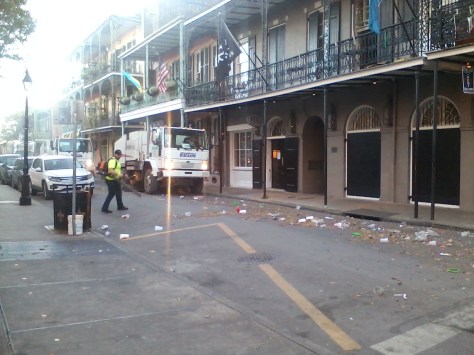
The janitorial service is busy cleaning the Quarter this morning and using blowers to get all of the trash into the street. Best use of those damn things I have seen since I saw a farmer use one to blow the weeds he just took out of his row crops to then burn them.

But here is a hiss for Empire: the way that they use the power washing method is a JOKE; they don’t even get water on the entire sidewalk and just blow the trash to the doorways.  Used to be that the power washer did 5-6 blocks carefully in one morning taking 10-20 minutes on each block; now they blow through in less than a minute! This crappy new method is a waste of manpower and resources as it doesn’t actually clean the sidewalks.

0210160713-020210160714-00