“Remembering that we only have this moment. Remembering that brothers and sisters sacrificed their lives for the freedoms we have today. Most of all to the souls who were taken away from us in Orlando we remember and honor you this weekend at 1239 Royal St.”
Author Archives
On “An Open Letter to the Tales of the Cocktail® Community”
I love this balanced letter linked at the end of this post from a true New Orleans visionary asking her event visitors to use conforming guest lodging. This is a very important letter to send out to as many folks as possible.
I do believe however, (and my unscientific poll of my neighbors seems to correspond with this) that there are two versions of unregulated STR scenarios and they need to be dealt with differently: those who offer extra rooms for rent while living there and the other of absentee owners kicking out long time residents and turning their hastily purchased properties into cash cows, not really caring who their users are and how they act while they are in town.
The second STR situation needs to be done away with and the only way it can be is through detailed regulations, fines levied because the neighbors are able to register real complaints that result in action and includes penalties that jeopardize homestead exemptions.The first type should have light regulations but high fines for anyone skirting the rules of on-site owner STRs. Looks to me that small tweaks of existing STR rules in the city can be updated to add onsite single STRS, as long as they are maxed out at a certain number of days per year.
So, as usual my post is about how I want to urge that we stop lumping in all STRs in one no-no.
It is true that most STRS are currently illegal as they are not permitted. It is not criminal, but instead, a violation of city code or of zoning, just as the illegal use of a home for a pop up snowball stand or neighborhood tire repair or those side windows where folks sell poboys would be dealt with. I think this is important as some of the conversation has become slightly overwrought and angrily denounces the neighbor who offers a single room in their home. A couple of other examples of illegal activity commonly seen in the city that few people know about: it was illegal for fishermen to sell seafood off their truck in Orleans Parish for many, many years. Every other parish allowed it (meaning they did not pass laws against it) but Orleans went through a time when seafood houses lobbied that they should be the ones selling seafood and shrimpers standing in the hot sun should not. This ordinance was passed for food safety reasons, but hurt occasional fishers and our ability to access really fresh shrimp and bycatch. It is also true that someone growing food under a few acres in New Orleans is not allowed to sell that produce on site. It is also true that farmers market vendors are not permitted by City Hall if they do not live in the parish. In most of these cases, the city has worked out some sort of agreement to allow it, but it is still non-conforming or illegal use.
And if it seems odd to think of some of that as not allowed, I like to think it will one day to seem odd that my neighbor or friend was not allowed to let her extra room out a few times per year.
Of course, when I bring up shrimpers selling off their truck, or poboy windows as examples of illegal behavior, there are those who go positively frothy at the mouth at the comparison. I do understand that there is a much larger danger in the unchecked nature of STRs that has never been equalled with shrimpers or cooler beer sales at a second line, but I think any of these ordinances can often have unintended consequences on entrepreneurial activity and so we need to consider all of it carefully as well as the ability of our city hall to enforce what is passed.
(I’d like to comment on the argument often heard that STRs don’t pay taxes when in fact they do receive a 1099 and must pay income tax. Of course, they also pay their property tax on their property as well, so let’s just not overstate that issue. It is true they don’t pay hotel tax, but the city website seems to indicate that many smaller b&bs don’t have to pay hotel privilege or sales tax if under a certain number of rooms or without private baths. Yes those b&bs pay many fees, taxes and have other costs, but collecting added taxes for a room or two over a few nights is a nonstarter of an argument in my book.)
Another topic that also makes some look at me as if I announced a ban on go cups and/or king cake: it is that I believe while we must examine STRs openly and critically, we should also look at the effect of hotel zones too and see if we can discourage the addition of more massive development of these and instead encourage more small hotels, b&bs and boarding houses across the city, owned by locals. I get that some people think this will become a giant loophole to drive STRs in to, but I believe that incentivizing small hotels and b&bs will have the opposite effect. The massive skyscraper hotels are detrimental to neighborhood life and offer very low numbers of good jobs. I myself worked in a few of those behemoths and was glad for the work, but to do so, I went to an area devoid of street life and locals and made a very low wage. Let’s face it: most of these large places are owned by far-off corporations that take as many opportunities to reduce their costs as they can, including low pay and few taxes and offering less for their buck.
So one reason that many of these visitors are choosing STRs is because the hotel industry has not evolved to include the type of layout or amenities that visitors increasingly want. Whether it is for pleasure or for business, people travel differently than they did two decades ago and want to be able to avail themselves of more types of experiences. More people travel with their friends or extended family and need shared space for cooking or lounging that hotels do not yet provide. Or they would rather not be at the mercy of lowest denominator tourist traps or beholden to a small group of taxi services who, if you have ever tried to register a serious complain against one, often have little regard for their customers comfort.
My point is when we get rid of the majority of STRs, an action that I fully support, we also need to reconsider what hospitality means in the 21st century and how New Orleans can offer it without losing our neighborhoods. I want more locals making a little money off tourism as long as it is managed so as not to drive our residents away.
The rental market also needs incentives to reboot itself, such as one time tax credits for adding decent long term rentals, technical assistance to homeowners to become good landlords and fair sublet regulations for students and residents who travel for part of the year. The best kind of housing advocacy is being done by folks around town like Jane Place Neighborhood Sustainability Initiative. This is the statement they added today:
JPNSI is concerned that thousands of housing units are being removed from residential use, particularly in our service area of Mid-City, which has seen a jump from 73 STRs in 2015 to 276 STRs in 2016- an increase of 278%. While we spoke out about how whole-house rentals are contributing to the housing crisis and displacement of residents, we also called for a strengthening of New Orleans’ notorious weak tenant laws that make it easy for landlords to evict tenants from housing, and recommend that a percentage of the monies generated by the permitting and regulation of STRs to be directed to the Neighborhood Housing Improvement Fund to support the development of affordable housing.
So I vigorously applaud the above and TOTC’s statement in favor of our gorgeous Monteleones, Roosevelts and Valentino-owned small Quarter hotels, but let’s try to get some balance and fair play to those neighbors who have the ability to offer a room or in wanting to legally add a small property for visitors along the Canal Streetcar line or out by the lakefront and legislate these uses for a small responsible number.
Source: An Open Letter to the Tales of the Cocktail® Community | Tales of the Cocktail
Sharpen for Summer

Festivals done right-er
Refashionista/writer/fairy godmother of flea (markets) Cree McCree wrote so well about the most recent Greek Fest on Bayou St. John, I don’t feel the need to embellish it. In her review, she describes an event that shares its culture graciously, has good logistics for getting all of the food/drink, and with a open invitation to join in on the dancing (or toga-wearing) fun. Just click the link below and be transported into a camp chair while she (in her unmistakable lilting/gravelly voice), her super-smart husband Donald and their tribe debate any number of subjects, as you do your best to keep up verbally and beverage-wise.
What I DO want to add is an exhortation for locals to consider the record of this festival hosted by a single church on and around its grounds in order to simply support its community’s historic life in our city. And one done without co-opting any other group’s culture or adding more stages or more tents ’til the space is positively unsafe and then unable to serve the musicians or vendors or attendees well. That may it serve as a good example of how not every event has to have VIP tents, to outsource every inch of space around its commercial interior or to run roughshod over people relaxing at the edges there just to soak up good ol’ New Orleans togetherness, aka good vibes.
In other words, wannabe Quint Davises: if you really want to know how to do it, check your ego and your greed at the parish line and bring a chair next year to some of these neighborhood or church deals to learn about what works. And look for Cree; she’ll give you some good intel.
Plessy anniversary
#tdih On June 7, 1892 Homer Plessy was arrested for violating Louisiana’s Separate Car Act. We all know the court’s Plessy v. Ferguson ruling, but less familiar is the incredible organizing by the Comité des Citoyens that led to this test case. The Comité dedicated years to fundraising, strategic planning, public education (with The Crusader newspaper), and more.They even raised the funds to hire the guard to arrest Plessy to be sure he was charged correctly in their effort to challenge an unjust law. Regardless of the court decision, the Comité played an important role in U.S. history. Learn about the organizing history in this online article by Keith W. Medley:http://bit.ly/LDMPMx
You can help ensure that students learn this history in middle and high school with a donation to the Zinn Education Project in honor of the Comité des Citoyens: https://zinnedproject.org/donate/
The 75 year-old Little Red School House on Royal (McDonogh 15)
When wealthy recluse John McDonogh died in 1850, the residents of New Orleans and Baltimore were surprised to find themselves the beneficiaries of his considerable estate. His will specified that the money was to be used for the purpose of establishing public schools in the two cities for “education of the poor of all castes and races.” Over 30 public schools bearing John McDonogh’s name were constructed in New Orleans.
Baltimore on the other hand, opened one which was established originally as an all-white, semi-military school for orphan boys, who worked on the farm in exchange for their tuition, room, and board. The first African-American student was admitted in 1959. In 1971, the military traditions of the school were discontinued but to this day it is regarded as one of the Baltimore region’s most prestigious preparatory schools.
LRS was constructed in 1932 by city architect, E. Christy on the site of the early 19th century St. Philip Theatre.

Before it was a theater, the playhouse on St. Philip Street was a ballroom, and it would revert to its original ballroom status several times during its lifetime, alternatively known as the Salle Chinoise, the Winter Tivoli, and, in perhaps its most famous incarnation, the Washington Ballroom. Under the ownership of Bernardo Coquet, the St. Philip Street ballroom was the scene of the first balls for free people of color, and in 1805, when it was leased by Auguste Tessier, it became the first hall to host quadroon balls. Between 1808 and 1832, when it became the Washington Ballroom, the theater competed first with the St. Peter Street Theater and later with the Orleans Theater to be the premier site of French opera in New Orleans. [J.G. de Baroncelli. Le Theatre-Francais de la Nouvelle Orleans. New Orleans, 1906] (nutrias.org)
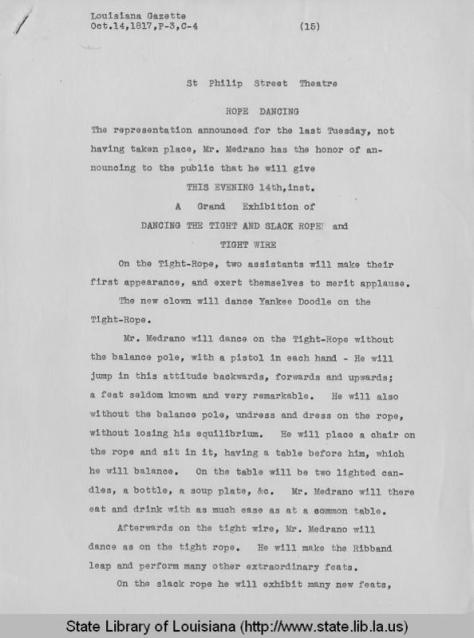
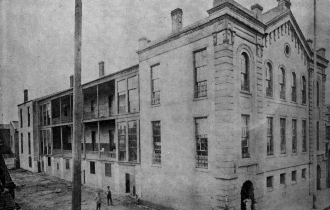
St. Philip School – Boys – No. 721 St. Philip (hnoc.org)
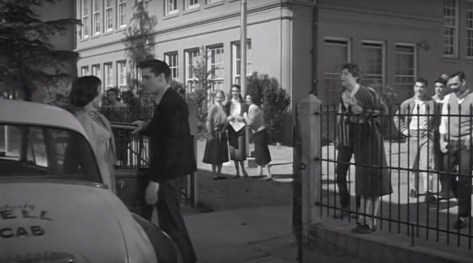
Building used in 1958 for King Creole school scenes
In 1970, Lucianne Carmichael requested to be sent to the lowest performing, most segregated school. While earning a Masters degree from Tulane University she developed and implemented a Language Arts project that operated centers in 26 public and parochial schools. From 1964 until 1969 Lucianne was responsible for assisting in the preparation of the E.S.E.A Title I proposal and developing new programs for inner city schools. In 1969 she was appointed acting principal of Howard No. 1 school. The next year she was assigned to McDonogh 15, an empty elementary school in the French Quarter. With the help of dedicated staff, she breathed life into a dead building and an innovative school was born.
2006- 2016:
KIPP McDonogh 15 School for the Creative Arts
KIPP McDonogh 15 School for the Creative Arts was a public charter school operated by KIPP New Orleans as part of the Louisiana Department of Education?s Recovery School District (RSD). In 2006, KIPP McDonogh 15 started serving 470 pre-kindergarten through eighth grade students. In 2011, KIPP McDonogh 15 Middle School moved to the Frederick Douglass building on St. Claude avenue and began functioning independently of the primary school. After a year at the Douglass building, the school moved to its current location in Gentilly, and renamed KIPP Morial in 2017. https://www.nola.com/education/2017/08/new_orleans_kipp_morial_school.html
Homer Plessy, A Community School
Homer Plessy School’s charter was granted in 2012, with a focus that placed that a high value on critical thinking, creativity, diversity and citizenship, and served its first student population in 2013. The school moved to the FQ campus in 2017.
Stolen Bikes Nola
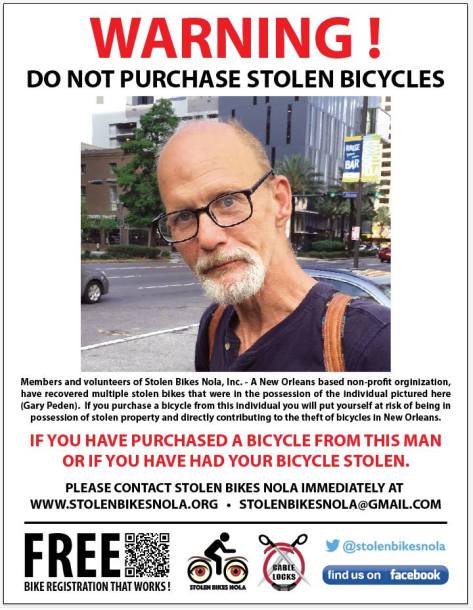
AND support this wonderful group of neighbors who are doing so much for those of us who rely on our 2 wheels, while making the bad people look over their shoulder.
 French Quarter block by block
You must be logged in to post a comment.