Tom Fitzmorris on Ted Brennan

From my perspective, this is exactly right. Thank you Tom Fitzmorris for giving Ted and the other Brennan boys their due.

Ted Brennan, 1948-2016.

There’s a tragic aspect to the end of every life. One hopes that the brighter qualities so outshine the darkness the the person’s life is celebrated gladly. Ted Brennan, who died on Wednesday, August 3, 2016 at the age of sixty-eight, had that balancing act pretty well accomplished.

Ted and his two brothers owned Brennan’s on Royal Street, one of the most successful, original, and loved establishments in the world history of the restaurant business. But three years before his passing he had to watch his restaurant pulled out from under him. It was a professional and personal disaster, one from which there didn’t seem to be any escape.
But Brennan’s was so much a part of Ted’s life that, even as his health gave out (Parkinson’s), he had plans in the works to open a new French Quarter restaurant with his son Teddy. It was such a reach that, frankly, I never thought I would see Ted Brennan’s On Decatur actually open. It hasn’t, yet, but all the pieces seem to be coming together for a fall opening. The plan includes Chef Lazone Randolph, the brilliant man who orchestrated the kitchen at Brennan’s for decades. I am ready to be very pleasantly surprised.
Ted was in his twenties, the youngest of Owen Brennan’s boys, when the three of them took full control of Brennan’s from their aunts and uncles in 1973. With their mother they already owned the place, having inherited it after father Owen died young in 1955. It was Owen and his siblings that had built Brennan’s into the fantastically popular and profitable restaurant it had become. (These aunts and uncles moved to Commander’s Palace, where they had to start all over again, and did-brilliantly.)
By 1973, Ted and his two brothers were already heavily involved in Brennan’s operation, and they were ready to run the establishment their way, without having to check in with Aunts Ella and Adelaide or Uncles Dick and John in every decision. The two sides of the family would never reconcile their differences.
That was okay with Ted, Pip and Jimmy. Pip eased into the nuts and bolts of general management. Jimmy became the man with the key to the wine cellar, which would become one of the best in America. Ted, with his good looks and sense of humor and hospitality, became the man standing at the entrance, making sure the VIPs and regulars were well cared for. I heard it said more than a few times that Ted most resembled his father Owen, who was one of the most convivial and best-liked hosts in New Orleans. Indeed, in almost all my meals and interviews at Brennan’s, Ted was the man I spoke with. Only once did I have dinner with the three of them at one table.
Two anecdotes about Ted and his personality: He showed up for a radio visit with me one afternoon. He walked into the studio with his finger on his lips. He pulled his hand away and shook it negatively. He pointed to his throat, then shrugged his shoulders. “What’s up?” I asked, puzzled. He grabbed a piece of paper and wrote on it, “I can’t talk. Laryngitis!” He can’t talk in an interview on the radio? Then he started laughing at me for falling for that.
Second anecdote: I was having dinner at Brennan’s one night, enjoying a half-dozen oysters casino. The dish is almost too simple: oysters baked on the shells with cocktail sauce and a slice of crisp bacon. Ted came up behind me and said, “Just like a stupid Irishman!” he said. “Eating oysters with hot ketchup and bacon. Hah!”
I looked up. “So why do you have it on your menu if it’s so awful?”
“Oh, no,” he said. “I like them too!” He didn’t have to tell me that he also was strongly Irish.
During their heyday from 1973 until just into the 2000s, the Brennan brothers had a simple business model. They knew it was a gold-laying goose, and they took very good care of that bird. They rarely made major changes in the menu. They were very generous with their friends and regulars. One staffer was responsible for contacting any friend of the Brennans who was having a birthday, and inviting the celebrant in for dinner.
For about ten years in the 1990s, they sent me a can of beluga caviar for Christmas every year. It would be clearly unethical for me to accept such a gift, but they wouldn’t take it when I tried to give it back. This led to my beginning a charitable dinner I would chef on Twelfth Night every year. The first of the ten courses was always beluga caviar atop savory waffles, courtesy of Brennan’s.
When we began the Eat Club dinner series in the 1990s, our first Christmas Eat Club dinner was at Brennan’s. To say that the wines and food they served us were far more valuable than what the Eat Clubbers had to pay is a gross understatement.
And then, in 2011, I was told that Brennan’s couldn’t do the Eat Club Reveillon dinner that year. Same thing next year, and forever after that. I would not have guessed that this was because Brennan’s was having financial problems. But that was the deal, all right.
And then Jimmy Brennan died. This clicked in one of several unusual agreements among the brothers as to what would happen if one of them died, retired, or otherwise left the scene. I have heard a few versions of how this worked, but most of them say that ownership in Brennan’s could not devolve to anyone other than one of the three brothers. The next development: Ted and Pip were taking legal action against one other. And then, they were all cast out, as new owners of Brennan’s cleared the deck, paying by far the highest price in the history of the New Orleans restaurant business.
And Ted was on the street. But he swore that he’d be back, with Teddy and Lazone, to re-establish his idea of what Brennan’s is supposed to me.
It gives me a sour feeling to review those desperate days for the Brennan brothers. Only Pip Brennan remains of the trio. Pip’s sons are in the restaurant business, but not here in town. I dearly hope that Teddy gets his father’s restaurant open this fall. I would give me something to smile about when I think of what happened to my friend Ted Brennan. Quel dommage!
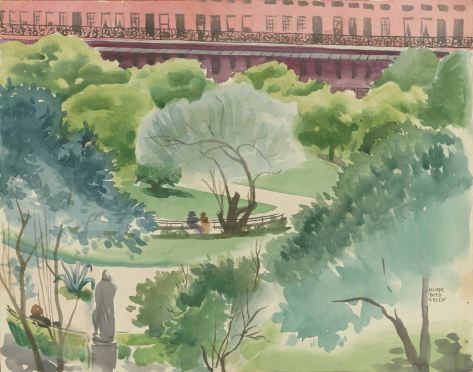
1930s Jackson Square watercolor

By Alvyk Boyd Cruise, for  the Historic American Buildings Survey.

13933449_10207225957190371_1793755057_n.jpg

$ 5 per day Satchmo Fest – Sunday schedule 2016

Daily admission is $5 (children 12 and under are free). Wristbands will be provided at the gates to allow festival-goers the option of coming and going throughout each day.

Fleurty Girl Back o’ Town Stage

Start End Performer
11:30 12:15 Dance Lesson: Traditional Jazz w/ NOLA Jitterbugs
12:15 01:00 Dance Lesson: 1920’s Charleston w/ NOLA Jitterbugs
02:15 03:00 Dance Lesson: Swing Dance w/ NOLA Jitterbugs
03:00 03:15 Dance Lesson
03:15 04:30 G & The Swinging Three

Cornet Chop Suey Stage

($5 per day) Satchmo Fest-Friday schedule

Satchmo SummerFest is a three-day local music showcase located within one block of the historic French Quarter: two stages and food booths are located in Jackson Square; a third stage and children’s area is located in the Louisiana State Museum’s Arsenal; the Satchmo Symposium takes place in Le Petit Theatre. Satchmo SummerFest features local music with a focus on contemporary and traditional jazz and brass bands. The community festival also features the ‘Red Bean Alley,’ festival food booths operated by some of New Orleans finest restaurants, open throughout the festival weekend.

What is the cost to attend Satchmo SummerFest?
Daily admission is $5 (children 12 and under are free). Wristbands will be provided at the gates to allow festival-goers the option of coming and going throughout each day.

$5 Satchmo Fest schedule

Cornet Restaurant Red Beans and Ricely Yours

$5 per day Satchmo Fest – Saturday schedule 2016

What is the cost to attend Satchmo SummerFest?
Daily admission is $5 (children 12 and under are free). Wristbands will be provided at the gates to allow festival-goers the option of coming and going throughout each day.


Fleurty Girl Back o’ Town Stage

Start End Performer
11:30 12:15 NOLA Jitterbugs Traditional Jazz Dance Lesson
12:15 01:00 Dance Lesson
01:00 02:15 Chance Bushman & The Ibervillianaires
03:00 03:15 Dance Lesson
03:30 04:30 Steve Pistorius and Frien

 Cornet Restaurant Red Beans and Ricely Yours

The Fundamentals of Letter Writing | Hermann-Grima + Gallier Historic Houses

Do you miss the art of the handwritten letter?  Hermann-Grima/Gallier Historic Houses are hosting a workshop just for you!

In this two-hour class, Nancy Sharon Collins will instruct, discuss, and encourage participants to practice hand-writing personal notes and letters. Collins is the country’s leading expert on engraved social stationery and authored The Complete Engraver, a guide to monograms, crests, ciphers, seals, and the etiquette and history of social stationery. She’s a frequent subject of popular media such as Town & Country, Garden & Gun, Martha Stewart Wedding, Vogue, Veranda, The New York Times, and the WWNO/NPR show “Out to Lunch.”

The workshop is July 23 at 10 AM. Bring your own stationery and favorite writing instrument, be it gel pen or quill feather and ink bottle! Gallier House is located at 1132 Royal Street in the French Quarter.

Source: The Fundamentals of Letter Writing | Hermann-Grima + Gallier Historic Houses

Enough.

For a French Quarter blog, this is a subject that must be covered. Anyone who watches the news or lives in or near the fancier areas of town has noted the outright racism shown by authorities to groups or individuals of color as they walk through these streets. And, we residents should also note the juxtaposition of all white faces of residents behind the gates as people of color walk in from Rampart at 6 am in kitchenwear, maid outfits and maintenance shirts to service our community. How many executive chefs are Creole anymore? How many of our gallery managers or front desk managers are anything but overwhelmingly white? How long do heroic statues of those who fought (and lost) a civil war to enslave their neighbors stand?

It matters because institutional racism limits access without thinking, discourages incentive and punishes those with the “wrong” color with bullets and beatings for simply walking, or driving with a broken tail light or for a million mundane activities that those of us with white faces do without thinking. As for the response of “just do what the cop says and you won’t get hurt” I hope Sandra Bland or Michael Brown are at least examples of how that is a lie, and now as of this week, our most recent neighbor Alton Sterling as seen in the horrifying videos shot by witnesses.

I promise my neighbors to always be a witness too.


Two local women talk about this issue below, both cut and pasted from their FB page.

 From local photographer Cheryl Gerber:

That awesome conversation that always goes south. That joke that makes you cringe. That Obama comment that goes way too far. As a white person growing up in the south, these things are all too common. If you grew up here, you know exactly what I’m talking about. I’ve had to examine my own prejudices and reprogram my thinking over a lifetime. I’m still learning. To my dear black friends, I’m sorry. I sorry for every time I didn’t speak up in the face of ignorance. I’m sorry I didn’t bring my black boyfriend to the company Christmas party because I was afraid of the backlash. And I’m sorry I didn’t feel more outrage when this continually happened before cellphone videos captured what you’ve been saying for years. I was young and programmed to be racist. I never hated anyone. But I didn’t understand white privilege and what my black friends were up against. But I can’t go back in time. I can only move forward. I’m teaching Kid G the complexities of racism and how to check himself. How to stand up and never be afraid to speak up in the face of racism. So far, I think I’ve done a good job. I have hope for the future. But right now I feel a sadness to the depths I’ve never known before. I was sad for Michael Brown and Freddy Gray and Eric Garner and all the others. But this time
It was in our backyard. Where racist policies are made. Where football fans fly purple and gold confederate flags. Where people publish hateful comments after a disaster. Where other mothers at the skate park feel so comfortable in our mutual whiteness that they can express their racist vitriol to me. I’m so glad I checked myself and my fears as a young woman. But it doesn’t seem like enough. I’m digging deep. I can’t stop hearing the cries of the woman who videotaped the shooting. Or the image of Alton’s 15-year-old son standing next to his crying mother at the press conference. Let justice be swift.


Tricia Boutté-Langlo Langevåg, Norway ·

 People always ask me, “Why did you move to Norway?” My initial response was, “It’s a beautiful country with a great social system, a fertile arts environment with great musicians and a stable future.” It’s become so much more than that over the past few years. One of the #1 reasons now, I FEEL, SAFE.Last year a lady in New Orleans asked me the same question and I gave her my standard response. She still didn’t get it. She said, “But it gets so cold there!” “Yea, but we have good winter clothes, warm, well insulated homes, oh, and the chances of a cop killing me for no reason, are basically nonexistent.” She was white. My statement made her uncomfortable. Good.
Norway isn’t perfect. No place is perfect, but I choose to be in a place where I have NEVER had a police officer follow me around in shops thinking I might be stealing something. I have NEVER been trailed by a police car waiting or hoping I forget to use a turn signal or make a full stop to have a “reason” to pull me over and kill me. I have NEVER been randomly targeted by law enforcement in any form in the country that I now call home. I FEEL, SAFE.
People, as a right of being human, deserve to FEEL SAFE. Especially from those who swore to protect and serve ALL CITIZENS EQUALLY.
Why does my hue make me expendable? Why is my brown a target?
My mother always told me, don’t stay in a place where you don’t feel welcome. I didn’t.
13607008_10154356613194700_1066161819568881713_n