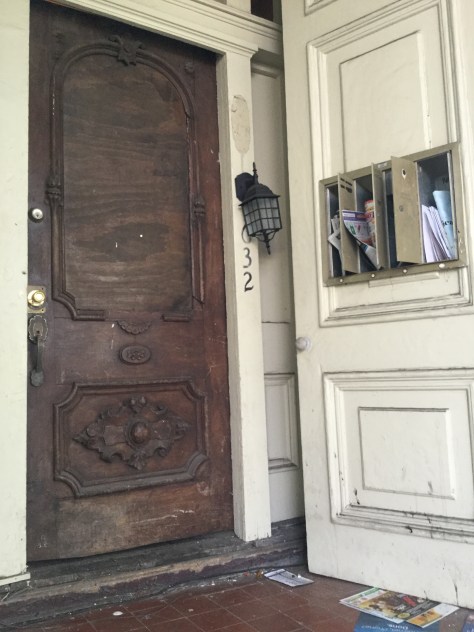


Ironwork
The Historic New Orleans Collection will join the City of New Orleans 2018 Commission’s Cultural and Historical Committee to present “Making New Orleans Home: A Tricentennial Symposium,” Thursday, March 8, through Sunday, March 11, 2018.
Comprising individual lectures and panel discussions, the four-day symposium will be held at locations throughout the city, including Tulane University, the Hotel Monteleone, Xavier University, and the University of New Orleans. Additional evening events will take place at The Historic New Orleans Collection and the New Orleans Jazz Museum at the Old US Mint.
Schedule
Thursday, March 8, 2018
Tulane University, McAlister Auditorium, McAlister Drive and Freret Street
| 6:30 p.m. | Welcome address Michael Fitts, president, Tulane University |
| Symposium address
Priscilla Lawrence and Sybil Haydel Morial, co-chairs, Cultural and Historical Committee, |
|
| Introduction
Emily Clark, chair, Symposium Program Committee, and Clement Chambers Benenson Professor in American Colonial History, Tulane University |
|
| Keynote address Cokie Roberts, NPR and ABC News political commentator |
Friday, March 9, 2018
Conference sessions: Monteleone Hotel, Queen Anne Ballroom, 214 Royal Street
Block party: 500 block of Royal Street
| 8:45–9 a.m. | Introductory remarks Priscilla Lawrence and Sybil Haydel Morial |
| 9–9:40 a.m. | Balbancha: How American Indians Kept New Orleans in their Homeland Daniel H. Usner, Holland N. McTyeire Professor of History, Vanderbilt University |
| 9:40–10 a.m. | Break |
| 10–10:45 a.m.
|
Revisiting the Devil’s Empire: French Colonial New Orleans Shannon Lee Dawdy, professor of anthropology, University of Chicago Traces of Endangered Pasts: New Orleans Archaeology at the Tricentennial |
| 10:45–11 a.m. | Break |
| 11–11:40 a.m. | Self Expression and Enslaved People Sophie White, associate professor of American studies, University of Notre Dame |
| 11:40 a.m.–1:15 p.m. | Lunch (on your own) |
| 1:15–1:30 p.m. | Afternoon welcome Daniel Hammer, deputy director, The Historic New Orleans Collection |
| 1:30–2:10 p.m.
|
Making New Orleans Home at the Table Jessica Harris, culinary historian and professor, Queens College, CUNY (retired) |
| 2:10–2:30 p.m. | Break |
| 2:30–3:15 p.m. | The Transatlantic Slave Trade: A Shared History David Fleming, director, National Museums Liverpool (UK) |
| 3:15–3:30 p.m. | Break |
| 3:30–4:15 p.m.
|
New Orleans and the Slave Trade Walter Johnson, Winthrop Professor of History, professor of African and African American studies, and director of the Charles Warren Center, Harvard University interviewed by Lawrence N. Powell, professor emeritus of history, Tulane University |
| 5–7:30 p.m. | Block party, 500 block of Royal Street Featuring performances by Leroy Jones’ Original Hurricane Brass Band and the Dukes of Dixieland Refreshments will be available for purchase. Viewing of New Orleans, the Founding Era, an exhibition at The Historic New Orleans Collection |
Saturday, March 10, 2018
Conference sessions: Xavier University, McCaffrey Ballroom, University Center (3rd floor), 1 Drexel Drive
Evening program: New Orleans Jazz Museum, 400 Esplanade Avenue
Food and drinks available for purchase at both venues.
| 8:45–9 a.m. | Welcoming remarks C. Reynold Verret, president, Xavier University |
| 9–9:45 a.m. | Featured address The Great Migration Isabel Wilkerson, author, The Warmth of Other Suns: The Epic Story of America’s Great Migration |
| 9:45–10:15 a.m. | Break |
| 10:15–11 a.m. | Panel discussion: Religion
|
| 11–11:45 a.m. | Panel discussion: “Creating Home: 300 Years of Builders and Architects in New Orleans”
|
| 11:45–2 p.m. | Lunch (on your own) Book signing with Isabel Wilkerson |
| 2–2:40 p.m. | New Orleans in the American Revolution Kathleen Duval, Bowman and Gordon Gray Distinguished Professor of History, University of North Carolina |
| 2:40–3 p.m. | Break |
| 3–3:45 p.m. | Panel discussion: Haiti and New Orleans
|
| 3:45–4 p.m. | Break |
| 4–4:45 p.m. | Panel discussion: New Orleans Music: Past, Present, and Future
|
| 4:45 p.m. | Invitation to evening event Greg Lambousy, director, New Orleans Jazz Museum |
| 6:30–10 p.m. | Minting NOLA Music at the Jazz Museum |
Sunday, March 11, 2018
University of New Orleans, Senator Ted Hickey Ballroom and Gallery Lounge, University Center, 2000 Lakeshore Drive. Parking will be complimentary in all university parking lots, including the University Center lot. Food and drinks available for purchase.
| 10:30–10:45 a.m. | Welcoming remarks Matt Tarr, Vice President for Research and Economic Development Introductory remarks |
| 10:45–11:30 a.m. | Panel discussion: Immigrants
|
| 11:30–12:15 p.m. | An Ethnic Geography of New Orleans: Residential Settlement Patterns across Three Centuries Richard Campanella, geographer, Tulane School of Architecture |
| 12:15–2:15 p.m. | Lunch (on your own) |
| 1–2:15 p.m | “Congo Square” and “Storyville” University of Louisiana at Lafayette Wind Ensemble conducted by William J. Hochkeppel, director of bands, University of Louisiana at Lafayette works composed by James Syler, University of Texas at San Antonio commentary by Freddi Evans, author, independent scholar, and arts educator |
| 2:15–3:15 p.m. | Civil Rights roundtable
moderated by Lawrence N. Powell, professor emeritus of history, Tulane University |
| 3:15–4 p.m. | Whither New Orleans? The Future of A Great American City Leslie M. Harris, professor of history and African American studies, Northwestern University |
| 4 p.m. | Closing remarks |
On Tuesday, Feb. 20, at Parisite Skatepark—on the corner of Pleasure St. and Paris Ave. under the I-610 overpass—a project manager from the City of New Orleans met with an architect and leaders of the park to discuss its expansion.
The park, which was sanctioned by the City in 2015, has been built in phases. Skylar Fein, the park’s founder, and Julian Welliz designed the phases with input from the skaters themselves. Parisite is a “DIY” skate park meaning it is funded, designed and maintained by the people who use it.
“These designs that are winding their way through the permitting process started with the skaters and are working their way through the city, through the state, through DOTD, to make sure that they are up to code and everything is safe, but the park users are really getting what they want,” Fein said.
I’ve been waiting for this for some time. The design of this program has depended on grants and at times, on the kindness of the neighborhood leadership, and as is the case far too often, on goodwill to carry them through. The costs (some of which are outlined in Paul Barricos’ thoughtful and honest interview in ensuing articles which indicate that the cost of rent and insurance were significant for a non-profit and doesn’t even mention the cost for utilities, which you can imagine…)
More importantly, the original idea was undercut almost immediately by for-profit versions of delivery services and by offering products with too little profit margin to make it. I also commend Paul and his Hollygrove CDC team who have done their best to learn about farming and retail as best they could and stepped up to provide…
View original post 177 more words
With the best of intentions, workers applied elastomeric coatings to the Cabildo around 1998 and the Presbytère in 2004. Around the same time, the Old Ursuline Convent in New Orleans and the Old State Capitol in Baton Rouge received similar applications. But what was first seen as a state-of-the-art technique soon turned out to be a preservationist’s nightmare. As it turns out, exterior masonry and stucco require a certain amount of moisture to maintain their structural integrity; without it, the exterior cracks and crumble.
“Elastomeric coats are designed to exclude water from buildings, and in theory they don’t cause problems as long as all water is excluded from entering a building. But that is impossible to do,” said Cangelosi. “Water can come from rising damp, hairline cracks, movement, interior sources including condensations, failure of adhesion of the stucco and other sources. And once in the moisture is in, it cannot escape, as the coating is designed to prevent the transmission of moisture.”
Trapped behind the paint, this moisture has no place to go except through the building’s interior plaster walls. But before this was realized, damage had been done. The Old Louisiana State Capitol building was one of the earliest buildings in Louisiana to report damage after it was discovered that the elastomeric coatings had been the culprit behind decay caused by trapped moisture within the building walls.
“Historic buildings and their fabric must be able to breathe,” Cangelosi said. “History has shown that any product which prevents that will have an adverse effect.”
Elastomeric coatings did not go from panacea to poison overnight, of course. But by 2005, the Vieux Carré Commission (VCC) rejected the Ursuline Convent’s request to repaint an elastomeric fence. Staff analysts concluded that such paints “are disastrously inappropriate for historic masonry walls and structures in all high humidity/high temperature climates and especially in sub-tropical and tropical climes like New Orleans.”
These words proved prophetic, and work to remove the elastomeric coatings on the Cabildo and the Presbytère began in 2014. By that point, the damage done to those buildings by the coatings was severe. “”I received a video early one morning from someone passing the Cabildo as parts of it literally were exploding off the building as the trapped moisture was trying to escape,” Cangelosi said. “Not only did it cause extensive damage to the building, but someone could have been seriously hurt.” Koch and Wilson Architects was selected to oversee the work of associated waterproofing at the Cabildo, and Jahncke & Burns Architects was chosen as the architect of record for the work of advanced waterproofing at the Presbytère. Associated Waterproofing is the contractor of work on the Cabildo, and Advance Waterproofing LLC served as general contractor for the Presbytère‘s first phase of work.
At first, the plan was to remove the coating from only the front façade of each building. As the work proceeded, however, it quickly became clear that not only would the other sides of the buildings need to be stripped, but that stucco and masonry underneath the elastomeric coatings had suffered extensive structural damage and would need repair.
New Orleans Black Restaurant Week is a bi-annual chance to celebrate the city’s rich history of culture and cuisine and the contributions made by African-Americans and minority chefs and restaurateurs. Our efforts to support minority-owned businesses and chefs in New Orleans will stimulate economic growth and awareness for these businesses.
New Orleans Black Restaurant week will begin February 12, 2018 and last for two weeks, ending February 24. More details coming soon on future dates, pop-ups and events.
Reservations for Eat NOLA Noir are now open:
Nola Noir


You must be logged in to post a comment.