Easter Parades in French Quarter

Sunday, April 1st
1. French Quarter Easter parade
Begins at 9:45 a.m.
The Historic French Quarter Easter Parade travels from @antoinesnola at 9:45 a.m. in time to make the 11 a.m. Mass at the @stlouiscathedral . After Mass, participants take a walk around Jackson Square. This parade was previously operated by a group known as the Friends of Germaine Wells, a legendary FQ restaurateur who died in 1983.*

2. Chris Owens French Quarter Easter Parade
Begins at 1 p.m.
The French Quarter icon leads her 34th annual parade from the @omniroyalorleans , then it heads up Royal Street to Canal Street. From there, it takes a right on Canal Street before turning onto Bourbon Street, then heads on to St. Philip Street to Decatur to St. Louis Street and ends back at the Omni Royal.

3. Gay Easter Parade
Begins at 4:30 p.m.
The 18th annual Official Gay Easter parade travels from Bourbon Street to GrandPre’s, 834 North Rampart St. 29542956_10156087422210535_1266946249170490939_n.jpg29513122_10156087422380535_7696489678015272349_n.jpg29572974_10156087422425535_6266546642161562017_n.jpg


The first 2 parades are slightly connected in that the parade founders were and are two of our most vibrant and glorious women leaders, known for their business acumen but also for their joie de vivre and love and care of the French Quarter.

Germaine Wells was the daughter of Arnaud Cazenave, founder of Arnaud’s Restaurant. Wells, who reigned as queen of 22 Carnival balls, introduced her Easter parade in 1956 after seeing the NYC Fifth Avenue Easter Parade. The New Orleans parade, with horse-drawn carriages, throws of stuffed animals and candy,  Easter bonnets and fancy Easter baskets continues today.  Back then, it would start at Wells’ house on the corner of Esplanade Avenue and Chartres Street and stop at St. Louis Cathedral for Mass at noon and then to Arnaud’s Restaurant for lunch. Around 2012, the parade began to start and end at Antoine’s and became more commonly known as the Historic French Quarter Easter Parade.

Chris Owens began her own Easter parade in 1983.  Many histories identify the founding of her parade as coming after Germaine Wells’ passing, but that seems inaccurate as Wells died in December of that year. The Owens parade is beautiful and has an extensive route to try to catch a throw from the Grand Duchess of Bourbon Street. Owens is one of my favorite celebrities in town, not only for her amazing club act which I have been lucky to have caught more than a few times but also for her astute sense in building and operating a club,  managing retail and residential property to the impressive level that she has maintained for decades at St. Louis and Bourbon. All Hail Queen Chris.


St. Joseph Altars, French Quarter

The altars, representing the Holy Trinity, are divided into three sections with a statue of St. Joseph at the head.  Candles, figurines, flowers, medals and other items are placed around the altar creating a beautiful and abundant effect. Offerings of food are added that are shared usually when the altar is broken down.

29339874_10211820114281427_8376678526090879901_n

The St. Joseph Altar Society does this block event.  The annual event attendance has grown each year with over 650 people attending in 2016.


29356098_10211820980103072_7435569755581916372_n

Beauregard-Keyes House altar 2018

29342921_10211820989023295_8714645403993429927_n


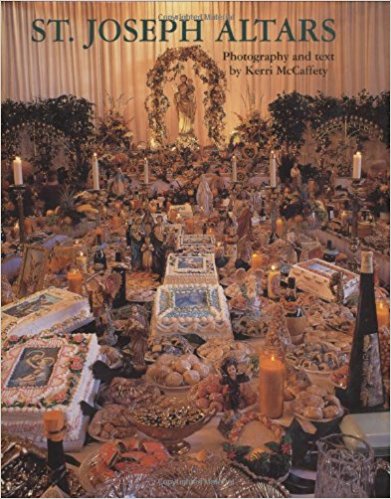
61C8RS6w-zL._SX389_BO1,204,203,200_

Great book on the altars by one of our best photographers.


The list of 2018 altars is found here.

Homer Plessy Protests

Homer Plessy Community School is one of several schools in our area that held walkouts Wednesday as part of National Walkout Day.

Students brought out balloons, gave speeches, read poetry, sang and chanted.

Kindergarten through 6th-grade students participated. The discussions regarding gun violence were coordinated with a school counselor, to make sure they’re appropriate for each class.


‘Children have the power’: Homer Plessy students stage walkout, singing and chanting for peace

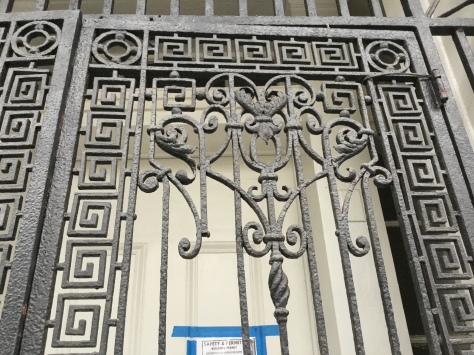
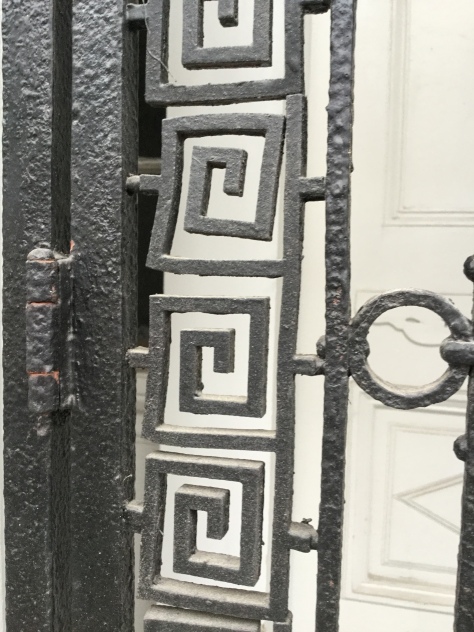
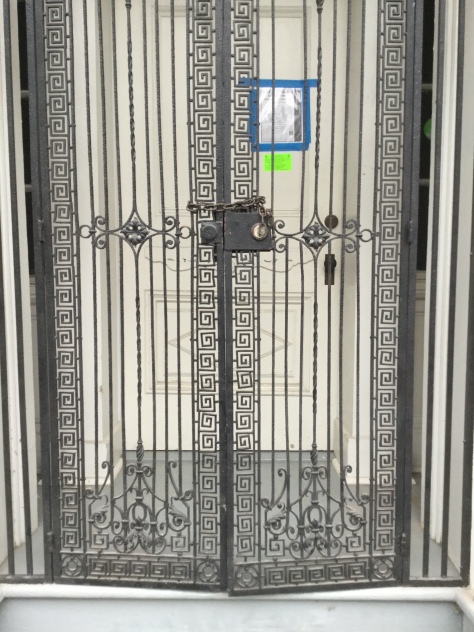
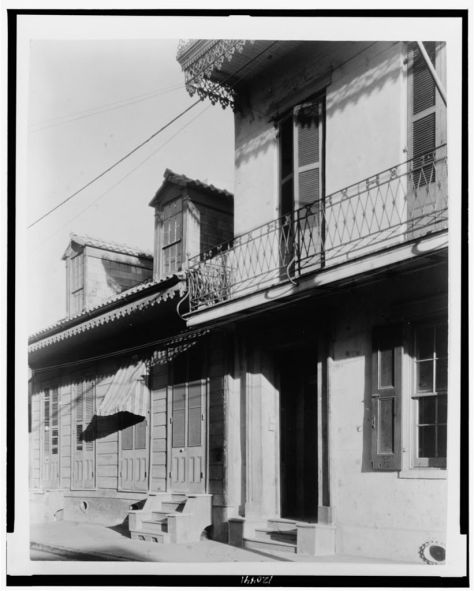
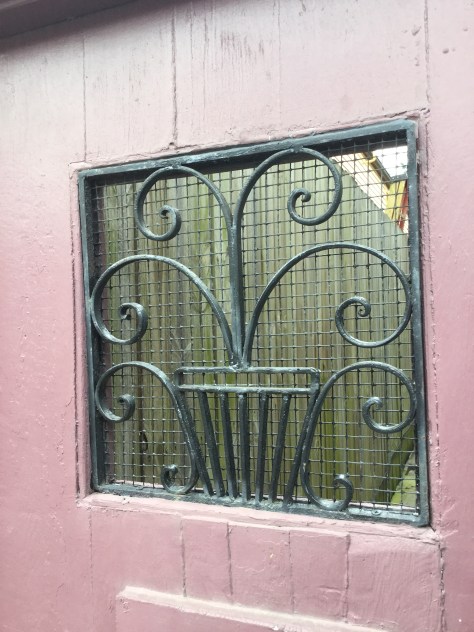
Ironwork: Gate detail 1100 Bourbon

at the Frances Benjamin Johnston house on Bourbon.  The 1940 era picture is from the Library of Congress archives and likely dates from soon after she purchased the property. She died in New Orleans in 1955.IMG_6900IMG_6902IMG_69033c20441v

Archaeology and New Orleans

Just attended the very excellent morning event at the Monteleone Hotel for the Making New Orleans Home: A Tricentennial Symposium.

This free set of events is happening today at the Monteleone, tomorrow at Xavier, and Sunday at UNO.
This morning’s talk, by Shannon Lee Dawdy, professor of anthropology at University of Chicago and D. Ryan Gray at University of New Orleans, was focused on the archaeological evidence found at a few sites in the French Quarter over the last 20 years, as well as  those professors using the tricentennial spotlight to state the clear political need to getting New Orleans a designation as World Heritage Site or at least an ordinance established on excavating properly before a new development is begun. (Professor Dowdy’s comment about how dire this situation was before Katrina was illustrated by her estimation of having only “5 cubic meters” of excavated of Colonial-era material available before Katrina.)
The two speakers were both known to me previously; Dowdy through her brilliant book, Revisiting the Devil’s Empire: French Colonial New Orleans – which is one of my top books on New Orleans history – and Gray through his digs, especially the one around the corner at 810 Royal, the details of which can be found here.
Dowdy’s focus has been on what she terms the “rogue colonialism” of the period from 1699-1769, and especially the years before the “administrative abandonment” of New Orleans by the French Crown in the 1730s. That abandonment was a result of the failure of Law’s Company of the West (more popularly known as The Mississippi Company) which ended in the economic failure known as The Mississippi Bubble.
(Of course, the French Crown retained control of the colony until the 1760s, but did little with it and so it was not until the Spanish rule that the infrastructure expanded along with the population.)

Professor Dowdy’s theory is that during the earlier Colonial period shipping and trade were actually more robust than official accounts of the time offer because so much of what was happening was technically illegal (as it was meant to be managed exclusively by Law and later by or through the Crown.) Even during and after the Bubble, locals amassed wealth which was indicated by findings on these digs analyzed as goods procured via smuggling routes, particularly with Cuba, Mexico and the Carribean islands. With her 2004-2005 dig at the Rising Sun Hotel on the Conti block between Chartres and Decatur, the 2009 St. Anthony’s Garden dig at the back of St. Louis Cathedral and the 2011 dig at the old Ursuline Convent, many of the artifacts date from the 1750s and include Mexican pottery, Spanish coins, gilded glass long before Spanish control. Her St. Anthony’s Garden dig gave material evidence to the idea of the Native American settlement, with huts that predate the 1726 gridlines of New Orleans as do a significant number of artifacts found at the Convent site.
The dig at the back of the Cathedral (Dowdy confesses this was her favorite New Orleans dig) indicates a robust market operating there from the 1740s to 1788, including extensive evidence of camping which suggests that many people came to town to sell or barter there.

After Dowdy presented, Professor Gray used the old St. Peter Cemetery as an excellent example of the lack of protection around our buried history. That cemetery was between Rampart and Burgundy and Toulouse and St. Peter and operated between 1725 and 1789 as a Catholic cemetery for both enslaved and free citizens. After it was no longer used, the ownership of the cemetery was tangled between the Cabildo and the Church so when the Cabildo sold off parcels of it, the Church refused to move the bodies.
Since then, it has been up to private developers and lot owners in that area to undertake an archaeological dig, as happened during the building of the Maison Dupuy in the 1970s, during condo development in the 1980s and most famously, during a potential swimming pool addition by homeowner Vincent Marcello who contacted UNO which resulted in the removal of 15 bodies to a vault in St. Louis #1.

The best comment of the morning was from Professor Gray summing up the current problem: “For a city that cares so much about its history, very few protections are in place to preserve the material past.”