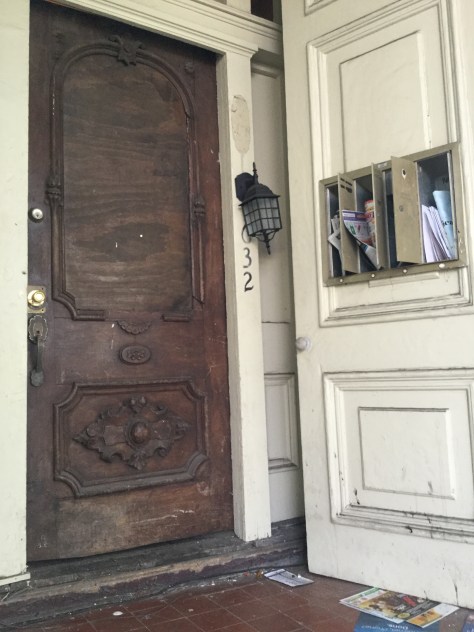
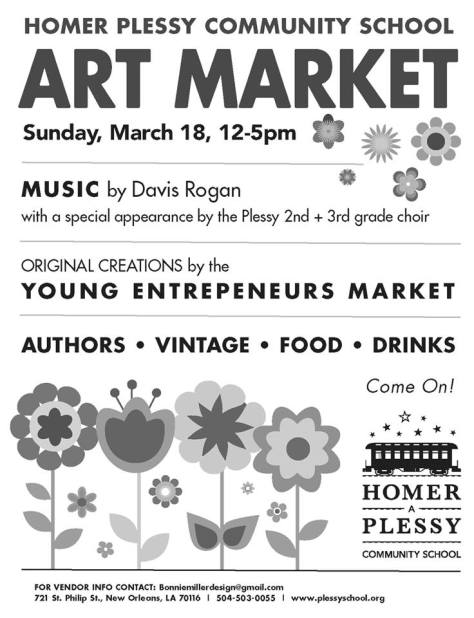
Homer Plessy Art Market rescheduled to Sunday, March 25 due to weather.


Homer Plessy Community School is one of several schools in our area that held walkouts Wednesday as part of National Walkout Day.
Students brought out balloons, gave speeches, read poetry, sang and chanted.
Kindergarten through 6th-grade students participated. The discussions regarding gun violence were coordinated with a school counselor, to make sure they’re appropriate for each class.
‘Children have the power’: Homer Plessy students stage walkout, singing and chanting for peace
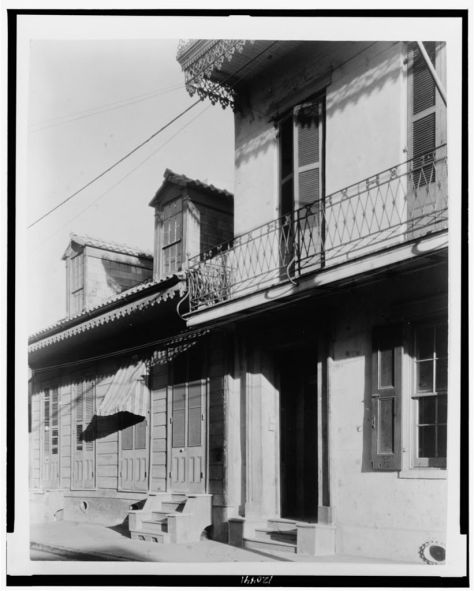
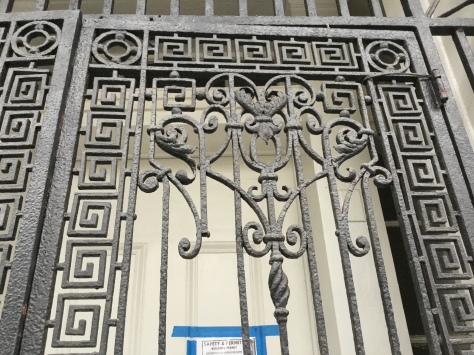
at the Frances Benjamin Johnston house on Bourbon. The 1940 era picture is from the Library of Congress archives and likely dates from soon after she purchased the property. She died in New Orleans in 1955.


Just attended the very excellent morning event at the Monteleone Hotel for the Making New Orleans Home: A Tricentennial Symposium.
This free set of events is happening today at the Monteleone, tomorrow at Xavier, and Sunday at UNO.
This morning’s talk, by Shannon Lee Dawdy, professor of anthropology at University of Chicago and D. Ryan Gray at University of New Orleans, was focused on the archaeological evidence found at a few sites in the French Quarter over the last 20 years, as well as those professors using the tricentennial spotlight to state the clear political need to getting New Orleans a designation as World Heritage Site or at least an ordinance established on excavating properly before a new development is begun. (Professor Dowdy’s comment about how dire this situation was before Katrina was illustrated by her estimation of having only “5 cubic meters” of excavated of Colonial-era material available before Katrina.)
The two speakers were both known to me previously; Dowdy through her brilliant book, Revisiting the Devil’s Empire: French Colonial New Orleans – which is one of my top books on New Orleans history – and Gray through his digs, especially the one around the corner at 810 Royal, the details of which can be found here.
Dowdy’s focus has been on what she terms the “rogue colonialism” of the period from 1699-1769, and especially the years before the “administrative abandonment” of New Orleans by the French Crown in the 1730s. That abandonment was a result of the failure of Law’s Company of the West (more popularly known as The Mississippi Company) which ended in the economic failure known as The Mississippi Bubble.
(Of course, the French Crown retained control of the colony until the 1760s, but did little with it and so it was not until the Spanish rule that the infrastructure expanded along with the population.)
Professor Dowdy’s theory is that during the earlier Colonial period shipping and trade were actually more robust than official accounts of the time offer because so much of what was happening was technically illegal (as it was meant to be managed exclusively by Law and later by or through the Crown.) Even during and after the Bubble, locals amassed wealth which was indicated by findings on these digs analyzed as goods procured via smuggling routes, particularly with Cuba, Mexico and the Carribean islands. With her 2004-2005 dig at the Rising Sun Hotel on the Conti block between Chartres and Decatur, the 2009 St. Anthony’s Garden dig at the back of St. Louis Cathedral and the 2011 dig at the old Ursuline Convent, many of the artifacts date from the 1750s and include Mexican pottery, Spanish coins, gilded glass long before Spanish control. Her St. Anthony’s Garden dig gave material evidence to the idea of the Native American settlement, with huts that predate the 1726 gridlines of New Orleans as do a significant number of artifacts found at the Convent site.
The dig at the back of the Cathedral (Dowdy confesses this was her favorite New Orleans dig) indicates a robust market operating there from the 1740s to 1788, including extensive evidence of camping which suggests that many people came to town to sell or barter there.
After Dowdy presented, Professor Gray used the old St. Peter Cemetery as an excellent example of the lack of protection around our buried history. That cemetery was between Rampart and Burgundy and Toulouse and St. Peter and operated between 1725 and 1789 as a Catholic cemetery for both enslaved and free citizens. After it was no longer used, the ownership of the cemetery was tangled between the Cabildo and the Church so when the Cabildo sold off parcels of it, the Church refused to move the bodies.
Since then, it has been up to private developers and lot owners in that area to undertake an archaeological dig, as happened during the building of the Maison Dupuy in the 1970s, during condo development in the 1980s and most famously, during a potential swimming pool addition by homeowner Vincent Marcello who contacted UNO which resulted in the removal of 15 bodies to a vault in St. Louis #1.
The best comment of the morning was from Professor Gray summing up the current problem: “For a city that cares so much about its history, very few protections are in place to preserve the material past.”


The Historic New Orleans Collection will join the City of New Orleans 2018 Commission’s Cultural and Historical Committee to present “Making New Orleans Home: A Tricentennial Symposium,” Thursday, March 8, through Sunday, March 11, 2018.
Comprising individual lectures and panel discussions, the four-day symposium will be held at locations throughout the city, including Tulane University, the Hotel Monteleone, Xavier University, and the University of New Orleans. Additional evening events will take place at The Historic New Orleans Collection and the New Orleans Jazz Museum at the Old US Mint.
Schedule
Thursday, March 8, 2018
Tulane University, McAlister Auditorium, McAlister Drive and Freret Street
| 6:30 p.m. | Welcome address Michael Fitts, president, Tulane University |
| Symposium address
Priscilla Lawrence and Sybil Haydel Morial, co-chairs, Cultural and Historical Committee, |
|
| Introduction
Emily Clark, chair, Symposium Program Committee, and Clement Chambers Benenson Professor in American Colonial History, Tulane University |
|
| Keynote address Cokie Roberts, NPR and ABC News political commentator |
Friday, March 9, 2018
Conference sessions: Monteleone Hotel, Queen Anne Ballroom, 214 Royal Street
Block party: 500 block of Royal Street
| 8:45–9 a.m. | Introductory remarks Priscilla Lawrence and Sybil Haydel Morial |
| 9–9:40 a.m. | Balbancha: How American Indians Kept New Orleans in their Homeland Daniel H. Usner, Holland N. McTyeire Professor of History, Vanderbilt University |
| 9:40–10 a.m. | Break |
| 10–10:45 a.m.
|
Revisiting the Devil’s Empire: French Colonial New Orleans Shannon Lee Dawdy, professor of anthropology, University of Chicago Traces of Endangered Pasts: New Orleans Archaeology at the Tricentennial |
| 10:45–11 a.m. | Break |
| 11–11:40 a.m. | Self Expression and Enslaved People Sophie White, associate professor of American studies, University of Notre Dame |
| 11:40 a.m.–1:15 p.m. | Lunch (on your own) |
| 1:15–1:30 p.m. | Afternoon welcome Daniel Hammer, deputy director, The Historic New Orleans Collection |
| 1:30–2:10 p.m.
|
Making New Orleans Home at the Table Jessica Harris, culinary historian and professor, Queens College, CUNY (retired) |
| 2:10–2:30 p.m. | Break |
| 2:30–3:15 p.m. | The Transatlantic Slave Trade: A Shared History David Fleming, director, National Museums Liverpool (UK) |
| 3:15–3:30 p.m. | Break |
| 3:30–4:15 p.m.
|
New Orleans and the Slave Trade Walter Johnson, Winthrop Professor of History, professor of African and African American studies, and director of the Charles Warren Center, Harvard University interviewed by Lawrence N. Powell, professor emeritus of history, Tulane University |
| 5–7:30 p.m. | Block party, 500 block of Royal Street Featuring performances by Leroy Jones’ Original Hurricane Brass Band and the Dukes of Dixieland Refreshments will be available for purchase. Viewing of New Orleans, the Founding Era, an exhibition at The Historic New Orleans Collection |
Saturday, March 10, 2018
Conference sessions: Xavier University, McCaffrey Ballroom, University Center (3rd floor), 1 Drexel Drive
Evening program: New Orleans Jazz Museum, 400 Esplanade Avenue
Food and drinks available for purchase at both venues.
| 8:45–9 a.m. | Welcoming remarks C. Reynold Verret, president, Xavier University |
| 9–9:45 a.m. | Featured address The Great Migration Isabel Wilkerson, author, The Warmth of Other Suns: The Epic Story of America’s Great Migration |
| 9:45–10:15 a.m. | Break |
| 10:15–11 a.m. | Panel discussion: Religion
|
| 11–11:45 a.m. | Panel discussion: “Creating Home: 300 Years of Builders and Architects in New Orleans”
|
| 11:45–2 p.m. | Lunch (on your own) Book signing with Isabel Wilkerson |
| 2–2:40 p.m. | New Orleans in the American Revolution Kathleen Duval, Bowman and Gordon Gray Distinguished Professor of History, University of North Carolina |
| 2:40–3 p.m. | Break |
| 3–3:45 p.m. | Panel discussion: Haiti and New Orleans
|
| 3:45–4 p.m. | Break |
| 4–4:45 p.m. | Panel discussion: New Orleans Music: Past, Present, and Future
|
| 4:45 p.m. | Invitation to evening event Greg Lambousy, director, New Orleans Jazz Museum |
| 6:30–10 p.m. | Minting NOLA Music at the Jazz Museum |
Sunday, March 11, 2018
University of New Orleans, Senator Ted Hickey Ballroom and Gallery Lounge, University Center, 2000 Lakeshore Drive. Parking will be complimentary in all university parking lots, including the University Center lot. Food and drinks available for purchase.
| 10:30–10:45 a.m. | Welcoming remarks Matt Tarr, Vice President for Research and Economic Development Introductory remarks |
| 10:45–11:30 a.m. | Panel discussion: Immigrants
|
| 11:30–12:15 p.m. | An Ethnic Geography of New Orleans: Residential Settlement Patterns across Three Centuries Richard Campanella, geographer, Tulane School of Architecture |
| 12:15–2:15 p.m. | Lunch (on your own) |
| 1–2:15 p.m | “Congo Square” and “Storyville” University of Louisiana at Lafayette Wind Ensemble conducted by William J. Hochkeppel, director of bands, University of Louisiana at Lafayette works composed by James Syler, University of Texas at San Antonio commentary by Freddi Evans, author, independent scholar, and arts educator |
| 2:15–3:15 p.m. | Civil Rights roundtable
moderated by Lawrence N. Powell, professor emeritus of history, Tulane University |
| 3:15–4 p.m. | Whither New Orleans? The Future of A Great American City Leslie M. Harris, professor of history and African American studies, Northwestern University |
| 4 p.m. | Closing remarks |
You must be logged in to post a comment.