Especially for downtown residents and visitors, City Park is a necessary amenity and is conveniently located only a few easy miles down Esplanade by bicycle, leg or vehicle. As a FQ teenager, I rode my bike to City Park regularly, learned how to drive there and generally used it to escape from my fabulous but often trying daily life of the Quarter. Because of all of that and more, it remains one of my favorite places in the entire region.
This new golf course will take away what has been a much-loved and well-used space since the 2005 levee breaks. There is no doubt that City Park management has had to find ways to monetize/program much of the park, and has done so by offering many great amenities (i.e. 24 hour beignets, putt-putt, Botanical Garden/music, soccer fields, stables, Grow Dat Youthfarm) but they also need to balance that with open space that encourages a wide variety of beneficial insects, wildlife and plants that add diversity and won’t be attracted to a golf course. People need diversity of spaces too, and the space in question has served as a recuperative spot for thousands who rebuilt the city and were here in the gloomy days after 2005. I believe this need was clearly defined by that use and the management should attend to the felt desire to offer non-programmed or non-monetized space that benefits its residents, visitors and the rest of the natural world.
Please consider signing the petition and sharing it so we can show the support for balanced uses of our beloved City Park.
Petition · Cancel plans for development of the "Championship" level golf course in Northern City Park · Change.org.
Tag Archives: New Orleans
Interview with Bella Blue, Lucky Pierre’s Burlesque Producer – 21st Century Burlesque Magazine
So impressed by this performer and producer. She speaks beautifully about community, artistic expression, performance freedom and corporate invisibility and responsibility in the interview linked below. This brouhaha happened because one of her Blue Book performers reported being fired by a club on Bourbon Street for her weight, which flies in the face of the acceptance of the diversity of women’s bodies that is common in burlesque. Bella Blue was her producer and speaks very carefully and forcefully in the interview about the situation and about the difference in the stories being told by the performer and the club.
Burlesque is an important and historic art form in our city and the renaissance that has happened in the last 15 years is because of dedicated performers/teachers like Bella Blue. Those born as women and those who perform as women are all represented in the clubs that showcase burlesque and drag and together have built a vibrant and supportive community. Very proud of these artists who represent our city so very well.
Exclusive: Interview with Bella Blue, Lucky Pierre's Burlesque Producer – 21st Century Burlesque Magazine.
Example of the burlesque calendar in New Orleans
If you are really interested, then school yaself

The Lovely GoGo McGregor in CLUE at Allways Lounge photo by Roy Guste
French Quarter living at Carnival time
If you’ve made it to the Quarter, you have seen us. We’re the folks who weave around you, moving quickly and usually with our head down (or at least not swiveling from side to side, and usually looking off into the middle distance) and keys or bags in hand. We’ll keep an eye out for anyone who looks confused and offer help (usually turned down by nervous tourists who assume I guess that we must be about to shake them down) but don’t try to slow us down without cause; we’ll growl or may even bite…
We live here.
Balcony versus couryards
You would probably think that it is better to have a balcony than a courtyard, but for the most part, its the other way around. Balconies mean noise travels to your rooms constantly and although it is fun to be viewed when you want to be viewed, it is not fun to be viewed when you just woke up and are just trying to have your coffee in the sunlight.
Also, it is likely that you’ll have short-term neighbors on a balcony next to or across from you who believe that it is necessary to WHOO-HOO throughout the night or to buy cases of beads to throw down at people. Between my mother and I, we have lived in slightly less than a score of places in the last 35 years in the Quarter, and only two or three times have either of us had a balcony apartment. Balcony apartments are also more expensive and mean stairs to climb, often rickety stairs! However, the best of both worlds is a balcony overlooking a courtyard, as long as the neighbors don’t congregate below late at night. That way, you get air flow and no one above you keeping time to music at 3 a.m.
Noise
This leads to a strange irony in the Quarter; most of your regular neighbors are super quiet and you never see them. If you drink to excess, you have a bar to do that near you. If you like to dance or sing, again places near have that. Most of us live in tiny spaces (a result of 18th century buildings cut up in the 19th century into tiny places for immigrants and po folk) and are fine with it, but it does cut back on home visiting. And after all, “let’s just meet at (enter name of new or fun place to eat or drink)” is appealing to just about everyone who visits you.
Vehicles
Traveling in or out of the Quarter during Mardi Gras is tricky and needs some planning. Well, it’s simple really: you need to get rid of your motor vehicle or pay a princely sum to put it in a garage. That’s right, no parking in 2/3 of the Quarter on the last weekend (and parade days before that) and restricted driving. I use a scooter and have it parked against the building (as required, leaving a 3 ft walkway) at the side of the public building next to mine. The workers know me and can alert me if anything happens to it. During Carnival though, it’s best to move it, as I live on one of the well-traveled spots whoo-hooing spots. So, I park it next to the little Red Schoolhouse (a elementary-level school, our last school in the Quarter, where Elvis’ movie King Creole filmed their high school scenes) and hope that no one messes with it. Don’t mess with it.
Food
There are really 2 ways to go here at all times, but especially during Carnival: either plan ahead and stock up on food or have the delivery menus ready; restaurants are mostly no-go as the lines pile up for hours before and after parades. Dozens of places offer take out and almost all of them can deliver too. Most of us are partial to the Nelly Deli (Bourbon), Verti Marte (Royal), Deja Vu (Dauphine), Mona Lisa (Royal), Matassa’s (Dauphine), Chinese food (two on Canal) or pick up at Wink’s (Decatur), Fiorella’s (Decatur), Petit Amelie (Royal), Bennachin (Royal) are some of the usual places we hit.
This year, I am also adding a new tradition of Lundi Gras brunch at Meauxbar. My pal Kristen Essig is their brilliant and capable chef and has put together a fantastic menu. Let’s hope it’s not a zoo.
Drink
Only one way to go during Mardi Gras: have your house stocked beforehand. I use my favorite liquor store in the Quarter at Vieux Carre Wine and Spirits; fantastic place with an amazing selection and. they. deliver.
Music
I feel lucky that I get to live in a place where New Orleanians of every talent (legal and illegal) can try to make a living. Chief among those legal talents are the musicians who populate every block during Carnival. I do find it deflating to see how many young transient white kids with barely the ability to pick a banjo have taken up so many spots. Still, some are these are good and good local musicians can be found on certain corners. The stories about our street musicians would astound most people, from those who lived in a van parked on the street and raised kids in that van for years and years, making a living and sending those kids onward to good lives from it, or others that have been out there daily for years, rain or shine, heat or cold and now have become the gentry (“eyes on the street”) of that block.
However, when a man who thinks he has the ability to sing “doo-wop” (but does not) sets up across from your doorway regularly or someone who only knows 2 or 3 songs and sings them again and again next to your door, you can grow cynical and be seen in your pjs at midnight shouting at those poor misguided souls. For me, it takes going out in the evening with a cocktail in hand and finding one of the good ones and listening and watching the crowd take extreme pleasure in coming across this or these musicians to renew my love of live street music.
Hustle
I am working on a new project that will detail how we get by here with “a job, a gig and a hustle.” People are sharing their stories with me and I am working on adding essays about the sharing economy and illegal economies to it as well. Stay tuned for news on that…So when I say hustle, I mean that thing some of us have to do to make the ends try to meet; it may be an illegal hustle or an informal hustle, but it is visible across the Quarter most days and certainly during MG. It includes someone standing in line on behalf of the Uptown dining crowd at Galatoires, or selling second line parasols right off Bourbon on the hood of a truck (you know its a hustle when no signs announce things are for sale; you need to ask so that the vendor can be sure you are not trying to bust her), or even driving a pedi-cab, which, by the way, is a good idea to take for those of you out way late and trying to cross the Quarter.
It’s amazing to me how many hustles I see in a block or two, and how much I admire the willingness of people here to try it and for all of us to support it.
Still, some of the hustles are dangerous, and so be alert and know that if locals see something bad about to go down, we’ll help if we can and alert law enforcement too (found this weekend every 3-4 blocks of the main drags). Be extra careful and don’t be stupid is the best advice I can give you. Walk into a hotel lobby or into a bar to look at your smart phone and leave the purses and wallets tucked away in your room or in the safe. Stay with crowds and expect that villains are afoot. And don’t throw trash or pee or puke on our steps or doorways please.
All in all, I am glad to be here even at the foulest and loudest time of year. I appreciate the joy and wonder I see as our visitors can’t believe their luck to be here on a sunny and warm February acting out their inner child as part of our public spectacle.
Welcome. Now get out of my way.
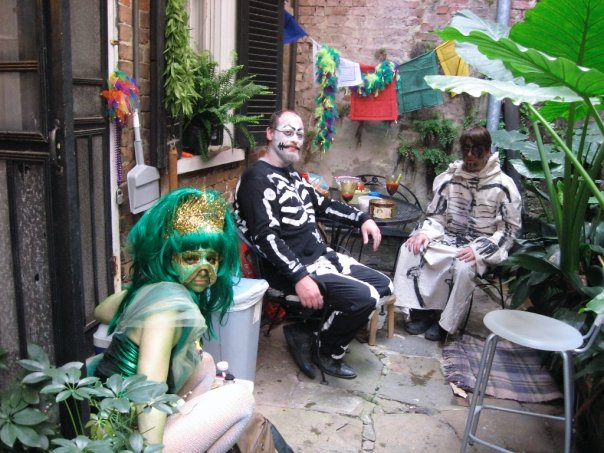
Some of my pals visiting me on Fat Tuesday during an earlier French Quarter life of mine..
Proposed sale of park worries residents
Cabrini Park is for sale. The one shared green space for residents, happy dogs and schoolkids alike is now waiting for a developer. Clearly, the neighborhood associations in the surrounding areas need a Martha Robinson-level activist with time and access to fight for this. How wonderful if the outcome of this is that we could have a first-rate green space led by the citizens much like Dufferin Grove Park in Toronto or People’s Park in Berkeley, both that I have made pilgrimage to during my organizing work. Proposed sale of park worries F.Q. residents.
Welcome Carnival 2015
Today we begin OUR holiday season-Carnival. It starts today with the celebration of the Feast of the Epiphany and Joan of Arc’s birthday and ends on Fat Tuesday aka Mardi Gras, the day before Ash Wednesday (Lent). I will celebrate with the first slice of king cake and maybe seeing two parades in this first Carnival day. Phunny Phorty Phellows-A little nonsense now and then is relished by the best of men! truly kicks off the season with their streetcar parade and then the Joan of Arc parade really shows what we do best with their walking (trotting?) French Quarter celebration. Not only is it great to be able to hit 2 parades (one within an easy bike ride of my neighborhood and the other here in the Quarter) but when in a late search of a small traditional king cake, I can hit 3 or 4 bakers or shops within a few blocks of my home and find one:


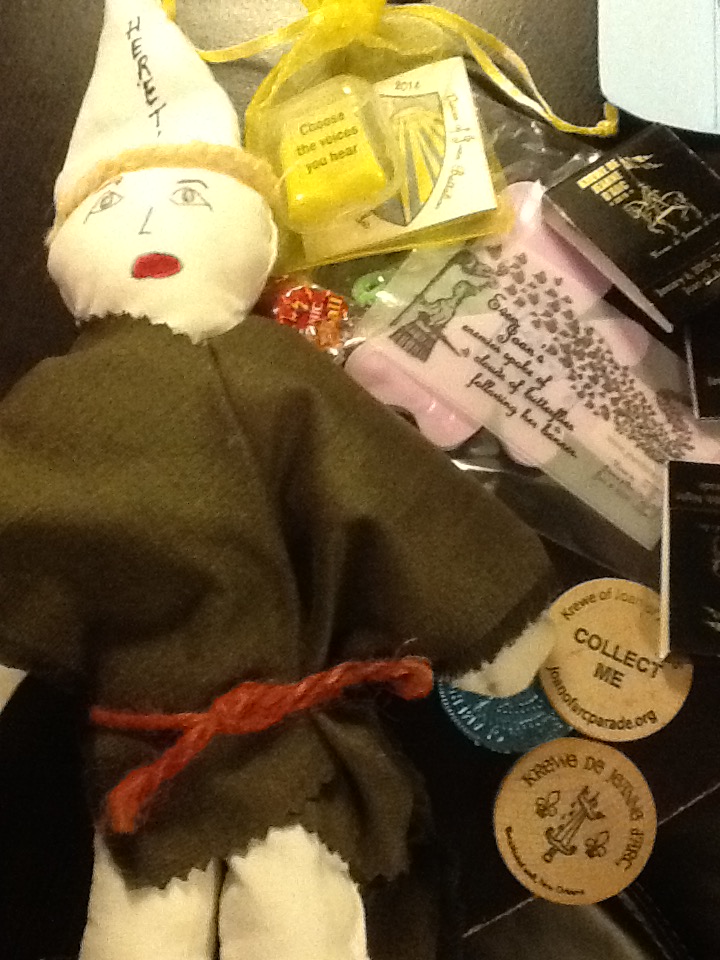
First throws of the 2015 season, including Joan of Arc matches and my very own Heretic Doll
History of a New Orleans friend
Recently, we lost one of the great guys of New Orleans, Michael Mizell-Nelson. A well-loved UNO professor and a historian of New Orleans, he was considered the expert on the history of the po-boy and its blue-collared underpinnings. Always interested in real history and in real people, Michael will never be forgotten by those that love New Orleans or those who admire the people bringing light and knowledge. R.I.P Michael.
He helped develop the Hurricane Digital Memory Bank, an online archive of more than 25,000 photos and oral histories from hurricanes Katrina and Rita.
Take a look at this site that he and his colleagues built with stories from our city:
New Orleans Historical
and listen to Poppy Tooker’s great interview and remembrance of Michael
Community Architect: The Future of Public Markets and the Case of the Lexington Market in Baltimore
A very good description and some simple rules for revitalizing public shed markets written by a Baltimore architect. He focuses his attention on the Lexington Market (which I have visited when in the area for farmers market business) that he seems to work near enough to observe regularly. I remember on my visits being impressed by the vitality of this market even though the quality and quantity of healthy goods seemed low. I actually still think about this market regularly, because it was a particular kind of anachronism that reminded me of visiting the old West Side Market in Cleveland in the 1960s/1970s; in other words, it still seems exactly like those dark and chaotic largely forgotten shed markets that were sprinkled throughout many American cities back in the mid 20th century. He points out that Lexington already has regular shoppers and acts as a food hub in what is largely a food desert, which is a significant point. It’s interesting that he seems to think that finding ways to attract tourists is one key to making this market really work, which may or may not be true in my estimation. I’ll leave that discussion for another time and post.
In any case, as pointed out by the author, the attention paid recently to many of these markets has often led to one of two outcomes: either successfully engineered spaces full of event activities and local color/products, filled regularly with proud residents on the weekends and eager tourists during the week, OR badly re-designed ones with ridiculous lighting and signage telling us of their authenticity with wide empty aisles and too much of one thing. Unfortunately, the French Market (especially after its hot mess of recent equally overdone and underdone renovations) is more of the second with chunks of the Lexington Market’s structural and place-based issues to solve, but I do believe that it is due for its renaissance. However, it has always seemed to me that the job of French Market director may require someone with the letter “S” on his or her undershirt. Last time I checked, I believe that the job included: maintaining a significant number of historical buildings for the city, being landlord to the uptown side of the Pontalba building/apartments, overseeing the anarchistic artist and reader colony space in Jackson Square, recruiting and serving the permanent storefront tenants from Jackson Square to Ursuline, and creating and managing events constantly. Ad oh yeah- somehow revitalize the 2 open shed markets at the Barracks end so that locals will come too. Honestly, having watched the last few eras of FM leadership closely, it seems that these open sheds take up 75% of the time and goodwill in that job, while supplying little of the income. What must be understood by the FM board and city officials is that these sheds are now difficult to access for most downtown residents, especially with no quality public transportation. And now with the management of the linear Crescent Park also on their to-do list, I’d say that the sheds and the park are one big problem all on their own, but also the most likely path to winning the hearts and minds of locals and savvy tourists too.
In addition, the massive size and varied uses of the French Market district presents a very different set of spatial problems and possible solutions than what was possible for the small D.C. Eastern or even its slightly more appropriate D.C. sister, the newly fabulous Union Market or any number of others that I or others have visited in the last two decades. The bad history of the last 40 years at the French Market has also meant that people actually have a negative perception, not just a neutral perception of this space and working on those sheds a little at a time is too little to change that to positive. The very serious lack of nearby farm production also needs to be acknowledged and means that simply signaling that local goods are welcome to be sold will not be enough to have enough on hand. And lastly, what to do with the dozens and dozens of vendors who exist there presently? Incentivize a product change or focus on encouraging them to move on to storefronts to make way for new ideas?
One can compare the French Market to the St. Roch Market to see how different their outcomes and the work to make it so. And yet, even with the small footprint and limited uses needed for St. Roch, look how many millions the city had to spend and how much time it has taken to just get to someone leasing it, much less actually successfully filling it with dynamic retail operator, and still, no grocery or low-income component.
from the original post:
Consultants, of course, also aim at the currently totally un-yuppified food selections, in which each baker (there are seven) has the same yellow cakes smothered in colorful oily frostings, and where there is more fried food than exotic fruit. But here, too, lingers the danger of eliminating the authentic Baltimore grit, with specialties like pigs’ feet, freshly cut veal liver (“baby beef”) that can only be had here or in some of the Asian supermarkets out in the County. Most famously and maybe most Baltimore, of course, is Faidley’s, with its seafood, oysters and crabs and, most importantly, the Baltimore crab-cakes, which are shipped on demand nationwide.
Discussions about the Lexington Market quickly touch nerves, depending on with whom one speaks, because the market serves various needs and maybe evokes even more aspirations. There are those who love its gruff authenticity and old fashioned food choices, there are those who use the market for their daily shopping because adjacent neighborhoods to the west have scarcely any stores, and then there is a growing number of people who think that the market surely doesn’t live up to its potential and needs a major re-set. Community Architect: The Future of Public Markets and the Case of the Lexington Market in Baltimore.
 French Quarter block by block
You must be logged in to post a comment.