Well, this letter could really be titled “Love Letter to the French Quarter” since that is where my mother brought me as a “world-weary” teenager and where I found my city. That lovely introduction to it all was why I write about the Quarter today; so that others will come to it and find their own home. I wrote this in an hour and sent it off without rereading it again so that I would have to let the emotion stay in there.
Tag Archives: New Orleans
All Saints Day/Feast of All Souls
With all of the hoopla now surrounding Hallowe’en, many newcomers to New Orleans may not know that today is as important or more to our culture as the ghoulish day before. All Saints Day is done in primarily Catholic places, like New Orleans, and is a day decreed by the Vatican as a catch-all day to pray to your saint of choice.
The day is honored by attending Mass and working on one’s family tomb, cleaning it and making it presentable for November 2 which is the Feast of All Souls or in some Catholic countries, the Day of the Dead. Taking time on All Saints Day is thought to have begun because most Catholic cities like New Orleans would decree the day before a holiday a day off and so people here used it to whitewash and make one’s family tomb presentable.
Today is a day to visit your nearest cemetery in New Orleans, and watch family tradition in action. Tomorrow, take a moment and remember your dead, especially those that you believe might still be in Purgatory…
The modern date of All Souls’ Day was first popularized in the early eleventh century after Abbot Odilo established it as a day for the monks of Cluny and associated monasteries to pray for the souls in purgatory. However, it was only in the Medieval period, when Europeans began to mix the two celebrations, that many traditions now associated with All Souls’ Day are first recorded.
Unfathomable City
 Unfathomable City: A New Orleans Atlas by Rebecca Solnit
My rating: 5 of 5 stars
I wrote an earlier review of this book ( I keep busy) and have now decided to update it since receiving the actual published book as I used the advanced reader copy for the previous review and now after reading more of it in a different location than the last time and viewing all of the maps that weren’t in the ARC and let me share that I did all of that new stuff all on All Saints Day, no less. Told you: multitudes.
I decided to do it without the cranky insertion of MY New Orleans up front that was in the previous review and to simply state that it’s a well designed, well-edited and at times beautifully written and illustrated homage to our mysterious city.
This book gives credit where credit is due. To the city’s geography, to its outlandish robber barons of bananas and oil, to the nameless and named that have brought us and bring us music, food, and public displays and joy and sorrow and pain and punishment. It neatly shows a number of juxtapositions that may be uncomfortable for some to view and others that are certainly unfathomable, but it does show them. There. credit given.
Now, back to me:
If you look through my reviews, you can spot a certain fondness for maps. I love them and love poring over them before, during or in spite of actually traveling to the place depicted.
If you read my reviews, you will no doubt spot a serious fondness for essayists. I admire what seems to me to be honest human bravery in extending a point or a purpose to a new end. Taking a walk with an author is how I visualize an essay, and yes there are times that I turn back before getting to the end, but I still appreciate the offer. So maps and essays seem like two sides of one coin and when put together well can alter or color each other’s point and purpose.
So that this is a book of illusory and real maps combined with odd and delightful essays, edited by two sensitive writers is enough for me to tell you.
Let me let the writers and artists tell you themselves in essays and maps such as:
Civil rights and Lemon Ice
Hot and Steamy: Selling Seafood and Selling Sex
Ebb and Flow: Migrations of the Houma, Erosions of the Coast
Juju and Cuckoo: Taking Care of Crazy
Stationary Revelations: Sites of Contemplation and Delight
The first essays introducing this book are alone worth poring over and sharing; how often is that true? That should tell you about the care and thought put into this entire work and offer the best reason to plunk down your money, open it and thumb through while having a Pimm’s or a coffee in front of you, tucked away in a shady corner of our shared city. Enjoy it all.
Not seven hills, just seven districts in our history
Another practical history lesson from Richard Campanella, a geographer with the Tulane School of Architecture and a Monroe Fellow with the New Orleans Center for the Gulf South, is the author of “Bienville’s Dilemma,” “Geographies of New Orleans,” and the forthcoming “Bourbon Street: A History” (2014). He may be reached through rcampane@tulane.edu or @nolacampanella on Twitter.
Until just a few years ago, each of the seven districts elected its own assessors, who staffed their own offices and assessed taxes independently — a system unique in the nation. It took civic intervention after Hurricane Katrina to finally consolidate those political redundancies.
Plantations, faubourgs, Creoles, Anglos, competition, expansion, drainage, politics, taxes: embedded in that seemingly mundane map are sundry episodes in the human geography of New Orleans, going back 200 years.
Dreamy Weenies
Polish dog with mustard, ketchup, onions and sauerkraut on the corner of Saint Ann and Rampart.

1920s New Orleans video and music
Sent to me on this rainy morning by my French Quarter friend, Jonny:
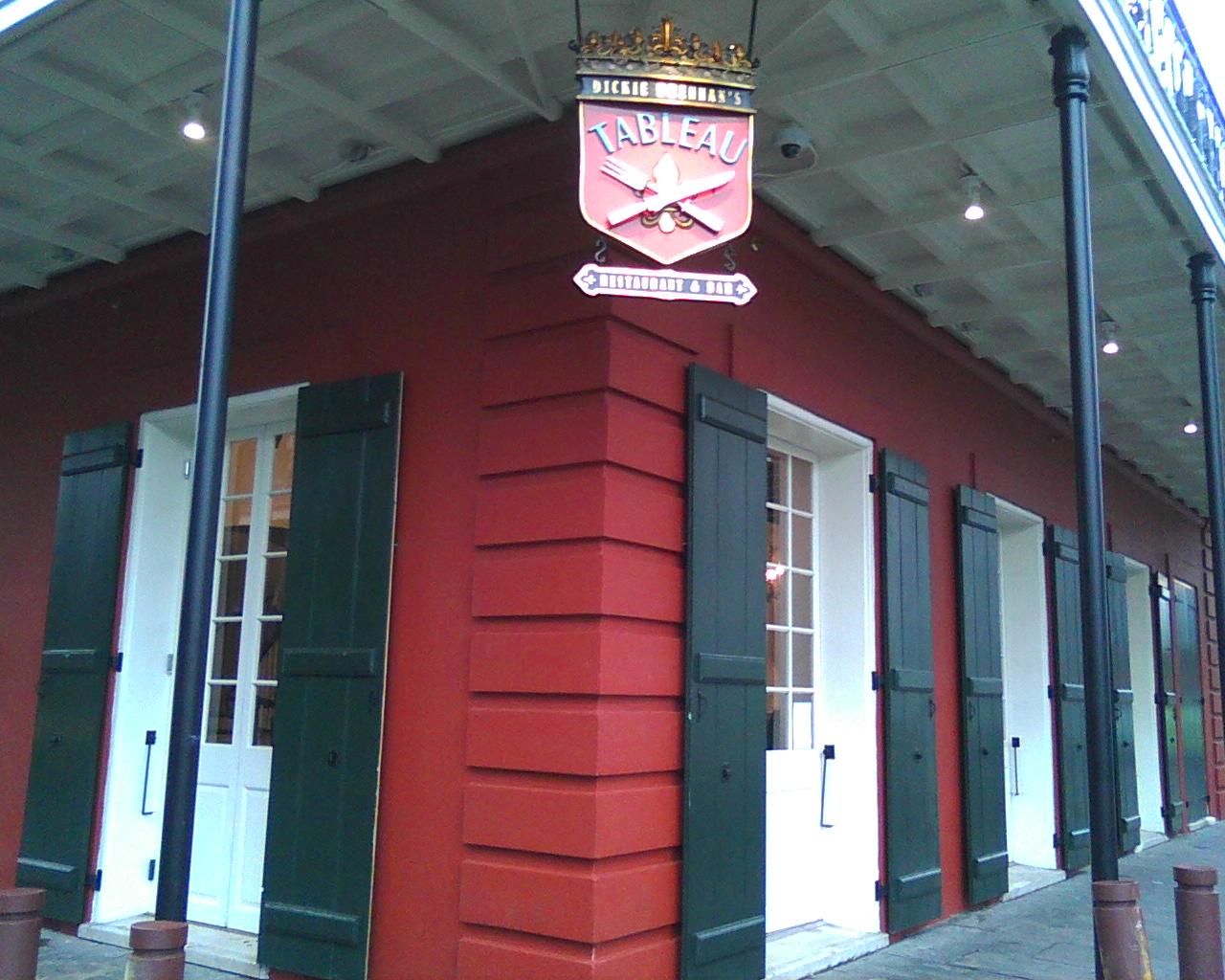
Tableau opens in the French Quarter

The brand new Brennan family restaurant Tableau at Saint Peter and Chartres. This is the other half of Le Petit Theater which left the other side as a functioning theater.

 French Quarter block by block
You must be logged in to post a comment.