Iterative participatory design: can City Hall and the Vieux Carre pull it off?

The City of New Orleans has begun to sound out their ideas around creating more pedestrian-only malls in the French Quarter through some contact with residents and through the media. Part of their idea seems to be spring from the idea that those using the Quarter need more room in this era of 6′ safe spacing, and another aspect seems to be that since we lack the millions of tourists that our Quarter businesses depend on for revenue, we need to realign our 80+ blocks to bring our neighbors to use it and add more local-focused businesses.

If those are the actual goals, then I am for this idea, although with strong reservations. Those reservations include all City department’s ability to listen and learn from the varied number of Quarterites which includes more than those who are full-time homeowners or business owners who have easy access to the decision makers on Loyola. It also must include workers, culture bearers, unhoused people and their advocates, renters, and those part-time homeowners who do love it and care for it (so not the illegal Airbnb-ers of which there are dozens and no obvious recent enforcement to keep them from becoming unchecked again.) And of course, to take in consideration the ideas and concerns of residents in Treme, Marigny, CBD, Central City too because they are clearly impacted by decisions made for the FQ.

Because these ideas have seemed to come out of very recent, very serious COVID-era needs and so haven’t run the usual years-long cycle of public meetings, some folks have suggested that this new ped-focused design is going to become another Riverfront Expressway-type issue. Although the comparison seems a little overwrought to me, I can certainly see part of their point. For those new to this, the Riverfront Expressway was a 1940s-1960s elevated elevated six-lane expressway project, 40 feet off the street and 108 feet wide along the Mississippi River. It was added to the planned I-10 design which (contrary to a local legend) was always planned for Claiborne* and was not moved there when the FQ residents successfully fought the Expressway spur. The Expressway suggestion was made via a 1940s consultant’s report on New Orleans by the infamous Robert Moses who thought by keeping auto traffic flowing through (over?) the Quarter it would actually benefit it. Of course he and other planners didn’t understand the Quarter, but back in those days people like Moses were unelected kings and their opinions became policy without the need of any other input.

(*However, even though the story of it being moved to Claiborne from the riverfront is incorrect, the reality of the I-10 being built on Claiborne did happen for exactly those same racist policies: that the historic and beautiful tree-lined Claiborne Avenue was sacrificed because it was the Black St. Charles Avenue and therefore had no political power. So whether or not FQ residents saved their neighborhood by sacrificing another is or isn’t precisely true doesn’t really matter, as it does seem be true that they did little to nothing to stop their neighbors in Treme in getting carved up again and again, before the I-10 and after it, and is still happening.)

So to some, the idea of the City throwing an idea out that is hastily designed at City Hall or only takes in some of the needs of some seems familiar. And that the I-10 and Riverfront experience suggests that someone or many someones will bear some negative brunt of the idea through what many sociologists and others like to call “the unintended impacts” of these multi-level decisions.

The truth is any solution that assists our world-class (what probably should be a UNESCO site!) historic neighborhood and its surrounding area will only work if the input is tremendous, dynamic, and sensitive to the needs of many. Yet what anyone who has been in these discussions can see is that everyone is coming to this with a lot of assumptions; for residents, its often assuming the City is not acting in good faith; for the City, its often assuming that Quarterites are inflexible or not interested in benefits that help others. And I also suspect based on my interactions that many at City Hall don’t believe we actually have residents here or serve other needs than as the main corridor for tourism.

Based on all of that, even though I am more in favor of these ideas than others, I’d suggest that the City might start with simpler ideas and then ask a lot of questions. Maybe start with adding protected bike lanes in and out of the Quarter, work on safer bike parking (more and more business owners are cutting bikes locked up for a shift from their gallery posts and few employers offer safe parking), add many more public transportation options for workers and locals, come up with some dynamic parking ideas for residents and workers, deal with illegal STRs and noise infractions- and maybe start to test these ideas by using their French Market property first. A French Market property project could do a lot to calm residents fears and can also test out ideas before those unintended impacts across a larger area cripple and divide the residential and business community of the Quarter. I’ve jotted down many ideas on my blog previously for the French Market space that including adding a storefront library, community health agencies, maybe an evening Louisiana-id carrying-only splash pad, pop up food truck events, and lots more of what we saw this week: the sheds and public space used for sharing regular city departments information and health work as it was for the COVID site this last week with hundreds in line in the market space to get their free test.
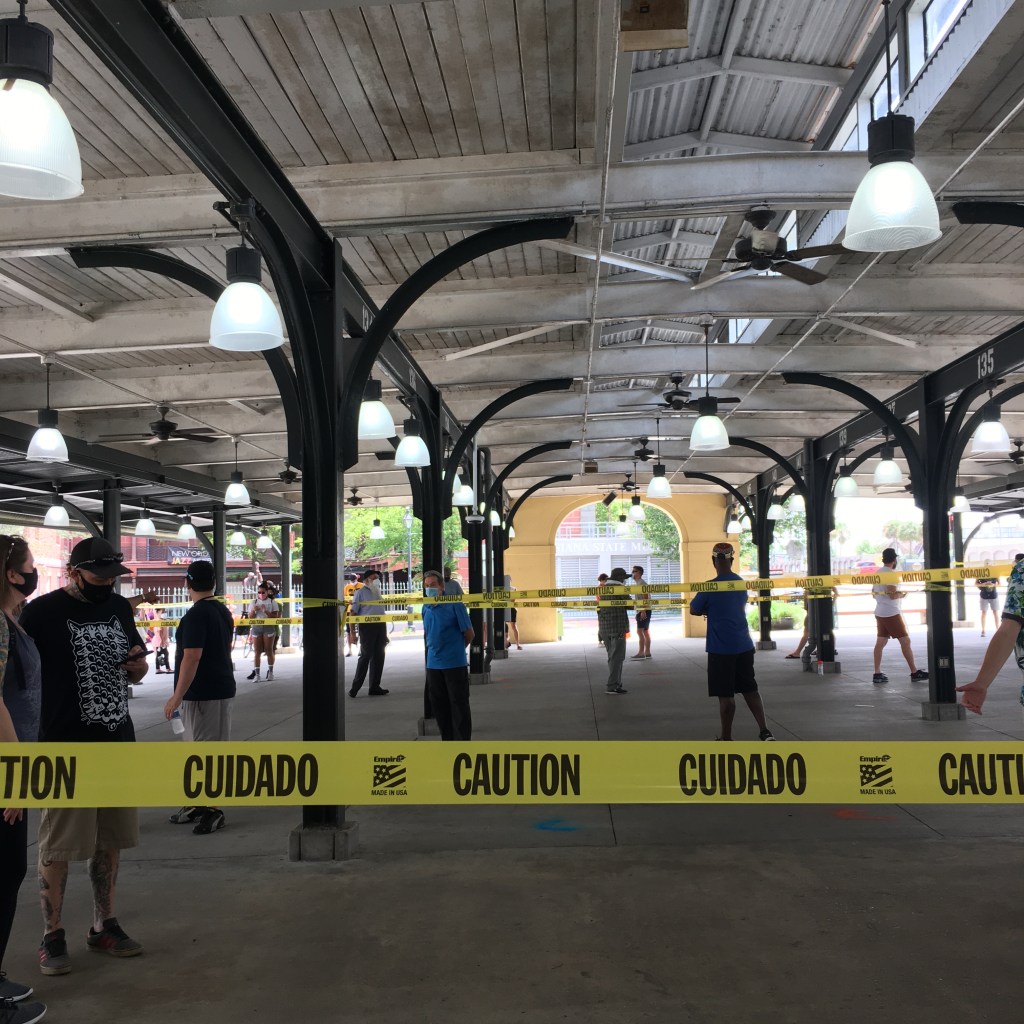
Once successful, the City can then quickly move to testing out single or 2-3 block ped areas, such as some I have noted previously include Wilkinson Row, Madison Street, the 1100 blocks of Chartres (which has St, Mary’s the Old Convent, Keyes museum, a boutique hotel) and adding local-friendly partnerships to activate those such as those NOMF musicians You Got This events, other health screenings, walking circuits similar to the Big Lake at City Park, or just rows of potted trees to add shade and beauty.

In any case, let’s all take a deep breath, do some homework, create some short term pilots, check our own assumptions and privilege, and listen as much as we talk.

French Quarter Ironwork: monograms and initials

I have been gathering photos of different ironwork motifs in all four quadrants of the Quarter and will be researching them further when I am able to get to the wonderful HNOC’s Williams Research Center.

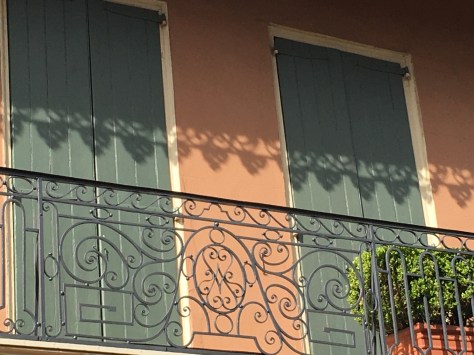
Here are all of the (18) monogram and initial motifs I have found – so far.

I have found them on Burgundy (2), Dauphine (1), Bourbon (1), Royal (5), St. Louis (1), Chartres (3), at the Pontalbas,  2 different motifs on the Skyscraper at St Peter and Royal, on a modest brick house on Dumaine (where the AP scrollwork from the Pontalbas is on the gate transom of a house in mid block for some mysterious reason) and two on Esplanade. Most are found on second or third-story balconies, but a few are on front doors, and a few others are on a gate.

Thanks to The Collins C. Diboll Vieux Carré Digital Survey at HNOC I was able to research each location to see if I could find a likely reason that particular monogram or initial was added. I am also searching for other history books to find other information as needed so I will continue to refine and add to this list in the next few weeks to capture each monogram and its history.

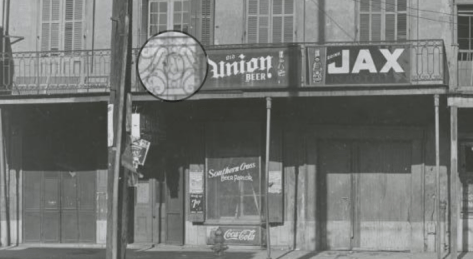
Have been long confused by description of the Bosque House: “The central panel of the rail has a most graceful arrangement of scrolls in the character of the best 18th-century work and in an oval at the center appears the monogram of Bartholome Bosque, curiously backward when seen from the street.” It doesn’t seem backward any longer.

Yet, in the 1930s pictures of the scrollwork it does indeed look backward in the picture:

Love the description too:

The wrought iron railing of this balcony is perhaps the finest feature of the façade and is comparable to only three or four other examples in New Orleans — the Cabildo, the Pontalba House, and the Correjolles House at 715 Governor Nicholls. All these railings are of about the same date and are all probably the work of the same craftsman, who, in the case of the Cabildo and the Pontalba House is known to have been Marcellino Hernandez, a local blacksmith of great skill.

I went to look at 715 Governor Nicholls and its ironwork certainly resembles the Bosque House:

715 Governor Nicholls

Next up: the anthemion or palmette motif.

Reworking French Quarter in the age of COVID and after

How do we redesign public spaces like those in the French Quarter for physical distancing needs?

Can we better activate public/private partnerships to renew the French Quarter for locals?

What can we do to spur activity to those businesses that are open and following protocols?

By all indications, the city’s recent activation of the 15 mph/local traffic only for Moss Street in Bayou St. John has been wildly popular among city residents. Based on that, one can see the city is willing to try some ideas out to increase space for safe pedestrian and human-powered traffic in different neighborhoods.

If the goal is to increase safe-distanced activities, renew the communal vibe that New Orleans does so well, get some sales kick-started among local businesses, and to ease some of the anxiety that comes from being quarantined…

… just walking through the Quarter, ideas pop up:

• close off specific targeted, appropriate single blocks for weekend activities, for kids or for musicians. Partner with local NGOs like NOMF, MACCNO, Arts Council, La Children’s Museum to activate a single block of the Quarter over a few days. I have long been in favor of Wilkinson Row being made into a pedestrian mall over weekends, maybe into a “Buskers Alley” where musicians can play on a particular painted space for 90 minutes before moving on.

Maybe also use Exchange Alley as a locals-only juried art market. This will not only bring locals and visitors together but will also increase activity to those businesses that are off the main avenues.

• Allow residents to nominate their block and, with majority support of its residents and businesses, build a day of low-stress, locals-focused activities.

• Add amenities to increase the use of the French Market for locals: add storefront library outlet, senior center activities, add “splash pad” from 6-8 p.m. at Flea Market.

• Use hotel meeting rooms for senior events: bingo, movies, low-stress exercise classes.

• Add shade trees in pots, for now, later plant permanently.

• add data collection to measure traffic flow, including using ping counters (as we are doing at farmers markets across the US) to measure how many, how long, and the direction they originated.

• Walking loop tracks mapped out with signage.

• Misting areas across Riverfront, Royal, Bourbon, and Burgundy on weekends during daylight hours.

• Invoke Carnival parking restrictions for the first weekend per month to increase pedestrian activity throughout the summer and fall.

• Create locals’ pricing on weekdays and evenings at French Market parking lots.

• Add circular bus route every hour Weds-Sun, stopping only on Esplanade and Rampart that goes towards UNO, another that goes to lower 9 and one that goes to Broadmoor area.

• Allow all New Orleanians the annual opportunity to purchase two 6-hour parking passes that can be used in residential permitted areas in FQ, Marigny. They should be able to purchase online that week before and print out to affix to their passenger front window. They would have unique codes that, if used more than once, will alert meter staff to issue high penalty tickets.

• Allow boutique hotels to offer courtyard or meeting space for pop up businesses to sell provided they do not directly compete with existing FQ businesses.

• Allow some pop-ups rules and incentives for commercial space landlords to encourage businesses from other neighborhoods to be able to vend in FQ for a month or so.

• Rework Decatur (ala FQF) to become mostly human-powered between Conti and Dumaine. Put temporary rotaries at Conti and at St. Phil to allow for easy u-turns.

• Add cardboard trash cans to every block Thurs-Sun.

• Add maps, signage, explanations of FQ history, and proper social distancing etiquette using local artists’ creativity.

• Add plywood walls for temporary chalk walls on Royal and Decatur.

• Allow more street vending for New Orleans culturally-specific items (yaka mein, callas, red beans, tamales etc) that prioritized walking/biking food vendors, maybe prioritize Jazz Fest vendors.

• Add multi-lingual signage everywhere.

But we also must consider the worker:

• As mentioned on these pages previously, incentivize rent control at the Pontalbas for FQ service workers. We’d change the Square overnight to a much safer and much more animated city center. Do the same for upper floors on Canal Street.

• Create shuttle services from edges for local workers to safely be able to park and get back to their vehicles after work. Incentivize worker parking in lots around Quarter.

• Build a circular bus route that runs during the shift changes such as 10 am, 2 pm,10 pm, 2 am. and goes to lots and surrounding neighborhoods.

• Penalize FQ employers who offer no bike parking or public transportation options for their staff.

• Allow mule carriages to do deliveries for FQ businesses and residences from items dropped/aggregated/stored at French Market.

And what about the residents?

• Reduce the number of out of date freight zones and no parking areas through a thorough audit.

• Add a circular bus route from FQ to other areas on weekends.

• Incentivize businesses that add services for locals including package receipt, concierge services such as grocery pickup, repair services (bike), pet services.

• Allow residents reports of STR violations to kick start a vigorous investigation which would use indicators such as multiple key boxes, trash out on Monday morning, photos of scofflaws, an excess number of people on balconies and late noise violations to spur the immediate removal of those visitors and hefty fines to owners. In addition, create a city office for STR management at French Market.

• Add senior activities in French Quarter, add senior center (Cathedral school building maybe?)

• Build a captains per square block system much like the Beacons of Hope system brilliantly used to rebuild the Lakeview and other areas post-K. Allow those captains to have priority access to city departments to assist in problem-solving, materials to welcome new residents, rewards for beautifying their areas and so on.

• Find places for dog-friendly activities.

• Keep an up to date online map of all current ‘no parking’ temporary permits to ensure that they are not illegally expanded or continued and that they are not conflicting with other temporary permits.

• Allow residents to apply for single temporary no parking spaces on their block when moving in or out.

• create a better flow for exiting or entering the Quarter via Rampart or Esplanade with better traffic controls. For example, it is almost impossible to turn left on to Rampart for long stretches of the day; street lights need to be better placed.

These are all my own ideas (or from my pals) and I am comfortable that some (most?) may turn out to be very unworkable. The point here is to think BIG how we can reconnect and revive our deep connections and our businesses while still becoming a more healthy city.

So in that vein, what are YOUR ideas?

related posts:

https://frenchquarterbxb.com/2019/05/20/can-the-french-market-be-saved-part-1/

https://frenchquarterbxb.com/2019/06/21/can-the-french-market-be-saved-part-2/

https://frenchquarterbxb.com/2010/11/14/festivals-how-the-grand-duchess-would-fix-this/

Rain and Rickie Lee Jones

I had no idea we were in for this type of evening. Rumbling thunder, flashes of light, steady rain. I am glad to be surprised. I stood at the doorway for a bit and marveled at the complete cleanliness in every direction, and the quiet of my block, here adjacent to Jackson Square. Not one drunk. Not one unholy tourist whoo-hooing to hear the echo. There is another crash of thunder just now, forewarned by its sky flash. I had turned off my courtyard lights because of news of the termites swarming earlier this week (even though we don’t see much of that in the Quarter with our dedicated termite plans; those silver round covers drilled into the sidewalks are part of a massive termite mitigation strategy that started a few decades back which mostly worked here), but the reminders to shut all outside lights off sounded like a good idea on its own, so I did it. Since the courtyard is dark, I can count between the lightning and the thunder to know the storm is far from here so there is no danger, only comfort. And while the magic of our city is palpable during massive events where we all get the same energy at the same time from a stage, it also shows up on these nights when we are quietly home, apart from each other and the power comes from nature.
I turn on music to add a soundtrack to the patter outside. As is often the case now, it is my fellow New Orleanian, Rickie Lee Jones. Since the days of “Chuck E’s In Love,” her work has always been part of the my own eras but for the last decade, she and Marianne Faithfull have been the constant addition to any playlist. (I did just rediscover Marshall Crenshaw and Dwight Twilley too, but power pop is such a part of my own time that it isn’t an indicator of mood, more of a muscle memory of sweeter days). RLJ has 13 albums on my phone’s library and I get to selections from all of them in most months, finding songs for every mood. Interestingly, the random sample during this rain starts with her version of “Don’t Let the Sun Catch You Crying” which is a great song by any singer but with RLJ, it becomes a masterpiece of yearning and beseechment:
“…the nighttime shadows…disappear” (what a thoughtful note!)
“and with them go….all your teeaaaaaars…..
cuz the morning” (flattens, then a lilt) “will bring joy,
for every girl and boy”…(so tenderly sung)….
“so don’t let the sun catch you crying.”

The Inertia of a Tourist Economy: Does it help or hurt during a crisis?

in•er•ti•a

  • n.
    Resistance or disinclination to motion, action, or change

On March 11, the city decreed a state of emergency over COVID-19. Too many scofflaws ignored that and so on March 16, Mayor Cantrell closed the bars and restaurants at midnight to shut down the expected all-day and night partying that St. Paddy’s day brings to cities across the US. Not everyone paid attention but a lot stopped immediately and then over the next week as the hotels emptied, so did most of everything else. On March 20, the city issued a firm, scolding stay-at-home mandate and on March 23, the state followed suit.

My social media post on March 26:

Its been 10 days since New Orleans shut down dine-in restaurants and bars and 6 days since the city stay-at-home order.  Since then, watching the wheels of commercial life slowly grind to almost a complete halt here in the French Quarter has been absorbing and sobering. At first, most places tried to stay open even though the bulk of their business had always been visitors, both those visiting from other places as well as the daily visitors who work in shops, in offices and seem to have so many lunch meetings. Some places did their best to drum up local take-out business via social media and word of mouth, but one by one, almost all in my quadrant have closed. Boards across windows and doors started going up at shops and galleries first, and then hotels and bars and cafes followed. It’s startling the first time you see the dark lobbies and gated locked parking lots 24 hours a day of a hotel normally lit up and staffed. You think about those workers that you saw 5 or 6 times a day for months or years and wonder if they will be back. (The bell captain at the little hotel down the street told me he had 120 days of PTO to use, but was still angry that he had to go home.) Yet even when the businesses began to shutter, some street traffic continued, albeit lighter than normal for a few more days. Then one day this week, I walked to Jackson Square and there was not a single person there.

At 2 in the afternoon. In sunny, 85 degree weather.

You’ll still see people walk a few times a day with their happy dogs, (saw a guy with his leashed ferret a few days ago), evening get togethers on carefully-spaced chairs on the street, a few tourists, and always some street people. The Mayor is slowly moving the homeless into hotels; the guy who lives in the window recess of the Presbytere Museum told me today that he had just missed the cut off to get in the Hilton Garden Inn by 6 people. I’d say the best way to describe his reaction was slightly stung. I told him they’ll find a place for him soon; he seemed to brighten at that. I think he looks forward to that mostly because he misses talking to people, he misses the hustle.  I mean, even the silver guy’s paint is almost entirely worn off. The musicians who are staying in the apartment across the street come out to the balcony in the afternoon and play music quietly but seem to have little of the animation and long jams that they offered in the first days. You make eye contact with strangers, but there is a bit of a hesitation in being too chummy; you don’t want to encourage them to slow down and stay around here. Some neighbors have chalked “Go Home; Be Safe” on the sidewalks; but those who get it are already home, and those who don’t get it, won’t. It’s odd to see the energy seep out of these entertaining streets, but at least we have a strong reason to believe much of it will return. In the meantime, we can save ourselves, our friends, and our neighbors by killing as much of it as possible. #nolacorona

Since that post, I have thought a lot about these silent streets since this post as the days tick by and wondered more and more about how and even if it will recover. Then, something my clearly exhausted but happy pal who owns a cafe in the Marigny said to me (as he bagged up order after order for folks patiently and happily waiting outside his place) struck me:

my business mantra right now is adapt or die.” 

Or as Arundhati Roy brilliantly said:

this pandemic is a portal.

Whatever it is, coronavirus has made the mighty kneel and brought the world to a halt like nothing else could. Our minds are still racing back and forth, longing for a return to “normality”, trying to stitch our future to our past and refusing to acknowledge the rupture. But the rupture exists. And in the midst of this terrible despair, it offers us a chance to rethink the doomsday machine we have built for ourselves. Nothing could be worse than a return to normality. Historically, pandemics have forced humans to break with the past and imagine their world anew. This one is no different. It is a portal, a gateway between one world and the next.” 

That portal can be hard to see in this anachronism of a neighborhood, charmingly designed for 17th and 18th-century living, and then made into a stage for visitors from other places to get a quick taste (and purchase) of that earlier time before heading back to their modern world.

Yet, even though it is primarily a stage, many things about this Quarter still work: the scale of it, the design of small apartments set above small storefronts, small well-run hotels, its nearness to the city center safeguarded behind massive well-engineered earthen levees instead of poorly-designed concrete walls such as those found in 9th ward or in Lakeview, utilities underground,  the highest ground, neighbors dealing with each other in shared alleys, on sidewalks and via on-street parking and so on. And because it is usually spared damage because of the care taken to maintain its facades for the tourists, it can quickly become a gathering place once again when hurricanes or floods devastate much of the city. Last but not least, this tourist center requires thousands of daily workers who become as dear as next-door neighbors, many of whom residents see more than their family, often relying on more than they do on far-off relatives.

Still, now as I venture out to the other parts of the city during this shut-down to get items, I see what I do not see here: restaurants and stores that have quickly adapted. From distilleries selling hand sanitizer or cocktail kits for homemade happy hours, cafes selling quarts of cold-brewed coffee or working with farmers to sell just-harvested items alongside their prepared items,  even fine dining places pivoting to offer a family meal (and 1/2 price bottles of wine) by drive-by pickup, they all seem to know what their neighbors would pay for and how often to serve them. Those businesses have bulletin boards,  funny, aspirational chalk signs for passersby and have become eyes and ears and care for their neighbors.

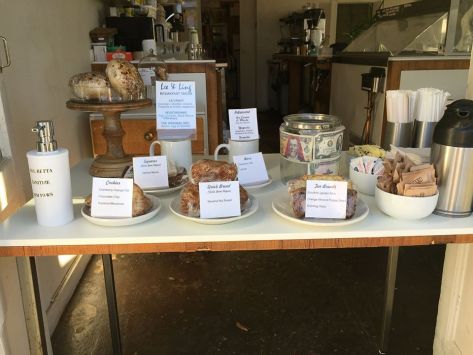
Orange Couch set  up for physically-distanced ordering at the side door

In these 90 or so blocks, enough locals live here so that we actually do have many neighborhoody things like drugstores, veterinarian offices, postal emporiums but it has become clear during this moment that even much of THAT relies on the millions of visitors who also come to these blocks, or it relies on the pockets of workers who, currently unsure of when or if they get to return to their store or will put that apron on again, are saving their bucks. Or maybe it doesn’t rely on those dollars at all but the business owners just think that it does. For whatever is actually true, what is clear is that almost all of them are closed. And they closed fast.

A few businesses tried to use social media to convince local folks to get items, but locals from other parts of town have been penalized and confused far too often by the parking rules here to dare to drive in. And even if they do brave it once in a while, most are not able to afford or stomach the majority-rule visitor-obsessed restaurants often enough to be familiar enough to check in with the others now.

As for residents: even though numbers have climbed steadily in the last 20 years, now at around 4,000 with around 1000 at or below poverty-level they mostly divide into the worker/residents of the Quarter (although far fewer than when I was one) now without income and the very very rich who have everything they need delivered by Amazon living behind their gates and private driveway.  Since 2000, owner-occupied units have risen from 24.6% to 48.2% with renter-occupied down from 75.4% to 51.8%;  fewer of us renters and therefore likely less of us remaining who seem to live here because we love it and not because we depend on it for work or because it is a family inheritance or peccadillo hideaway. As a result, those able to go get items from the restaurants who tried to offer food is even a smaller group than those other areas of town.

The other obvious issue clearly seen now that the Quarter is only serving its residents: it is so very very white which wasn’t the case when I moved here as a teen. And even though it has become clearly whiter in terms of residents since the pre and post 84 World’s Fair development furor,  on a normal day the cross-section of tens of thousands of workers, hustlers, and visitors allow the FQ to be as diverse and energetic as any place in this city, pound for pound, 24 hours a day, 7 days a week.

Not right now though. The only faces of color or heard talking in other languages here during COVID-19 have been the sanitation folks, grocery workers and security personnel. The usual Quarter workers and artists who represent the diversity of our city are home in their own neighborhoods which since 2005 are far far from here. (Which ironically, also means that the multi-generational food entrepreneurs offering good, culturally appropriate food to a cross-section of New Orleanians are also now far from here.) That diversity is the heart and soul of what makes New Orleans interesting and important. And when we reopen, it’s possible that many culture bearers and much of our indigenous knowledge base may just not care to keep fighting their way back here this time – or the next.

All of this calls into question the future through this portal: what will an economy only based on tourism offer our city, once disruptions come again and again, as we have to expect they will?

More simply and directly, what will remain alive after just this one shutdown? And what if the US opens up later this summer just as we hit the height of hurricane season?

In only a month, I have already seen 1-2 brand-new commercial For Rent signs, talked to business owners who are mulling the idea of not reopening their storefront that cost upwards of tens of thousands of dollars per month, and have heard of a few neighbors who are moving away to live with family or to cheaper cities to replenish their savings. One has to imagine that restarting the tourism wheel will take a while, especially when rumors (and logic) have it that JazzFest will likely not operate in 2020 or if it does at all, be a much smaller and leaner version. We’d have to assume the same will go for French Quarter Fest and others as they depend on sponsors as much as visitors. Connected to that is the outcome we have to expect if the seasoned staff of the past few decades that ran our best places like clockwork will not return intact.

So the question is how will we look once through this portal? Will the French Quarter adapt as it always has, or will it finally “die”- meaning become smaller, less lively, maybe owned by more out-of-towners with deeper pockets who move more to the middle in terms of what they present as New Orleans? That could mean losing what had been a critical mass of authentic experiences and becoming too small to entice enough visitors to hold this city together.

Or maybe – just maybe – this old city will just adapt as it has so many times previously.

In 2008, the book Building the Devil’s Empire offered the intriguing analysis (via many years of archaeological digs around the old city) that by the mid-1720s due to the failure of New Orleans as a tobacco exporter and the effect of Law’s Mississippi Bubble bursting,  France had basically given up on this colony, although not turning it over to the Spanish until the 1760s. Yet those digs show lively trade and activity in those 40 years, proving that New Orleans became a smuggler’s capital by turning its attention to the Caribbean to find its own opportunities even though that was against French law. That “rogue colonialism”, as Dawdy names it, she believes was mirrored in 2005 when the federal government did its best to thwart returning residents and stymie small businesses yet many found a way around that to survive and even some to thrive.

That rogue colonialism is clearly an adapt or die portal which could be vital for whenever the country opens back up for business. Do we have another one in us here? And if so, what will that version center on: regional food?  port activities? design for climate challenge places?

And maybe to help that, possibly commercial rents in the FQ will come down to reality. Maybe people will see the need for downsizing their place to something smaller and more communal as only the Quarter can offer. Maybe my idea of Canal Street and Pontalba being offered tax credits to become rent-controlled to entice residents to move upstairs into all of those decaying camera shops will happen.

I hear bike shops around town are doing bang-up business right now; maybe we’ll see a few open in FQ again.

Maybe less crap made in China will be for sale in our shops and more useful services for all residents can return. Shutter repair? Seamstresses? Metalwork? Mule-driven delivery around the city?

Maybe the French Market can add a splash park on the concrete pad, a storefront library, citywide compost drop off and community or senior services along its many block span to serve the entire city in some manner?

In any case, the way through this portal does seem to require a push to something new even if it might actually resemble something old and tested.

The question is: can we begin to turn in that direction?