Concerts in the Courtyard returns at HNOC

Friday: Concerts in the Courtyard with Hot Club of New Orleans

Show: 6–8 p.m.; Doors: 5:30 p.m.
533 Royal Street
Admission is $10, free for THNOC members.

Now in its seventh year, Concerts in the Courtyard offers a fun, casual way to kick off the weekend with live outdoor performances by Louisiana musicians. The fall series opens Friday, March 14, with a performance by Hot Club of New Orleans.

Hot Club of New Orleans, whose performance at the November 2013 event was rained out, takes swing-era music and retains a classical groove, melding it with modern sensibilities. They count greats like Duke Ellington, Django Reinhardt, and Stephan Grappelli among their influences, and their tight but fun sound has led to performances at various festivals including the New Orleans Jazz and Heritage Festival, French Quarter Festival, Fellini Jazz Festival, and Jazz Ascona Festival in Switzerland. Band members include Christopher Kohl (clarinet), Matt Rhody (violin/vocals), Nathan Lambertson (bass), Larry Scala (guitar), and John Rodli (guitar).

All concerts this season will feature white wine from Republic National Distributing Co. and beer from NOLA Brewing Co. Republic National Distributing Co. is the second-largest beverage alcohol distributor of premium wine and spirits in the U.S. NOLA Brewing Co. was launched in 2008 by local entrepreneur Kirk Coco and Peter Caddoo, a former brewmaster at Dixie Beer.

Mark your calendars for the rest of the spring 2014 season:

Thursday, April 17: New Orleans Nightingales
presented in conjunction with the exhibition Shout, Sister, Shout! The Boswell Sisters of New Orleans

Friday, May 16: Viváz
presented in conjunction with the exhibition Creole World: Photographs of New Orleans and the Latin Caribbean Sphere

Friday, June 13: Africa Brass
Societies of Saint Anne and Saint Cecelia march today

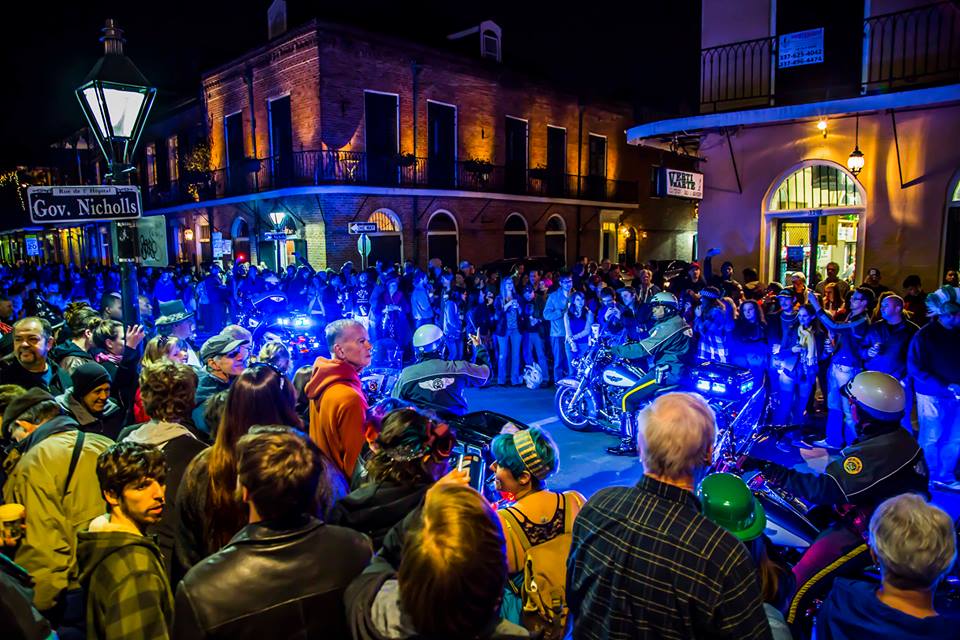
“Some parading organizations are longtime closed groups; others are more open, like the famous Society of St. Anne, which has been parading through the Marigny and French Quarter for years. It was that group’s extraordinary growth and worldwide recognition that was the impetus for the creation of St. Cecilia, in an effort to scale down the number of paraders and be more “neighborhoody,” Kate says.
St. Cecilia Society was created in 2007, along the lines of the older St. Anne Society.

It’s off through the Marigny to the French Quarter, with a stop at Harry’s Bar on Chartres Street, and down to the Mississippi River.
Once we got to the river, people often had small bags of ashes,” Kate McNee explains. “They would do an offering. The band calmed down and played a dirge, much like a New Orleans funeral. Then when that ceremony was done, they would be back up, and we moved on joyful and triumphant. In St. Cecilia, we do continue that tradition.”

Landrieu hands keys to city to Rex

In Spanish Plaza, this year’s queen of Carnival, Carroll Gelderman, stood by as Rex issued a proclamation.
“I do hereby ordain decree the following,” Laborde said, “that during the great celebration all commercial endeavors be suspended. That the children of the realm be freed from their studies and be permitted to participate in the pageantry.”
And to the city’s political leaders, he added:
“That the mayor and City Council cease and desist from governance.”

“We will fulfill the will of the people and turn over the key to the city to you, so that tomorrow in New Orleans will be a day of abandon,” Landrieu said. “Happy Mardi Gras.”

Landrieu hands keys to city to Rex | wwltv.com New Orleans.

Roy Guste, FQ photographer captures Krewe de Vieux 2014

1920240_10203168534516524_208781388_n1795540_10203168561317194_132826920_n

When was Carnival’s golden age? Take a look around — we’re living in it | The Lens

C.W. Cannon one of my favorite columnists, talks of our current Carnival period as a golden age with more democratic and satirical characteristics than we experienced in the late 20th century, where whites-only krewes had their way and superfloats flourished which led to the demise of many of the small neighborhood parades. I’ll tell him how much I appreciate this on the downtown parade routes that I am sure to see him on over the next few weeks..

Russian literary critic Mikhail Bakhtin, in a book about folk culture influences on the great Renaissance French writer Rabelais, outlined a theory of Carnival based on ancient and medieval traditions. Centuries later, it’s remarkable to witness how the “carnivalesque” spirit he details lives on so palpably on the other side of the world. A few of the key attributes Bakhtin ascribes to Carnival are a satirical impulse of a bawdy kind that he calls “grotesque realism,” the inversion of normal prevailing social hierarchies, and mass participation.

In light of principles like these, it’s a no-brainer that the latest city ordinance supports, rather than inhibits, the ancient foundations of Carnival tradition. Even here in New Orleans, one of the prevailing social strictures upended by Carnival has been segregation in public settings. Blocking off and segregating swaths of the public space for members-only parties doesn’t jibe with the carnivalesque injunction to cast off social distinctions and rub shoulders with strangers for a limited period of time.

When was Carnival’s golden age? Take a look around — we’re living in it | The Lens.

Beaten musician Doug Potter awakens, moves to Touro Infirmary for therapy

Beaten musician Doug Potter awakens, moves to Touro Infirmary for therapy | NOLA.com.