I continue to do research on the history of the square in terms of how it has been used and reworked by entrepreneurs, including the Baroness herself.
Last January was my month to dive deeply into the city archives to find new visual clues and records to bring alive the last 170 years of the Upper Pontalba. I was able to review the rental and management documents for the building at the New Orleans Public Library…
I am hoping THIS January I can unlock the key to gaining access to the state archives to be able to research the Lower Pontalba in the same detail.
Happy to find a photo of the Works Progress Administration (WPA) era renovation of the buildings as that project had the largest influence on the buildings and the Square in their history- so far.
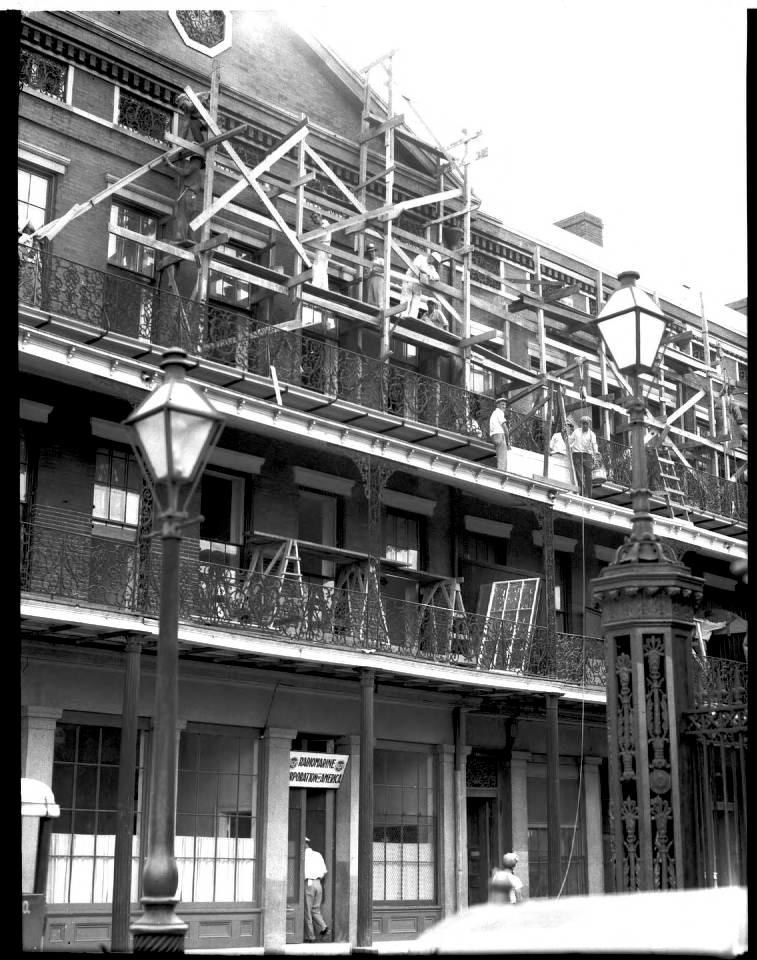
The WPA had an enormous impact on the entire city, and one could argue that it set the table for the population explosion, (which peaked at 627,000 around 1960), and the subsequent media attention that New Orleans had through the post war years,
By most accounts, New Orleans was in the top 5 in terms of completed projects through this Roosevelt administration initiative, most notably City Park where many WPA plaques and motifs can still be seen.
The Pontalbas received about $300,000 in repairs through the WPA, a staggering sum for 2 buildings that had been purchased just a few years earlier by preservationists for (likely) around 1/3 of that cost.
They had been built 80 years before for a total cost of about $330,000 and held by the Pontalba family in France through 3 generations before selling the Upper (St. Peter side) to Alfred Danzinger, Jules D. Dreyfous, and William Runkel in 1920, and the Lower (Saint Ann side) in 1922 to William Radcliffe Irby. Irby bought the Lower building for 68,000 and when he passed in a few years later, deeded it to the Louisiana State Museum.
 French Quarter block by block
You must be logged in to post a comment.