New Study Confirms: “Share The Road” Is a Problem 

In sharp contrast to the complete uselessness of “Share The Road”, survey respondents who were shown the “Bicycle May Use Full Lane” sign showed uniformly high understanding of permissible cyclist lane positioning and appropriate safe passing behavior for motorists.

“Comprehension of the familiar “Share the Road” signage as a statement of bicyclists’ roadway rights has been challenged, based on arguments that it is ambiguous, imprecise, frequently misinterpreted, and not designed for that purpose…In fact, the US state of Delaware discontinued use of the “Share the Road” plaque in November, 2013.

Source: New Study Confirms: “Share The Road” Is a Problem | Bike Delaware Inc.

Cookbook signing November 14 @ Kitchen Witch

Kitchen Witch Cook Book Shop
Will Host
Kit Wohl / Celebrations Cookbook
Jyl Benson / Fun, Funky, and Fabulous Cookbook
Poppy Tooker / Tujagues Cookbook
The Signing Party will be Nov. 14th Saturday 2 – 4 PM
1452 North Broad Street Suite C
New Orleans 70119
504-528-8382

Lavender Interview 

A perceptive and sensitive interview with New Orleans poet/publisher Bill Lavender.

What’s involved here is the very same bias that Zizek speaks of in “The Subject Supposed to Loot and Rape,” his article on the national perception of New Orleans in the wake of Katrina. Or, as Deleuze put it, “If you’re trapped in the dream of the Other, you’re fucked.” We in the South have been trapped in some New Yorker’s dream for some time now. The stereotype has actually gotten worse, I think, in recent times, as the cultural hegemony of New York and California have been eroding and they scramble to bolster the pretense that they still matter…

…The New Orleans scene has waxed and waned since I’ve been involved in it, and the political and generally extra-aesthetic forces that have shaped it would make a very interesting study…. The reason, I think, that MFA programs have flourished to the point of overpopulation of late is that they have attempted to recreate real artistic movements, with the comradery and passion and competitiveness of a real scene but within the artificial environment of the university. MFA programs represent the disneyfication of writing. They are simulacra of real artistic discovery, available only with a paid ticket. It isn’t that nothing good goes on in them (I’ve taught in and directed one myself), but a real movement can only happen outside this system, in the political and economic “real world.”

Source: Lavender Ink Interview | Jacket2

Bidding adieu to the Vieux Carré as we once knew and loved it | The Lens

In the title piece, Cannon basically says: Rich retirees from Dallas now enjoy the sanitized ambience of a neighborhood New Orleanians used to live in.

in reply, I say all of this:
Charles, you always get me thinking…
I am sure that Elizabeth Werlein’s failure to keep Pat O’Briens off St. Peter (in the 1940s) was considered a death knell for the Quarter for some locals. Or shall we talk of the loss of the French Opera House (1920s) as the last great day? Or maybe the original Lafitte’s owners losing their lease in 1950s and having to move to a new location? I myself like to talk about the Jax Brewery and Canal Place openings as when my Quarter began to change, but I ended up getting a full-time job at both for a spell and making a living only a few blocks from my apartment, so maybe I was wrong..
What those moments tell me (as does your story of the wax museum) is that all of us want the Quarter to be the place we hold dear in our memories. And that mythologizing a place is not always helpful to active participation in city life; myths rely on heroic narratives that in the retelling are sanitized themselves.

The Quarter still looks and acts like a lot of neighborhoods in the city with the same problems that most of them have -or will soon have- which may have been part of your point, Charles. Like many residents, I appreciate the nostalgic concern for the quick demise of our neighborhood, still with its groceries, drugstore, (expanded) hardware, laundromat, hair salons, locksmith, coffeehouses etc, but feel as if data might be more helpful in this case. Data about the loss of schools and of our low-income neighbors are absolutely some indicators of change that are not welcome to us, but that trend is citywide and pushing downward since 2005. Data about less families is not as clear; 2010 Census shows more families than in 2000 and more elderly, and for the falling numbers of socioeconomic indicators in the Quarter, most not falling as far as the rest of the city, using Data Center/census info. (Census numbers always seem suspicious to me, maybe you too, but there you are.)
My street has lots of regular-folk residents and new shops run by locals and workers who have been at their job for 20 years or longer. So which indicators should I look at? The loss of the little red schoolhouse is very bad, seems imminent and will likely lose us some of those families, but I remember thinking of the loss of the Cabrini Day Nursery on St. Philip in the late 1990s as the first death knell of family life. Maybe though, the real question I should have asked is how many Catholic institutions closed or consolidated in my lifetime already? And how many schools that were deeply embedded in walkable neighborhoods are successful in a charter system where just about every child needs to be transported to it?
The lack of rent controls and addition of gated condos may spiral up here and pit the haves against the rest of us more and more, or it might buck the trend and remain the only neighborhood where those with all of the entitlements must deal with those of us without and force compromises… And what about bike lanes and street musicians and a farmers market and local food businesses working to bring healthy local food to downtown at the old public market? Certainly seems better than the other neighborhood’s public market’s offerings? My building is owned by the two daughters of a longtime FQ family who rent to locals and are fair and good and are not the only ones; my mother has the same story at her place across the quarter.
I don’t know the answer to any of it,or if any of what I offer here is related to saving or destroying the Quarter, I just want us to ask better questions and use better data to get at the real issues.

The added tax for sheriffs for hire is troubling. Yet, we know our commercial neighbors need to have a presence of police and since they asked for it, we residents agreed to share the burden for their needs. We all know that our system of policing needs serious overhauling and we hope this is not permanent and that the city gets the NOPD on track sooner or later. In the meantime, millions of people unfamiliar with the city have to be able to see law enforcement if needed. Not our finest hour for sure, but I doubt that most residents voted for the tax because they think sheriffs are here to act as our police force.

In any case, i am certainly not trying to argue that the Quarter is “healthy” or becoming the thriving place it was in years past, but instead to ask for true indicators of positive and negative nets. To restrain from declaring any area dead or gone or sanitized before it is true. It doesn’t help any of us if the story we base our activism is based on old emotion only and not on data or true trends.
Maybe the smaller city means a smaller Quarter and a whiter city means a whiter Quarter – although again 2010 census says a slight downward trend of whites and uptick of other ethnics since 2000 – but that may have been a post-Katrina blip only. Maybe what will remain after the Katrina money moves on to the next city (in order to extract value from it) are some workers, hustlers and people who love the Quarter and it will remain a neighborhood.
For me, the only constant about the Quarter is the change, which is city life in microcosm. And that means we have to evaluate that change as clearly as possible.

Source: The entire piece by Cannon

Order QR Code Decals for your bike via Stolen Bikes NOLa

How it works:

QR codes are a discrete way to put your contact information on your bike. The idea is that traditional “Property Of” markings will be removed or covered up by a thief before they sell it. By using an industrial quality QR code decal, the average thief will assume it is some advertisement for the manufacturer or just a decorative decal. In addition we provide 4 copies of your decal (with our standard $5 kit) so some can be placed in plain site and others hidden.

How exactly will this get my stuff back?:

This idea was developed for marking bicycles in New Orleans by “Stolen Bikes Nola Inc.”. The common scenario was that bikes were stolen and quickly resold or abandoned around town and picked up by the next rider to be used. The theft would be reported to the Stolen Bikes group but recovery would become problematic when the bike was not easily identifiable. Victims would even say, ” I see my bike down by Small Mart everyday but I can’t be sure it’s mine so there’s not much I can do”. The QR code label is not a perfect solution but it is an inexpensive way to mark your bike and simplify the recovery effort.

Source: Peninsula Business Forms | Order QR Code Decals

268 foot tall building on Royal?

On Thursday, November 5, developer Angelo Farrell will approach the New Orleans City Council to seek approval for a proposed 268 foot-tall hotel and condo building – which is nearly four times taller than the area’s allowed 70-foot height limit – that he intends to construct at 121 Royal Street.121_Royal_Street_250x322

Sign petition here to say no.

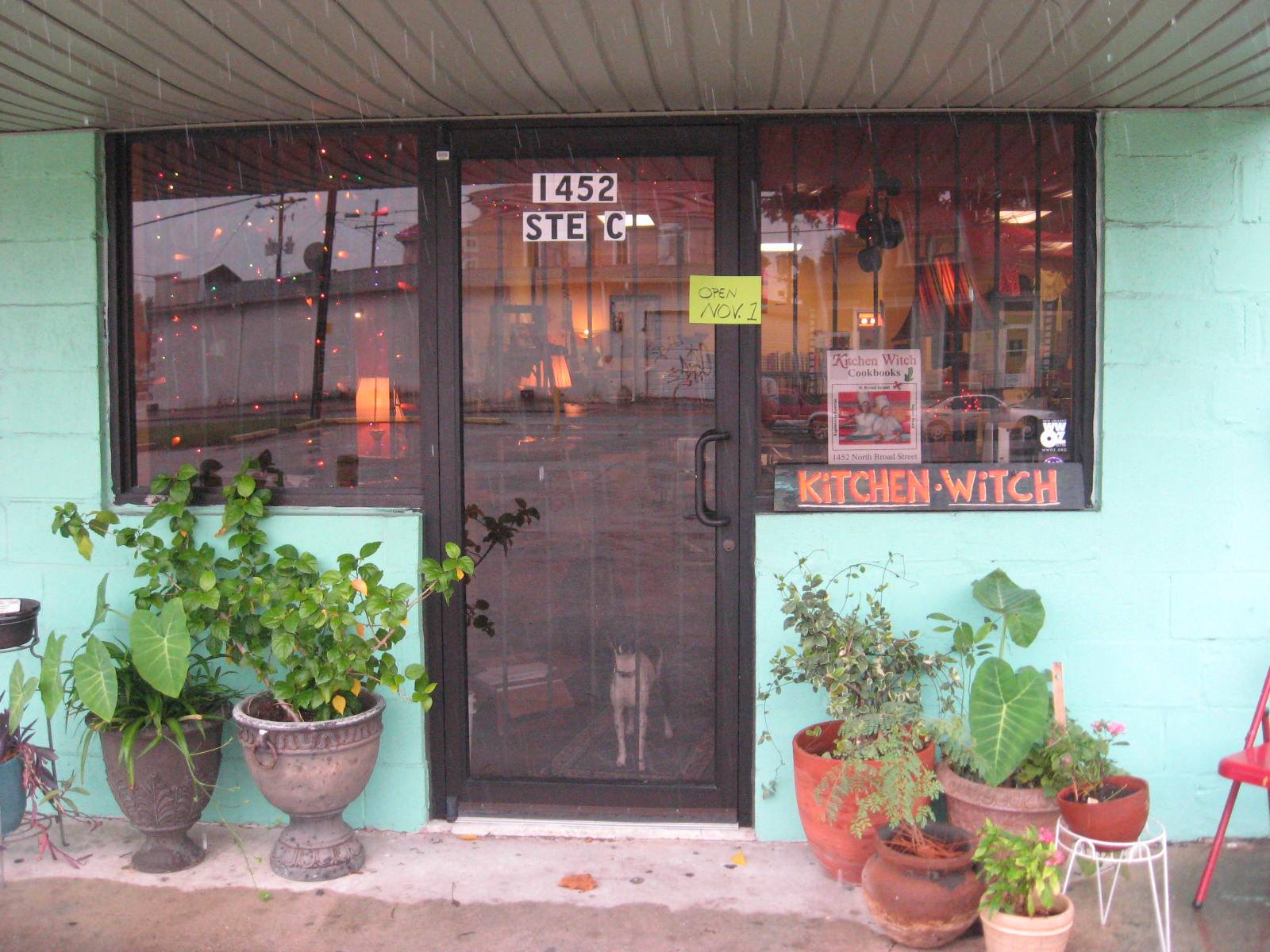
Kitchen Witch Cookbook store is pushed from FQ but finds a warm welcome @ 1452 N. Broad

Sadly, the lively cookbook/ spice/vinyl/art store Kitchen Witch had to leave the Quarter, due to the ridiculous commercial rents. (Even though I believe ever more residents are living in the Quarter than had been since the mid 1980s, I also believe that commercial rents are so out of control that we are rapidly losing our good, useful stores at a frightening rate.) What is truly sad is the owners of Kitchen Witch have been working/ living in the Quarter for decades but now are completely out of it, which is a real loss.  I wish them well.

Happily, Kitchen Witch immediately found a place quite near their home in a lovely community on N. Broad and Bayou Road. You can shop there with Deb and Philipe, add a stop at the Community Bookstore just a few footsteps away, buy vinyl and cds at Domino Records, browse for beauty prods at King and Queen Emporium and at Beauty on de Bayou, pick up first-class fried chicken at McHardy’s, find some Jamaican tastes at CoCo Hut, meet friends for excellent coffee and egg cups at the great Pagoda Cafe at Bayou and Dorgenois, and refresh your artistic eye at the brand new world-class Joan Mitchell center one more block to the river.

Broad Street has so many new and longtime businesses from Canal to Bayou that it is impossible to list them all here. Lucky for me, the community center has a excellent list.

The Bayou Road area is one of the richest cultural corridors in the city, since it is one of the oldest streets. New Orleans had been founded when Bienville was directed by Native Americans to travel from the Gulf of Mexico up Bayou St. John. There, the group portaged over land using a stretch of the area that is now Bayou Road to the present day French Quarter.

Here’s one slice of culture in this section of town that most present-day New Orleanians either don’t know about or have forgotten about:

The Greek New Orleans population goes back to French Colonial New Orleans and was centered around this area.  Roughly half of all Greeks in New Orleans lived within a mile of Holy Trinity which was at 1222 N Dorgenois before moving to its present location along Bayou St. John at Robt. E. Lee.  A wealthy Athens merchant named Michael Dracos arrived in the 1760s and married a local woman of mixed Acadian and Native American lineage. When their daughter married a Greek native in New Orleans in 1799, it became recorded as the first known marriage of two people of Greeks origins in North America.

Debbie Lindsey and Philipe LaMancusa opened their store at 1452 N. Broad, suite C, on All Saints Day. Kitchen WItch Cookbook  is planning to be open 7 days a week, 10ish to 4ish and will feature book signings and related events.

12189400_1202973753063422_6072622833745103757_o

Its in the little strip mall-like building with the Boost Store and the Beauty Supply.