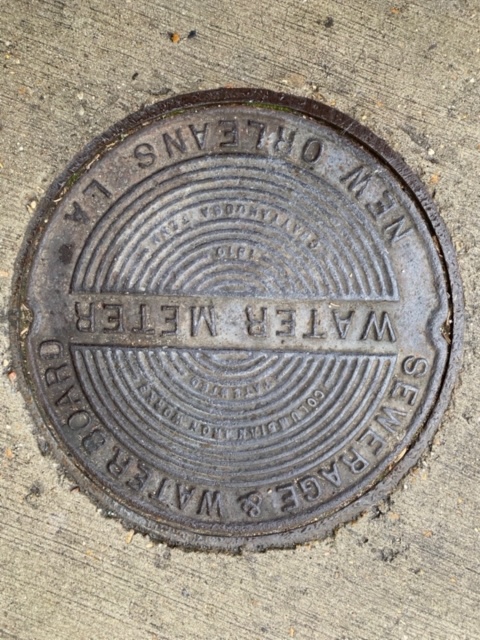
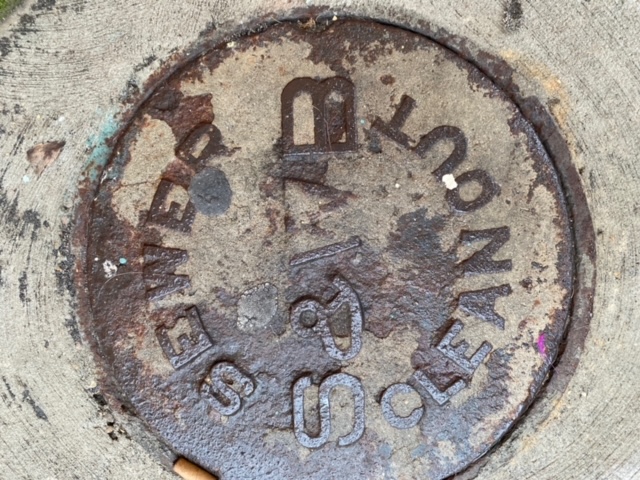
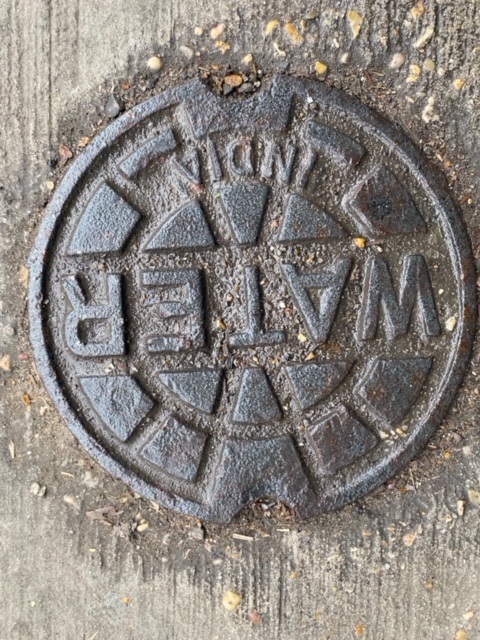
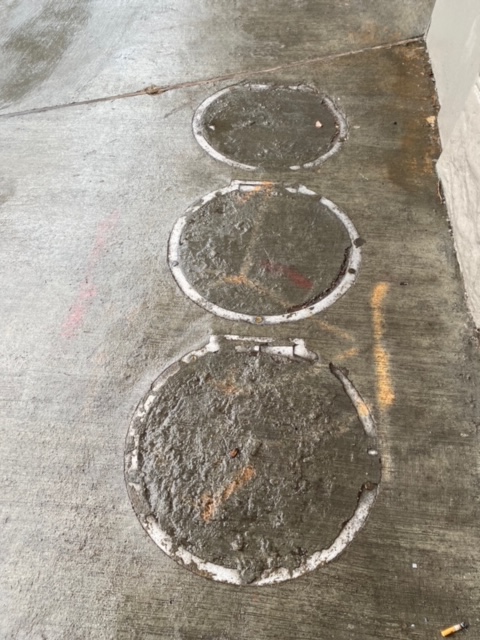
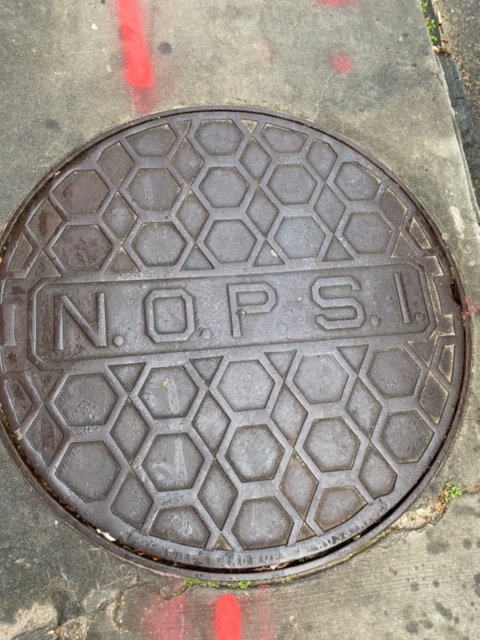
SWB logo lids

“The Sewerage & Water Board of New Orleans’ Crescent Cover Logo, also known as the Meter Cover Logo, is a federally protected trademark registered with the U.S. Patent and Trademark Office. It is also recognized and protected by Louisiana law, including a special statute that specifically pertains to the Crescent Cover Logo.”

News story:
“A woman was caught red-handed stealing two in Uptown, one local said. The water meter covers, with the iconic crescent and stars logo, are no longer manufactured, and the image is trademarked and protected by Louisiana law.”

The only cover with the iconic logo that I can find in the French Quarter is on St. Peter in front of the Upper Pontalba. Don’t steal it.

Glitter Box

Written at the start of 2020 when retail was doing its thing. GB is no longer in business.

Anyone who has spent time in the Quarter knows that Royal Street has more than one face. Starting at Canal Street, the 100 to the 900 blocks are replete with glittering windows of goods, carriageways selling framed art, and even a few stately hotels with ornate entrances that offer a peek at plush interiors. The shops are famous for offering a wide set of items including antebellum Southern furniture, elaborate lighting, French kitchen items, Italian stationery, books, a wide variety of souvenir items, even a tiny grocery store.

Seeing it all at a human pace is aided by the pedestrian mall that Royal is transformed into between the 400 and 700 blocks from 11 a.m. to 4 p.m. Monday through Friday. Once the car traffic goes away, those blocks are crowded with street musicians, “poets for hire,” hustlers, unhoused folks, and painters using the ironwork of the St. Louis Cathedral’s back garden to show their items. Oh, it’s a scene.

However, once past the little Red Schoolhouse at the corner of St. Philip, the street quiets considerably. Like neighboring Bourbon Street, it then becomes mostly residential and therefore invites fewer tourists. For the curious who continue in that direction, there are many wonderful surprises to discover, including a tiny store in the 1100 block with a simple red and white sign: Glitter Box.

The first mention of a building at 1109 Royal in the Vieux Carre Digital Survey Database is in 1828, erected by the Company of Architects of the City of New Orleans. Here is Stanley Clisby’s description of the company and the block in his 1930s book,  Old New Orleans: A History of the Vieux Carré:

“STREET OF BALCONIES 1101-1141 Royal Street. Upon our return to Royal Street, our attention is instantly caught by the row of houses on the left-hand side of the thoroughfare and their balconies covered with cast-iron lace and twining vines growing from the flower boxes and pots that line the galleries. These houses were all erected at one time by the forerunner in New Orleans of what we now denominate homestead and building and loan association. This particular company, headed by Jules Mossy and operating under the name of La Compagnie des Architectes, purchased the entire site and in the winter of 1831-1832 built the houses and sold them individually at public auction.”

In the late 1960s and early 1970s, FQ resident and writer Darlene Fife identifies the shop as the “first natural foods store in New Orleans” when it was known as The Sunshine Workshop. In her memoir “Portraits From Memory: New Orleans in the Sixties,” Fife remembered that the store’s only books were by the Anthroposophic Society  which advocated “”spiritual science” theories developed by Rudolf Steiner and how the owner Michael Coby didn’t carry dairy products because he “could smell people who ate cheese.” Legendary Covington Farmers Market vendor Norma Jean Marcon remembered working at the store in the early 1970s and that she got the job because her astrological sign aligned with Colby’s.

The address’s cavalcade of characters also included “Mr. Joe” a licensed embalmer at Thorp-Sontheimer-Laudumiey Funeral Home who was also active in the Vieux Carre Commission. His children, Jonathan and Romany, grew up there, no doubt roaming the French Quarter as happy little pirates. From his online memorial: “Mr. Joe” became a French Quarter personality. Everyone knew him and loved him; his ‘white balcony’ at 1109 Royal St. has been seen in many films.”

Honoring the building’s colorful history, the current operator Glitter Box at 1109 Royal packs a lot in its 800ish square feet: it offers unique gifts, art, apparel, printed materials, and health and wellness items presented artfully and with approachable price points. All items are made exclusively by women and femme-identified Gulf Coast artists living and working from Texas to Florida. GB also creates items in collaboration with Women with A Vision that supports WWAV’s work with previously incarcerated women under the Glitter Box Goods brand and acts as an education and community resource center.  For example, the shop is a community outpost for Reproductive Justice Action Collective (ReJAC), which distributes free and by-donation emergency contraception through community partners and a network of community support members in the greater New Orleans area.

A collaborative nature

The GB brand was unveiled at the location in 2017 after spending a few years as the Foundation Gallery, which had a related but wider mission of supporting regional artists and was also funded by the Heymann Foundation. Co-founder Alice McGillicuddy was behind the idea to change it to Glitter Box, adding maker events, and building its artist roster, all ideas enthusiastically supported by co-founder Lila Heymann. The change came from both women’s desire to support a wider range of artists and promote intersectional feminism, becoming more of an approachable community space than a traditional art gallery.

When the shop is open, two floor-to-ceiling windows on Royal show off its colorful displays, but its entrance through the courtyard to the right confounds many, even with the a-frame sign next to it, inviting people in. When its white shutters are closed, it is almost impossible to notice. 

Curator and manager Kate McCurdy is originally from New York City and has been in New Orleans for seven years.  She says, “this gallery is why I live in New Orleans; It has a supportive nature, a collaborative nature.” McCurdy started out by hosting Craft Nights, where the events range from knitting circles to Carnival headdress workshops which, because of McGillicuddy’s reputation as a movie prop fabricator, were well-attended from the start.

McCurdy is always seeking new types of products for the shop and working with the artists to source materials as locally as possible and encouraging eco-friendly packaging and materials. Fairtrade sourcing is also suggested when the artist is using materials from outside of the U.S., and McCurdy has been thinking about how to help the gallery’s artists with building fair wage jobs when they get to that level. It’s something she has some experience with as she was one of the founders of the Lucky Art Fair which centers on the philosophy of fair pay for artists.

Currently, there are around 150 artists represented in the shop with some of the items sold through consignment.  McCurdy gets 2-3 emails a week from artists inquiring about space, and does her best to direct artists to resources like the Fab Lab at Delgado which has free access to laser cutters, CNC routers (used for cutting plastic, model foam or other soft materials), a vinyl cutter, 3D printers, and more.

“The idea is to give them (artists) whatever support we can.”

Glitter Box also created the “Babes In Business” map and online directory, to encourage support of women-owned businesses across the city. The online directory features over 500 women-owned businesses and is searchable and divided by business type. The Glitter Box also holds a wide selection of workshops and community events like their new book club and donates a percentage of total sales every month to worthy non-profits and community groups. Since opening in 2017, they have donated over $40,000 to organizations like Sexual Trauma Awareness & Response (STAR), Planned Parenthood Gulf South, BreakOUT!, and NOLA Women & Children’s Shelter.

Everyone connected to the shop packs a lot of community into their day:

Lila Heymann: Owner & Co-Founder. Heymann has been recently working to become a licensed social worker while currently living in Charlottesville VA, although often back home in Louisiana working on the family foundation. The Foundation was founded to honor the family’s deep roots in Lafayette as business leaders: The Heymann’s Department Store was opened in downtown Lafayette by Maurice Heymann in 1916, and was a full-scale retail store, remaining in business downtown until the mid- 1980s. Uncle Maurice Heymann developed the present Oil Center in 1960 into a major retail, professional, and medical office facility that remains the nerve center of business in Lafayette.

Alice McGillicuddy: Co-Founder & Curator.  McGillicuddy is focusing on her doula career, now in Scotland. McGillicuddy worked as a prop fabricator in television and movie projects and on installations including the well-loved Music Box Village originally in City Park,  now in its permanent home at the end of North Rampart at the Industrial Canal.

Kate McCurdy: Shop Manager & Curator, Her latest side venture is the Lucky Art Fair, an event showcasing unrepresented artists working in New Orleans, where the goal is to fairly pay artists and art workers. McCurdy is also involved with Ladies in the Arts New Orleans (a networking group for all kinds of creative womxn), and the Krewe of Full Bush.

Karin Curley: Content and Marketing Coordinator. Curley also works for local non-profit festivals such as French Quarter Fest and Mid-City Bayou Boogaloo and also manages marketing for GinaWare Costumes and Clothing, a monthly and pop-up shop in Mid City which features recycled and vintage clothing, costumes, and costume pieces and parts for men and women. 

Neisha Johnson: Glitter Box Goods Designer and Production Assistant. Neisha was originally brought on to the team through Glitter Box’s partnership with Women With A Vision. She created a poem and design called Beauty of My Struggles which she silkscreens onto t-shirts and tote bags, along with other designs from the Glitter Box Goods in-house line. Her design represents the personal strength she discovered and leaned on to pull herself through dark times in her life, and acts as a promise to herself to never settle for less.

Jillian Desirée Oliveras: Shop Assistant. Born and raised in Puerto Rico, Jillian made New Orleans home post-Hurricane Maria in 2017. Jillian, a photographer, joined the shop as another way to connect to the local community outside of her bartender profession.

With its multitude of items and educational purpose focused on female entrepreneurs and community health, Glitter Box is a great argument for a long walk through the Quarter the next time that you are in need of a few gifts or just some inspiration.

I wrote this in 2020 for an online site where I had published similar stories but these were never finished by the editor; all of them will instead be published here.

Open Letter to Matassa’s Market

Dear (newish) owner,

Was so very glad to see your interest in this community asset, and the upgrades you added. I also shop at the Broad and Canal store which I enjoy a great deal. And already, the store looks great and honors its long history.

As someone who has shopped on St Phil and Dauphine for more than 35 years – and has designed and managed many retail outlets – I have some thoughts about how to make it work even better for this time.

I’m sure tired of hearing in the media about how ‘no one” lives in the Quarter or we don’t want to shop; we do. And that “we” includes the hundreds of people who live near the Quarter, or work in the Quarter who also shop for groceries, and yes it does also include SOME of our short-term residents- the ones who rent the houses or that use their friend’s FQ place so they can hang out, cook, and visit. In other words, there are PLENTY of shoppers for this little store by increasing those shoppers who shop for quality goods which will raise the average sale and its frequency. Rouse’s doesn’t work for a lot of people so you can succeed with its overflow and by building your own loyal shopper which requires patience and planning to gain those new shoppers and reclaim those lost.

These thoughts, some collected from my neighbors are about how we’d redo this lovely legacy store to make it work for this era, for the way people shop now are for you to take or leave but do know they are offered with all good intentions.

Reorient the store: It has loads of space that is not used to its best benefit. Yes, change it once again! Paint the inside bright colors. Add even more lights. Lots of well painted or printed signs, including prices for everything. Keep it VERY clean – inside and outside too. Reduce aisle clutter whenever possible. Reduce the height of the shelves in the front room to increase sightlines around the store.

In retail anthropology terms, when people come in a store, they automatically go to their right and the first 10-15 feet are hard for them to notice anything. In your store, that sends them past the coolers and to the back room. Keep that trek to the back room as clear of clutter as possible. Instead of coolers on the St. Phil side of the store, use low shelves and have low stacks of water, other non-alcoholic drinks in small cases, and some high-end cocktail mixes. Keep that area attractive and open and well lit. Across from that area (in the front room), maybe add a single long table for customers to eat with a small bit of local artist goods behind it; think artist CDs and other music items to honor the Mattassa legacy and also fun, a few NOLa kitchen items).

In the backroom, single-serve cold drinks should take over the first 2 coolers on the back wall. For the rest of the coolers, reduce the number of SKUs of food in the freezers, and pack it tightly with a selection allowing for an entire cooler of cold beer to remain.

As for produce, less is actually more here- little to no bagged produce, sell all by weight or by each and less space devoted to it. Stick to basics but more varieties of bananas, grapes, citrus, apples, and pears, but the olds gotta go! Cull it often to get rid of rotten and mealy.

With vegetables, focus on the basics for New Orleans and sell most as “each”, not bagged:: onions, peppers, garlic, sweet potatoes, celery, red potatoes, tomatoes, mirlitons other seasonal squash etc, carry only a tiny bit of the fresh unusual items such as avocados, ginger, fresh herbs.

The open coolers in the middle of the store in the back room should only have a little bit of single item cold produce, with more space devoted to lots of dips, yogurt, hot dogs, cheeses, and sausage and ready to eat items. (see below about varieties of brands).

Salsa is the number one condiment in the US now. Put a good selection on the shelf and in the cooler, hummus too, guacamole (that hot guac from Broad!) and always more than one brand. A selection of pizza crusts and specialty items like naan too.

For all food items in coolers, freezers, and on shelves:

Fully stock (nobody wants the last or second to last of something!) shelves with 2-3 varieties of staples. Follow the Trader Joe and Whole Foods model of stocking deeply with 1 national brand, add a small amount of 1 trendy version, and a lot of 1-2 local/regional brands. For the national brand, no off-brands. Look at the labels and try to find mid-range, somewhat healthy versions of items.

For example, mayonnaise: try Helmann’s, maybe a wasabi-flavored or sriracha mayo, and Blue Plate and Duke. Beans: Bush’s or Heinz, maybe A Dozen Cousins for the trend, Blue Runners, and Camelia.

(Hot dogs: Oscar Meyer beer and turkey, maybe Nathan’s, a skinless version, and maybe even a vegan brand)

Same with yogurt: single-serve but also quarts and a variety such as Greek styled, plain, fruit, low-fat high fat, yogurt drinks.

Same with ice cream: offer a good selection of single-serve and sizes, have national, trendy, and local brands. Put the ice cream in the cooler way in the back next to the old deli counter. Put signs that point people to it.

Stock more single-serve items of the staples: milk. creamers, peanut butter, crackers, granola bars, crackers, chips. Workers and visitors want a snack now and then as do residents!

Offer the deli space to the dozens and dozens of pop-up vendors across town who are doing amazing food choices and need commercial kitchen space. Let them hold lunch and evening food events and even stock their items in your ready-to-eat area.

Formalize the package service that some neighbors know that the family has offered forever. Add attractive storage for packages on the back wall where paper goods are now and even use the delivery guy to drop off those packages -all for a monthly fee.

and hey- why not go for a single 10-minute passenger zone for the first parking spot in on the next block? Give those drivers a fair chance to load up.

Oh, we have even more ideas and thoughts, but we hope you can see some good ones already. Let’s just get Mattassa’s to its next level.

Funds for People of the Bayou

The city of New Orleans cannot and will not exist without a thriving Louisiana.

Ida and the longtime lack of interest in offering meaningful, resilient infrastructure for these small fishing and farming places did a whopper on our neighbors homes and businesses; the fundraiser below is leading the efforts to get real help to those families and communities right now.

We are raising cash money to put in the hands of people in our bayou communities who have lost their homes. We have already started handing out $400 cash payments. Please help us continue this operation.

https://gofund.me/bb6bc166

Tourism and New Orleans in the Pandemic-Era

The 2014 book Desire and Disaster in New Orleans, looked at how the post Civil-War era New Orleans developed a white middle-class tourist economy that traded only on the French colonial and the antebellum history, and since 1980, has almost exclusively relied and expanded it to the exclusion of any other economy. That inertia certainly led to the emergence of disaster tourism after the 2005 levee breaks as the only plan by city leaders which increased dangerous and short-sighted construction like the doomed and deadly Hard Rock project – shockingly thrown up at the very site of the historic Woolworth lunch counter sit-ins.

From the book: “New Orleans post-Katrina tourism has promoted the type of political inactivism common with other forms of do-good capitalism and grassroots privatization that undermine democratic process, perpetuate social hierarchies and inequities, and reinforce the status quo.”

As I continue to dive more deeply into Professor Thomas’ and others work on the racial politics that developed those earlier eras of New Orleans tourism, we here are aware that the next round is already emerging and will have even more troubling implications for the future of New Orleans.

I’ll be covering some of those specific indicators in these pages over the next few months including:

-City Hall allowing limitless short term rental situation by pointedly ignoring the enforcement of current rules, hampering the taxis while allowing gig drivers to operate with impudence

-the addition of beach-style amenities that encourage ever larger, more rowdy groups (such as unlicensed golf carts careening everywhere and huge loitering party buses endangering the airways of anyone within a half mile)

-the lack of official support for local musicians and buskers

-and the political pressure by the restaurant and hotel industry to end the COVID safety net for Louisiana food and service workers to get them back into the poverty wages and unrelenting schedules that is required in this current system.

Of course, the lack of concerted regional support for affordable housing, for public or human-powered transportation investments and enforcement, for accessible primary and secondary education choices, and the continuing massive prison pipeline that relies on a militarized police force using traffic stops to target black residents to fund and fill the courts and prisons, also ensure that tourism remains the choice for those few who profit from any and all of those issues.

As many locals have discussed on social media and in informal meet ups on what once were quiet residential corners, unchecked tourism is a public health killer for our residents, an ecological nightmare for the most fragile coast in the U.S., and is escalating conflicts among neighbors. Yet it also allows us to celebrate one of the few black and indigenous urban capitals left in North America, and could be a lever to increase political power and the honoring of the talents and skills among our Creole, Black, indigenous, people of color and their offspring.

With the next mayoral election not too far off, I am already hearing musings from long-time activists pondering a run, and even if not running, preparing to demand that all candidates come up with a more equitable and just plan for the future around these issues. I plan to contribute to that here and elsewhere and look forward to highlighting writers and activists leading the way.

Its gonna be a wild year folks.

Rickie Lee joneses for the road

Review of her new memoir Last Chance Texaco: Chronicles of an American Troubadour by Rickie Lee Jones

My rating: 5 of 5 stars


Yes, I am a longtime fan. I remember the SNL appearance and the beginning of her FM play with Chuck E; My friends and I (bc that was how you watched SNL then) were struck by the originality of the songs and of the singer herself. As suburban kids, we were a little awed but very charmed by her total commitment.
I carried her cassettes in my secondhand cars for decades, rewinding perfectly to replay and replay some of my favorite songs: The Horses, Company, Last Chance Texaco, Coolsville, Ghetto of My Mind… the list goes on too long to have it all here. Now it is digital and even longer.
But I think even if I wasn’t a fan of her music (and now someone who seems to frequent many of the same places and has a few people in common, neither of which is that unusual in New Orleans), I think I’d still have purchased this. I love memoirs. When done right, the well-told personal story is more fascinating to me than any tale.
The movement implied in one of her greatest songs had Rickie arranging her book in sections of “The Backseat, Riding Shotgun, The Driver’s Seat, and The Way Back Seat” showing how one’s journey/quest isn’t always led by its protagonist. Her story has elements that I and many other mid-20th century American kids recognize too well, full of broken homes, drugs and drink, friends and love dropping in and out, and violence out there on the road, which astonishingly, was often just a near-miss for Rickie and for so many of us. At least she had the job of a Troubadour to explain why she stayed (stays) out there for so long. Even with the romantic job description, she admits to the dead-ends she herself pursued, the people she may have moved on from maybe before their time in her life should have been completed. But that’s the deal isn’t it – if you keep moving forward, you’re gonna leave people behind. Leaving is the drug I think many of us can’t kick.
If you are looking for “famous people” stories, she throws in a few, but only because they are meaningful to her travels. This is an artist’s story, and so hers to decide what and who was important and life-changing and illustrative Her love and empathy for those who were a roadblock are extraordinary to me. I’m not as evolved & stay mostly pissed at everyone.
It’s extraordinary but not surprising, as her listeners and readers know, having felt the sweetness and tenderness in her work since the beginning.
In the song, it’s the last chance for love along a road that may not have options coming up again. In the memoir, there is hope and promise in Rickie’s story that she has come to see success is about choosing new happy over the old hurt, and always, the freedom to create over the pursuit of empty fame. She also accepts the importance of family, realizing that they always have the sign lit for each other.
And of course, her travel story is certainly not done yet. So, if you are out there and see a woman with a guitar, a smile, a sweet voice, and a lot of killer songs under her arm…


View all my reviews

Movin’ On Up

I suppose I don’t have to explain why in the fall of 2020, I decided to prioritize getting a healthier and more comfortable place to live and work. After 40 years on and off in the city (all in the Quarter or MidCity) I’ve lived many varied versions of the New Orleans renter. Since Katrina though, I’ve barely made a home, instead living as minimally as possible, and sometimes for years roaming about as a house sitter. Don’t get me wrong- I make great spaces with lots of funky touches but they are not everyone’s cup of tea when it comes to size or amenities.

I enjoyed it all really because I wanted to spend most of my time and money on creative people and pursuits. Still do. But with the lockdown, a lack of concern from the property owner where I had been living, and the remote work likely sticking around for a bit, I took a deep breath and did something many New Orleanians say they would like to do someday:

I moved to the Upper Pontalba* on Jackson Square.

To answer your first question, no, the waiting list isn’t outrageous. At least not currently. At least not on the city-owned side.

To answer your second question, no the rent isn’t out of scale with post K city rent prices (yeah I know…) At least not currently. At least not on the city-owned side.

The process was not super quick or even clear at times, even though the property management staff did a fantastic job trying to explain the system and being enthusiastically supportive of the current tenants and in getting new people in. Lovely folks.

If you have read this blog for a while, then you know I am have been doing research on the timeline and people of Jackson Square since the Pontalba Buildings were built in 1850. That research is to tell the story of how the French Quarter was meant to be transformed by these buildings and even though it didn’t really work out as its owner expected, the original city square was saved and beautified. My business card even has an old postcard of the Square and the Lower Pontalba.

So it felt like a sign when I had the opportunity.

The light is stunning and the access to the famous ironwork even on the 4th floor is very inspiring.
Modern French Quarter kitchens renovations are usually an afterthought and make them barely functional. This is not like that.

This move has offered a new vantage point for me, and also some inspiration too for my research and writing. I am sure that inspiration is true for some of my neighbors too.

Interestingly, the Lower side seems to have a very different tenant relationship and attitude about that building from its caretakers. I’ve actually known more people who lived on that side and so have spent a fair time in those apartments. All agree that the state side is not as updated, and the rents are higher. Lots of long term tenants headed out in the last few years when the rents skyrocketed, and those who remain tell me stories of their interaction with the state that are either combative or cold.

Over here as of now, this has been a very good choice for me and there are a few apartments available which is not that common. So maybe this is a opportunity for you.

http://upperpontalba.org/apartments/leasing/

*Upper is the St. Peter side, Lower is the Saint Ann side of the Square. Upper was donated to the city by local civic leaders (Alfred Danzinger, Jules D. Dreyfous, and William Runkel) via the Pontalba Building Museum Association in 1930 which then donated it to the City of New Orleans. As part of a Federal Works Progress Administration-funded project, the row houses are reconfigured into 50 apartments and the ground floor commercial spaces are converted into residential spaces. (Commercial spaces return in the 1970s to the Uppper Pontalba.) In the 1990s Morial Adminstration did the last major renovation on the Upper Pontalba to the tune of 8 million bucks.

The Lower was donated to the state around the same time before the Upper by William Radcliffe Irby* Once in a while, I do silently thank him. And I also thank our Micaela too.

*from 64 Parishes: On Saturday morning, November 20, 1926, Irby went about his day in his normal manner. He visited the bank, performed a few routine duties, and had a mid-morning cup of coffee. He next took a cab to the Tharp-Sontheimer-Tharp undertaking parlors at Carondelet and Toledano Streets. The Times-Picayune reported that Irby “greeted the attendants affably” and told them he had “come to make arrangements for a funeral.” He looked at coffins on the second floor and then requested a morning newspaper. When the undertaker went downstairs to fetch the paper, Irby, sitting on a sofa, fired a revolver into his right temple. He left a note “requesting simplicity in his funeral.” A second note cited an “incurable heart disease” as the reason for his suicide. He was buried in New Orleans’s Metairie Cemetery.