Revealing the heart of the old city

That these 80 plus blocks of the French Quarter are constantly changing is the idea is at the heart of this blog really; every 6-8 hours a new group of users are in control of these streets and activity.

Over the last 40 years, I have wandered these blocks in busy times, at slow points, before, during, and after disaster, during the recent and massive “festivalization” that happens more and more on these tiny blocks, and on so many “regular” days.

The “stage” of the actual buildings is the wow factor, but when you see it used and often abused by folks, you start to notice the wear and tear more than the beauty.

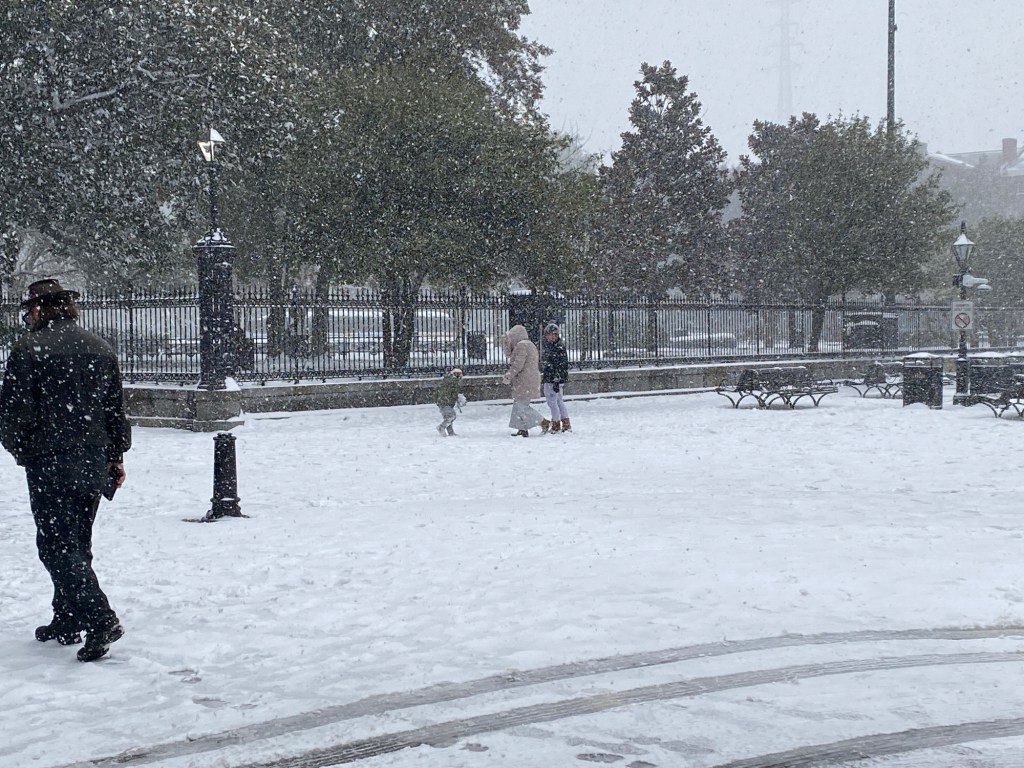
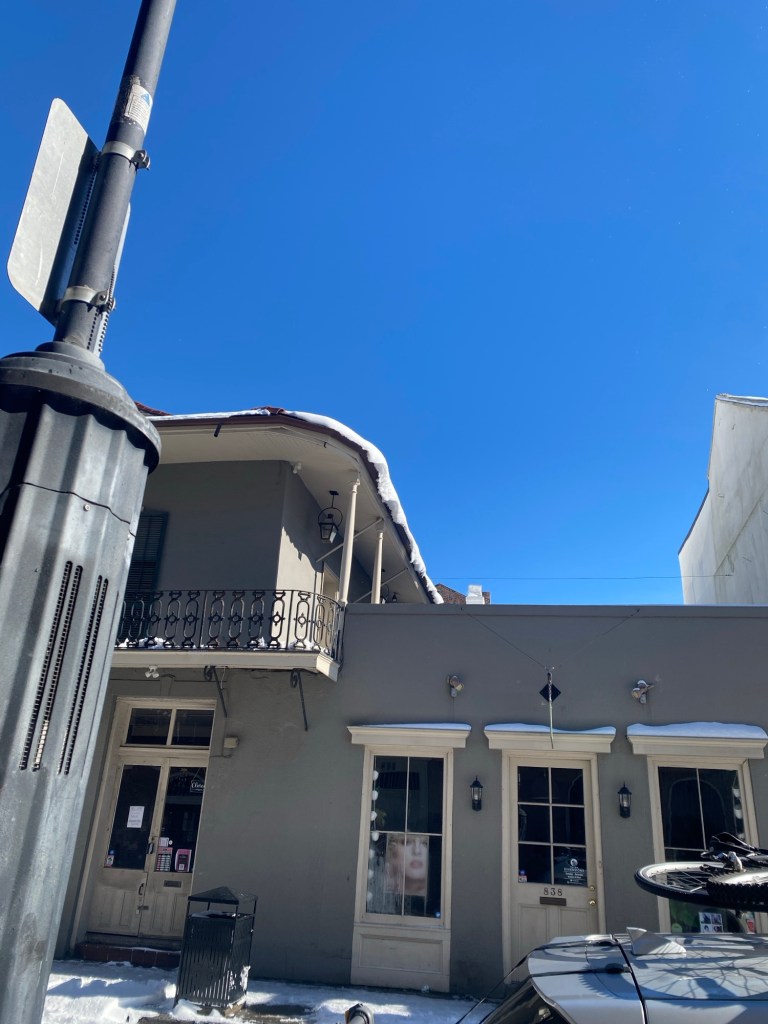
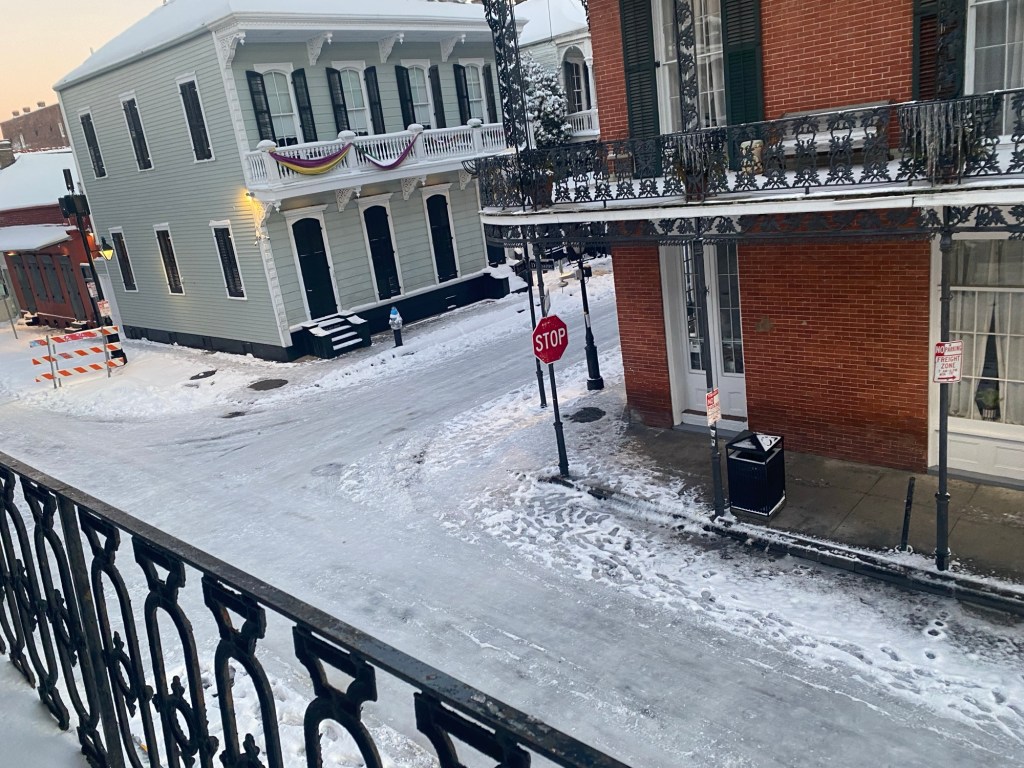
Therefore, the opportunity to see it without the people is rare and allows to remind yourself of the beauty and the appropriate scale of it all.

IMG_2308 (1)


600 block of St. Peter, Part 1

The block has its share of plaques with details of people long gone, businesses and residences with deep family, literary, and civic histories, and of course, astonishing architecture. Because of that, it seems an ideal block to dive into the long history of the city, as well as to analyze the current uses to see what New Orleans and particularly the French Quarter, is about now.

The block has around 14 buildings, depending on how one assesses complexes such as the Le Petit building now operating as 2 separate businesses, and the wraparound buildings on the Royal corner which have Royal Street addresses but also have side entrances and addresses on St. Peter.

There are 11 addresses on the downtown side and 8 on the uptown side of the street.

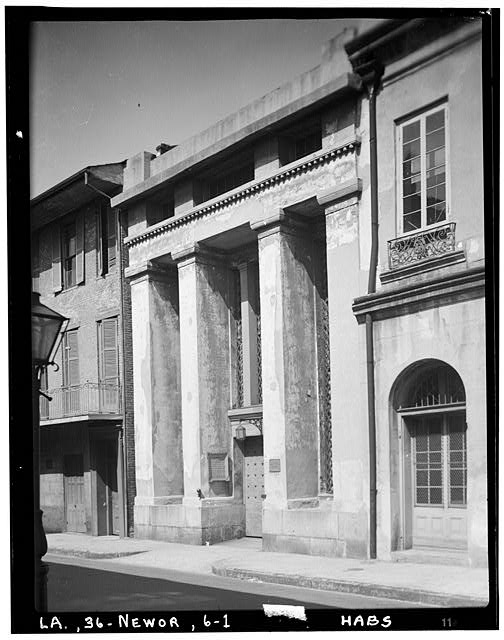
First on the list: The Arsenal

615 St. Peter (secondary address: 614 Pirates Alley.)

Current photo. Note the added bas-relief images on the top of the building (exploding cannonballs on the parapet and cannons and flags in the cast-iron panels above the entablature!) not on the building in the earlier pictures below, although some of the designs seem to have been indicated in the description*.* Nor do the early 20th-century pictures include the ironwork now on the top windows and the fence.

This forbidding building (“one example of the beautifully austere Classical Revival and Gothic Revival”), with its dusty gates and grimy plaques, is often missed by pedestrians and even when spied, is often assumed to just be a side entrance to the Cabildo Museum that fronts the square.

History

This property always belonged to the City of New Orleans. The site was occupied as early as 1728 by a French guardhouse and prison which was destroyed by fire on 21 Mar 1788 (the Good Friday fire). It was rebuilt by the Spanish and again destroyed by fire on Dec 8, 1793. It was AGAIN rebuilt in connection with the Cabildo in 1795 (by Don Andres Almonester y Roxas, Micaela Almonester, Baroness de Pontalba’s father) and was used as a prison or “calaboose” until 1837. On 25 Feb 1836, Governor S. B. White, of Louisiana, approved an Act of the Legislature authorizing:

“That the Civil Engineer shall draw a plan and estimate of an Armory, to be built on a lot of ground belonging to the City of New Orleans on the site of the old prison, near the principals and that said building shall be at least two stories high and so constructed as to contain twenty pieces of artillery, and ten thousand stands of arms; and that the sum of twenty thousand dollars be appropriated for that purpose. Said building to be commenced as soon as the City Council of New Orleans, or a majority thereof shall have notified the Governor of the State, of their consent to transfer to the State the property of the ground necessary for the aforesaid building”

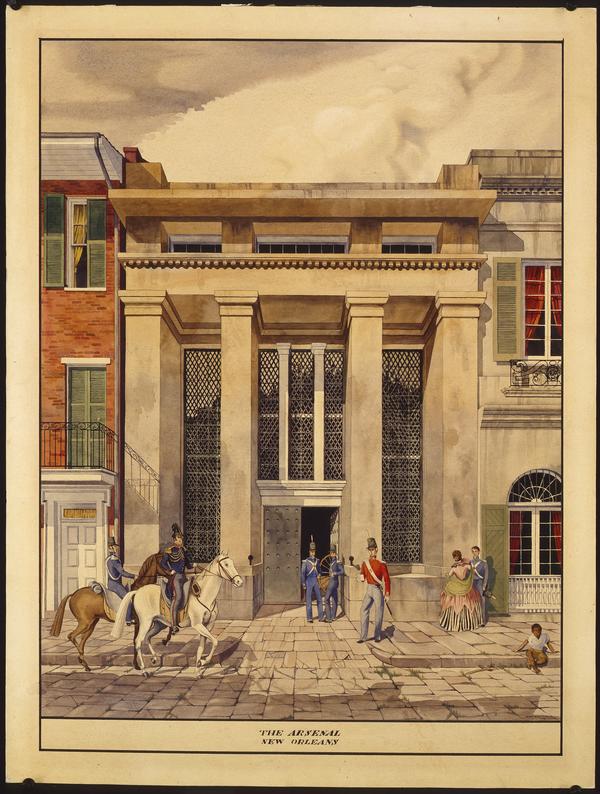
The new arsenal building, designed by Dakin and Dakin Architects, was used from 1846 until the Civil War by the Orleans Artillery and as a state Arsenal. Donated to Louisiana State Museum on January 1, 1908.

Arsenal Facade view of the Arsenal at 615 St. Peter Street in Vieux Carre. The building was designed by James H. Dakin and built in 1839. The scene depicted is ca. 1850

From the original 1830s building contract:

“The front door on St. Peter Street will be made four inches thick in double thickness and the outside lined with iron or zinc, and the whole bolted together with strong iron bolts with neat fancy oast heads of two-inch projection, and hung in two folds with six trap hinges three feet six inches long, each end fastened on the inside with a strong iron bar and face bolts in the most substantial manner. The front windows will be made as represented by the elevation with sashes one and three-quarters inches thick, hung in boxed frames with lines and weights, and glazed with long cylinder glass. There will be an iron screen or guard in front of each window, as represented by the drawings with frames or margins three inches wide by three-quarters inch thick, filled with network or diagonal bars one and a quarter by three-eights inches rabated together at every intersection, and the whole secured to the wall or front of the sash frame in the most substantial manner. The small …. of the center window will be made of wood, and the lintel between the door and the window of bricks. The attic or friese windows will be made with glased (sic) sashes hung to swing on the inside of the wall, properly fastened, and the front of the openings will be filled with such ornaments as are shown by the drawings, neatly carved in wood. **In the centre tablet above the cornice will be placed the arms of the State of Louisiana, made of cements, or some other suitable and durable material in the most tasty manner and style. All the other ornaments of the front and the . . . and entablature and blocking or attio above the cornices will be rough formed with bricks and stone work and finished with cement in imitation of white marble.”

Genthe, Arnold, photographer taken between 1920-1926
Richard Koch, Photographer, June, 1934 IRON LANTERN BRACKET IN COURTYARD
Historic American Buildings Survey/Historic American Engineering Record/Historic American Landscapes Survey

This is information on the plaque that is to the right of the door.

https://neworleanshistorical.org/

fortwiki.com/

https://www.hnoc.org/

https://property.nola.gov/

•Karen Kingsley and Lake Douglas, “The Arsenal“, [New OrleansLouisiana], SAH Archipedia, eds. Gabrielle Esperdy and Karen Kingsley, Charlottesville: UVaP, 2012—, http://sah-archipedia.org/buildings/LA-02-OR9.

Great NOLa.com article about this bldg:

Tennessee Williams Festival : “Blow out your candles” for another year

I’ve written about this wonderful festival before (see bottom of post) and was happy to find time to go again this year. I believe I went first in the late 1980s, and then began to go annually around 1999 or so.

I have a good outsider viewpoint to share so maybe that this “world-class literary festival”(as a globe-trotting festival-goer firmly declared to me years ago) remains relevant and exciting. The good news is that the people attached to the festival are excellent, and grow increasingly more representative of the city and region. The bad news is fewer locals that are not writers or theater buffs attend even though there are many exciting and enjoyable topics for non-writers. The other bad news is that it is banged about on all sides by a half dozen or more events and festivals happening in the same week.

I’d like to see:

more outdoor events (still like my idea from earlier post of having Streetcar movie playing in Square on Thursday night) should also be a short brass band event to celebrate TW’s birthday (bring back the birthday toast and singing, just move to Square or to Pirate’s Alley)

more interaction between other TW festivals and this one

more on St. Louis!

more on local lore, local history from the 20th century, (an era possibly the least understood of New Orleans’ 3 centuries…)

bring back popular panels from early years

sponsor a nearby Tennessee Flea market full of all (quality) things New Orleans 20th century as well as collector’s editions of his works

more items for sale such as reproduction posters of productions, clothing not directly tied to festival but TW related. Work with stores in FQ to highlight TW and literary items that weekend.

more panels and materials on/from Mississippi, TW’s other home

more panels and materials on the Mississippi River history and places from St. Louis to New Orleans

highlight other Southern writers with their own small track (Flannery, Eudora even gasp Anne Rice)

more with emerging writers, especially with schools around the city (i.e.Neighborhood Story Project)

TWLF history hunt with prizes

Tie in TWLF with FQ Fest and JazzFest with a linked exhibit or sponsored musician

Let’s just make this a engaging, engrossing, and illuminating weekend, centered around the great modern playwright who loved this city.

A cross section of things I’ve written about the festival on this blog:

https://frenchquarterbxb.com/?s=Tennessee

https://frenchquarterbxb.com/page/4/?s=Tennessee

Chris Stall, Bell Captain

From the International Hotel School website:

A bell captain usually supervises the conduct of bellhops and porters. Generally working in a hotel, a person in this position is usually cross-trained to take on other hospitality tasks like concierge or desk clerk duties in addition to bell captain duties, depending on the size of the organization.

On the 600 block of Saint Ann, the seven-floor parking garage (yes 7 floors; you have to stand in front for a few minutes to see it) is the  “side porch” of the Place d’ Armes Hotel. The hotel which has around 80 rooms, caters to regulars and sophisticated visitors. That is indicated by the lack of all-night “whoo-hooing” balconies for rent here. The few rooms with balconies overlooking Saint Ann are told upon check-in to honor the neighborhood vibe and shut the outside party down at a decent hour.

The garage is not self-parking. You and your car enter (that is, if the valet guys have the sign turned around to the public parking allowed side of the metal stand or you’re a hotel guest or contract holder), and within seconds of you pulling in, the keys are in their hand and you are on your way out to the bright sunlight. Maybe you stop to watch them expertly pull your car into the car elevator, or maybe you don’t. Maybe it helps to hear that no one remembers any major garage accident or mishap from this system.

Chris Stall, the bell captain, has been on the bell/valet staff for 13 years. He is the senior member of that staff although outrank him in seniority in other jobs. Always agreeable, chatty, never flustered, he is extremely courteous about listening  and mildly commenting on a wide range of subjects.

His familiarity with hotels is long; his dad had a career in the food & beverage divisions of hotels at the Sheraton and the Intercontinental on Canal and also opened new hotels in Orlando, Las  Vegas, Nashville, among others. The four kids went along, but as soon as Stall was 18, he came back home for good, as did each of his siblings as they came of age. He lives with his rescue dogs in Chalmette where he was born and bred and where most of the family still resides. 

He started his own hotel career 15 years ago at the Hotel St. Marie, where his brother worked at the front desk, then to Place d’Armes 13 years ago. The Valentino family owns both hotels along with Prince Conti, the French Market Inn, and the Lafayette Hotel in the CBD. They also manage the City Sightseeing New Orleans Bus (the red, double decker Hop-On-Hop-Off) tours and the Basin Street Welcome Station.

That brother is long gone from hotel work and now a locksmith.  In turn, Chris has passed along the good fortune of a connection to other members of his family; until recently, his cousin spent five years as a valet at the hotel.

He works 40 hours but only on weekends, pulling two 16-hour shifts, and finishing with 8 hours on Sunday.  This allows for great flexibility for his off time, although as captain he is expected to handle any staff shortages. If you ask if he is in charge, you get a laugh and an acknowledgment shrug, befitting his self-effacing demeanor. He is, but the work is simple to understand for the staff. “It’s a great job for a young person going to school or getting started,” he says.

Along with spaces for hotel guests, the garage holds about 80 contractholders, with about 20 of those coming and going daily or weekly. If the regulars’ routines shift at all, he wonders what happened to them. Short chats with regulars, helping with unloading groceries, holding the dog leash, and passing along news of the area is all included.

Sometimes one of his sisters brings their family down for an event, but for his part, he doesn’t spend his off time in the Quarter. However, when someone talks about the Quarter, he mostly defends it. “After all, this is the bread and butter of the city.” 

The nuttiest thing he has seen while working in the Quarter? He says the list is too long.

I wrote this in 2020 for an online site where I had published similar stories but these were never finished by the editor; all of them will instead be published here.

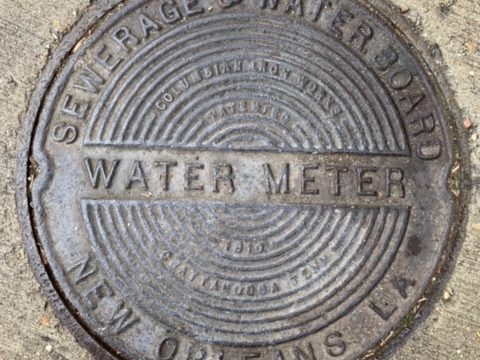
SWB logo lids

“The Sewerage & Water Board of New Orleans’ Crescent Cover Logo, also known as the Meter Cover Logo, is a federally protected trademark registered with the U.S. Patent and Trademark Office. It is also recognized and protected by Louisiana law, including a special statute that specifically pertains to the Crescent Cover Logo.”

News story:
“A woman was caught red-handed stealing two in Uptown, one local said. The water meter covers, with the iconic crescent and stars logo, are no longer manufactured, and the image is trademarked and protected by Louisiana law.”

The only cover with the iconic logo that I can find in the French Quarter is on St. Peter in front of the Upper Pontalba. Don’t steal it.

Glitter Box

Written at the start of 2020 when retail was doing its thing. GB is no longer in business.

Anyone who has spent time in the Quarter knows that Royal Street has more than one face. Starting at Canal Street, the 100 to the 900 blocks are replete with glittering windows of goods, carriageways selling framed art, and even a few stately hotels with ornate entrances that offer a peek at plush interiors. The shops are famous for offering a wide set of items including antebellum Southern furniture, elaborate lighting, French kitchen items, Italian stationery, books, a wide variety of souvenir items, even a tiny grocery store.

Seeing it all at a human pace is aided by the pedestrian mall that Royal is transformed into between the 400 and 700 blocks from 11 a.m. to 4 p.m. Monday through Friday. Once the car traffic goes away, those blocks are crowded with street musicians, “poets for hire,” hustlers, unhoused folks, and painters using the ironwork of the St. Louis Cathedral’s back garden to show their items. Oh, it’s a scene.

However, once past the little Red Schoolhouse at the corner of St. Philip, the street quiets considerably. Like neighboring Bourbon Street, it then becomes mostly residential and therefore invites fewer tourists. For the curious who continue in that direction, there are many wonderful surprises to discover, including a tiny store in the 1100 block with a simple red and white sign: Glitter Box.

The first mention of a building at 1109 Royal in the Vieux Carre Digital Survey Database is in 1828, erected by the Company of Architects of the City of New Orleans. Here is Stanley Clisby’s description of the company and the block in his 1930s book,  Old New Orleans: A History of the Vieux Carré:

“STREET OF BALCONIES 1101-1141 Royal Street. Upon our return to Royal Street, our attention is instantly caught by the row of houses on the left-hand side of the thoroughfare and their balconies covered with cast-iron lace and twining vines growing from the flower boxes and pots that line the galleries. These houses were all erected at one time by the forerunner in New Orleans of what we now denominate homestead and building and loan association. This particular company, headed by Jules Mossy and operating under the name of La Compagnie des Architectes, purchased the entire site and in the winter of 1831-1832 built the houses and sold them individually at public auction.”

In the late 1960s and early 1970s, FQ resident and writer Darlene Fife identifies the shop as the “first natural foods store in New Orleans” when it was known as The Sunshine Workshop. In her memoir “Portraits From Memory: New Orleans in the Sixties,” Fife remembered that the store’s only books were by the Anthroposophic Society  which advocated “”spiritual science” theories developed by Rudolf Steiner and how the owner Michael Coby didn’t carry dairy products because he “could smell people who ate cheese.” Legendary Covington Farmers Market vendor Norma Jean Marcon remembered working at the store in the early 1970s and that she got the job because her astrological sign aligned with Colby’s.

The address’s cavalcade of characters also included “Mr. Joe” a licensed embalmer at Thorp-Sontheimer-Laudumiey Funeral Home who was also active in the Vieux Carre Commission. His children, Jonathan and Romany, grew up there, no doubt roaming the French Quarter as happy little pirates. From his online memorial: “Mr. Joe” became a French Quarter personality. Everyone knew him and loved him; his ‘white balcony’ at 1109 Royal St. has been seen in many films.”

Honoring the building’s colorful history, the current operator Glitter Box at 1109 Royal packs a lot in its 800ish square feet: it offers unique gifts, art, apparel, printed materials, and health and wellness items presented artfully and with approachable price points. All items are made exclusively by women and femme-identified Gulf Coast artists living and working from Texas to Florida. GB also creates items in collaboration with Women with A Vision that supports WWAV’s work with previously incarcerated women under the Glitter Box Goods brand and acts as an education and community resource center.  For example, the shop is a community outpost for Reproductive Justice Action Collective (ReJAC), which distributes free and by-donation emergency contraception through community partners and a network of community support members in the greater New Orleans area.

A collaborative nature

The GB brand was unveiled at the location in 2017 after spending a few years as the Foundation Gallery, which had a related but wider mission of supporting regional artists and was also funded by the Heymann Foundation. Co-founder Alice McGillicuddy was behind the idea to change it to Glitter Box, adding maker events, and building its artist roster, all ideas enthusiastically supported by co-founder Lila Heymann. The change came from both women’s desire to support a wider range of artists and promote intersectional feminism, becoming more of an approachable community space than a traditional art gallery.

When the shop is open, two floor-to-ceiling windows on Royal show off its colorful displays, but its entrance through the courtyard to the right confounds many, even with the a-frame sign next to it, inviting people in. When its white shutters are closed, it is almost impossible to notice. 

Curator and manager Kate McCurdy is originally from New York City and has been in New Orleans for seven years.  She says, “this gallery is why I live in New Orleans; It has a supportive nature, a collaborative nature.” McCurdy started out by hosting Craft Nights, where the events range from knitting circles to Carnival headdress workshops which, because of McGillicuddy’s reputation as a movie prop fabricator, were well-attended from the start.

McCurdy is always seeking new types of products for the shop and working with the artists to source materials as locally as possible and encouraging eco-friendly packaging and materials. Fairtrade sourcing is also suggested when the artist is using materials from outside of the U.S., and McCurdy has been thinking about how to help the gallery’s artists with building fair wage jobs when they get to that level. It’s something she has some experience with as she was one of the founders of the Lucky Art Fair which centers on the philosophy of fair pay for artists.

Currently, there are around 150 artists represented in the shop with some of the items sold through consignment.  McCurdy gets 2-3 emails a week from artists inquiring about space, and does her best to direct artists to resources like the Fab Lab at Delgado which has free access to laser cutters, CNC routers (used for cutting plastic, model foam or other soft materials), a vinyl cutter, 3D printers, and more.

“The idea is to give them (artists) whatever support we can.”

Glitter Box also created the “Babes In Business” map and online directory, to encourage support of women-owned businesses across the city. The online directory features over 500 women-owned businesses and is searchable and divided by business type. The Glitter Box also holds a wide selection of workshops and community events like their new book club and donates a percentage of total sales every month to worthy non-profits and community groups. Since opening in 2017, they have donated over $40,000 to organizations like Sexual Trauma Awareness & Response (STAR), Planned Parenthood Gulf South, BreakOUT!, and NOLA Women & Children’s Shelter.

Everyone connected to the shop packs a lot of community into their day:

Lila Heymann: Owner & Co-Founder. Heymann has been recently working to become a licensed social worker while currently living in Charlottesville VA, although often back home in Louisiana working on the family foundation. The Foundation was founded to honor the family’s deep roots in Lafayette as business leaders: The Heymann’s Department Store was opened in downtown Lafayette by Maurice Heymann in 1916, and was a full-scale retail store, remaining in business downtown until the mid- 1980s. Uncle Maurice Heymann developed the present Oil Center in 1960 into a major retail, professional, and medical office facility that remains the nerve center of business in Lafayette.

Alice McGillicuddy: Co-Founder & Curator.  McGillicuddy is focusing on her doula career, now in Scotland. McGillicuddy worked as a prop fabricator in television and movie projects and on installations including the well-loved Music Box Village originally in City Park,  now in its permanent home at the end of North Rampart at the Industrial Canal.

Kate McCurdy: Shop Manager & Curator, Her latest side venture is the Lucky Art Fair, an event showcasing unrepresented artists working in New Orleans, where the goal is to fairly pay artists and art workers. McCurdy is also involved with Ladies in the Arts New Orleans (a networking group for all kinds of creative womxn), and the Krewe of Full Bush.

Karin Curley: Content and Marketing Coordinator. Curley also works for local non-profit festivals such as French Quarter Fest and Mid-City Bayou Boogaloo and also manages marketing for GinaWare Costumes and Clothing, a monthly and pop-up shop in Mid City which features recycled and vintage clothing, costumes, and costume pieces and parts for men and women. 

Neisha Johnson: Glitter Box Goods Designer and Production Assistant. Neisha was originally brought on to the team through Glitter Box’s partnership with Women With A Vision. She created a poem and design called Beauty of My Struggles which she silkscreens onto t-shirts and tote bags, along with other designs from the Glitter Box Goods in-house line. Her design represents the personal strength she discovered and leaned on to pull herself through dark times in her life, and acts as a promise to herself to never settle for less.

Jillian Desirée Oliveras: Shop Assistant. Born and raised in Puerto Rico, Jillian made New Orleans home post-Hurricane Maria in 2017. Jillian, a photographer, joined the shop as another way to connect to the local community outside of her bartender profession.

With its multitude of items and educational purpose focused on female entrepreneurs and community health, Glitter Box is a great argument for a long walk through the Quarter the next time that you are in need of a few gifts or just some inspiration.

I wrote this in 2020 for an online site where I had published similar stories but these were never finished by the editor; all of them will instead be published here.

Open Letter to Matassa’s Market

Dear (newish) owner,

Was so very glad to see your interest in this community asset, and the upgrades you added. I also shop at the Broad and Canal store which I enjoy a great deal. And already, the store looks great and honors its long history.

As someone who has shopped on St Phil and Dauphine for more than 35 years – and has designed and managed many retail outlets – I have some thoughts about how to make it work even better for this time.

I’m sure tired of hearing in the media about how ‘no one” lives in the Quarter or we don’t want to shop; we do. And that “we” includes the hundreds of people who live near the Quarter, or work in the Quarter who also shop for groceries, and yes it does also include SOME of our short-term residents- the ones who rent the houses or that use their friend’s FQ place so they can hang out, cook, and visit. In other words, there are PLENTY of shoppers for this little store by increasing those shoppers who shop for quality goods which will raise the average sale and its frequency. Rouse’s doesn’t work for a lot of people so you can succeed with its overflow and by building your own loyal shopper which requires patience and planning to gain those new shoppers and reclaim those lost.

These thoughts, some collected from my neighbors are about how we’d redo this lovely legacy store to make it work for this era, for the way people shop now are for you to take or leave but do know they are offered with all good intentions.

Reorient the store: It has loads of space that is not used to its best benefit. Yes, change it once again! Paint the inside bright colors. Add even more lights. Lots of well painted or printed signs, including prices for everything. Keep it VERY clean – inside and outside too. Reduce aisle clutter whenever possible. Reduce the height of the shelves in the front room to increase sightlines around the store.

In retail anthropology terms, when people come in a store, they automatically go to their right and the first 10-15 feet are hard for them to notice anything. In your store, that sends them past the coolers and to the back room. Keep that trek to the back room as clear of clutter as possible. Instead of coolers on the St. Phil side of the store, use low shelves and have low stacks of water, other non-alcoholic drinks in small cases, and some high-end cocktail mixes. Keep that area attractive and open and well lit. Across from that area (in the front room), maybe add a single long table for customers to eat with a small bit of local artist goods behind it; think artist CDs and other music items to honor the Mattassa legacy and also fun, a few NOLa kitchen items).

In the backroom, single-serve cold drinks should take over the first 2 coolers on the back wall. For the rest of the coolers, reduce the number of SKUs of food in the freezers, and pack it tightly with a selection allowing for an entire cooler of cold beer to remain.

As for produce, less is actually more here- little to no bagged produce, sell all by weight or by each and less space devoted to it. Stick to basics but more varieties of bananas, grapes, citrus, apples, and pears, but the olds gotta go! Cull it often to get rid of rotten and mealy.

With vegetables, focus on the basics for New Orleans and sell most as “each”, not bagged:: onions, peppers, garlic, sweet potatoes, celery, red potatoes, tomatoes, mirlitons other seasonal squash etc, carry only a tiny bit of the fresh unusual items such as avocados, ginger, fresh herbs.

The open coolers in the middle of the store in the back room should only have a little bit of single item cold produce, with more space devoted to lots of dips, yogurt, hot dogs, cheeses, and sausage and ready to eat items. (see below about varieties of brands).

Salsa is the number one condiment in the US now. Put a good selection on the shelf and in the cooler, hummus too, guacamole (that hot guac from Broad!) and always more than one brand. A selection of pizza crusts and specialty items like naan too.

For all food items in coolers, freezers, and on shelves:

Fully stock (nobody wants the last or second to last of something!) shelves with 2-3 varieties of staples. Follow the Trader Joe and Whole Foods model of stocking deeply with 1 national brand, add a small amount of 1 trendy version, and a lot of 1-2 local/regional brands. For the national brand, no off-brands. Look at the labels and try to find mid-range, somewhat healthy versions of items.

For example, mayonnaise: try Helmann’s, maybe a wasabi-flavored or sriracha mayo, and Blue Plate and Duke. Beans: Bush’s or Heinz, maybe A Dozen Cousins for the trend, Blue Runners, and Camelia.

(Hot dogs: Oscar Meyer beer and turkey, maybe Nathan’s, a skinless version, and maybe even a vegan brand)

Same with yogurt: single-serve but also quarts and a variety such as Greek styled, plain, fruit, low-fat high fat, yogurt drinks.

Same with ice cream: offer a good selection of single-serve and sizes, have national, trendy, and local brands. Put the ice cream in the cooler way in the back next to the old deli counter. Put signs that point people to it.

Stock more single-serve items of the staples: milk. creamers, peanut butter, crackers, granola bars, crackers, chips. Workers and visitors want a snack now and then as do residents!

Offer the deli space to the dozens and dozens of pop-up vendors across town who are doing amazing food choices and need commercial kitchen space. Let them hold lunch and evening food events and even stock their items in your ready-to-eat area.

Formalize the package service that some neighbors know that the family has offered forever. Add attractive storage for packages on the back wall where paper goods are now and even use the delivery guy to drop off those packages -all for a monthly fee.

and hey- why not go for a single 10-minute passenger zone for the first parking spot in on the next block? Give those drivers a fair chance to load up.

Oh, we have even more ideas and thoughts, but we hope you can see some good ones already. Let’s just get Mattassa’s to its next level.