Spring Fiesta Senors and Senoritas!

“hey, do you want a beer?”
I would.
“where have you been all day?”
I was at the Spring Fiesta.
“What is that? Some type of Latino festival?”
Umm no. Its a 75-year-old French Quarter tradition that celebrates the culture of New Orleans by offering $25 house tours of 5 homes each day.
‘I never heard of it.”
Well, they have a website. But I think you are just supposed to know, since it’s been going on so long.
“I guess I am not getting this. What do they do, this group? Offer tours?”
Oh, they have a parade too. They give flowers out while wearing period dress.
“Like crinolines or some of that shit? on carriages?”
Of course on carriages. How could it be old New Orleans without carriages?
“Well, so what is the point anyway?”
Well there is a Spring Fiesta Queen and a court.
“OH, NOW I get it. Why didn’t you say that to begin with?”
Well, the houses are really nice too.

Give me another beer, wouldya?

Human-powered transportation updates

The French Quarter should lead the way for the entire city in bike safety, bike parking opportunities, pedi-cab activity and official business done on foot or by bike whenever possible. Can I get an amen?

From the French Quarter Business Association newsletter:

Cycling in the French Quarter

FQBA’s board was asked to support a survey studying bicycle usage and parking in the Quarter. All were in favor of supporting the efforts of The Metro Bicycle Coalition (MBC) in doing so. MBC is excited to announce this project aimed to measure the attitudes and beliefs of French Quarter business and property owners regarding bicycle parking in the Quarter.

NOPD Bicycle Unit

We are excited to announce that FQBA members have stepped up and helped the 8th district with their goal of ten (10) bicycles for officers in the French Quarter. We will formally announce the donors at a press event soon. Other districts are still in need of assistance please contact the New Orleans Police and Justice Foundation for information on how you can help get NOPD officers on bicycles in your neighborhood.

Licensing Pedi-cabs
From time to time we have revisited the issue of pedi-cabs. The final word on licensing legal pedi-cabs for the City of New Orleans is that the City Council is reviewing the administration’s proposed policies and procedures as to how licenses will be approved. The administration proposed a lottery system, however, the city council’s transportation committee, chaired by District “C” Councilmember Kristin Gisleson Palmer, supports a merit-based system. The process was discussed at the city council’s transportation committee meeting on March 24th. The Transportation Committee’s changes to the procedures will be available April 1st on the city council’s website at http://www.nolacitycouncil.com. This matter will be discussed at the April 7th city council meeting.

FQBA is in favor of a merit-based system for issuing these pedi-cab permits and has corresponded accordingly with Councilmember Giselson Palmer’s office.

The story of Stanley and Stella

In restaurant form that is.
A classic New Orleans story with food as the central character. Scott Boswell, a young chef who is serious about his ongoing training, owns these restaurants with his wife Tanya. Scott is found at Stella’s working the kitchen (when he’s not traveling to restaurants to offer himself as a free apprentice) and Tanya can be seen daily at Stanley’s working the door and watching the entire place.
Both restaurants serve excellent food. Stella’s is award-winning and pretty expensive, but even with the deep pocket needed to go there,I can’t count how many times I have heard that this was the favorite meal of visitors and some locals who hit all of the top ones. Many times.
I know the chef and his wife from their stalwart support of the Crescent City Farmers Market, where I work. We opened a 4th location a few years before Katrina and they did anything they could do to support it. We’ll never forget it.
I like these folks because they are Quarter residents and real workers and committed to a scale of production, service and ambience that has made the city what it is.
(Now I have a friend who is not very happy with them and feels slighted in every way; she’s a savvy local who has loads of patience for quirks but got bad service and a worse response after, so I sorrowfully acknowledge that too. It’s the only version I have heard of that story, but she is pretty sore with them now.)
My experience has been great and now they have added a Stanley’s service bar right next door on the Square and so a tip of my cap again is in order. Espresso, pastries, ice cream and sandwiches in a beautifully designed storefront. Some work remains to do to get it all done but if you’re out at 8 am til evening in the area, go try the coffee or ice cream and then go have a eggs hollandaise poboy next door.

And revel in the culture renewing itself in the oldest part of the city, thanks to entrepreneurs like Scott and Tanya..

The newest addition to the Pontalba family. Espresso, pastries and ice cream from 8-7ish daily.

Study of a Friday morning

Royal Street at Esplanade.
The camera zooms in to a helmeted female, leisurely biking alongside of the parked cars. Weaving figure 8s, she squints up at the sun and nods to a few people on either sidewalk. We see her:
catch sight of the wisteria blooming on Royal in the Princess of Monaco courtyard. She pulls up on the sidewalk under it and stops to admire it.
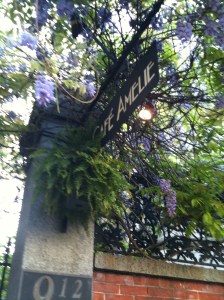
Early morning wisteria at Cafe Amelie on Royal

After breakfast at Royal Blend, she takes a middle seat inside the Historic New Orleans Collection for the first Master Class of the year at the Tennessee Williams Literary Festival. At its end, she is overheard saying to an acquaintance that it was more of a panel than a class. No matter. Still useful she says firmly, 2-3 new tidbits of information. She walks politely but quickly ahead of the more mature part of the crowd through the carriageway, into the sunlight and on to the street itself.

Tennessee Williams Literary Festival-Friday Master Class at HNOC

She cuts diagonally down Royal and again diagonally across Toulouse and spies the open door at Kitchen Witch Cook Books. She stops to chat about the Festival with its owners, neighbors and friends of hers. The couple are perennial TWiLFers as well. Lively talk among the 3 for a few minutes, then the female half of the couple kisses the male half goodbye and walks quickly to the corner of Decatur with lunch in hand.The man continues to talk to our heroine (arms folded, scrunched down a bit to be at eye level with her), while the cookbook dogs settle in for a long nap on the floor. On the way out she admires the mix of everything.
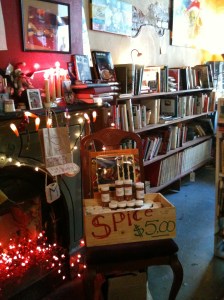
Kitchen Witch Cookbooks

A few zigzags across the French Quarter over the next few hours with some writing in a notebook and some chat. At 1 p.m. more or less, she walks to Jackson Square, past table-waiting couples giving their names to a white-shirted waiter and goes directly to the counter inside Stanley’s. She orders quickly and assuredly: small gumbo with potato salad, Italian soda with pomegranate. On either side of her, people watch her settle in. She notices them and engages both sides in conversation: first, on her right-a couple from California, married at the river last Friday. Long time visitors to the city. She thinks to herself it sounds like the woman married the city rather than the man.
Next, at her left is a Colorado couple in for “March Madness” which sounds odd to her ears. All discuss New Orleans, and interestingly both women ask our heroine what “she does”. She answers politely but does not ask them what they do. Instead she asks them what they want to do while here and offers suggestions.

The gumbo with potato salad, and the eggs benedict poboy

The waiter asks her if she likes the gumbo. She wonders why.

Clean plate at Stanley's

Book bag now in the basket, she swings a leg over her bicycle as it begins to roll down Chartres. The camera pans over the entire Square, which is seen with activity and life and music in every corner; at the end of the shot, she and her bicycle are indistinguishable from the rest.
The End. No credits.

Tennessee is back

It is upon us. One of my favorite weekends is here- the Tennessee Williams Literary Festival weekend. Starting tonight with a world premiere of 3 one-act plays from our favorite author, then with ticket sales from Thursday through Sunday at the Royal Sonesta Hotel.
Here is a Tennessee Williams haiku:
Master classes and
literary panels til
Stanley shouts Stella

Updating live from TwilLf headquarters all weekend…

Half Off Entry Fee to the CitySolve Urban Race

Well that would explain those crazy people I see from time to time, sprinting and or skipping while yelling “it’s here!” (Alas, I thought it was over my cheap drink map…)

review: City Life

City Life: Urban Expectations In A New WorldCity Life: Urban Expectations In A New World by Witold Rybczynski
My rating: 4 of 5 stars

I liked Rybczynski’s book “Home” which observed how comfort, family life, privacy, efficiency (damn those Victorians) and work have shaped the idea of home.

“City Life” is an excellent overview of how Americans have evolved the modern culture of cities which remains one of our few last exports to the rest of the world.

He makes many useful observations:
The evolving definition of city, or town or burg. The word city comes from towns that had bishopric seats, and had nothing to do with population. In general, it had religious connotations. gulp.
That Americans simply brought their urban culture to the rural communities. Therefore, it follows that we don’t have the parallel cultures that much of Europe has still but instead share more within the building blocks of each community.
Maybe there is hope for us.
Unfortunately, I think much of what we now share across the nation starts with American Idol and ends with WalMart.
That many universities were built by architects as self-contained towns with a rich patron to bankroll the ideas and had little or no opposition to their ideas. That made me pause; since almost all architects and planners come from those environs, it occurs to me that their last experience of village life before designing them are these mock towns that believe wholeheartedly in the built environment and most often in a sort of medieval spires and green field view of life.
Uh oh.
But the most important part of this book for me is his chapter on housing for the poor and the great migration (great meaning whole bunches) of African-Americans to the Northern manufacturing areas. As we need to remember, the post war boom was basically over by the mid-1960s and yet no changes were made in the policies of the US for those who migrated to where the jobs once were. Housing for the poor reflected that missed opportunity and still does.
I wish this part was longer but at least he attempts to add it to the conversation. That accessibility is still the main reason for city life I agree with but not sure that I agree that with wireless accessibility, fewer physical cities may need to exist. That may be true, although I feel that theory has been preached since the 19th century (and its advent of the ” annihilation of time and distance” with the invention of the telegraph, railroad and photography) yet cities continued to grow in importance and size in that very time.

I also wish there was more on the immigrant experience and how it has changed in America and therefore changed cities too. I know that in my own city newly arriving immigrants are now moving to the suburbs of Jefferson Parish as soon as they arrive and not to the city center which worries me. I’d like to hear some perspective on that.
Rybczynski writes well for a wide audience and gives concrete examples of places that illustrate his points.
You can do worse than reading this primer, especially if you are new to the subject or prefer less academic views of heavy subjects, like me.

View all my reviews