|
|
After a NOLA.com inquiry, a city representative said that the bench disappearance is only temporary. The eight iron seats were cut from their moorings in order to make room for a little-publicized welcoming ceremony at 10 a.m. Saturday (April 21) that relates to New Orleans’ ongoing tricentennial celebration. Mayor Mitch Landrieu is expected to speak at the site in front of the Cabildo (which was once the city’s seat of government).
The benches, which are sometimes used by musicians as impromptu stages and sometimes by music lovers as they watch street performers, will be returned on Saturday, after the ceremony, according to the city spokesman.
And this monstrosity was necessary I suppose:

Large obstruction in the public square that is for a brief ceremony on Saturday morning, which would have been one of the busiest days of one of the busiest months for the vendors of the Square. Instead, the city will push them aside to conduct this meaningless ceremony THERE instead of using available space inside the park, or on the Moonwalk or maybe even just a small dais directly in front of the Cabildo!
The Historic New Orleans Collection will join the City of New Orleans 2018 Commission’s Cultural and Historical Committee to present “Making New Orleans Home: A Tricentennial Symposium,” Thursday, March 8, through Sunday, March 11, 2018.
Comprising individual lectures and panel discussions, the four-day symposium will be held at locations throughout the city, including Tulane University, the Hotel Monteleone, Xavier University, and the University of New Orleans. Additional evening events will take place at The Historic New Orleans Collection and the New Orleans Jazz Museum at the Old US Mint.
Schedule
Thursday, March 8, 2018
Tulane University, McAlister Auditorium, McAlister Drive and Freret Street
| 6:30 p.m. | Welcome address Michael Fitts, president, Tulane University |
| Symposium address
Priscilla Lawrence and Sybil Haydel Morial, co-chairs, Cultural and Historical Committee, |
|
| Introduction
Emily Clark, chair, Symposium Program Committee, and Clement Chambers Benenson Professor in American Colonial History, Tulane University |
|
| Keynote address Cokie Roberts, NPR and ABC News political commentator |
Friday, March 9, 2018
Conference sessions: Monteleone Hotel, Queen Anne Ballroom, 214 Royal Street
Block party: 500 block of Royal Street
| 8:45–9 a.m. | Introductory remarks Priscilla Lawrence and Sybil Haydel Morial |
| 9–9:40 a.m. | Balbancha: How American Indians Kept New Orleans in their Homeland Daniel H. Usner, Holland N. McTyeire Professor of History, Vanderbilt University |
| 9:40–10 a.m. | Break |
| 10–10:45 a.m.
|
Revisiting the Devil’s Empire: French Colonial New Orleans Shannon Lee Dawdy, professor of anthropology, University of Chicago Traces of Endangered Pasts: New Orleans Archaeology at the Tricentennial |
| 10:45–11 a.m. | Break |
| 11–11:40 a.m. | Self Expression and Enslaved People Sophie White, associate professor of American studies, University of Notre Dame |
| 11:40 a.m.–1:15 p.m. | Lunch (on your own) |
| 1:15–1:30 p.m. | Afternoon welcome Daniel Hammer, deputy director, The Historic New Orleans Collection |
| 1:30–2:10 p.m.
|
Making New Orleans Home at the Table Jessica Harris, culinary historian and professor, Queens College, CUNY (retired) |
| 2:10–2:30 p.m. | Break |
| 2:30–3:15 p.m. | The Transatlantic Slave Trade: A Shared History David Fleming, director, National Museums Liverpool (UK) |
| 3:15–3:30 p.m. | Break |
| 3:30–4:15 p.m.
|
New Orleans and the Slave Trade Walter Johnson, Winthrop Professor of History, professor of African and African American studies, and director of the Charles Warren Center, Harvard University interviewed by Lawrence N. Powell, professor emeritus of history, Tulane University |
| 5–7:30 p.m. | Block party, 500 block of Royal Street Featuring performances by Leroy Jones’ Original Hurricane Brass Band and the Dukes of Dixieland Refreshments will be available for purchase. Viewing of New Orleans, the Founding Era, an exhibition at The Historic New Orleans Collection |
Saturday, March 10, 2018
Conference sessions: Xavier University, McCaffrey Ballroom, University Center (3rd floor), 1 Drexel Drive
Evening program: New Orleans Jazz Museum, 400 Esplanade Avenue
Food and drinks available for purchase at both venues.
| 8:45–9 a.m. | Welcoming remarks C. Reynold Verret, president, Xavier University |
| 9–9:45 a.m. | Featured address The Great Migration Isabel Wilkerson, author, The Warmth of Other Suns: The Epic Story of America’s Great Migration |
| 9:45–10:15 a.m. | Break |
| 10:15–11 a.m. | Panel discussion: Religion
|
| 11–11:45 a.m. | Panel discussion: “Creating Home: 300 Years of Builders and Architects in New Orleans”
|
| 11:45–2 p.m. | Lunch (on your own) Book signing with Isabel Wilkerson |
| 2–2:40 p.m. | New Orleans in the American Revolution Kathleen Duval, Bowman and Gordon Gray Distinguished Professor of History, University of North Carolina |
| 2:40–3 p.m. | Break |
| 3–3:45 p.m. | Panel discussion: Haiti and New Orleans
|
| 3:45–4 p.m. | Break |
| 4–4:45 p.m. | Panel discussion: New Orleans Music: Past, Present, and Future
|
| 4:45 p.m. | Invitation to evening event Greg Lambousy, director, New Orleans Jazz Museum |
| 6:30–10 p.m. | Minting NOLA Music at the Jazz Museum |
Sunday, March 11, 2018
University of New Orleans, Senator Ted Hickey Ballroom and Gallery Lounge, University Center, 2000 Lakeshore Drive. Parking will be complimentary in all university parking lots, including the University Center lot. Food and drinks available for purchase.
| 10:30–10:45 a.m. | Welcoming remarks Matt Tarr, Vice President for Research and Economic Development Introductory remarks |
| 10:45–11:30 a.m. | Panel discussion: Immigrants
|
| 11:30–12:15 p.m. | An Ethnic Geography of New Orleans: Residential Settlement Patterns across Three Centuries Richard Campanella, geographer, Tulane School of Architecture |
| 12:15–2:15 p.m. | Lunch (on your own) |
| 1–2:15 p.m | “Congo Square” and “Storyville” University of Louisiana at Lafayette Wind Ensemble conducted by William J. Hochkeppel, director of bands, University of Louisiana at Lafayette works composed by James Syler, University of Texas at San Antonio commentary by Freddi Evans, author, independent scholar, and arts educator |
| 2:15–3:15 p.m. | Civil Rights roundtable
moderated by Lawrence N. Powell, professor emeritus of history, Tulane University |
| 3:15–4 p.m. | Whither New Orleans? The Future of A Great American City Leslie M. Harris, professor of history and African American studies, Northwestern University |
| 4 p.m. | Closing remarks |
While it is true that Carnival always begins on January 6th aka Three Kings Day, aka The Epiphany (as befits its Catholic underpinnings) always kicked off by a citywide king cake frenzy and the Phunny Phorty Phellows‘ streetcar ride, the real Carnival spirit in the city begins once there are parades every weekend which for 2018, means today.
There are parades in the ‘burbs today but more importantly, it also marks the most elaborate walking parade held during Carnival, known as Krewe du Vieux. This parade is important for more than its mostly French Quarter route, it is also the most anticipated because of its skill in skewering the pompous, the inept, and the famous fallen alike.
The theme this year is Bienville’s Wet Dream which is a nod to the 300th anniversary of the city but also to the floods of the summer of 2017 which uncovered the fact that the city had never bothered to repair most of its generators that ran the Sewerage and Water’s pumps, and inexplicably had working generators and pumps offline during the tropical summer, swamping the city on 2 separate occasions. If outsiders want to know why we view our government with such cynicism here, it may be best explained by the fact that some of the pumps were not activated during those rain events because as the SWB later blithely explained those sites (near the lake!) required on site operators to turn them and – and those operators could not get there in the flood.
I swear.
We should expect the recent downfall of Chef John Besh to be a major theme, and the new mayor who had a bit of a government credit card issue, as well as the departing mayor who seems to have lost interest in repairing current infrastructure and instead wants to spend his final months in office spending millions for a security state with cameras everywhere and a new Disneyfied Bourbon Street.
I swear.
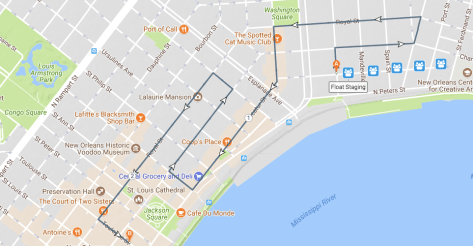
2018 route
This parade grew out of the Krewe of Clones which paraded in the 1970s and 1980s. Like many krewes, there was a disagreement as to the style and tone that members wanted and so Krewe du Vieux was formed when some decided that success lay with the most debased, most ridiculous, and the most profane version.
It is also known for the profusion of brass bands that they hire:
They became truly de rigueur in 2006 with their parade less than 6 months after Katrina and its C’est Levee theme that was impressively hilarious and pointedly mocking of the government that had failed us so completely. I still have throws from that year as do many of my friends and neighbors. From their 2006 release:
Lifes a breach, and sometimes you just gotta go with the contraflow. So pop a cold one (pop a looter too if you have to), torch the nearest mound of trash and roast some weenies, and pretend that convoy of National Guard hummers rolling by is just another parade.
For 2018, its king is Rich Campanella, Tulane geographer, historian and obsessive researcher of the accurate history of our 300 years. His list of books is extensive, his articles are constant and on top of that, he is a nice guy always interested in hearing an opinion or a factoid on the physical space of our colony. Here is King Rich’s piece on the history of the route that he will lord over this evening.
Come out on his appropriately wet parade evening to honor him and the motley who take over our streets at 6:30 p.m. tonight.
 French Quarter block by block
You must be logged in to post a comment.