Entrepreneurial Jackson Square

The cultural and political significance of the square has already been well researched and widely published, all of it illustrating its role over the 300+ year history of New Orleans. Many writers have highlighted its colonial role as a military parade grounds, and others have focused on its development into its current role as the chief tourist mecca for the more than 10 million visitors the city hosts annually. Few writers however, focus on the individuals that have and continue to shape this square, doing so as builders, philanthropists, artists, activists, residents, and more.

Since the archives of written pieces on that history exists, this series of articles will instead focus on how entrepreneurs have used the Square since 1850. That date was chosen because it is when the Almonaster/Pontalba family added its final (of many previous) contributions to the Square with the iconic 4-story red brick buildings that still anchor the upper (west) and lower (east) sides of the Square. The buildings built by Micaela Almonaster Pontalba, a native daughter of the city who sailed back to France after they were completed never to return, set the scale and rhythm of how the Square conducts business to this very day.

Baroness Pontalba herself will be one of the entrepreneurs that this series will celebrate, as her efforts are a perfect prologue for the modern uses of the Square. Her half-decade long development of the two Pontalba buildings will center this story, as will the later generations of the Pontalba family who could not withstand the late 19th century and early 20th century abandonment of the square by the city’s elite. Luckily for them, others stepped in once again to keep the Square a democratic and dynamic place.

Even though the buildings remain the most significant contributor to how commerce is conducted in these 2.5 acres, the Baroness’ original plan for their use has to be considered an almost total failure. Instead, in true New Orleans fashion, the Square’s users adapted them through philanthropic intervention, city, state and federal oversight, and the sheer vehemence of New Orleanians who saw their value. These interventions happened at various times over the last 170 years, often at the last possible moment before demolition would have invariably led to the loss of the Square’s daily activity.

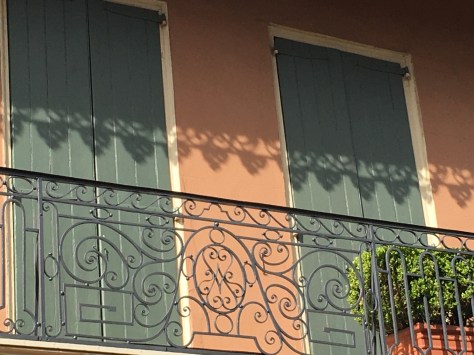
French Quarter Ironwork: monograms and initials

I have been gathering photos of different ironwork motifs in all four quadrants of the Quarter and will be researching them further when I am able to get to the wonderful HNOC’s Williams Research Center.

Here are all of the (18) monogram and initial motifs I have found – so far.

I have found them on Burgundy (2), Dauphine (1), Bourbon (1), Royal (5), St. Louis (1), Chartres (3), at the Pontalbas,  2 different motifs on the Skyscraper at St Peter and Royal, on a modest brick house on Dumaine (where the AP scrollwork from the Pontalbas is on the gate transom of a house in mid block for some mysterious reason) and two on Esplanade. Most are found on second or third-story balconies, but a few are on front doors, and a few others are on a gate.

Thanks to The Collins C. Diboll Vieux Carré Digital Survey at HNOC I was able to research each location to see if I could find a likely reason that particular monogram or initial was added. I am also searching for other history books to find other information as needed so I will continue to refine and add to this list in the next few weeks to capture each monogram and its history.

Have been long confused by description of the Bosque House: “The central panel of the rail has a most graceful arrangement of scrolls in the character of the best 18th-century work and in an oval at the center appears the monogram of Bartholome Bosque, curiously backward when seen from the street.” It doesn’t seem backward any longer.

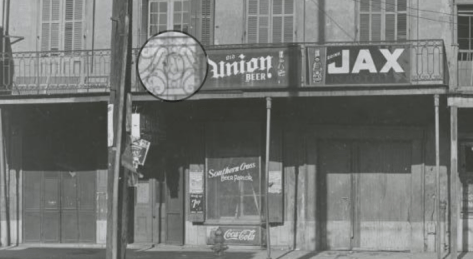
Yet, in the 1930s pictures of the scrollwork it does indeed look backward in the picture:

Love the description too:

The wrought iron railing of this balcony is perhaps the finest feature of the façade and is comparable to only three or four other examples in New Orleans — the Cabildo, the Pontalba House, and the Correjolles House at 715 Governor Nicholls. All these railings are of about the same date and are all probably the work of the same craftsman, who, in the case of the Cabildo and the Pontalba House is known to have been Marcellino Hernandez, a local blacksmith of great skill.

I went to look at 715 Governor Nicholls and its ironwork certainly resembles the Bosque House:

715 Governor Nicholls

Next up: the anthemion or palmette motif.

My take on this take on Jane Jacobs and New Orleans

Post in The Lens by urban critic Roberta Brandes Gratz:

What would Jane Jacobs make of our post-Katrina transition from ‘death’ to ‘life’?


My response:

I always appreciate Roberta’s take on things, even though I think that she (and The Lens) sometimes rely on a narrative that is preservation precious, meaning it focuses on historic corridors and “worthy” buildings over a real housing criticism. Her exultation over the neighborhood corridor boom is a bit odd when in New Orleans, neighborhood mom and pops simply never went away but instead brought back after the levee breaks whiter and trendier than before.
Maybe the real issue is the feeling I often have that too many people still have a vision in their head of a return to the halcyon days of Main Street America, circa 1950, and expect city hall to deliver us a version of that, even though our lives and shopping have changed completely. That thinking limits the potential of old corridors and gives tacit approval to keep them empty until someone can redevelop them as before rather than re-imagining storefronts as low-income rental units or as rooms for unhoused population or shared workspaces or (gasp) even green space where buildings were before.

However, Roberta was spot on in her early assessment of the new hospital zone – about it being a developers boondoggle and about offering those jokers retail leases at ground floor and not about a better hospital than Charity.  That one of its aims wasto kill the street retail of Canal Street of one type by moving it to Tulane and likely make the old street filled with very exclusive shops and hotels- that is already coming to pass.
She is right about the code busting happening at City Hall: the new CZO is a joke. A form-based approach to zoning would be much more appropriate to our city than what we got.
The argument about streetcars is sort of lame, as the Rampart line going to Poland was stymied by the railroad and not by local policy or willingness, and the lack of public transportation is a deep and long problem that is not changed by that type of investment that involves streetcars which are clearly for the visitor.

Of course I am annoyed by her ignoring the French Quarter, my neighborhood, which is still a neighborhood and pound for pound the most active, diverse and mixed use area in the city in any 24-hour period; yes we have millions of visitors in our midst, but also have a somewhat steady population since K (and the changes correlate to the Orleans Parish census), more residents than the Marigny, or Bayou St. John or some other areas. We got our problems and some of them like development (or an overemphasis on festival culture!) are getting worse like every other area, but don’t dismiss us just ‘cuz that is the “supernative” thing to do when talking about New Orleans!

Since she was a many-times return visitor who then bought a home (although I think she may have since sold it) I am surprised at her toss off of the short-term rental issue. It seems to me it requires a thoughtful approach by thinkers like her, as she must know that it has allowed many homeowners to keep their house here and to do repairs and new residents to decide where to buy, and so when used well by principal homeowners, this system can be a boon.

But let’s give her writing the credit it is due: “Jacobs did not try to dictate how things ought to be; she wasn’t prescriptive..Local wisdom, she found, is where the best ideas for change take root. They don’t come from political leaders, planning professionals, developers or credentialed experts.” This is so right and because it is what I try to do in my work, I am glad to see it written so beautifully and simply.


(another response I posted the same day to a VCPORA story in the Advocate on lower population in the Quarter since 2000):

First, according to the Data Center, the numerical changes in our FQ neighborhood correlate to the dip in the entire parish. Second, those changes have a lot to do with the love affair planners and neighborhood associations have with encouraging massive single home renovations over incentivizing real mixed use. And the resident and business associations allowing heavy trucks in by just paying a small fee, actively discouraging bike or scooter parking, allowing film and festival culture to take over our area constantly are part of the problem residents have to overcome. Here are some things associations can do right now to swing the pendulum the other way: work to incentivize rent controlled apartments by offering tax breaks to those homeowners who have little used property (including upper floors of commercial buildings, especially on Chartres, Decatur and Canal), walk to find and fine those who hang key boxes on their gate that indicate illegal STR units, create a citizen reporting app to allow FT residents to file complaints immediately and directly about code violations and stop focusing on tshirt shop raids and instead focus on adding amenities that residents care about.

A serious renovation begins on Royal Street house

(original post from 2013)
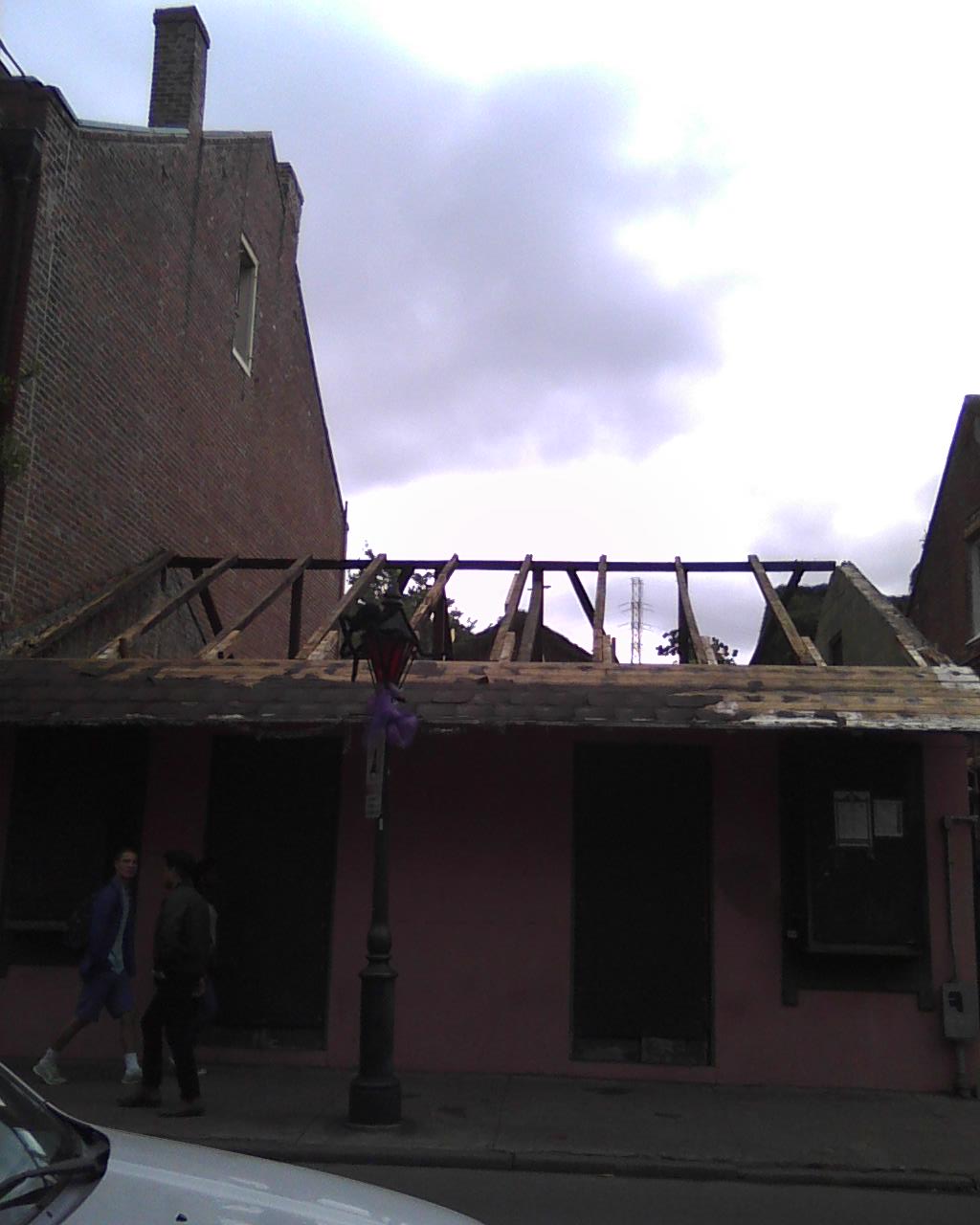
This is a nice little house in the 1000 block of Royal Street between Ursuline and St. Philip. The family that owned for the last 80 years sold it after using it as rental property for much of that time. The new owner is reportedly from New Orleans and is moving back to live in this house, once renovated.
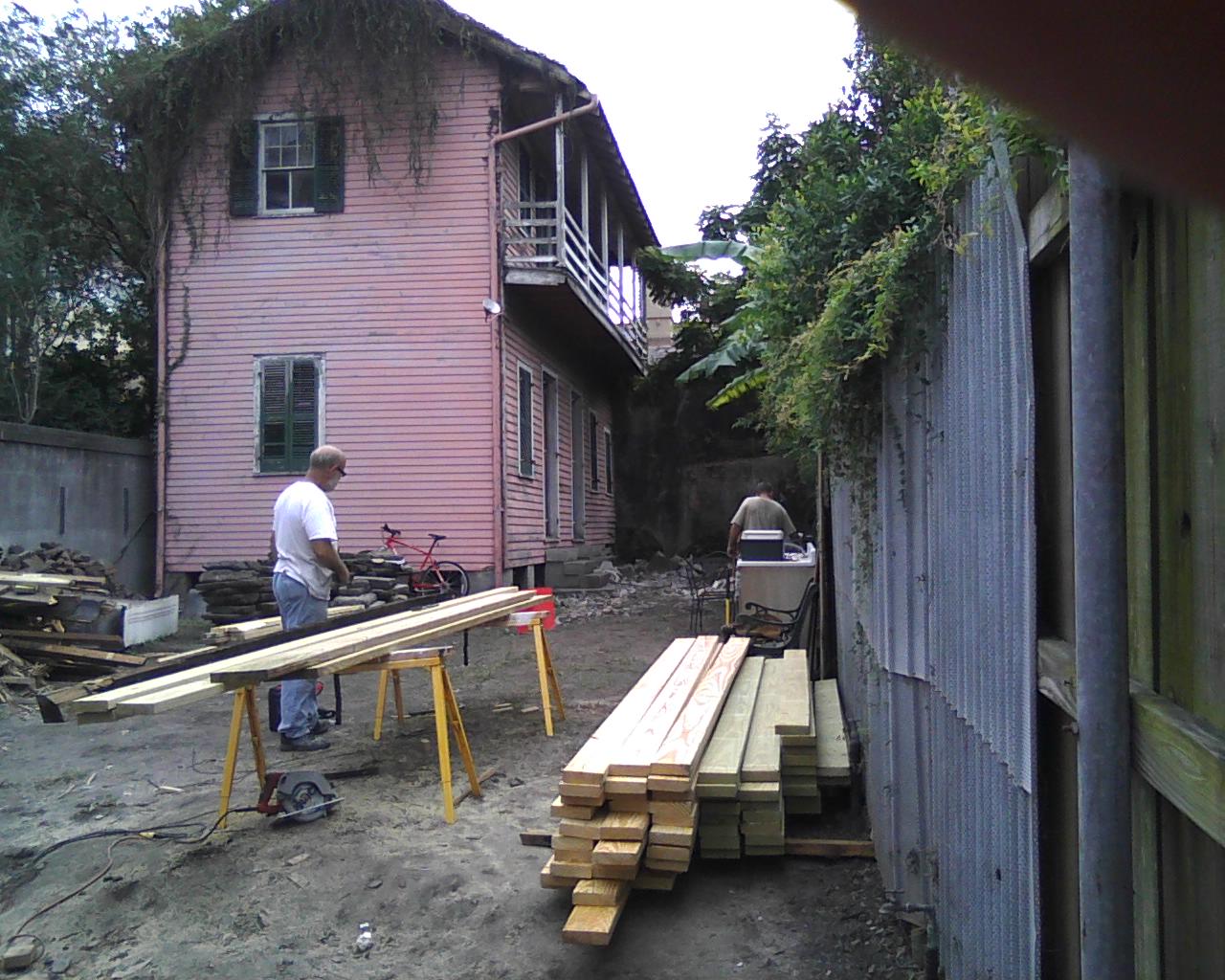
Literally, the house has been taken down to its front and side outside walls and will be expanded over the next year or more. That back house has been empty forever and they will deal with it after the front house is done.

Stay tuned for more pictures over the next few months….

The front of the house as of 10-18-2013

The front of the house as of 10-18-2013

looking into the house from the back.

looking into the house from the courtyard


The long abandoned house at the back of the property in the courtyard.

The long abandoned house at the back of the property in the courtyard.

Habana Outpost secures approval of Vieux Carre Commission

Habana Outpost secures approval of Vieux Carre Commission | NOLA.com.