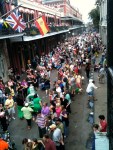
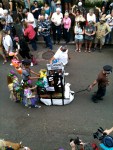
Barkus is a game changer (STILL!)

(From 2011)

Before my time, parades used to roll through the French Quarter. Well, really, they used to roll through lots of neighborhoods.

Now one has to get to the Uptown side of things or at least stand on the dividing line to participate in float parades, except for Endymion. However, I stay far from that Mid City mess which is held on the last Saturday before Fat Tuesday. To explain my p.o.v., just know that some groups start to camp out on the Thursday before Endymion and that it seems to celebrate white middle class New Orleans more than any other parade in the city. And even though I am in that number, I know we have no proud history of adding much to Mardi Gras, music or food around here. So, when we throw a parade, you can expect it to be loud, big and lacking some finesse. So good luck to those brave enough to make it. Me, I wish ol Endymion would find that long sleep again.
My schedule is usually seeing 1-3 parades and 1 of them is one of the 2 walking parades in the French Quarter. Barkus is almost always the choice.
What I like about it:
1. It benefits a worthy cause-pet rescue and allows any brave dog owners to participate.
2. It is the right scale. Those folks have to stay sober enough to walk miles with their dogs but drunk enough to wear feathers or shirts that match them.
3. It has a sense of humor. South Pawcific?
4. It’s over before dinner time.
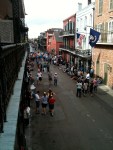
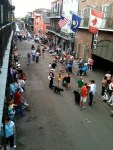
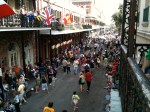
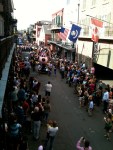
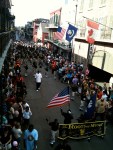
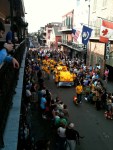
I have been watching it recently from a friend’s place on Saint Ann to watch the crowds. Some of us sit on the balcony, some of us draw up chairs on the ground, chatting with anyone near enough to be caught. What I have noticed is that much like French Quarter Festival, it seems to be bringing in locals who spend the day roaming the Quarter and reacquainting themselves with it. I see groups of people chatting for hours, sitting with a beer and their chair set up in the sun. Children are very plentiful and the Barkus participants keep an eye out for them to bestow their trinkets first.

Many parades are somewhat hierarchical: we sit waiting for the masked riders to roll by hoping to catch their eye or their ear. As glorious as they can be, they can also be passive and maybe even a little cruel. I find the walking parades much more interactive and personal.
Really, it is one of the reasons why the Quarter remains useful: in a small way, like Tahrir Square, we use it to perambulate and to connect and if we need to, to protest. Lucky for us, a change in government is possible here with peaceful transitions.
I contend that the reason we came through our most recent federal disaster with so little strife among the citizenry was that we have this release every year we call Carnival season. It forces us to meet new people, and allows us to have the time to catch up with old friends in detail. We laugh at bad puns together, cheer a good throw or catch and generally get the anxiety and angst out.
And when we can do it in the middle of the old city with our best companions, what can be better?

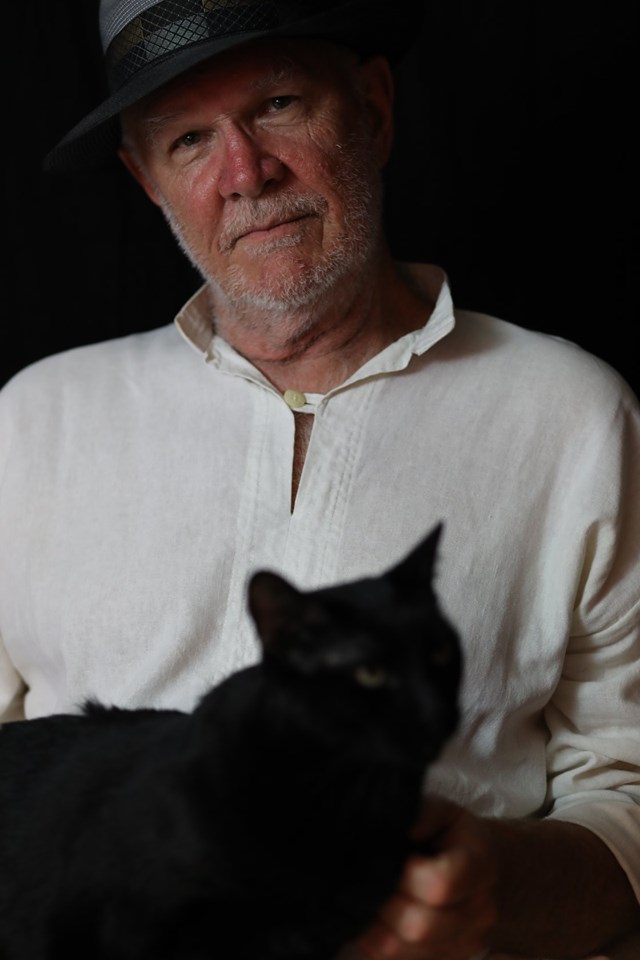
Chris Stall, Bell Captain

From the International Hotel School website:

A bell captain usually supervises the conduct of bellhops and porters. Generally working in a hotel, a person in this position is usually cross-trained to take on other hospitality tasks like concierge or desk clerk duties in addition to bell captain duties, depending on the size of the organization.

On the 600 block of Saint Ann, the seven-floor parking garage (yes 7 floors; you have to stand in front for a few minutes to see it) is the  “side porch” of the Place d’ Armes Hotel. The hotel which has around 80 rooms, caters to regulars and sophisticated visitors. That is indicated by the lack of all-night “whoo-hooing” balconies for rent here. The few rooms with balconies overlooking Saint Ann are told upon check-in to honor the neighborhood vibe and shut the outside party down at a decent hour.

The garage is not self-parking. You and your car enter (that is, if the valet guys have the sign turned around to the public parking allowed side of the metal stand or you’re a hotel guest or contract holder), and within seconds of you pulling in, the keys are in their hand and you are on your way out to the bright sunlight. Maybe you stop to watch them expertly pull your car into the car elevator, or maybe you don’t. Maybe it helps to hear that no one remembers any major garage accident or mishap from this system.

Chris Stall, the bell captain, has been on the bell/valet staff for 13 years. He is the senior member of that staff although outrank him in seniority in other jobs. Always agreeable, chatty, never flustered, he is extremely courteous about listening  and mildly commenting on a wide range of subjects.

His familiarity with hotels is long; his dad had a career in the food & beverage divisions of hotels at the Sheraton and the Intercontinental on Canal and also opened new hotels in Orlando, Las  Vegas, Nashville, among others. The four kids went along, but as soon as Stall was 18, he came back home for good, as did each of his siblings as they came of age. He lives with his rescue dogs in Chalmette where he was born and bred and where most of the family still resides. 

He started his own hotel career 15 years ago at the Hotel St. Marie, where his brother worked at the front desk, then to Place d’Armes 13 years ago. The Valentino family owns both hotels along with Prince Conti, the French Market Inn, and the Lafayette Hotel in the CBD. They also manage the City Sightseeing New Orleans Bus (the red, double decker Hop-On-Hop-Off) tours and the Basin Street Welcome Station.

That brother is long gone from hotel work and now a locksmith.  In turn, Chris has passed along the good fortune of a connection to other members of his family; until recently, his cousin spent five years as a valet at the hotel.

He works 40 hours but only on weekends, pulling two 16-hour shifts, and finishing with 8 hours on Sunday.  This allows for great flexibility for his off time, although as captain he is expected to handle any staff shortages. If you ask if he is in charge, you get a laugh and an acknowledgment shrug, befitting his self-effacing demeanor. He is, but the work is simple to understand for the staff. “It’s a great job for a young person going to school or getting started,” he says.

Along with spaces for hotel guests, the garage holds about 80 contractholders, with about 20 of those coming and going daily or weekly. If the regulars’ routines shift at all, he wonders what happened to them. Short chats with regulars, helping with unloading groceries, holding the dog leash, and passing along news of the area is all included.

Sometimes one of his sisters brings their family down for an event, but for his part, he doesn’t spend his off time in the Quarter. However, when someone talks about the Quarter, he mostly defends it. “After all, this is the bread and butter of the city.” 

The nuttiest thing he has seen while working in the Quarter? He says the list is too long.

I wrote this in 2020 for an online site where I had published similar stories but these were never finished by the editor; all of them will instead be published here.

The Inertia of a Tourist Economy: Does it help or hurt during a crisis?

in•er•ti•a

  • n.
    Resistance or disinclination to motion, action, or change

On March 11, the city decreed a state of emergency over COVID-19. Too many scofflaws ignored that and so on March 16, Mayor Cantrell closed the bars and restaurants at midnight to shut down the expected all-day and night partying that St. Paddy’s day brings to cities across the US. Not everyone paid attention but a lot stopped immediately and then over the next week as the hotels emptied, so did most of everything else. On March 20, the city issued a firm, scolding stay-at-home mandate and on March 23, the state followed suit.

My social media post on March 26:

Its been 10 days since New Orleans shut down dine-in restaurants and bars and 6 days since the city stay-at-home order.  Since then, watching the wheels of commercial life slowly grind to almost a complete halt here in the French Quarter has been absorbing and sobering. At first, most places tried to stay open even though the bulk of their business had always been visitors, both those visiting from other places as well as the daily visitors who work in shops, in offices and seem to have so many lunch meetings. Some places did their best to drum up local take-out business via social media and word of mouth, but one by one, almost all in my quadrant have closed. Boards across windows and doors started going up at shops and galleries first, and then hotels and bars and cafes followed. It’s startling the first time you see the dark lobbies and gated locked parking lots 24 hours a day of a hotel normally lit up and staffed. You think about those workers that you saw 5 or 6 times a day for months or years and wonder if they will be back. (The bell captain at the little hotel down the street told me he had 120 days of PTO to use, but was still angry that he had to go home.) Yet even when the businesses began to shutter, some street traffic continued, albeit lighter than normal for a few more days. Then one day this week, I walked to Jackson Square and there was not a single person there.

At 2 in the afternoon. In sunny, 85 degree weather.

You’ll still see people walk a few times a day with their happy dogs, (saw a guy with his leashed ferret a few days ago), evening get togethers on carefully-spaced chairs on the street, a few tourists, and always some street people. The Mayor is slowly moving the homeless into hotels; the guy who lives in the window recess of the Presbytere Museum told me today that he had just missed the cut off to get in the Hilton Garden Inn by 6 people. I’d say the best way to describe his reaction was slightly stung. I told him they’ll find a place for him soon; he seemed to brighten at that. I think he looks forward to that mostly because he misses talking to people, he misses the hustle.  I mean, even the silver guy’s paint is almost entirely worn off. The musicians who are staying in the apartment across the street come out to the balcony in the afternoon and play music quietly but seem to have little of the animation and long jams that they offered in the first days. You make eye contact with strangers, but there is a bit of a hesitation in being too chummy; you don’t want to encourage them to slow down and stay around here. Some neighbors have chalked “Go Home; Be Safe” on the sidewalks; but those who get it are already home, and those who don’t get it, won’t. It’s odd to see the energy seep out of these entertaining streets, but at least we have a strong reason to believe much of it will return. In the meantime, we can save ourselves, our friends, and our neighbors by killing as much of it as possible. #nolacorona

Since that post, I have thought a lot about these silent streets since this post as the days tick by and wondered more and more about how and even if it will recover. Then, something my clearly exhausted but happy pal who owns a cafe in the Marigny said to me (as he bagged up order after order for folks patiently and happily waiting outside his place) struck me:

my business mantra right now is adapt or die.” 

Or as Arundhati Roy brilliantly said:

this pandemic is a portal.

Whatever it is, coronavirus has made the mighty kneel and brought the world to a halt like nothing else could. Our minds are still racing back and forth, longing for a return to “normality”, trying to stitch our future to our past and refusing to acknowledge the rupture. But the rupture exists. And in the midst of this terrible despair, it offers us a chance to rethink the doomsday machine we have built for ourselves. Nothing could be worse than a return to normality. Historically, pandemics have forced humans to break with the past and imagine their world anew. This one is no different. It is a portal, a gateway between one world and the next.” 

That portal can be hard to see in this anachronism of a neighborhood, charmingly designed for 17th and 18th-century living, and then made into a stage for visitors from other places to get a quick taste (and purchase) of that earlier time before heading back to their modern world.

Yet, even though it is primarily a stage, many things about this Quarter still work: the scale of it, the design of small apartments set above small storefronts, small well-run hotels, its nearness to the city center safeguarded behind massive well-engineered earthen levees instead of poorly-designed concrete walls such as those found in 9th ward or in Lakeview, utilities underground,  the highest ground, neighbors dealing with each other in shared alleys, on sidewalks and via on-street parking and so on. And because it is usually spared damage because of the care taken to maintain its facades for the tourists, it can quickly become a gathering place once again when hurricanes or floods devastate much of the city. Last but not least, this tourist center requires thousands of daily workers who become as dear as next-door neighbors, many of whom residents see more than their family, often relying on more than they do on far-off relatives.

Still, now as I venture out to the other parts of the city during this shut-down to get items, I see what I do not see here: restaurants and stores that have quickly adapted. From distilleries selling hand sanitizer or cocktail kits for homemade happy hours, cafes selling quarts of cold-brewed coffee or working with farmers to sell just-harvested items alongside their prepared items,  even fine dining places pivoting to offer a family meal (and 1/2 price bottles of wine) by drive-by pickup, they all seem to know what their neighbors would pay for and how often to serve them. Those businesses have bulletin boards,  funny, aspirational chalk signs for passersby and have become eyes and ears and care for their neighbors.
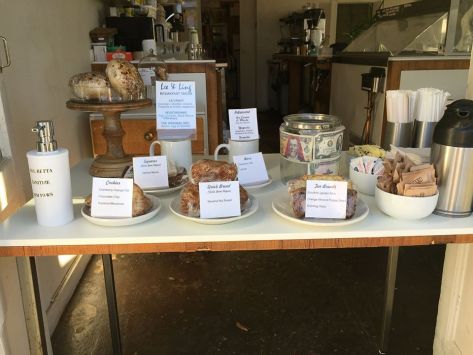
Orange Couch set  up for physically-distanced ordering at the side door

In these 90 or so blocks, enough locals live here so that we actually do have many neighborhoody things like drugstores, veterinarian offices, postal emporiums but it has become clear during this moment that even much of THAT relies on the millions of visitors who also come to these blocks, or it relies on the pockets of workers who, currently unsure of when or if they get to return to their store or will put that apron on again, are saving their bucks. Or maybe it doesn’t rely on those dollars at all but the business owners just think that it does. For whatever is actually true, what is clear is that almost all of them are closed. And they closed fast.

A few businesses tried to use social media to convince local folks to get items, but locals from other parts of town have been penalized and confused far too often by the parking rules here to dare to drive in. And even if they do brave it once in a while, most are not able to afford or stomach the majority-rule visitor-obsessed restaurants often enough to be familiar enough to check in with the others now.

As for residents: even though numbers have climbed steadily in the last 20 years, now at around 4,000 with around 1000 at or below poverty-level they mostly divide into the worker/residents of the Quarter (although far fewer than when I was one) now without income and the very very rich who have everything they need delivered by Amazon living behind their gates and private driveway.  Since 2000, owner-occupied units have risen from 24.6% to 48.2% with renter-occupied down from 75.4% to 51.8%;  fewer of us renters and therefore likely less of us remaining who seem to live here because we love it and not because we depend on it for work or because it is a family inheritance or peccadillo hideaway. As a result, those able to go get items from the restaurants who tried to offer food is even a smaller group than those other areas of town.

The other obvious issue clearly seen now that the Quarter is only serving its residents: it is so very very white which wasn’t the case when I moved here as a teen. And even though it has become clearly whiter in terms of residents since the pre and post 84 World’s Fair development furor,  on a normal day the cross-section of tens of thousands of workers, hustlers, and visitors allow the FQ to be as diverse and energetic as any place in this city, pound for pound, 24 hours a day, 7 days a week.

Not right now though. The only faces of color or heard talking in other languages here during COVID-19 have been the sanitation folks, grocery workers and security personnel. The usual Quarter workers and artists who represent the diversity of our city are home in their own neighborhoods which since 2005 are far far from here. (Which ironically, also means that the multi-generational food entrepreneurs offering good, culturally appropriate food to a cross-section of New Orleanians are also now far from here.) That diversity is the heart and soul of what makes New Orleans interesting and important. And when we reopen, it’s possible that many culture bearers and much of our indigenous knowledge base may just not care to keep fighting their way back here this time – or the next.

All of this calls into question the future through this portal: what will an economy only based on tourism offer our city, once disruptions come again and again, as we have to expect they will?

More simply and directly, what will remain alive after just this one shutdown? And what if the US opens up later this summer just as we hit the height of hurricane season?

In only a month, I have already seen 1-2 brand-new commercial For Rent signs, talked to business owners who are mulling the idea of not reopening their storefront that cost upwards of tens of thousands of dollars per month, and have heard of a few neighbors who are moving away to live with family or to cheaper cities to replenish their savings. One has to imagine that restarting the tourism wheel will take a while, especially when rumors (and logic) have it that JazzFest will likely not operate in 2020 or if it does at all, be a much smaller and leaner version. We’d have to assume the same will go for French Quarter Fest and others as they depend on sponsors as much as visitors. Connected to that is the outcome we have to expect if the seasoned staff of the past few decades that ran our best places like clockwork will not return intact.

So the question is how will we look once through this portal? Will the French Quarter adapt as it always has, or will it finally “die”- meaning become smaller, less lively, maybe owned by more out-of-towners with deeper pockets who move more to the middle in terms of what they present as New Orleans? That could mean losing what had been a critical mass of authentic experiences and becoming too small to entice enough visitors to hold this city together.

Or maybe – just maybe – this old city will just adapt as it has so many times previously.

In 2008, the book Building the Devil’s Empire offered the intriguing analysis (via many years of archaeological digs around the old city) that by the mid-1720s due to the failure of New Orleans as a tobacco exporter and the effect of Law’s Mississippi Bubble bursting,  France had basically given up on this colony, although not turning it over to the Spanish until the 1760s. Yet those digs show lively trade and activity in those 40 years, proving that New Orleans became a smuggler’s capital by turning its attention to the Caribbean to find its own opportunities even though that was against French law. That “rogue colonialism”, as Dawdy names it, she believes was mirrored in 2005 when the federal government did its best to thwart returning residents and stymie small businesses yet many found a way around that to survive and even some to thrive.

That rogue colonialism is clearly an adapt or die portal which could be vital for whenever the country opens back up for business. Do we have another one in us here? And if so, what will that version center on: regional food?  port activities? design for climate challenge places?

And maybe to help that, possibly commercial rents in the FQ will come down to reality. Maybe people will see the need for downsizing their place to something smaller and more communal as only the Quarter can offer. Maybe my idea of Canal Street and Pontalba being offered tax credits to become rent-controlled to entice residents to move upstairs into all of those decaying camera shops will happen.

I hear bike shops around town are doing bang-up business right now; maybe we’ll see a few open in FQ again.

Maybe less crap made in China will be for sale in our shops and more useful services for all residents can return. Shutter repair? Seamstresses? Metalwork? Mule-driven delivery around the city?

Maybe the French Market can add a splash park on the concrete pad, a storefront library, citywide compost drop off and community or senior services along its many block span to serve the entire city in some manner?

In any case, the way through this portal does seem to require a push to something new even if it might actually resemble something old and tested.

The question is: can we begin to turn in that direction?
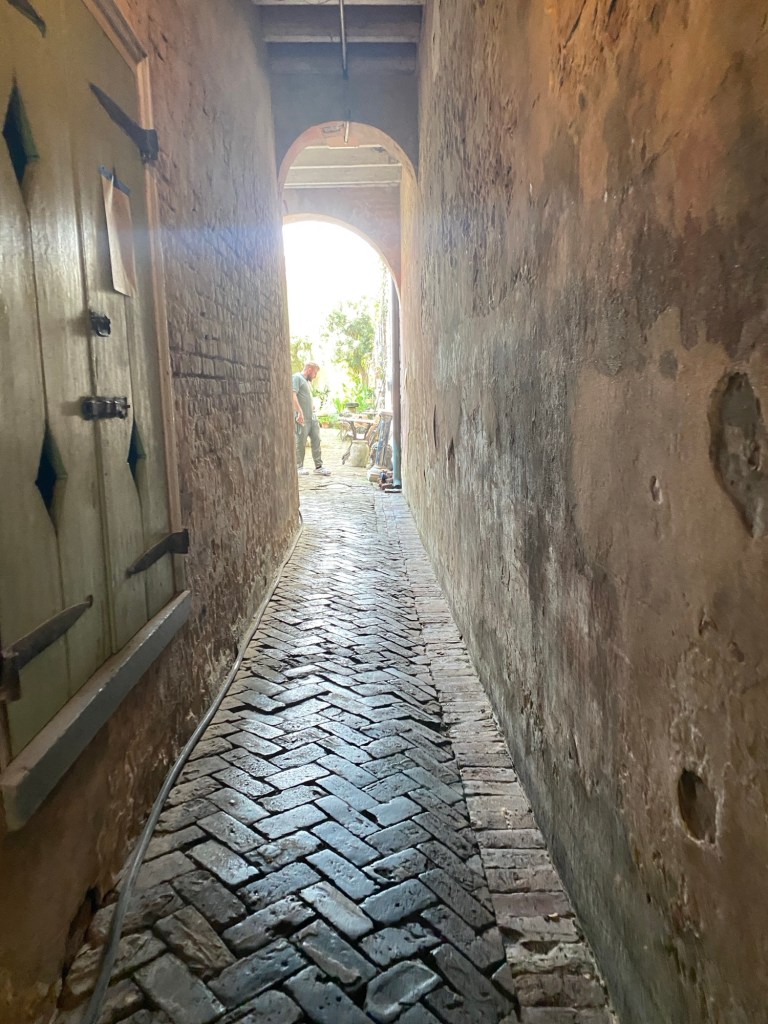


Events this week: Glam, literary New Orleans


Join us for an evening of carnival-inspired fashion and festivities! Hosted within the Presbytere’s Mardi Gras exhibition, this runway show will present works inspired by the lavish costumes and gowns on display, worn by local performers and models. Attendees will get an after-hours view of Grand Illusions: The History and Artistry of Gay Carnival in New Orleans, which highlights the ground-breaking work of local costumers and krewes and provides further inspiration for how carnival attire can influence year-round fashion. This event is made possible through a partnership with Louisiana State Museum, Friends of the Cabildo, and New Orleans Fashion Week, and all proceeds will benefit the museum.

Purchase tickets here


Wednesday (10AM): September 25th
Tickets: $20 Members | $25 General Admission 
Departure Point: 1850 House Museum Store (523 St. Ann St.)

Celebrate the Tennessee Williams Festival with a two-hour French Quarter Literary Tour. The French Quarter and New Orleans served as a muse for some of most important American writers of the 20th century including Tennessee Williams, William Faulkner and Truman Capote. Follow their paths through the French Quarter and see how the city impacted their writing.

Purchase tickets here


A job, a gig, and a hustle – and a cracker.


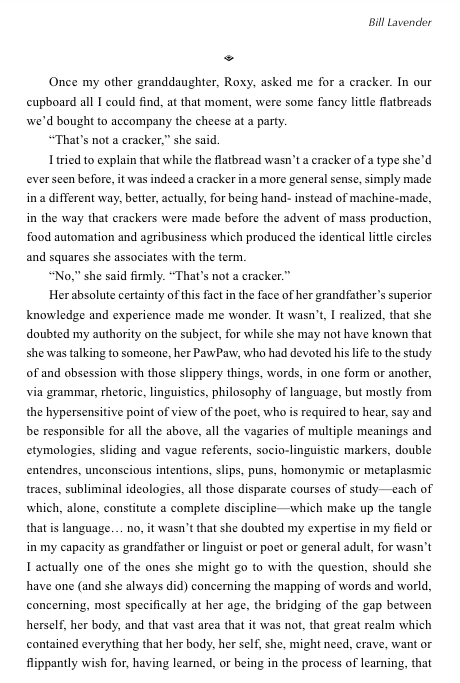
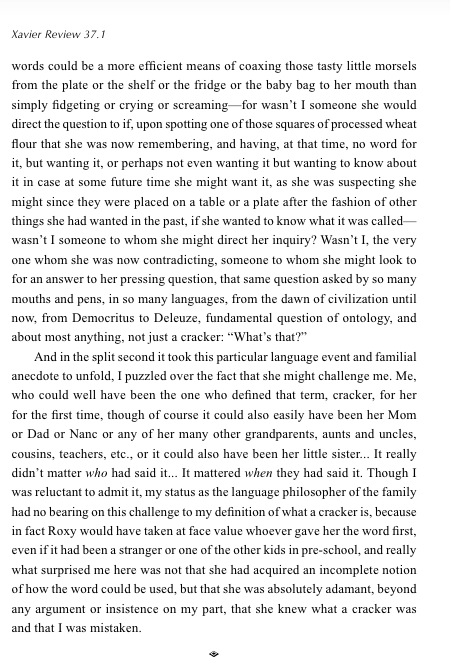
On my other blog, I try to show my appreciation for an essay that local poet Bill Lavender has written. In it, I mention the part about Roxy and the cracker. You are welcome.


Lavender_cracker1

LavenderCracker2.png


photo of Bill by writer Louis Maistros

70828988_10158759332926754_6244070124039438336_n.jpg


Long lost poet reaches out

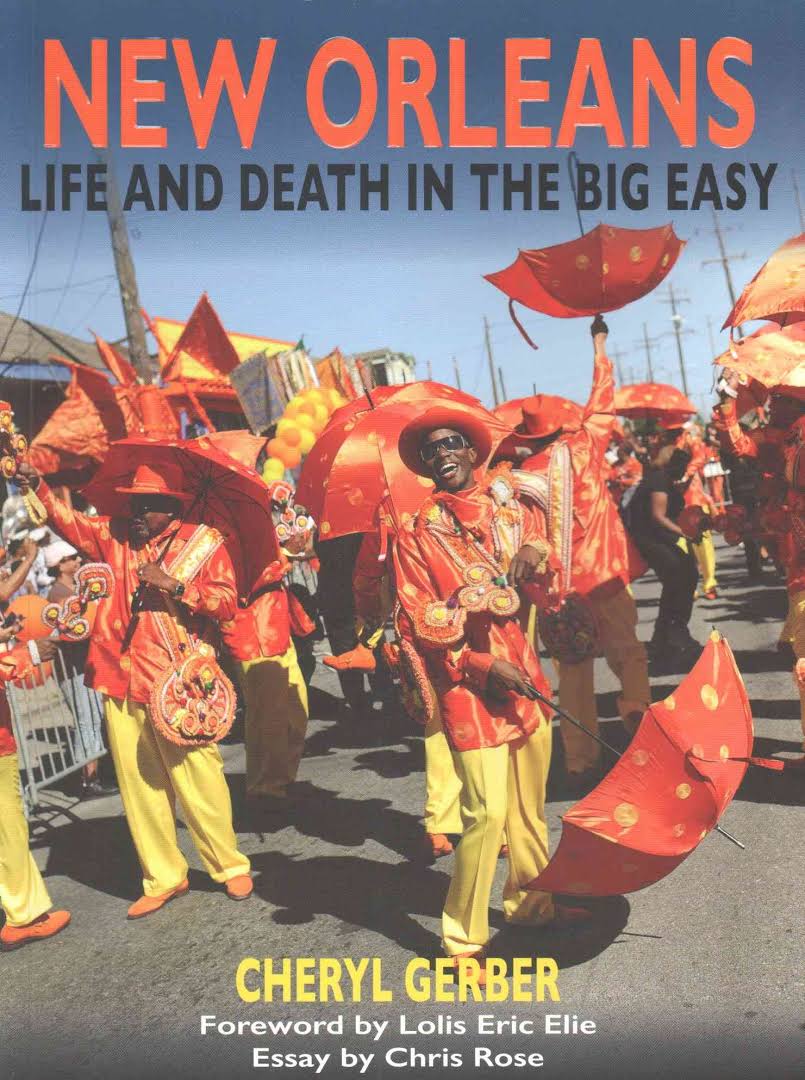
One of the great everyday heroes of New Orleans is photojournalist Cheryl Gerber, who is constantly roaming the streets of New Orleans searching for stories to show the deep humanity of our place. Her book, “New Orleans, Life and Death in the Big Easy” is one of my favorites not only for its gorgeous photos, but for its awareness of the deep racial divide that can be seen by anyone looking. Those inequities don’t cancel out the joy, but it does underscore that our public life is rooted in the reality of the challenges we face here and the fragility of this part of the world,  circa 2019.


Similarly, Cheryl has brought to her neighbors’ attention an emerging story about a street person that she had noted in the past (and even had a pic of him) but hadn’t felt he wanted her to approach. Recently, something changed and he came to her, told her a great deal about himself and led her to believe that he might be okay with her being more involved. She stayed up all night, researching the info he shared and miraculously, made contact with friends of his. She found he was sorely missed and had been sought again and again, but as no information had reached them they had no idea what to do next. In their conversations, those friends told her of his talent, his story, and his effect on them. His best friend flew to New Orleans almost immediately to search for him, and on the second trip, they found each other and I defy anyone not to have tears rolling down their face at the telling of that moment which is found through the link below (under Story).

All because of the legendary New Orleans-style tough hide/soft heart and an endless curiosity about others in the public space that Cheryl puts into practice daily.

So the next step is for those of us who want to aid his friends help him get back on his feet in the city he loves so dearly, to follow the link to do so.

And maybe you will also be inspired by Cheryl to find a way to connect to one of your neighbors, maybe even one whom you don’t fully understand. Maybe even help them to find the happiness standing right in front of them on Esplanade Avenue.


Sit at the river and visit and remember

I wrote this in 2015. I still agree with it.

Okay. I promised myself I wouldn’t and yet here I am…But this time I am only talking to my neighbors in New Orleans and across the Gulf Coast. Not that I don’t appreciate you, my fellow Yankees and you Canadians and Westerners with your fierce belief in a fair shake for our city. I do, but I feel like I’ve spent these years talking to you about New Orleans and Louisiana and Mississippi and sharing the secret greatness of it with you and by this point, you either get it or you don’t. You either believe we matter or you don’t and there is nothing more I can say to help you understand. But I’ve had little time for my neighbors and pals here so this is for them because so many of them are downhearted and angry about the state of their place.
Now that we have the distance of time from 2005 to raise our eyes and look about, it is very clear that we have lost a tremendous amount that is not going to return. My grandmother died in July of 2006, after returning in January to her remodeled and unfamiliar home. That home that her daughter had done her best to make right, working hard to make even better in some cases. Still, I am convinced Mary Louise looked around for a bit and just said, no thanks. Many seem to know exactly how she must have felt as friends have packed up and moved away – for good most of them – because they are bitter or they are sad, so sad or frightened by the real possibility of it happening again.

At the end of 2005, I wrote this email to friends who had not returned yet:
I know some of you have heard comments from some New Orleanians about your decision to not come back right now. Some people are acting badly about who is here now and who is not. I (and many others) understand why it is not feasible for some folks to come back right now. I think that it is very clear thinking to make sure that you are taking care of yourself and family, as well as doing what you must do to keep a job or children going.This is a frontier town right now, and not too pretty or easy. The ups and downs are dramatic and ongoing. I tell you, I would not be here either right now if my work did not depend on it. Having said that, I am glad I am here. I am glad because I can help with direct action, which is my thing, but if your thing is keeping the awareness up in other places, cool. I know each of you is doing the good work out therein the “normal” world. Thank you for that and please know all of us- whether on Esplanade Avenue or Main Street- are in this together.

——————————–
Some of those who received it replied with gratitude and promises to return and some did not reply at all. Some who didn’t reply returned soon and some who promised to come back quickly never did. I was wrong a lot about who would stay away and who would return. You never can tell.
I don’t know what wind event or infrastructure collapse or political spite is coming for us next, but there is one thing that I do know: the cool and lovely fall IS coming and with it, second lines and festivals and outdoor movies and football and satsuma season and much more. And then it will be Carnival season and we will sit together on neutral grounds and laugh and sing and dance and shake our head in amazement that people work every day and shovel snow when they could be here. I’ll bike to the park and meet friends for a walk around the Big Lake or make plans to meet for drinks for “an hour” and still find we are still there 3 hours later laughing until we cry, wiping tears away with paper napkins. The server will smile and bring us more drinks and napkins, pleased with our fun. I’ll stand on a corner good-naturedly arguing politics with favored friends who I find walking their dog and when done, will go back to my car thinking how amazing they are. Stopping at a store near my house, I’ll have a looong chat with the shopkeeper and find we went to the same high school or that he is related to my next-door neighbor and neither of us will be that surprised by the many connections. Artist friends will touch me with their enthusiasm and talent, so open and loving to a world that rarely honors them. My mother will proudly show me all of the young bananas on her trees and ask me once again if I know of anyone who wants them-if not, can I just put them on the curb, cuz we both know somebody will take them.And in doing all of this, we’ll get through it again.  Hopefully without any evacuation scares or more oil spilling and then we’ll have had another season to catch our breath and keep rebuilding even as we watch more of why we want to rebuild slip away or be taken from us. And really, that knowledge of loss past and present and likely in the future does connect us and make the time together sweeter. It doesn’t always make it easier but makes you feel less alone or unsure. So don’t hide away this week or next; embrace the ragged and the unfinished or shake a fist or raise a finger at the profanely new and shiny. Who cares what the world says about us or about 2005 or the city since; all that matters is what we think, what we do and how we shape it. Take in all of it with the grace and humor that we are awarded at birth or as soon as we kill that first palmetto bug (and keep right on talking) and let’s just go sit at the river and visit and remember.