2-year eviction of Upper Pontalba residents

As someone who lived in the building until recently and as someone who has spent the last decade researching the rich history of these buildings and their effect on our public square, lets just say I am deeply interested in the recent news that the residents of the 50+ apartments on the city-managed Pontalba (St. Peter side) have informed its residents that they will all need to vacate the building while a long renovation is done.

First, let’s get to the facts and do away with the misinformation about this building:

  1. It’s all rentals, no owners. The city was given this building back in the 30s by the preservationists who bought it and saved it from likely destruction.
  2. Essentially each of the Pontalba buildings was designed as 16 3-story townhouses, each with their own entrances. They do share infrastructure between them but any of the 16 can be easily closed off from the others.
  3. The rents are not astronomical but are in line with current rents around FQ. For example, the large one-room efficiencies are around 900 a month.*
  4. The apartments are lovely, and have updated modern kitchens, bathrooms and HVAC.
  5. There are a large number of full-time residents some of whom have been there for decades and have invested thousands of their own dollars in repairs and upgrades.
  6. There is not a years-long waiting list. There are often empty apartments which are first offered to residents, then to folks who sign up at the office to be contacted, then a larger search is undertaken (they say they do this phase, although I have never seen any evidence of it online). If someone on the contact list doesn’t reply, they are taken off the list (although that list seems to a bit of a snarl in terms of who manages it and how well it is maintained. That is based on feedback I have received from those on the list.)
  7. The staff is generally wonderful. For example, the men and women who do the custodial and minor repairs are caring and smart folks, many of whom have worked there for decades. (It has also been recently suggested in casual conversations that those positions might instead be independent contractors and not staff positions, which might mean new folks who know less and likely care less about the building to “come by” and deal with stuff.)

There are definitely some big issues such as the roof damage from Hurricane Ida to be dealt with, but the renovations seem to be more about “upgrading” the building. Again, very little in writing is given to residents or neighbors so this is based on my own conversations with staff and reading emails sent by various people connected with the building.

Residents seem willing to work with the renovation, even moving for short periods to other apartments. As a matter of fact, while I lived there, I asked where my latest lease renewal was and was told that since they may need to move us to another apartment, they were holding off on assigning us a lease for a specific apartment. So it was clearly an idea they were also working with at the time.

The issue with removing all residents for upgrades and roof repair is that many of them will not be able to find another space nearby. I think of neighbors who were service industry folks who worked later shifts and came home around 4 in the morning after work. Finding a space that is safe and quiet for folks like that is very nearly impossible in a neighborhood with so many illegal airbnbs operating.

Another question is if emptying it out is even needed. If you live and rent in the FQ, you have worked with landlords who need to do major repairs to these old buildings. I have never (not has anyone I know) had a landlord suggest I needed to leave for years to do those repairs.

And certainly important, is that they are losing 2 years of income.

There has been little information on this topic given in writing, including the actual plans of what is to be done.

In civic activist Jane Jacobs’ parlance, having mixed use and spaces made for people and not for massive development or infrastructure is necessary for a vibrant city. Those who live on the square happily share it with artists, readers, musicians, and others because all are needed to keep it dynamic and useful to the city. The residents are there after the shops close and the museums are shuttered, keeping an eye and an ear on late night activities, sharing information with the Square’s daytime users. It’s a delicate balance, and one that generally works.

Lastly, through my research on entrepreneurial activity in Jax Square, I have found that over the last 170 years, the residents of the buildings have almost always taken pride and care in living there. There have been times that it has housed people of civic stature, other times it had the workers or those newly arrived to the city, and very often, the creative and the enterprising have found their muse there.

That contribution cannot be overstated, especially in a neighborhood that is so physically important and so socially necessary. Let’s do better sharing what is planned and working with the residents and neighborhood to make this renovation helpful.
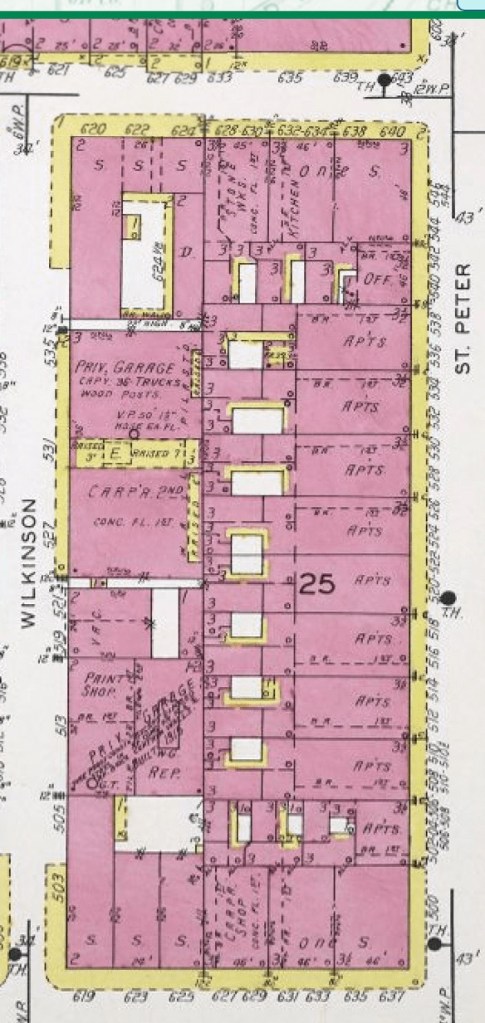
1940 map of the building. Note there were apartments even on the first floor.

* I would even suggest that the city seriously consider the idea I have raised here many times: that offering owners incentives to build in a few rent-controlled spaces for the service industry in the smaller units in these buildings and throughout the commercial areas of the Quarter and Canal Street would be a game changer for the neighborhood vitality, for employers, and for the city.

Entrepreneurial Jackson Square

The cultural and political significance of the square has already been well researched and widely published, all of it illustrating its role over the 300+ year history of New Orleans. Many writers have highlighted its colonial role as a military parade grounds, and others have focused on its development into its current role as the chief tourist mecca for the more than 10 million visitors the city hosts annually. Few writers however, focus on the individuals that have and continue to shape this square, doing so as builders, philanthropists, artists, activists, residents, and more.

Since the archives of written pieces on that history exists, this series of articles will instead focus on how entrepreneurs have used the Square since 1850. That date was chosen because it is when the Almonaster/Pontalba family added its final (of many previous) contributions to the Square with the iconic 4-story red brick buildings that still anchor the upper (west) and lower (east) sides of the Square. The buildings built by Micaela Almonaster Pontalba, a native daughter of the city who sailed back to France after they were completed never to return, set the scale and rhythm of how the Square conducts business to this very day.

Baroness Pontalba herself will be one of the entrepreneurs that this series will celebrate, as her efforts are a perfect prologue for the modern uses of the Square. Her half-decade long development of the two Pontalba buildings will center this story, as will the later generations of the Pontalba family who could not withstand the late 19th century and early 20th century abandonment of the square by the city’s elite. Luckily for them, others stepped in once again to keep the Square a democratic and dynamic place.

Even though the buildings remain the most significant contributor to how commerce is conducted in these 2.5 acres, the Baroness’ original plan for their use has to be considered an almost total failure. Instead, in true New Orleans fashion, the Square’s users adapted them through philanthropic intervention, city, state and federal oversight, and the sheer vehemence of New Orleanians who saw their value. These interventions happened at various times over the last 170 years, often at the last possible moment before demolition would have invariably led to the loss of the Square’s daily activity.

Glitter Box

Written at the start of 2020 when retail was doing its thing:

Anyone who has spent time in the Quarter knows that Royal Street has more than one face. Starting at Canal Street, the 100 to the 900 blocks are replete with glittering windows of goods, carriageways selling framed art, and even a few stately hotels with ornate entrances that offer a peek at plush interiors. The shops are famous for offering a wide set of items including antebellum Southern furniture, elaborate lighting, French kitchen items, Italian stationery, books, a wide variety of souvenir items, even a tiny grocery store.

Seeing it all at a human pace is aided by the pedestrian mall that Royal is transformed into between the 400 and 700 blocks from 11 a.m. to 4 p.m. Monday through Friday. Once the car traffic goes away, those blocks are crowded with street musicians, “poets for hire,” hustlers, unhoused folks, and painters using the ironwork of the St. Louis Cathedral’s back garden to show their items. Oh, it’s a scene.

However, once past the little Red Schoolhouse at the corner of St. Philip, the street quiets considerably. Like neighboring Bourbon Street, it then becomes mostly residential and therefore invites fewer tourists. For the curious who continue in that direction, there are many wonderful surprises to discover, including a tiny store in the 1100 block with a simple red and white sign: Glitter Box.

The first mention of a building at 1109 Royal in the Vieux Carre Digital Survey Database is in 1828, erected by the Company of Architects of the City of New Orleans. Here is Stanley Clisby’s description of the company and the block in his 1930s book,  Old New Orleans: A History of the Vieux Carré:

“STREET OF BALCONIES 1101-1141 Royal Street. Upon our return to Royal Street, our attention is instantly caught by the row of houses on the left-hand side of the thoroughfare and their balconies covered with cast-iron lace and twining vines growing from the flower boxes and pots that line the galleries. These houses were all erected at one time by the forerunner in New Orleans of what we now denominate homestead and building and loan association. This particular company, headed by Jules Mossy and operating under the name of La Compagnie des Architectes, purchased the entire site and in the winter of 1831-1832 built the houses and sold them individually at public auction.”

In the late 1960s and early 1970s, FQ resident and writer Darlene Fife identifies the shop as the “first natural foods store in New Orleans” when it was known as The Sunshine Workshop. In her memoir “Portraits From Memory: New Orleans in the Sixties,” Fife remembered that the store’s only books were by the Anthroposophic Society  which advocated “”spiritual science” theories developed by Rudolf Steiner and how the owner Michael Coby didn’t carry dairy products because he “could smell people who ate cheese.” Legendary Covington Farmers Market vendor Norma Jean Marcon remembered working at the store in the early 1970s and that she got the job because her astrological sign aligned with Colby’s. She remembers it as a great era.

The address’s cavalcade of characters also included “Mr. Joe” a licensed embalmer at Thorp-Sontheimer-Laudumiey Funeral Home who was also active in the Vieux Carre Commission. His children, Jonathan and Romany, grew up there, no doubt roaming the French Quarter as happy little pirates. From his online memorial: “Mr. Joe” became a French Quarter personality. Everyone knew him and loved him; his ‘white balcony’ at 1109 Royal St. has been seen in many films.”

Honoring the building’s colorful history, the current operator Glitter Box at 1109 Royal packs a lot in its 800ish square feet: it offers unique gifts, art, apparel, printed materials, and health and wellness items presented artfully and with approachable price points. All items are made exclusively by women and femme-identified Gulf Coast artists living and working from Texas to Florida. GB also creates items in collaboration with Women with A Vision that supports WWAV’s work with previously incarcerated women under the Glitter Box Goods brand and acts as an education and community resource center.  For example, the shop is a community outpost for Reproductive Justice Action Collective (ReJAC), which distributes free and by-donation emergency contraception through community partners and a network of community support members in the greater New Orleans area.

A collaborative nature

The GB brand was unveiled at the location in 2017 after spending a few years as the Foundation Gallery, which had a related but wider mission of supporting regional artists and was also funded by the Heymann Foundation. Co-founder Alice McGillicuddy was behind the idea to change it to Glitter Box, adding maker events, and building its artist roster, all ideas enthusiastically supported by co-founder Lila Heymann. The change came from both women’s desire to support a wider range of artists and promote intersectional feminism, becoming more of an approachable community space than a traditional art gallery.

When the shop is open, two floor-to-ceiling windows on Royal show off its colorful displays, but its entrance through the courtyard to the right confounds many, even with the a-frame sign next to it, inviting people in. When its white shutters are closed, it is almost impossible to notice. 

Curator and manager Kate McCurdy is originally from New York City and has been in New Orleans for seven years.  She says, “this gallery is why I live in New Orleans; It has a supportive nature, a collaborative nature.” McCurdy started out by hosting Craft Nights, where the events range from knitting circles to Carnival headdress workshops which, because of McGillicuddy’s reputation as a movie prop fabricator, were well-attended from the start.

McCurdy is always seeking new types of products for the shop and working with the artists to source materials as locally as possible and encouraging eco-friendly packaging and materials. Fairtrade sourcing is also suggested when the artist is using materials from outside of the U.S., and McCurdy has been thinking about how to help the gallery’s artists with building fair wage jobs when they get to that level. It’s something she has some experience with as she was one of the founders of the Lucky Art Fair which centers on the philosophy of fair pay for artists.

Currently, there are around 150 artists represented in the shop with some of the items sold through consignment.  McCurdy gets 2-3 emails a week from artists inquiring about space, and does her best to direct artists to resources like the Fab Lab at Delgado which has free access to laser cutters, CNC routers (used for cutting plastic, model foam or other soft materials), a vinyl cutter, 3D printers, and more.

“The idea is to give them (artists) whatever support we can.”

Glitter Box also created the “Babes In Business” map and online directory, to encourage support of women-owned businesses across the city. The online directory features over 500 women-owned businesses and is searchable and divided by business type. The Glitter Box also holds a wide selection of workshops and community events like their new book club and donates a percentage of total sales every month to worthy non-profits and community groups. Since opening in 2017, they have donated over $40,000 to organizations like Sexual Trauma Awareness & Response (STAR), Planned Parenthood Gulf South, BreakOUT!, and NOLA Women & Children’s Shelter.

Everyone connected to the shop packs a lot of community into their day:

Lila Heymann: Owner & Co-Founder. Heymann has been recently working to become a licensed social worker while currently living in Charlottesville VA, although often back home in Louisiana working on the family foundation. The Foundation was founded to honor the family’s deep roots in Lafayette as business leaders: The Heymann’s Department Store was opened in downtown Lafayette by Maurice Heymann in 1916, and was a full-scale retail store, remaining in business downtown until the mid- 1980s. Uncle Maurice Heymann developed the present Oil Center in 1960 into a major retail, professional, and medical office facility that remains the nerve center of business in Lafayette.

Alice McGillicuddy: Co-Founder & Curator.  McGillicuddy is focusing on her doula career, now in Scotland. McGillicuddy worked as a prop fabricator in television and movie projects and on installations including the well-loved Music Box Village originally in City Park,  now in its permanent home at the end of North Rampart at the Industrial Canal.

Kate McCurdy: Shop Manager & Curator, Her latest side venture is the Lucky Art Fair, an event showcasing unrepresented artists working in New Orleans, where the goal is to fairly pay artists and art workers. McCurdy is also involved with Ladies in the Arts New Orleans (a networking group for all kinds of creative womxn), and the Krewe of Full Bush.

Karin Curley: Content and Marketing Coordinator. Curley also works for local non-profit festivals such as French Quarter Fest and Mid-City Bayou Boogaloo and also manages marketing for GinaWare Costumes and Clothing, a monthly and pop-up shop in Mid City which features recycled and vintage clothing, costumes, and costume pieces and parts for men and women. 

Neisha Johnson: Glitter Box Goods Designer and Production Assistant. Neisha was originally brought on to the team through Glitter Box’s partnership with Women With A Vision. She created a poem and design called Beauty of My Struggles which she silkscreens onto t-shirts and tote bags, along with other designs from the Glitter Box Goods in-house line. Her design represents the personal strength she discovered and leaned on to pull herself through dark times in her life, and acts as a promise to herself to never settle for less.

Jillian Desirée Oliveras: Shop Assistant. Born and raised in Puerto Rico, Jillian made New Orleans home post-Hurricane Maria in 2017. Jillian, a photographer, joined the shop as another way to connect to the local community outside of her bartender profession.

With its multitude of items and educational purpose focused on female entrepreneurs and community health, Glitter Box is a great argument for a long walk through the Quarter the next time that you are in need of a few gifts or just some inspiration.

I wrote this in 2020 for an online site where I had published similar stories but these were never finished by the editor; all of them will instead be published here.

Tourism and New Orleans in the Pandemic-Era

The 2014 book Desire and Disaster in New Orleans, looked at how the post Civil-War era New Orleans developed a white middle-class tourist economy that traded only on the French colonial and the antebellum history, and since 1980, has almost exclusively relied and expanded it to the exclusion of any other economy. That inertia certainly led to the emergence of disaster tourism after the 2005 levee breaks as the only plan by city leaders which increased dangerous and short-sighted construction like the doomed and deadly Hard Rock project – shockingly thrown up at the very site of the historic Woolworth lunch counter sit-ins.

From the book: “New Orleans post-Katrina tourism has promoted the type of political inactivism common with other forms of do-good capitalism and grassroots privatization that undermine democratic process, perpetuate social hierarchies and inequities, and reinforce the status quo.”

As I continue to dive more deeply into Professor Thomas’ and others work on the racial politics that developed those earlier eras of New Orleans tourism, we here are aware that the next round is already emerging and will have even more troubling implications for the future of New Orleans.

I’ll be covering some of those specific indicators in these pages over the next few months including:

-City Hall allowing limitless short term rental situation by pointedly ignoring the enforcement of current rules, hampering the taxis while allowing gig drivers to operate with impudence

-the addition of beach-style amenities that encourage ever larger, more rowdy groups (such as unlicensed golf carts careening everywhere and huge loitering party buses endangering the airways of anyone within a half mile)

-the lack of official support for local musicians and buskers

-and the political pressure by the restaurant and hotel industry to end the COVID safety net for Louisiana food and service workers to get them back into the poverty wages and unrelenting schedules that is required in this current system.

Of course, the lack of concerted regional support for affordable housing, for public or human-powered transportation investments and enforcement, for accessible primary and secondary education choices, and the continuing massive prison pipeline that relies on a militarized police force using traffic stops to target black residents to fund and fill the courts and prisons, also ensure that tourism remains the choice for those few who profit from any and all of those issues.

As many locals have discussed on social media and in informal meet ups on what once were quiet residential corners, unchecked tourism is a public health killer for our residents, an ecological nightmare for the most fragile coast in the U.S., and is escalating conflicts among neighbors. Yet it also allows us to celebrate one of the few black and indigenous urban capitals left in North America, and could be a lever to increase political power and the honoring of the talents and skills among our Creole, Black, indigenous, people of color and their offspring.

With the next mayoral election not too far off, I am already hearing musings from long-time activists pondering a run, and even if not running, preparing to demand that all candidates come up with a more equitable and just plan for the future around these issues. I plan to contribute to that here and elsewhere and look forward to highlighting writers and activists leading the way.

Its gonna be a wild year folks.

Palmer holds ped-friendlier FQ meeting

WHAT: Virtual public meeting to discuss pedestrianization plans for the French Quarter

WHEN: Monday, August 17, 5:30 PM to 7 PM
WHERE: ZOOM 

Please note: Due to the expected high number of participants, questions will only be allowed through the Zoom chat feature and text messages. You can also submit your questions and feedback in advance by emailing tiffaney.bradley@nola.gov .