Creole World by Richard Sexton

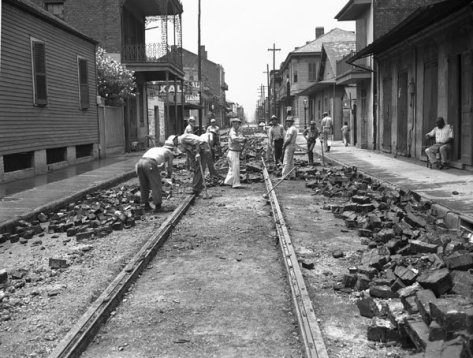
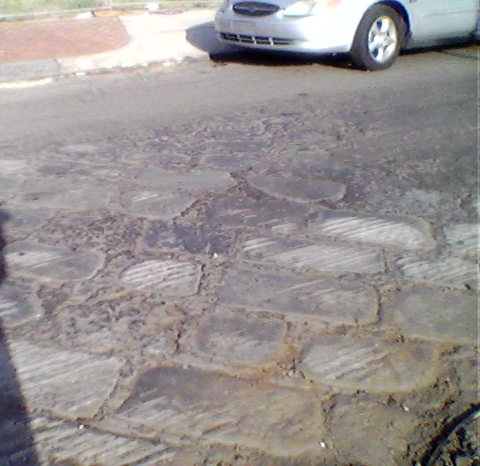
Great exhibit at the Historic New Orleans Collection’s Laura Simon Nelson Galleries of photographer Richard Sexton’s details of Caribbean life. It includes New Orleans, Colombia, Haiti, Ecuador and of course Cuba. The exhibit is designed well, with the New Orleans scenes hung next to their Caribbean counterpart, both photos sharing the exact same architectural or at least many composite details.

The exhibit reminds one that the Caribbean face of New Orleans is most likely another reason for its emotional distance from the rest of America. Those places have no great hold on  the American imagination, as seen in the lack of the same architectural styles of Washington DC, or in Savannah or even San Antonio.

America turned its back after its imperialism was slowed by Bolivar, Castro and others and left little New Orleans (and Miami too) without any older sisters to sit with, remembering the past.

On viewing this exhibit, I was reminded of one of my favorite quotes from those dark days of 2005 post-levee break reconstruction, said by a well known Cuban architect in a piece in The Atlantic. Andrés Duany, a co-founder of the Congress for New Urbanism, and a persistent advocate for traditional small-town design, gets to the essence of New Orleans as a Caribbean city said then:

“When I originally thought of New Orleans, I was conditioned by the press to think of it as an extremely ill-governed city, full of ill-educated people, with a great deal of crime, a great deal of dirt, a great deal of poverty,” said Duany, who grew up in Cuba. “And when I arrived, I did indeed find it to be all those things. Then one day I was walking down the street and I had this kind of brain thing, and I thought I was in Cuba. Weird! And then I realized at that moment that New Orleans was not an American city, it was a Caribbean city. Once you recalibrate, it becomes the best-governed, cleanest, most efficient, and best-educated city in the Caribbean. New Orleans is actually the Geneva of the Caribbean.”

Sexton’s Creole World Blog

exhibit and book information

And for those that remember the old Tally Ho Restaurant that was here at the corner of Chartres and Conti, it is a treat to walk through the gallery and remember the ghosts of past grits and red beans had at that counter….

A Red Light Look at New Orleans History

Wednesday: THNOC librarian & curator Pamela Arceneaux, sheds light on the history of prostitution with library presentation in Gentilly
Wednesday, May 21 • 6 p.m.
Norman Mayer Library
3001 Gentilly Boulevard
Admission is free.

Pamela Arceneaux, THNOC senior librarian/rare books curator, will present a lively history of prostitution in New Orleans, including references to the “correctional” girls and the casket girls, quadroon balls and the system of plaçage, red light areas prior to Storyville, prominent personalities, the Blue Books, jazz, and the demise of Storyville.
She will discuss the popular topic again on Wednesday, May 28, at 6 p.m. at the Algiers Regional Library, 3014 Holiday Drive.

bicycle culture in New Orleans, circa 1880

(…and was as elitist as expected back then…)

New Orleans jumped onto the bandwagon, forming the New Orleans Bicycle Club (NOBC) in 1880. The NOBC’s evolution mirrored the changing times. Born first as a ‘gentleman’s club,’ they initially described themselves as “men of affairs of relatively high standing.” The less affluent were kept from membership by default, as they wouldn’t be likely to afford the expensive bicycles.

… Issues of race arose because the Northern cycling groups accepted applicants regardless of color, while the NOBC wasn’t ready to do that.

Cycling History on Baronne St, Embodied in New Orleans Bicycle Club 

All Saints Day/Feast of All Souls

With all of the hoopla now surrounding Hallowe’en, many newcomers to New Orleans may not know that today is as important or more to our culture as the ghoulish day before. All Saints Day is done in primarily Catholic places, like New Orleans, and is a day decreed by the Vatican as a catch-all day to pray to your saint of choice.
The day is honored by attending Mass and working on one’s family tomb, cleaning it and making it presentable for November 2 which is the Feast of All Souls or in some Catholic countries, the Day of the Dead. Taking time on All Saints Day is thought to have begun because most Catholic cities like New Orleans would decree the day before a holiday a day off and so people here used it to whitewash and make one’s family tomb presentable.

Today is a day to visit your nearest cemetery in New Orleans, and watch family tradition in action. Tomorrow, take a moment and remember your dead, especially those that you believe might still be in Purgatory…

The modern date of All Souls’ Day was first popularized in the early eleventh century after Abbot Odilo established it as a day for the monks of Cluny and associated monasteries to pray for the souls in purgatory. However, it was only in the Medieval period, when Europeans began to mix the two celebrations, that many traditions now associated with All Souls’ Day are first recorded.

American Horror Story: Coven Location Guide

Great overview of the locations for this series and, really, just some great houses and sites around New Orleans to visit for any reason.

American Horror Story: Coven Location Guide | Deep South Magazine – Southern Food, Travel & Lit.