Festivals done right-er

Refashionista/writer/fairy godmother of flea (markets) Cree McCree wrote so well about the most recent Greek Fest on Bayou St. John, I don’t feel the need to embellish it. In her review, she describes an event that shares its culture graciously, has good logistics  for getting all of the food/drink, and with a open invitation to join in on the dancing (or toga-wearing) fun. Just click the link below and be transported into a camp chair while she (in her unmistakable lilting/gravelly voice), her super-smart husband Donald and their tribe debate any number of subjects, as you do your best to keep up  verbally and beverage-wise.

What I DO want to add is an exhortation for locals to consider the record of this festival hosted by a single church on and around its grounds in order to simply support its community’s historic life in our city. And one done without co-opting any other group’s culture or adding more stages or more tents ’til the space is positively unsafe and then unable to serve the musicians or vendors or attendees well. That may it serve as a good example of how not every event has to have VIP tents,  to outsource every inch of  space around its commercial interior or to run roughshod over people relaxing at the edges there just to soak up good ol’ New Orleans togetherness, aka good vibes.
In other words, wannabe Quint Davises: if you really want to know how to do it, check your ego and your greed at the parish line and bring a chair next year to some of these neighborhood or church deals to learn about what works. And look for Cree; she’ll give you some good intel.

Source: Raise Some Retsina – It’s Greek Fest

The 75 year-old Little Red School House on Royal (McDonogh 15)


When wealthy recluse John McDonogh died in 1850, the residents of New Orleans and  Baltimore were surprised to find themselves the beneficiaries of his considerable estate. His will specified that the money was to be used for the purpose of establishing public  schools in the two cities for “education of the poor of all castes and races.”  Over 30  public schools bearing John McDonogh’s name were constructed in New Orleans.

Baltimore on the other hand, opened one which was established originally as an all-white, semi-military school for orphan boys, who worked on the farm in exchange for their tuition, room, and board. The first African-American student was admitted in 1959. In 1971, the military traditions of the school were discontinued but to this day it is regarded as one of the Baltimore region’s most prestigious preparatory schools.

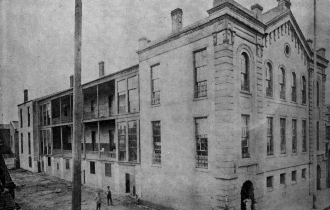
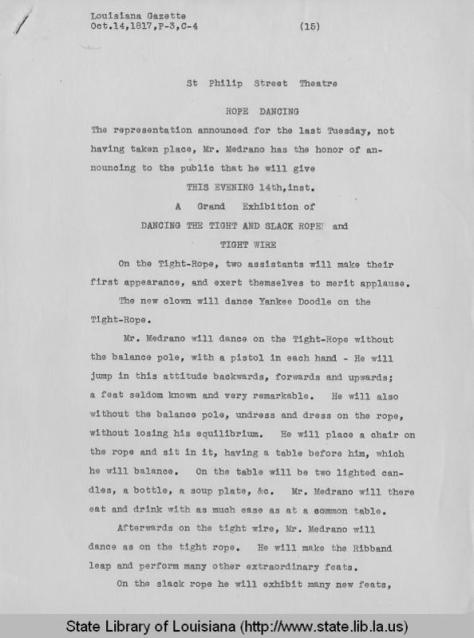
LRS was constructed in 1932 by city architect, E. Christy on the site of the early 19th century St. Philip Theatre.

stphil-1.jpg

Before it was a theater, the playhouse on St. Philip Street was a ballroom, and it would revert to its original ballroom status several times during its lifetime, alternatively known as the Salle Chinoise, the Winter Tivoli, and, in perhaps its most famous incarnation, the Washington Ballroom. Under the ownership of Bernardo Coquet, the St. Philip Street ballroom was the scene of the first balls for free people of color, and in 1805, when it was leased by Auguste Tessier, it became the first hall to host quadroon balls. Between 1808 and 1832, when it became the Washington Ballroom, the theater competed first with the St. Peter Street Theater and later with the Orleans Theater to be the premier site of French opera in New Orleans. [J.G. de Baroncelli. Le Theatre-Francais de la Nouvelle Orleans. New Orleans, 1906] (nutrias.org) 

view.jpg


C056N3143.jpg

St. Philip School – Boys – No. 721 St. Philip  (hnoc.org) 

-b07127366751df3b.jpg

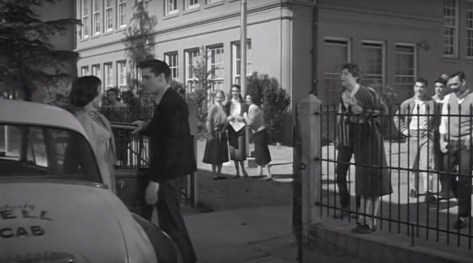
Building used in 1958 for King Creole school scenes 

In 1970, Lucianne Carmichael requested to be sent to the lowest performing, most segregated school. While earning a Masters degree from Tulane University she developed and implemented a Language Arts project that operated centers in 26 public and parochial schools. From 1964 until 1969 Lucianne was responsible for assisting in the preparation of the E.S.E.A Title I proposal and developing new programs for inner city schools. In 1969 she was appointed acting principal of Howard No. 1 school. The next year she was assigned to McDonogh 15, an empty elementary school in the French Quarter. With the help of dedicated staff, she breathed life into a dead building and an innovative school was born.IMG_1140

2006- 2016:

KIPP McDonogh 15 School for the Creative Arts

KIPP McDonogh 15 School for the Creative Arts was a public charter school operated by KIPP New Orleans as part of the Louisiana Department of Education?s Recovery School District (RSD). In 2006,  KIPP McDonogh 15 started serving 470 pre-kindergarten through eighth grade students. In 2011, KIPP McDonogh 15 Middle School moved to the Frederick Douglass building on St. Claude avenue and began functioning independently of the primary school. After a year at the Douglass building, the school moved to its current location in Gentilly, and renamed KIPP Morial in 2017. https://www.nola.com/education/2017/08/new_orleans_kipp_morial_school.html

Homer Plessy, A Community  School

Homer Plessy School’s charter was granted in 2012, with a focus that placed that a high value on critical thinking, creativity, diversity and citizenship, and served its first student population in 2013. The school moved to the FQ campus in 2017.

MAC-Notes on the elephant

Excellent input from one of the city’s great clarinetists, himself a transplant albeit decades ago. So as he says (and represents) it is not that all comers are unwelcome. It is that it is vital and brave to truly comprehend what it means to support the complex dynamics of the formal and informal cultural activity that has held our place together. And that actively working for useful and manageable ordinances and zoning that discourage a “monocrop” society has to be everyone’s goal.

Let’s get serious about this damn elephant. He’s being too well-fed by our civic leadership, which continues to march toward a goal of 13 million annual visitors by 2018. Though they are beginning to listen to the bearers of their culture, they mostly try to measure our contributions in terms of “cultural economy.” And, given their attentions to the tourism lobby and neighborhood associations, it seems they still regard us more as an extension of the service industry than part of our city’s lifeblood. The resultant clashes between policy and organic culture are exacerbated by ham-handed and selective enforcement of our sound ordinance and an unwieldy process for amending the Comprehensive Zoning Order and “Plan for the 21st Century.”

Those of us who are truly committed to our community’s cultural vitality need dialogues that reflect appropriate ambivalence from all stakeholders and respect the issue’s complex dynamics.

Source: MAC-Notes: Everyone Sees the Elephant. Now What? | NolaVie – Life and Culture in New Orleans

and this truly accurate response:

I moved from Uptown in 2001 to Burgundy Street in the Marigny. My immediate neighbors consisted of a nice (African-American) family in the double on one side and a Honduran woman, Miss Consuela, who barely spoke English on the other side. Across the street was a corner bar, a Section 8 double, and a long-time resident (Caucasion) who works at a hospital. An old man on the other corner lived behind his long-closed, 1930(ish) gas station. We were a diverse bunch to be sure. But we all knew each other. We all helped each other out. We were neighbors. After the storm, the only ones of us left were us, the bar, the hospital worker and Miss Consuela. Then someone bought the double next door. They completely rennovated it, flipped it and sold it as 2 condos to some really wonderful people who live there now. The Secton 8 house was sold after a brief stint as a crack house. It too was sold and rennovated. It is now a long-term rental. An expensive one. Miss Consuela fell ill and died. Her home was sold at a tax auction to a doctor who took it down to the studs, added a camel back, renovated the entire thing and hasn’t spent a single night there. It is an illegal short-term rental. Less than 3 feet from our home. It sleeps 10. At least that is what the Airbnb ad says. Sometimes the people are very nice. We try to engage all of them. Sometimes they are gaping assholes. The group two weeks ago who were blaring bad disco music at 4:30 in the morning into the top of the line outdoor sound system come to mind. All this while the doctor takes his homestead exemption on this place. We have complained to City Hall. They don’t care. I could go on about the slumlord rental on the block that smells like ass, and rents for $1275. It was $500 pre-K and housed a loveable ‘OZ dj who can no longer afford to live here. Or the house next door to that, which housed a local band, then a young family, and finally turned Airbnb. Or the hordes of bicycle tourists who block the street like a particularly large school of minnows and shout “car!” whenever an automobile approaches, all while gawking at the neighborhood like we are in some kind of bizzaro, New Orleans, performance piece. Don’t get me wrong. I am happy that these buildings around me are being “rebuilt, renewed and restored”. I just wish we could find a balance that allows us to look toward the future without completely losing the past. Sorry this is so long. But it does feel better to write it.

Gerber on the Big Easy


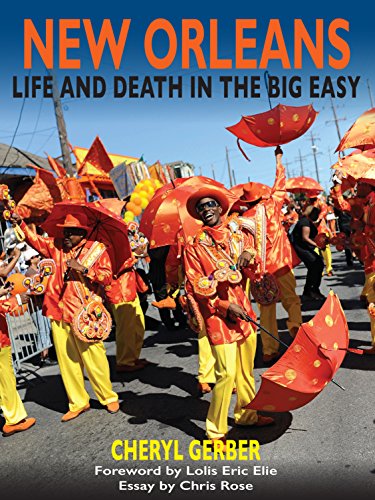
images.duckduckgoOf course I had noted Gerber’s pictures before, but like so many of our “journeyman” photographers, her work has most often been published in our ephemeral media and with that comes a tiny name credit all that marked it as hers, likely often missed. And oddly for such a visual city, the writer of words is usually given prominence over those who use a camera. It’s not that photographers are never celebrated: Gerber’s own photography mentor Michael Smith is renowned as are at least a half dozen or more names. But since working photographers are thankful to get one shot at a time published, it is often only when you see a number of photos together that the individual’s viewpoint emerges.

This book offers Gerber’s sensitive and sensible view of her city and of her neighbors. You notice she is often at near-to-middle distance, close enough to catch an eye or to elicit a smile or gesture, but not too close to  influence the moment, which points to her work as a photographer for Gambit and other news outlets. Action permeates her work, but just as often she appreciates a simple moment of acknowledgement. Humor more than glee, sadness more than despair make it seem like she just happened to photograph a thousand normal days here. And gives me a sense of the photographer quietly saying to me over my shoulder, “see that guy? he…”

The physical space of New Orleans is covered here, especially in the time of Katrina when less people were here and those who were did not need their picture taken (as Gerber well knows) but her favorite subject seems to be a single person. Even when there is more than one in the photo, the others are usually reacting to the protagonist. And that seems very right in a book about New Orleans since musicians, parades, sporting events and yes even murder scenes all have main characters who propel or narrate the action, all done publicly. Yet the choice of photographs and the layout of this book means the juxtaposition of two or more images on a single page or across two pages forces us to to consider each photo as part of a more complex story; even the choice of Chris Rose and Lolis Elie as the essay writers at the beginning tell us to prepare for that. A photo at the JCC uptown pool with white children jumping in is paired with two African-American boys landing on a pile of mattresses outside of a boarded up house. The two photos uncannily mirror each other in the physical layout and are connected by the childish joy seen in both but still, the divide is vast. Both the connection and the distance between linked images is presented again and again, although not with one image dominant over the other. As a matter of fact, the pairings or clusters seem necessary to tell the entire story of each. Buffalo Soldiers and NOPD on horseback, Metairie Cemetery gleaming and paved next to weedy, handwritten  Holt, Roller Derby girls as bulls on skates next to Mardi Gras Indians with horns, even David Vitter and his Canal Street Madam (well that one made me laugh)…all together tell the story. I don’t think I have seen the life here shared in photos any better.

Buy it here


My take on this take on Jane Jacobs and New Orleans

Post in The Lens by urban critic Roberta Brandes Gratz:

What would Jane Jacobs make of our post-Katrina transition from ‘death’ to ‘life’?


My response:

I always appreciate Roberta’s take on things, even though I think that she (and The Lens) sometimes rely on a narrative that is preservation precious, meaning it focuses on historic corridors and “worthy” buildings over a real housing criticism. Her exultation over the neighborhood corridor boom is a bit odd when in New Orleans, neighborhood mom and pops simply never went away but instead brought back after the levee breaks whiter and trendier than before.
Maybe the real issue is the feeling I often have that too many people still have a vision in their head of a return to the halcyon days of Main Street America, circa 1950, and expect city hall to deliver us a version of that, even though our lives and shopping have changed completely. That thinking limits the potential of old corridors and gives tacit approval to keep them empty until someone can redevelop them as before rather than re-imagining storefronts as low-income rental units or as rooms for unhoused population or shared workspaces or (gasp) even green space where buildings were before.

However, Roberta was spot on in her early assessment of the new hospital zone – about it being a developers boondoggle and about offering those jokers retail leases at ground floor and not about a better hospital than Charity.  That one of its aims wasto kill the street retail of Canal Street of one type by moving it to Tulane and likely make the old street filled with very exclusive shops and hotels- that is already coming to pass.
She is right about the code busting happening at City Hall: the new CZO is a joke. A form-based approach to zoning would be much more appropriate to our city than what we got.
The argument about streetcars is sort of lame, as the Rampart line going to Poland was stymied by the railroad and not by local policy or willingness, and the lack of public transportation is a deep and long problem that is not changed by that type of investment that involves streetcars which are clearly for the visitor.

Of course I am annoyed by her ignoring the French Quarter, my neighborhood, which is still a neighborhood and pound for pound the most active, diverse and mixed use area in the city in any 24-hour period; yes we have millions of visitors in our midst, but also have a somewhat steady population since K (and the changes correlate to the Orleans Parish census), more residents than the Marigny, or Bayou St. John or some other areas. We got our problems and some of them like development (or an overemphasis on festival culture!) are getting worse like every other area, but don’t dismiss us just ‘cuz that is the “supernative” thing to do when talking about New Orleans!

Since she was a many-times return visitor who then bought a home (although I think she may have since sold it) I am surprised at her toss off of the short-term rental issue. It seems to me it requires a thoughtful approach by thinkers like her, as she must know that it has allowed many homeowners to keep their house here and to do repairs and new residents to decide where to buy, and so when used well by principal homeowners, this system can be a boon.

But let’s give her writing the credit it is due: “Jacobs did not try to dictate how things ought to be; she wasn’t prescriptive..Local wisdom, she found, is where the best ideas for change take root. They don’t come from political leaders, planning professionals, developers or credentialed experts.” This is so right and because it is what I try to do in my work, I am glad to see it written so beautifully and simply.


(another response I posted the same day to a VCPORA story in the Advocate on lower population in the Quarter since 2000):

First, according to the Data Center, the numerical changes in our FQ neighborhood correlate to the dip in the entire parish. Second, those changes have a lot to do with the love affair planners and neighborhood associations have with encouraging massive single home renovations over incentivizing real mixed use. And the resident and business associations allowing heavy trucks in by just paying a small fee, actively discouraging bike or scooter parking, allowing film and festival culture to take over our area constantly are part of the problem residents have to overcome. Here are some things associations can do right now to swing the pendulum the other way: work to incentivize rent controlled apartments by offering tax breaks to those homeowners who have little used property (including upper floors of commercial buildings, especially on Chartres, Decatur and Canal), walk to find and fine those who hang key boxes on their gate that indicate illegal STR units, create a citizen reporting app to allow FT residents to file complaints immediately and directly about code violations and stop focusing on tshirt shop raids and instead focus on adding amenities that residents care about.

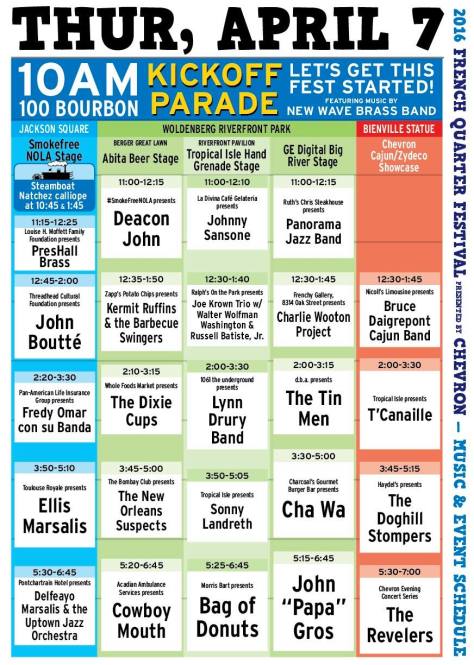
French Quarter Fest 2016 – Thursday

12779041_950815388329727_2969293313513702104_o.jpg

Confederate Stories

here’s my new conversation starter about the Confederate monuments around town. If you want to honor Civil War history, then (as befits the victors),  for the Lee statue, insert Grant; for the J. Davis one, Lincoln; for PGT Beauregard, Gen. Lovell or Butler. In fact, the history that would be appropriate would be to only have the victor depicted with information about the war and the losers left to a plaque, and would then offer true Civil War history to the future generations…That is my argument; explaining the history of a failed insurrection (of which New Orleans was in for all of 16 months or so of its 300 year history) was not the point of those statues, but rather meant as a defiance of the order of the victors to integrate, and as a way to tell this new tall tale of the “Lost Cause.” The Davis statue, in particular is in that camp as it was put up in the 1900s (I hope no one is arguing for the Battle of Liberty Place Monument to remain). I believe anyone who argues for these to stay as they are is arguing for a false narrative of triumph and encouraging that long ago generation’s view of subjugation of their neighbors. Still, I’d like them to remain in the city, in an appropriate place with other symbols of previous times available to all to see and understand. History is not erased but with the removal of false idols, is also no longer appropriated and altered as it is presently.

When people scornfully use the argument that those who want this change want to deny history, I reply that it is those who argue for the losers of the war to be depicted who are the ones denying history. Yes, let’s absolutely depict the  history of our horrific Civil War, but do it truthfully and with respect to ALL of our people and our (at times, shameful) history. If you truly want to have our history on display, then get actively involved in finding innovative and respectful ways to match the complicated details of it.