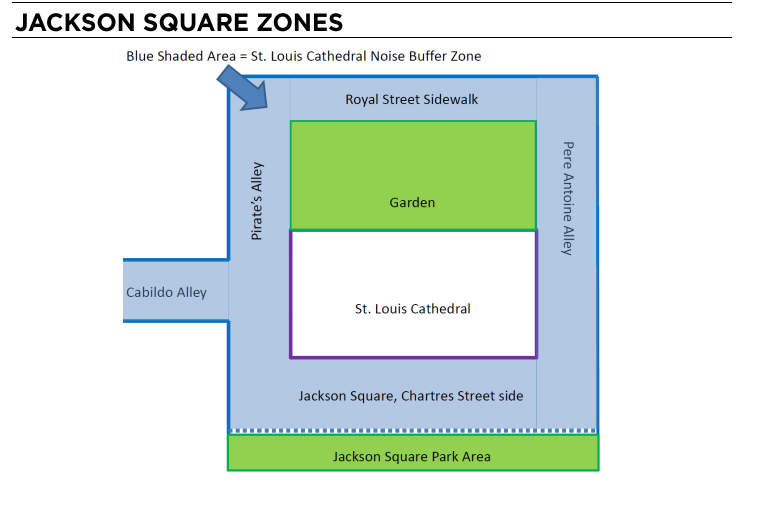
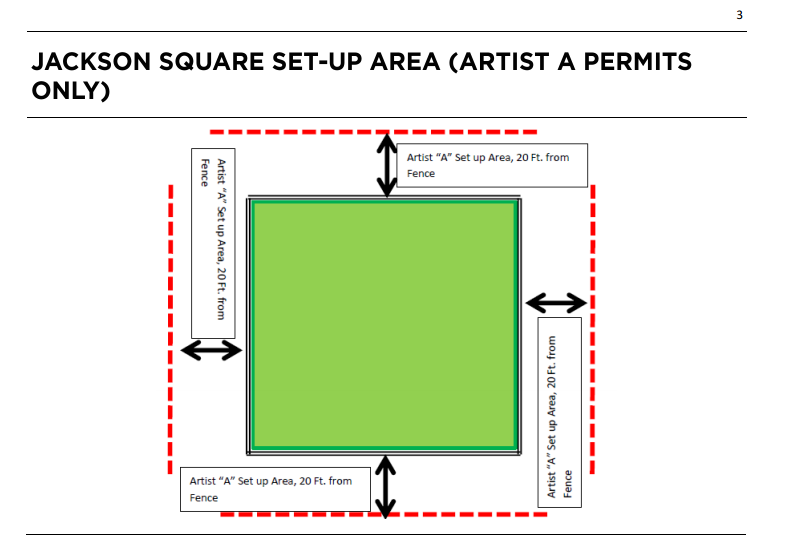
I was sent these diagrams by the city of New Orleans and I will also be uploading the corresponding regulation text. This came about because there was a heavy handed idea by the city to “close” the square overnight, seemingly in a feeble attempt to reduce the small bad element found there 24 hours a day among the many good elements also there 24 hours a day. I wrote in protest and was invited to one meeting and sent this months later. The other attendees at the meeting were the folks who work in the Square- readers, musicians and artists. No one from the JS businesses, the museums or church were there, nor were any other residents. I wrote about the meeting in an earlier post:
JS meeting notes
Category Archives: New Orleans
*Plantation thinking on Canal Street and beyond.
While on Facebookistan recently, I did the thing I usually know not to do and got involved in a polemic back and forth about the proposed demolition of the World Trade Center building here in New Orleans. I tried to resist but didn’t.
A good friend to New Orleans and well-know preservation activist is fighting to save it and shared an article from a Uptown lawyer who had already written other things I haven’t liked, (yes I see my part in this), so I chimed in.
Needless to say, my opinion is in the extreme minority. I’ll explain later.
Those for saving it seem to line up in one or two queues: either preservation of this mid-century building, of which little is still left in New Orleans, or “saving” commerce by saving this trade building. Of course, it must be said that our mayor who seems to mostly be hiding behind the curtain these days is not doing himself any favors by talking of dismantling it for his bizarre “green space” slash monument which will double as a “ride” across the river-seriously, that’s what he is suggesting, I kid you not.
I get the preservation angle. Although since I am not a fan of it myself, I just selfishly do not care to save that style of architecture. But sure, I know others do and can probably explain why they feel the need. In my mind, as long as we have the Superdome and the Hilton, we have enough examples of that era although if we had saved the Rivergate I would be for demolishing that Hilton too!
What troubles me about all of this is the limited thinking we employ in New Orleans. Those interested in the built environment seem less or not at all interested in its effect on the natural environment. And those interested in commerce seem opposed to addressing the barriers that exist for real people to get skills to use that arena to lift themselves out of dire circumstances. So “global” trade or a tourist destination: that’s all we can offer?
My (main) issue with that building there on Canal Street is the scale; its size doesn’t fit with our little tropical city’s main street as it is today. It’s more in line with the type of unrealistic trade aspirations that New Orleans and the greater area had in previous eras and therefore it should be changed to more adaptive, realistic uses that fit our future. Fighting to save it for commerce seems to fly in the face of the challenges that many emerging areas of the city have in finding tenants already and it reminds me of the days of Caribbean imperialism (or oil drilling imperialism). Yeccchh..
Instead:
Maybe we can put a small glass building at street level and ask Tulane (et al) to put its environmental research at street level there with scientists and researchers working on water issues and disaster preparation in full sight of its citizens?
Maybe we add a significant streetcar/ferry/bus/bicycle station that everyone would use?
Maybe we can add small, well-designed open spaces for public gatherings? Encourage those with graffiti chalk walls and small natural podiums?
Maybe add some infrastructure for symphonic-style music events? (But leave jazz and pop to our clubs!)
Maybe add adapted shipping containers for food and other entrepreneurs to use?
http://www.theglobeandmail.com/news/toronto/shipping-containers-whet-entrepreneurs-appetites/article4223726/
Maybe none of these. Maybe all of these. But what i hope is for a lessening of thinking that runs to maintaining the status quo of yesteryear (massive buildings devoted to unsustainable commerce hidden behind security checkpoints) or more Disney-like experiences for our visitors (who I think want more authenticity instead) and instead investments in encouraging locals and visitors to mingle in spaces that work for everyone.
* A good decription of plantation thinking found online: The natural environment is heavily managed with interventions of all kinds to protect againsts pests and disease. There is a narrow view of what the desired outcomes are. Anything that grows outside clearly defined parameters is weeded out. It is important for all specimens to reach certain minimum standards but there is little or no room for diversity. This tendency towards a monoculture with a narrow gene pool halts natural evolution and increases vulnerability to long term or sudden environmental change. There is uniformity, conformity and an emphasis on control. The plantation managers are profoundly risk averse and, where improvements are needed, have a predisposition to seek out tried and tested methods with predictable outcomes.
Upcoming Words and Music
The Pirate’s Alley Alley Faulkner Society, Inc.
624 Pirate’s Alley
Dear Friends:
The Faulkner Society is a (501) (c) (3) literary and educational non-profit. Donations are, therefore, tax deductible.
Our major projects for the fall will include our festival, Words & Music, a Literary Feast in New Orleans, December 4 – 8. Part of the programming will focus on
the work of Walker Percy, author of The Moviegoer, which won the National Book Award, Love in the Ruins, Lancelot, and other works of fiction, as well as
entertaining and enlightening non-fiction, such as Signposts in a Strange Land and The Last Self-Help Book. Our literacy project concurrent with Words & Music,
will include distribution of free copies of a Walker Percy novel, as well as a master class for students and teachers on his work.
Our next free event will be a multi-author My New Orleans event July 21 at the Cabildo. Among authors will be Liz Wiliams and Rick Barton.
For more on the Faulkner Society, visit our web site.
Notes from meeting with city about Jackson Square issues
Jackson Square meeting
Scott Hutcheson, Asante Salaam, and city attorney had a second meeting with folks interested in maintaining Jackson Square as a dynamic public space.
Artist, musician and psychic spokespeople were in attendance and spoke convincingly about their wish for a viable community space in Jackson Square. Here are my notes from the meeting: in the notes below, the statements were made by the artists, musicians and readers that attended the meeting. SH is Scott Hutcheson, Mayor’s Advisor on Cultural Economy and is the city staff person who responded during meeting, and his responses are in italics. Overall, it was a very amiable meeting.
SH has talked to Farmers Market Corporation (FMC)
FMC security may start patrolling the Square
City can do in-depth training with FMC security personnel
FMC has 11 security personnel, 3 full-time, the rest part-time
Psychic org: fine with that, but no one will still have permit oversight.
Recently, readers leaving set-ups 24 hours a day.
Vendors illegally chalking their spaces to hold, including artists.
Out of control artists ignoring rules and entreaties from peers to follow rules; video on YouTube of artist on Square passed out with needle in arm.
Can licenses be in jeopardy when they ticket?
NOPD has said in past that they will not enforce the rules, they have just woken people up and told them to stay awake.
SH said they ticketed Thursday before FQF
Ticket should go to revenue dept, rather than municipal court to relate the infractions back to license.
All artists should have to show licenses. Some scofflaws leave a homeless person with their stuff so it is “attended”.
Guidelines before Katrina were clear and enforceable, need to go back to that.
Pre-Katrina: Set up more than an hour was unattended, the setup would be moved by NOPD or other readers or artists.
SH: not sure it’s legal to do that, have to be clear about codified law versus standards of conduct
Illegal activity is widespread and unenforced.
Calling emergency services is almost impossible as they want street addresses.
Extra space when big events for artists? State museum says yes, but FQF says no.
Want to talk to French Market about using more space.
Dutch Alley, used to be an open spot, street entertainers still get run off.
SH: FMC asks street performers only to “register”, although it says “permit” on it.
SH: No such thing as a street performer permit in the city.
dba licenses, can anything be done? (No says city attorney)
Enforce before 6 pm on St. Peter and St. Ann that readers cannot hold spaces.
FMC security already has oversight over Jackson Square: can manage city owned property.
FMC demanded FMC permit for Decatur reader
Illegal vending happens on Jackson Square and artists/readers are powerless to stop.
Vieux Carre church sets up table and does ceremonies illegally.
Segways in the square are problem.
Stanchions-have a hard time getting them unlocked in emergencies and locked to stop cars and trucks.
Slope of the entryways is problematic for older people, needs to be textured.
Loading zone tickets are given to musicians and artists even though they have been told they can use them to unload and load.
NOPD says artists and musicians can unload in the “curve” but only informally.
Barkers are working illegally, overwhelming honest vendors.
Street performers with amplifiers are a problem.
Television from museum plays constantly and loudly.
Save Tujague’s – Please –
If this doesn’t beat all. FQ building owner showing his ignorance for his own family’s legacy and his building by saying he is selling one of the most historic restaurants in the city to a t-shirt shop owner in the Quarter who says it will soon be filled with fried chicken and more t-shirts. This building housed Madame Begue’s which was the most popular pre-Civil War era restaurant in New Orleans (and maybe North America) and was rejuvenated by This guy’s brother, the convivial Steven Latter as an “everybody knows your name” French Quarter place. Now that Steven Latter has passed away, they have barely waited for him to be in the ground before pulling this crap.
Not sure much can be done by regular citizens-this may be up to the money folks who can throw some dollars at this jerk to get him to sell and move the hell away.
Stay tuned.
UPDATE: SAVED by the citizens of our city with new menu and cookbook.
Save Tujague's – Please – The Editor's Room – March 2013 – New Orleans, LA.
Fringes of the festival
Once you buy a panel pass for the TWLF, I understand that you might then feel compelled to squeeze every dime from it, running from one room to the next, checking off workshops, circling possibilities, slowly scanning the merchandise table in a spare moment, sure that the right gift for your literary friends is here. I have been guilty of that. 75 bucks doesn’t come that easily to me and so often I equate value with quantity, like so many Americans. I do, after all , shop at the dollar store.
Luckily, with age comes experience (let’s not talk about the bad eyesight and odd aches- what DID I do to my arm?) and so I have grown more aware of my choices, at least those that are available with a panel pass.
I could sit in the uncomfortable chairs of a ballroom or a museum through the post-breakfast to cocktail hours, hoping that the gentleman behind me would realize that his throat clearing is not discreet at all, but incredibly well-timed to cover the bon mots that most likely were what the rest of the audience was chuckling over when my ambient hearing returned. I could do that and have.
Or, I could pack up when I feel the energy lagging at the 12:10 mark and head for a fortifying gumbo lunch at the most appropriately named restaurant for a Tennessee festival goer (I believe in you. you CAN decipher this) followed by a cheap cocktail from the oddly agreeably afternoon haunt of the Chart Room, ultimately heading to Crescent City Books for an afternoon of lessons.
Once there, you meet Isabel, their traumatized but healing cat and talk of books and John Boutte with local author and bookseller Michael Z.
You head upstairs and immediately find a book that has no reason to be prominently displayed (this visit it was “Farmers Last Frontier: Agriculture 1860-1897, which is an astounding find this month), sit with your discreet, illicit cocktail and thumb through it while viewing books and book lovers, pausing to think of calliopes on steamboats and why people honk their horns so often and how creaking stairs can be both frightening and comforting.
And salute Tennessee and his devotees who bring you to the Quarter this fine day.
Southern Gothic for breakfast
This morning, we are starting with a discussion about Southern Gothic in novels with
Barton Palmer, Annette Saddik, Harvey Young with mod Robert Bray.
At least sitting in the Williams Research Center evokes a bit more mystery and ambience than the Queen Anne Ballroom of the otherwise lovely Monteleone Hotel.
There is a small cartography exhibit in the anteroom, which is a pleasant way to prepare for sitting for an hour or more. The “oilmen” map is a particular good example of the lovely and profane and so might be the best example of Gothic out there.
For me, Southern Gothic smacks of Mississippi and Alabama more than New Orleans, except of course for Tennessee himself, who we must always remember, was actually born in Mississippi.
Romantic and grotesque is always an appropriate way to describe any part of the South or any area really that has as many defeated people yet the abundance that we have.
Pat Conroy said “All southern writing can be traced to this one statement: On the night that the hogs ate Willie, momma died when she heard what daddy did to sister.”
Or, unfortunately, what one panelist this morning did to the others by taking more than half of the time allotted this panel.


You must be logged in to post a comment.