Tear that wall down

Here’s a link to a story about when highways are removed from inner cities:
http://gizmodo.com/6-freeway-demolitions-that-changed-their-cities-forever-1548314937

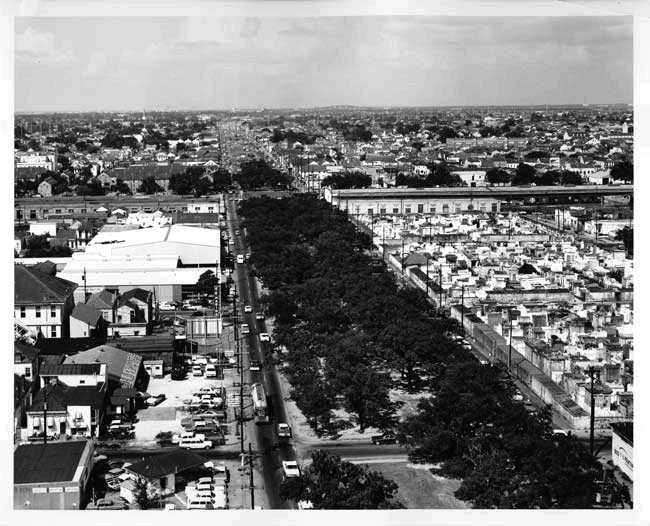
This is an issue at the forefront in New Orleans because of the ramps to the Claiborne Expressway built in the 1960s, need to be repaired soon. “An option that’s been tossed around for awhile is to remove the overpass, restore a former tree-lined boulevard there and let traffic run along it and surrounding streets.”

It may be important to remember both the spur that was never built:

220px-New_Orleans_Riverfront_Expressway_Octopus


And the expressway that was:

images.duckduckgo

And what Claiborne used to look like:
images.duckduckgo
As long as we’re on this story again, I am always surprised by how many freethinkers still trot out the erroneous story of how the win to not build the Riverfront spur in the Quarter in the 1960s led to the Claiborne Expressway. Simply not true.

In any case, it’s time to focus on the positive benefits of taking down the Claiborne Expressway and make sure that more negative developments are not put in its place.

Cookbook signing November 14 @ Kitchen Witch

Kitchen Witch Cook Book Shop
Will Host
Kit Wohl / Celebrations Cookbook
Jyl Benson / Fun, Funky, and Fabulous Cookbook
Poppy Tooker / Tujagues Cookbook
The Signing Party will be Nov. 14th Saturday 2 – 4 PM
1452 North Broad Street Suite C
New Orleans 70119
504-528-8382

Lavender Interview 

A perceptive and sensitive interview with New Orleans poet/publisher Bill Lavender.

What’s involved here is the very same bias that Zizek speaks of in “The Subject Supposed to Loot and Rape,” his article on the national perception of New Orleans in the wake of Katrina. Or, as Deleuze put it, “If you’re trapped in the dream of the Other, you’re fucked.” We in the South have been trapped in some New Yorker’s dream for some time now. The stereotype has actually gotten worse, I think, in recent times, as the cultural hegemony of New York and California have been eroding and they scramble to bolster the pretense that they still matter…

…The New Orleans scene has waxed and waned since I’ve been involved in it, and the political and generally extra-aesthetic forces that have shaped it would make a very interesting study…. The reason, I think, that MFA programs have flourished to the point of overpopulation of late is that they have attempted to recreate real artistic movements, with the comradery and passion and competitiveness of a real scene but within the artificial environment of the university. MFA programs represent the disneyfication of writing. They are simulacra of real artistic discovery, available only with a paid ticket. It isn’t that nothing good goes on in them (I’ve taught in and directed one myself), but a real movement can only happen outside this system, in the political and economic “real world.”

Source: Lavender Ink Interview | Jacket2

Order QR Code Decals for your bike via Stolen Bikes NOLa

How it works:

QR codes are a discrete way to put your contact information on your bike. The idea is that traditional “Property Of” markings will be removed or covered up by a thief before they sell it. By using an industrial quality QR code decal, the average thief will assume it is some advertisement for the manufacturer or just a decorative decal. In addition we provide 4 copies of your decal (with our standard $5 kit) so some can be placed in plain site and others hidden.

How exactly will this get my stuff back?:

This idea was developed for marking bicycles in New Orleans by “Stolen Bikes Nola Inc.”. The common scenario was that bikes were stolen and quickly resold or abandoned around town and picked up by the next rider to be used. The theft would be reported to the Stolen Bikes group but recovery would become problematic when the bike was not easily identifiable. Victims would even say, ” I see my bike down by Small Mart everyday but I can’t be sure it’s mine so there’s not much I can do”. The QR code label is not a perfect solution but it is an inexpensive way to mark your bike and simplify the recovery effort.

Source: Peninsula Business Forms | Order QR Code Decals

Kitchen Witch Cookbook store is pushed from FQ but finds a warm welcome @ 1452 N. Broad

Sadly, the lively cookbook/ spice/vinyl/art store Kitchen Witch had to leave the Quarter, due to the ridiculous commercial rents. (Even though I believe ever more residents are living in the Quarter than had been since the mid 1980s, I also believe that commercial rents are so out of control that we are rapidly losing our good, useful stores at a frightening rate.) What is truly sad is the owners of Kitchen Witch have been working/ living in the Quarter for decades but now are completely out of it, which is a real loss.  I wish them well.

Happily, Kitchen Witch immediately found a place quite near their home in a lovely community on N. Broad and Bayou Road. You can shop there with Deb and Philipe, add a stop at the Community Bookstore just a few footsteps away, buy vinyl and cds at Domino Records, browse for beauty prods at King and Queen Emporium and at Beauty on de Bayou, pick up first-class fried chicken at McHardy’s, find some Jamaican tastes at CoCo Hut, meet friends for excellent coffee and egg cups at the great Pagoda Cafe at Bayou and Dorgenois, and refresh your artistic eye at the brand new world-class Joan Mitchell center one more block to the river.

Broad Street has so many new and longtime businesses from Canal to Bayou that it is impossible to list them all here. Lucky for me, the community center has a excellent list.

The Bayou Road area is one of the richest cultural corridors in the city, since it is one of the oldest streets. New Orleans had been founded when Bienville was directed by Native Americans to travel from the Gulf of Mexico up Bayou St. John. There, the group portaged over land using a stretch of the area that is now Bayou Road to the present day French Quarter.

Here’s one slice of culture in this section of town that most present-day New Orleanians either don’t know about or have forgotten about:

The Greek New Orleans population goes back to French Colonial New Orleans and was centered around this area.  Roughly half of all Greeks in New Orleans lived within a mile of Holy Trinity which was at 1222 N Dorgenois before moving to its present location along Bayou St. John at Robt. E. Lee.  A wealthy Athens merchant named Michael Dracos arrived in the 1760s and married a local woman of mixed Acadian and Native American lineage. When their daughter married a Greek native in New Orleans in 1799, it became recorded as the first known marriage of two people of Greeks origins in North America.

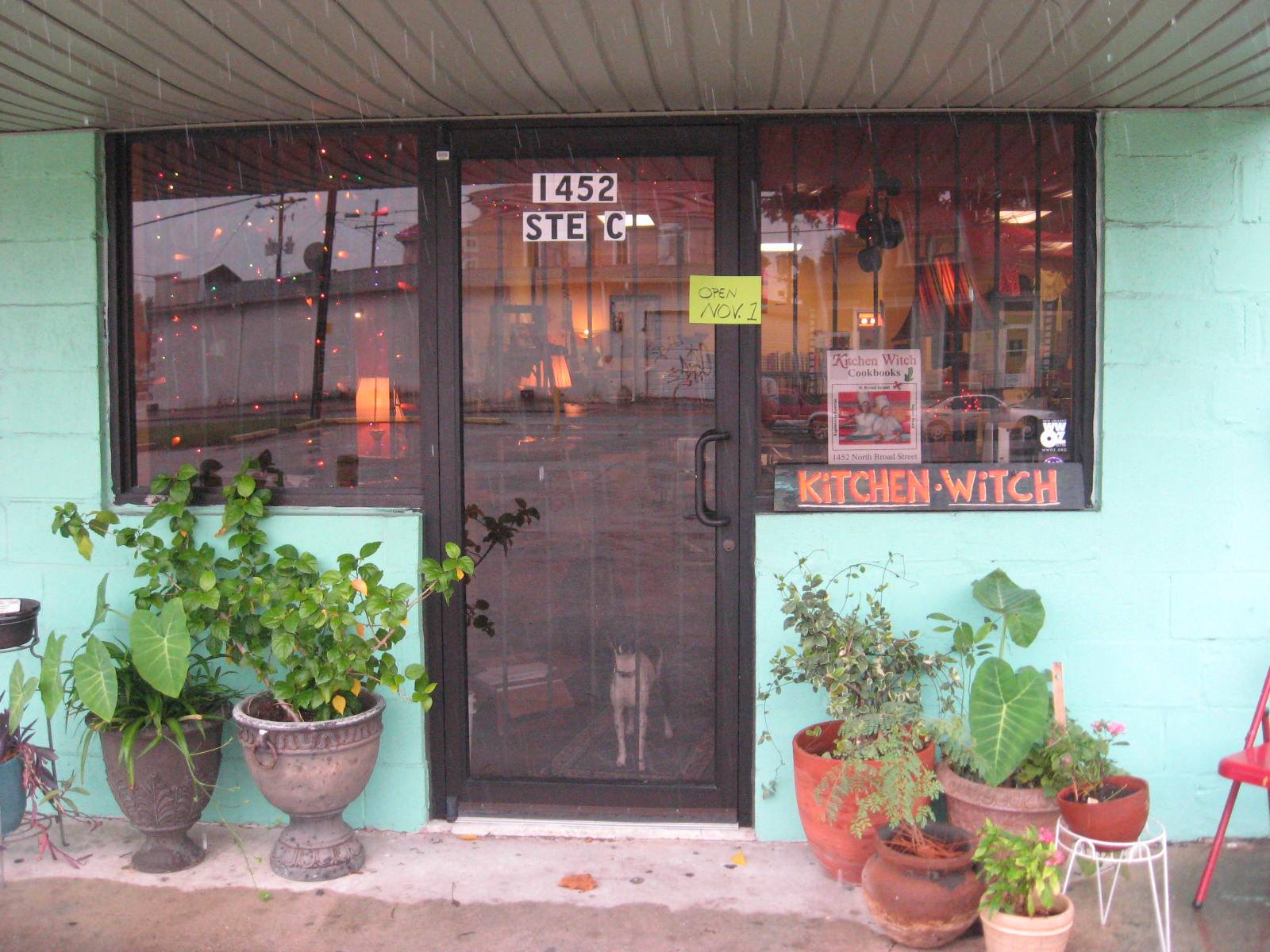
Debbie Lindsey and Philipe LaMancusa opened their store at 1452 N. Broad, suite C, on All Saints Day. Kitchen WItch Cookbook  is planning to be open 7 days a week, 10ish to 4ish and will feature book signings and related events.

12189400_1202973753063422_6072622833745103757_o

Its in the little strip mall-like building with the Boost Store and the Beauty Supply.

Money is the crop.

Capitalism
Is the plantation owner
Money is the crop

My wise friend Peter’s daily haiku is the perfect way to start off a post about a recent opinion piece posted on The Lens that I link below. The writer is leaving after 5 years here and gives us his opinion on us before he hightails it to higher ground. So many people are like the opinion writer Sam and don’t even see themselves as wage slaves or ever sharecroppers living on the scraps allowed by their owner. And maybe they do know this but won’t admit to it- that they’d throw everything of real value over the side of the boat if they could paddle faster to the gold they seek.

Following that link is my response that I wrote to young Sam, who I have taken to task before (poor Sam). It’s on the site but comment section sometimes get lengthy and the newest are most easily found, so I stuck it here too.

Opinion

And my response to it:

Entertaining as usual, but I not surprised that this writer once again lays the core impulse of his youth on external issues. He did it in his job seeking column and does it again here. Sam, you write well, yet with a great deal of self-importance and either a lack of understanding about systems or for self-preservation’s sake, using a disingenuous style of discovery, neither of which is gonna fly here. Here is the thing Sam; The truth is that young white Northerners like yourself are searching for something that small Southern port towns cannot give you and have never promised to give you. Full disclosure: I was once one of you; yes I have a New Orleanian parent and generations of family here and can join in the high school naming game but I had an out. Being partially raised up North in a small suburb that was (back then) lily-white and clean as hell meant I had experienced another life. And so at one point, I bolted from here, telling my family and friends a whole bunch of reasons why I left, but the truth was, I needed more than New Orleans could offer. Simply that I needed more and knew that in places with industry and middle-class comforts, I could get them. The difference is I knew I would come back to live among family and that the pull of the diverse culture for me would be to much to block out after some years; I was right about that (after a dozen years away), I came back to stay. So i get the impulse, but own up to your decision that is being done for reasons that are not to do with New Orleans really but to do with your ambition for things not offered in towns like ours, a restlessness of youth, and discomfort with the way a colony operates – all fine by the way. To talk (on a news site read by locals) about festivals, and wild partying shows the visitor in you even after your five years. Those things never keep anyone here. You didn’t talk about the families lining the parade routes and the multi-generational celebrations within neighborhoods and the blue-shirted men who are the heart and soul of their workplace and the St. Joseph altars and the purple light at night in the sky…
I can see that both of us romanticize the place and so I’m no better, but do us one a favor – tell the complete story when you go and not just tales of your “exploits” of staying up all night, of drive-thru daiquiris and “knowing” Kermit. New Orleans bides in a state with a misanthropic governor, a non-existent regional system and has to withstand waves of new people that come to extract value and comment on our pitiful existence and, somehow, rises above it still with a great deal of grace. It has a problem with race as does every American city (including the one I grew up next to in my suburb and yours too) and it does have widespread corruption and commodity industries that do not support creativity or informality, also like other cities. Some of them have “solved” some of that by pushing out those without enough resources rather than offering a hand or by criminalizing things like homelessness. Other cities focus on attracting virtual industries that allow their workers to live in a bubble, high above the mean streets, without the regular interaction necessary when you have a physical job to go to and work at among neighbors. What has to happen to fix these systems is embedding yourself in it, fixing it by being present and by being open to the new and the old and finding what works best from either and both and talking openly about all of it. I’m not saying we have accomplished any of it, but the opportunity remains for it to come to fruition as long as we commit to being here.
I wonder if you ever really meant to stay, ever really committed yourself to the place where people like you (and me) are minorities and our talents are not that useful. Because that is what I suspect is true among your peers; you were always meant to go and so you cannot blame us for knowing that and not offering you the golden ring you seek. Good luck in your search and thank you for your kind words for us during your stay. Tell the rest that we’ll stay as long as the water can be contained, because we can’t go anywhere else.

A site devoted to tracking the goodbyes: http://fleur-de-leaving.tumblr.com/

I wish I wish: Two opinions on Maple Street Bookstore’s closing

After reading the writer’s opinion/apology in the Advocate about losing Maple Street, I decided to add my opinion here. You can read his in the link that is at the bottom of this post. Here are my thoughts:

I loved the Maple Street store. In the 1980s, I traveled by streetcar up to it regularly from my downtown teen life. That store, along with Little Professor on Carrollton, DeVille’s on Carondelet (although frightening to find yourself the focus of George’s eye while there, as mocking might ensue), Doubleday and other chains on Canal and all of the used bookstores in the Quarter were my delights. In the Quarter, my favorites were Beckham’s for its quiet and its history section, Librairie’s well-organized criticism and anthology section, Matt’s biography section and Olive Tree (?) on Royal for the overall quality of books available. I remember the constant consternation of my best friend Roger Simonson about what he thought was the disgraceful amount of money I spent on the books that lined the walls of my tiny efficiency on Burgundy. He disapproved, but when I decided to move back to Ohio sometime later, he gamely helped me load and unload the 22 huge boxes of books I couldn’t bear to part with at the Amtrak station to ship them there the cheapest way.

But back to those browsing days Uptown: I would open the screen door at Maple and slowly make my way back through the rooms and sit with a pile of books somewhere, listening to the wisps of conversation that made it to where I was sitting. I remember being entirely happy sitting there, choosing what to buy that day and making a list of the others, silently promising to come back for them as if I were leading a rescue team. The store was full of pictures of authors sitting exactly where I was sitting and  were clearly pictures of friends and not just a laundry list of who’s who.
Yet, when I moved back to New Orleans in 2000, I was delighted to find Octavia Books and for many reasons, it became my bookstore rather than returning regularly to Maple Street again. Some of those reasons may have something to do with the announcement of Maple Street closing so I’ll share them here.

In my estimation all great bookstores do a few things. Here are what I believe they do, in no particular order and in no means meant to be a comprehensive list. Just mine.
•They go deep in a few areas. No “human-scaled” bookstore can do everything, and local stores should reflect the tastes of those who work in it and buy for it. If there is someone who appreciates children’s literature, the store should reflect that deep interest by carrying the best of and the unique and be able to handsell it. Which also means that they have an organizational and shelving system to go that deep.
•The stores are beautiful, peaceful and have great light.
•The staff is welcoming and chatty, but people-wise enough to know when to stop talking and just nod to you in passing.
•They offer new and used books.
•They do events that are varied and interesting and held often enough to remind their shoppers to check their calendar but not too often to lose the regular quiet found in a good bookstore.
•They get to know their best customers tastes and alert those customers about what has arrived.
•They value local authors and distributors and support them with prime space.
•They involve themselves in the activities of their town or their street, offering space or support whenever possible.
•They stay attuned to changing needs and trends, adapting themselves to those when necessary and not in opposition to their own values.
•Their location is accessible to many kinds of travelers and have hours that reflect the needs of their area.
•Browsers get the same courtesies that buyers receive.

By those measures, Octavia became my go-to store post 2000. They don’t do all of these things, but my experienced eye told me they hit most of them well. Maple Street, on the other hand, had fewer of these qualities but remained my cherished store upon my return since it had been my first own bookstore. I did make sure to frequent it faithfully, that is, until the expansion happened. I was excited when Maple Street expanded to Bayou St. John (although a bit taken aback at the choice of location) but dismayed when the other new location at The Healing Center also opened simultaneously. I went to both and found those locations lacking in most of the above, and really seemed more like airport kiosks than bookstores and not at all like the original Maple Street. And when I returned to the original, the shelves had less and the store seemed…small for the first time.

I have also added other stores to my new favorite Octavia, such as Crescent City Books on Chartres, (and had added Beth’s Books in the Marigny while it lasted) and appreciate Blue Cypress’ neat layout and constantly evolving inventory. CCB has become my favorite for many of the reasons listed above including that I only need to walk a few blocks to get to it, but also because of booksellers like Michael Zell, who interestingly, I first met while he worked at Octavia a dozen years ago. The list of booksellers at Octavia that I knew and know by name and have talked with on many subjects is so extensive I couldn’t list it here, but what’s important is that the list continues to be added to regularly over these 15 years.
Here is why: the main thing that great bookstores do is to employ and encourage book people to build a community. In all local businesses, this is the goal certainly, but it is vital in bookstores since much of the inventory is the same as the others, and that inventory requires some information in order to be purchased. Reviews and prior awareness of the author do help, but truly, the ability of a great bookseller to handsell the right item is the key to success, even if that only means  stocking and “front facing” the best books to get the most views.
If I read every new book put out by Rebecca Solnit (which I do), then I can buy it anywhere. However, if one store’s staff calls out to me when I walk in, “Did you know Solnit has a new book out? It’s right there…” they are gonna get my business.
I don’t mean that every person should be known by face and list, but many should and the rest should be treated as if they are going to be on that list someday. And everyone who enters with the interest in finding a book or just wanting to be among books should feel welcome.

These type of store requires constant calibration in order to maintain the right scale, to find ways to create peaks of excitement and to increase levels of engagement with many tiers of customers. Unfortunately, Maple Street lost much of that intensive tinkering time with their expansion. And like many stores, they had already been hard hit by the online book-buying spike. The staff remained pleasant and chatty, but over time, seemed less familiar and less involved with the book community. The store was no longer bursting with book energy and authors coming and going but seemed increasingly forlorn on an embattled street of changing shops and harried students and construction. That sent a signal to those who desired a full experience or, put in other terms, the lack of or the loss of a winning personality is quite often a death blow to a local store. It’s unfortunate that the retail world now is so regularly changing that a few bad seasons can undo a beloved store, but it can and does often. Remember that as customers.
The good news is that bookselling still remains in local hands around town, and will as long as enough of us take the time on a hot Tuesday evening or a rainy Saturday to come by and buy something every once in a while, which in turn means that those inside have to be ready for whenever that time comes.

So, the final word is I will always miss Maple Street, but the truth is I was already missing it.

Source: Dennis Persica: I wish I would have gone to the Maple Street Bookshop more, now that it is closing | Opinion | The New Orleans Advocate — New Orleans, Louisiana