History, people, fables and critical essays on the 24/7 life of the French Quarter. “The great music of the city is…when you say good morning and good evening.” (Mr. Jerome Smith)
Category Archives: Jackson Square and its Entrepreneurs
I continue to do research on the history of the square in terms of how it has been used and reworked by entrepreneurs, including the Baroness herself.
Last January was my month to dive deeply into the city archives to find new visual clues and records to bring alive the last 170 years of the Upper Pontalba. I was able to review the rental and management documents for the building at the New Orleans Public Library…
I am hoping THIS January I can unlock the key to gaining access to the state archives to be able to research the Lower Pontalba in the same detail.
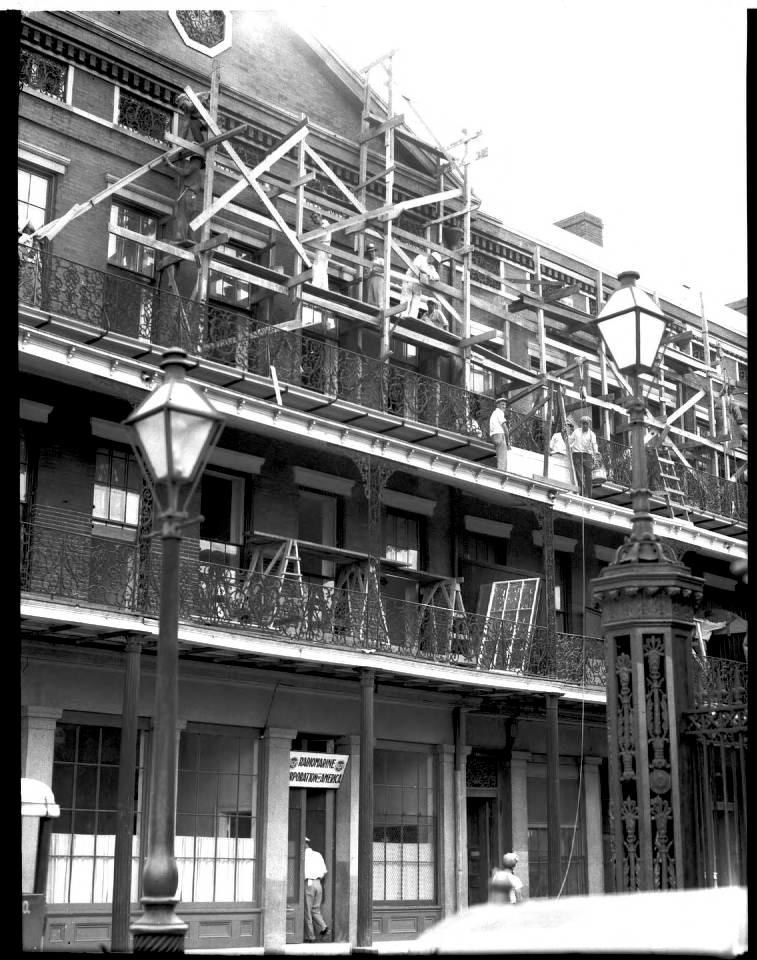
Happy to find a photo of the Works Progress Administration (WPA) era renovation of the buildings as that project had the largest influence on the buildings and the Square in their history- so far.
WPA renovation 1930s of Upper Pontalba. Courtesy of the City Archives Repository
The WPA had an enormous impact on the entire city, and one could argue that it set the table for the population explosion, (which peaked at 627,000 around 1960), and the subsequent media attention that New Orleans had through the post war years,
By most accounts, New Orleans was in the top 5 in terms of completed projects through this Roosevelt administration initiative, most notably City Park where many WPA plaques and motifs can still be seen.
The Pontalbas received about $300,000 in repairs through the WPA, a staggering sum for 2 buildings that had been purchased just a few years earlier by preservationists for (likely) around 1/3 of that cost.
They had been built 80 years before for a total cost of about $330,000 and held by the Pontalba family in France through 3 generations before selling the Upper (St. Peter side) to Alfred Danzinger, Jules D. Dreyfous, and William Runkel in 1920, and the Lower (Saint Ann side) in 1922 to William Radcliffe Irby. Irby bought the Lower building for 68,000 and when he passed in a few years later, deeded it to the Louisiana State Museum.
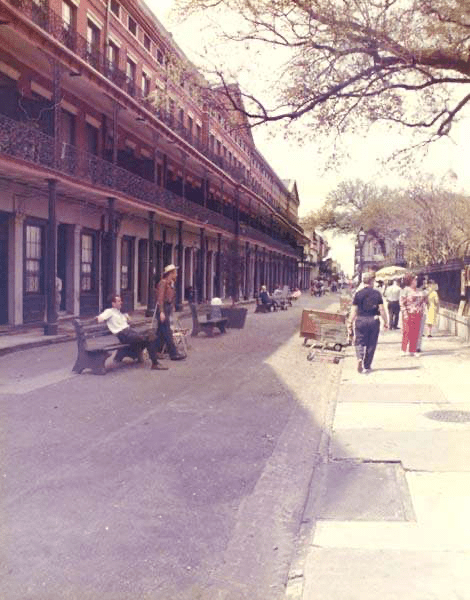
Seeing visual clues about how the buildings and the open square have been designed and used and redefined during that 170 years is amazing. This pic was taken right before retail shops returned to the Upper Pontalba. Notice the sash windows on the ground floor! *Notice it is also still a road and not yet made into the permanent pedestrian mall.
1973 courtesy of the Vieux Carre Commission, photographer unknown
The lower Pontalba DID have some retail throughout the 20th century including the 1850 house and Tourist Center, the latter opening in 1965.
The letter to the editor below from the same year that the picture was taken indicates the tension that often arises between preservationists and entrepreneurs: “The commission’s decision to restore the first floor shops was to bring back to the building and Jackson Square the kind of activity and occupancy originally envisioned by the Baroness Pontalba when she erected these buildings. No ‘tourist’ shops will be allowed. Only shops which will be patronized locally..””
[N.B. Henry M. Krotzer, Jr. was employed by the firm Koch & Wilson.] — Source: Times-Picayune Author: Henry M. Krotzer, Jr., architect Date: Saturday, April 7th 1973.
As someone who lived in the building until recently and as someone who has spent the last decade researching the rich history of these buildings and their effect on our public square, lets just say I am deeply interested in the recent news that the residents of the 50+ apartments on the city-managed Pontalba (St. Peter side) have informed its residents that they will all need to vacate the building while a long renovation is done.
First, let’s get to the facts and do away with the misinformation about this building:
It’s all rentals, no owners. The city was given this building back in the 30s by the preservationists who bought it and saved it from likely destruction.
Essentially each of the Pontalba buildings was designed as 16 3-story townhouses, each with their own entrances. They do share infrastructure between them but any of the 16 can be easily closed off from the others.
The rents are not astronomical but are in line with current rents around FQ. For example, the large one-room efficiencies are around 900 a month.*
The apartments are lovely, and have updated modern kitchens, bathrooms and HVAC.
There are a large number of full-time residents some of whom have been there for decades and have invested thousands of their own dollars in repairs and upgrades.
There is not a years-long waiting list. There are often empty apartments which are first offered to residents, then to folks who sign up at the office to be contacted, then a larger search is undertaken (they say they do this phase, although I have never seen any evidence of it online). If someone on the contact list doesn’t reply, they are taken off the list (although that list seems to a bit of a snarl in terms of who manages it and how well it is maintained. That is based on feedback I have received from those on the list.)
The staff is generally wonderful. For example, the men and women who do the custodial and minor repairs are caring and smart folks, many of whom have worked there for decades. (It has also been recently suggested in casual conversations that those positions might instead be independent contractors and not staff positions, which might mean new folks who know less and likely care less about the building to “come by” and deal with stuff.)
There are definitely some big issues such as the roof damage from Hurricane Ida to be dealt with, but the renovations seem to be more about “upgrading” the building. Again, very little in writing is given to residents or neighbors so this is based on my own conversations with staff and reading emails sent by various people connected with the building.
Residents seem willing to work with the renovation, even moving for short periods to other apartments. As a matter of fact, while I lived there, I asked where my latest lease renewal was and was told that since they may need to move us to another apartment, they were holding off on assigning us a lease for a specific apartment. So it was clearly an idea they were also working with at the time.
The issue with removing all residents for upgrades and roof repair is that many of them will not be able to find another space nearby. I think of neighbors who were service industry folks who worked later shifts and came home around 4 in the morning after work. Finding a space that is safe and quiet for folks like that is very nearly impossible in a neighborhood with so many illegal airbnbs operating.
Another question is if emptying it out is even needed. If you live and rent in the FQ, you have worked with landlords who need to do major repairs to these old buildings. I have never (not has anyone I know) had a landlord suggest I needed to leave for years to do those repairs.
And certainly important, is that they are losing 2 years of income.
There has been little information on this topic given in writing, including the actual plans of what is to be done.
In civic activist Jane Jacobs’ parlance, having mixed use and spaces made for people and not for massive development or infrastructure is necessary for a vibrant city. Those who live on the square happily share it with artists, readers, musicians, and others because all are needed to keep it dynamic and useful to the city. The residents are there after the shops close and the museums are shuttered, keeping an eye and an ear on late night activities, sharing information with the Square’s daytime users. It’s a delicate balance, and one that generally works.
Lastly, through my research on entrepreneurial activity in Jax Square, I have found that over the last 170 years, the residents of the buildings have almost always taken pride and care in living there. There have been times that it has housed people of civic stature, other times it had the workers or those newly arrived to the city, and very often, the creative and the enterprising have found their muse there.
That contribution cannot be overstated, especially in a neighborhood that is so physically important and so socially necessary. Let’s do better sharing what is planned and working with the residents and neighborhood to make this renovation helpful.
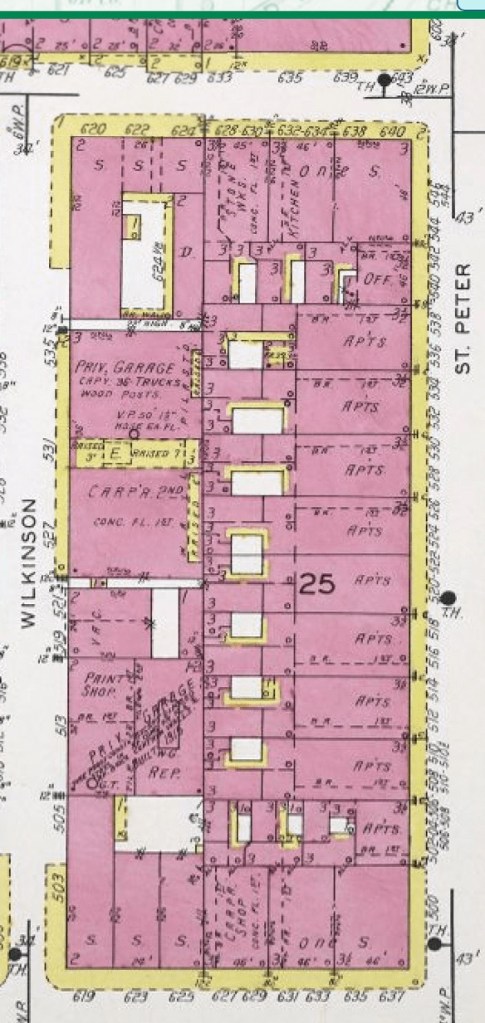
1940 map of the building. Note there were apartments even on the first floor.
* I would even suggest that the city seriously consider the idea I have raised here many times: that offering owners incentives to build in a few rent-controlled spaces for the service industry in the smaller units in these buildings and throughout the commercial areas of the Quarter and Canal Street would be a game changer for the neighborhood vitality, for employers, and for the city.
 French Quarter block by block
You must be logged in to post a comment.