in•er•ti•a
On March 11, the city decreed a state of emergency over COVID-19. Too many scofflaws ignored that and so on March 16, Mayor Cantrell closed the bars and restaurants at midnight to shut down the expected all-day and night partying that St. Paddy’s day brings to cities across the US. Not everyone paid attention but a lot stopped immediately and then over the next week as the hotels emptied, so did most of everything else. On March 20, the city issued a firm, scolding stay-at-home mandate and on March 23, the state followed suit.
My social media post on March 26:
Its been 10 days since New Orleans shut down dine-in restaurants and bars and 6 days since the city stay-at-home order. Since then, watching the wheels of commercial life slowly grind to almost a complete halt here in the French Quarter has been absorbing and sobering. At first, most places tried to stay open even though the bulk of their business had always been visitors, both those visiting from other places as well as the daily visitors who work in shops, in offices and seem to have so many lunch meetings. Some places did their best to drum up local take-out business via social media and word of mouth, but one by one, almost all in my quadrant have closed. Boards across windows and doors started going up at shops and galleries first, and then hotels and bars and cafes followed. It’s startling the first time you see the dark lobbies and gated locked parking lots 24 hours a day of a hotel normally lit up and staffed. You think about those workers that you saw 5 or 6 times a day for months or years and wonder if they will be back. (The bell captain at the little hotel down the street told me he had 120 days of PTO to use, but was still angry that he had to go home.) Yet even when the businesses began to shutter, some street traffic continued, albeit lighter than normal for a few more days. Then one day this week, I walked to Jackson Square and there was not a single person there.
At 2 in the afternoon. In sunny, 85 degree weather.
You’ll still see people walk a few times a day with their happy dogs, (saw a guy with his leashed ferret a few days ago), evening get togethers on carefully-spaced chairs on the street, a few tourists, and always some street people. The Mayor is slowly moving the homeless into hotels; the guy who lives in the window recess of the Presbytere Museum told me today that he had just missed the cut off to get in the Hilton Garden Inn by 6 people. I’d say the best way to describe his reaction was slightly stung. I told him they’ll find a place for him soon; he seemed to brighten at that. I think he looks forward to that mostly because he misses talking to people, he misses the hustle. I mean, even the silver guy’s paint is almost entirely worn off. The musicians who are staying in the apartment across the street come out to the balcony in the afternoon and play music quietly but seem to have little of the animation and long jams that they offered in the first days. You make eye contact with strangers, but there is a bit of a hesitation in being too chummy; you don’t want to encourage them to slow down and stay around here. Some neighbors have chalked “Go Home; Be Safe” on the sidewalks; but those who get it are already home, and those who don’t get it, won’t. It’s odd to see the energy seep out of these entertaining streets, but at least we have a strong reason to believe much of it will return. In the meantime, we can save ourselves, our friends, and our neighbors by killing as much of it as possible. #nolacorona

Since that post, I have thought a lot about these silent streets since this post as the days tick by and wondered more and more about how and even if it will recover. Then, something my clearly exhausted but happy pal who owns a cafe in the Marigny said to me (as he bagged up order after order for folks patiently and happily waiting outside his place) struck me:
“my business mantra right now is adapt or die.”
Or as Arundhati Roy brilliantly said:
this pandemic is a portal.
“Whatever it is, coronavirus has made the mighty kneel and brought the world to a halt like nothing else could. Our minds are still racing back and forth, longing for a return to “normality”, trying to stitch our future to our past and refusing to acknowledge the rupture. But the rupture exists. And in the midst of this terrible despair, it offers us a chance to rethink the doomsday machine we have built for ourselves. Nothing could be worse than a return to normality. Historically, pandemics have forced humans to break with the past and imagine their world anew. This one is no different. It is a portal, a gateway between one world and the next.”
That portal can be hard to see in this anachronism of a neighborhood, charmingly designed for 17th and 18th-century living, and then made into a stage for visitors from other places to get a quick taste (and purchase) of that earlier time before heading back to their modern world.
Yet, even though it is primarily a stage, many things about this Quarter still work: the scale of it, the design of small apartments set above small storefronts, small well-run hotels, its nearness to the city center safeguarded behind massive well-engineered earthen levees instead of poorly-designed concrete walls such as those found in 9th ward or in Lakeview, utilities underground, the highest ground, neighbors dealing with each other in shared alleys, on sidewalks and via on-street parking and so on. And because it is usually spared damage because of the care taken to maintain its facades for the tourists, it can quickly become a gathering place once again when hurricanes or floods devastate much of the city. Last but not least, this tourist center requires thousands of daily workers who become as dear as next-door neighbors, many of whom residents see more than their family, often relying on more than they do on far-off relatives.
Still, now as I venture out to the other parts of the city during this shut-down to get items, I see what I do not see here: restaurants and stores that have quickly adapted. From distilleries selling hand sanitizer or cocktail kits for homemade happy hours, cafes selling quarts of cold-brewed coffee or working with farmers to sell just-harvested items alongside their prepared items, even fine dining places pivoting to offer a family meal (and 1/2 price bottles of wine) by drive-by pickup, they all seem to know what their neighbors would pay for and how often to serve them. Those businesses have bulletin boards, funny, aspirational chalk signs for passersby and have become eyes and ears and care for their neighbors.
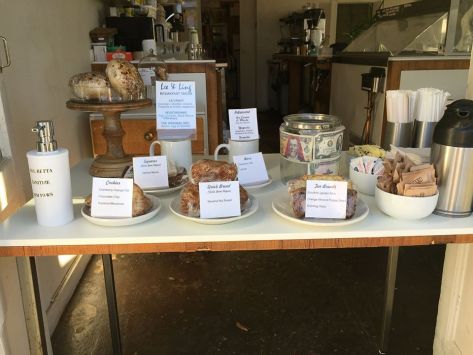
Orange Couch set up for physically-distanced ordering at the side door
In these 90 or so blocks, enough locals live here so that we actually do have many neighborhoody things like drugstores, veterinarian offices, postal emporiums but it has become clear during this moment that even much of THAT relies on the millions of visitors who also come to these blocks, or it relies on the pockets of workers who, currently unsure of when or if they get to return to their store or will put that apron on again, are saving their bucks. Or maybe it doesn’t rely on those dollars at all but the business owners just think that it does. For whatever is actually true, what is clear is that almost all of them are closed. And they closed fast.
A few businesses tried to use social media to convince local folks to get items, but locals from other parts of town have been penalized and confused far too often by the parking rules here to dare to drive in. And even if they do brave it once in a while, most are not able to afford or stomach the majority-rule visitor-obsessed restaurants often enough to be familiar enough to check in with the others now.
As for residents: even though numbers have climbed steadily in the last 20 years, now at around 4,000 with around 1000 at or below poverty-level they mostly divide into the worker/residents of the Quarter (although far fewer than when I was one) now without income and the very very rich who have everything they need delivered by Amazon living behind their gates and private driveway. Since 2000, owner-occupied units have risen from 24.6% to 48.2% with renter-occupied down from 75.4% to 51.8%; fewer of us renters and therefore likely less of us remaining who seem to live here because we love it and not because we depend on it for work or because it is a family inheritance or peccadillo hideaway. As a result, those able to go get items from the restaurants who tried to offer food is even a smaller group than those other areas of town.
The other obvious issue clearly seen now that the Quarter is only serving its residents: it is so very very white which wasn’t the case when I moved here as a teen. And even though it has become clearly whiter in terms of residents since the pre and post 84 World’s Fair development furor, on a normal day the cross-section of tens of thousands of workers, hustlers, and visitors allow the FQ to be as diverse and energetic as any place in this city, pound for pound, 24 hours a day, 7 days a week.
Not right now though. The only faces of color or heard talking in other languages here during COVID-19 have been the sanitation folks, grocery workers and security personnel. The usual Quarter workers and artists who represent the diversity of our city are home in their own neighborhoods which since 2005 are far far from here. (Which ironically, also means that the multi-generational food entrepreneurs offering good, culturally appropriate food to a cross-section of New Orleanians are also now far from here.) That diversity is the heart and soul of what makes New Orleans interesting and important. And when we reopen, it’s possible that many culture bearers and much of our indigenous knowledge base may just not care to keep fighting their way back here this time – or the next.
All of this calls into question the future through this portal: what will an economy only based on tourism offer our city, once disruptions come again and again, as we have to expect they will?
More simply and directly, what will remain alive after just this one shutdown? And what if the US opens up later this summer just as we hit the height of hurricane season?
In only a month, I have already seen 1-2 brand-new commercial For Rent signs, talked to business owners who are mulling the idea of not reopening their storefront that cost upwards of tens of thousands of dollars per month, and have heard of a few neighbors who are moving away to live with family or to cheaper cities to replenish their savings. One has to imagine that restarting the tourism wheel will take a while, especially when rumors (and logic) have it that JazzFest will likely not operate in 2020 or if it does at all, be a much smaller and leaner version. We’d have to assume the same will go for French Quarter Fest and others as they depend on sponsors as much as visitors. Connected to that is the outcome we have to expect if the seasoned staff of the past few decades that ran our best places like clockwork will not return intact.
So the question is how will we look once through this portal? Will the French Quarter adapt as it always has, or will it finally “die”- meaning become smaller, less lively, maybe owned by more out-of-towners with deeper pockets who move more to the middle in terms of what they present as New Orleans? That could mean losing what had been a critical mass of authentic experiences and becoming too small to entice enough visitors to hold this city together.
Or maybe – just maybe – this old city will just adapt as it has so many times previously.
In 2008, the book Building the Devil’s Empire offered the intriguing analysis (via many years of archaeological digs around the old city) that by the mid-1720s due to the failure of New Orleans as a tobacco exporter and the effect of Law’s Mississippi Bubble bursting, France had basically given up on this colony, although not turning it over to the Spanish until the 1760s. Yet those digs show lively trade and activity in those 40 years, proving that New Orleans became a smuggler’s capital by turning its attention to the Caribbean to find its own opportunities even though that was against French law. That “rogue colonialism”, as Dawdy names it, she believes was mirrored in 2005 when the federal government did its best to thwart returning residents and stymie small businesses yet many found a way around that to survive and even some to thrive.
That rogue colonialism is clearly an adapt or die portal which could be vital for whenever the country opens back up for business. Do we have another one in us here? And if so, what will that version center on: regional food? port activities? design for climate challenge places?
And maybe to help that, possibly commercial rents in the FQ will come down to reality. Maybe people will see the need for downsizing their place to something smaller and more communal as only the Quarter can offer. Maybe my idea of Canal Street and Pontalba being offered tax credits to become rent-controlled to entice residents to move upstairs into all of those decaying camera shops will happen.
I hear bike shops around town are doing bang-up business right now; maybe we’ll see a few open in FQ again.
Maybe less crap made in China will be for sale in our shops and more useful services for all residents can return. Shutter repair? Seamstresses? Metalwork? Mule-driven delivery around the city?
Maybe the French Market can add a splash park on the concrete pad, a storefront library, citywide compost drop off and community or senior services along its many block span to serve the entire city in some manner?
In any case, the way through this portal does seem to require a push to something new even if it might actually resemble something old and tested.
The question is: can we begin to turn in that direction?
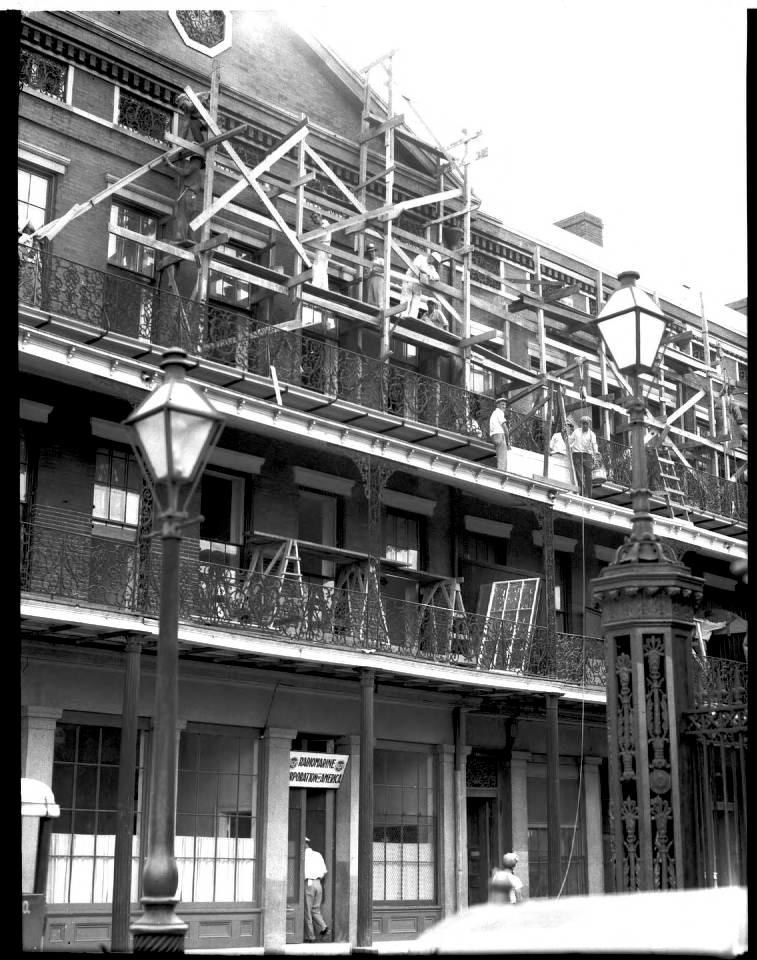
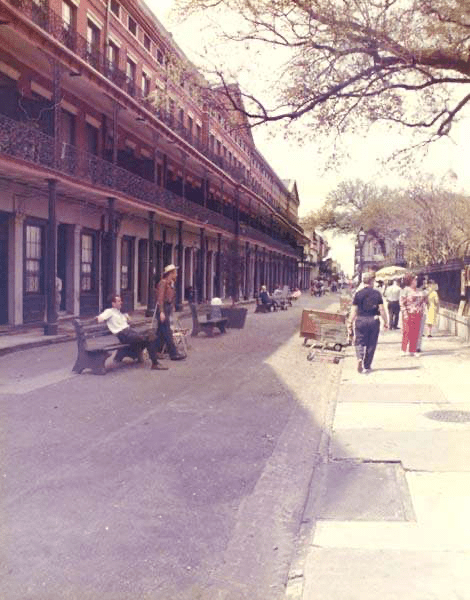
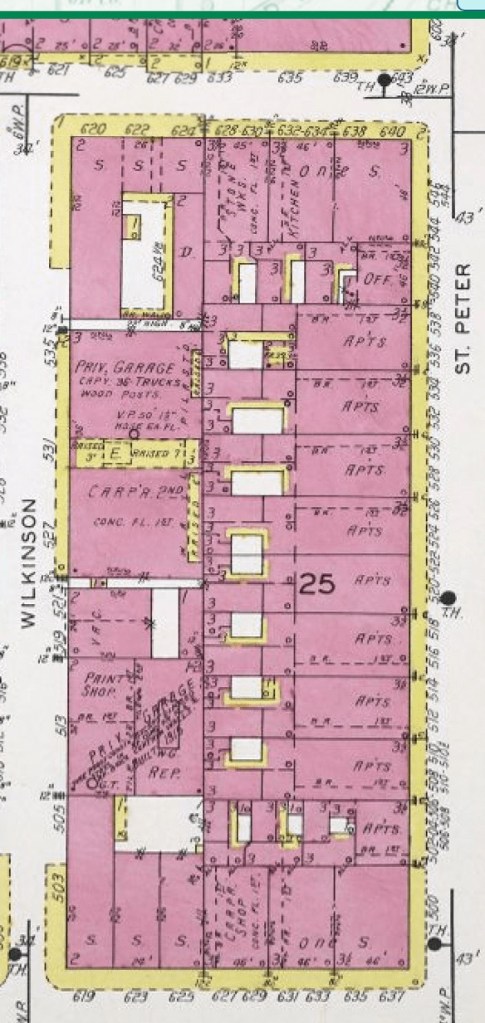


 French Quarter block by block
You must be logged in to post a comment.