Southern Decadence Parade Routes

SD-Parade-Route-Friday14

SD-Parade-Route-Sunday14

2014 is the 43rd Annual Southern Decadence celebration.However, 2014 brings us the 40th annual Sunday afternoon parade, as there was no official parade in 1972, 2005 (Hurricane Katrina) and 2008 (Hurricane Gustav).

Southern Decadence Parade Routes.

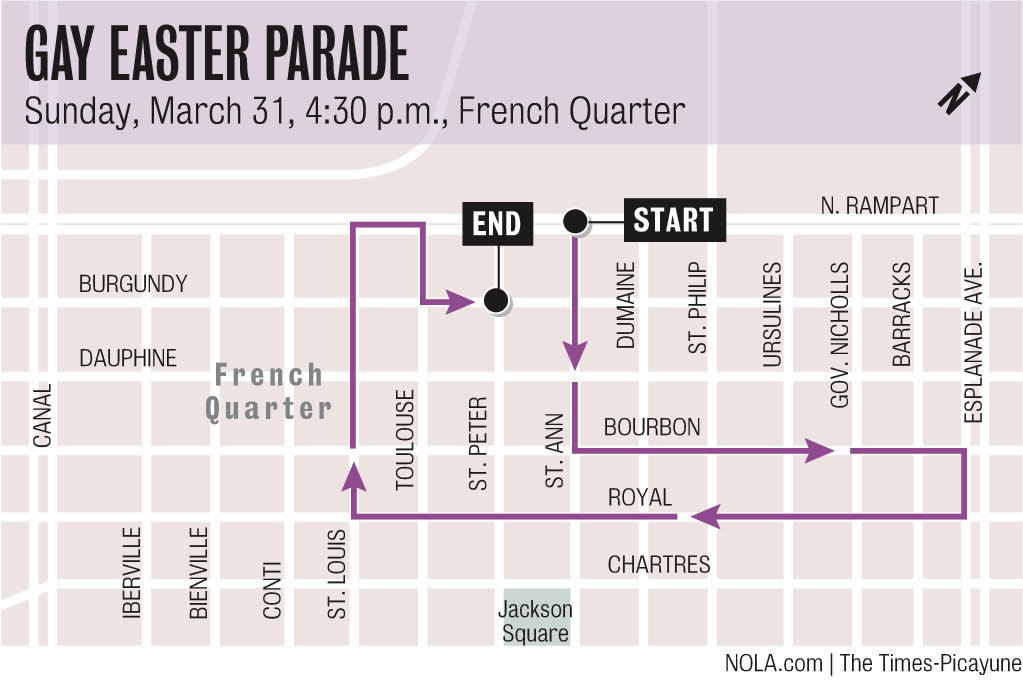
Easter Parades 2014

historic-french-quarter-easter-parade-2014-map-08fc4eda0a4cc629
chris-owens-easter-parade-2014-map-7131615e3e0a6529

gay-easter-parade-2014-map-bf5e64c8acc46701

Roy Guste, FQ photographer captures Krewe de Vieux 2014

1920240_10203168534516524_208781388_n1795540_10203168561317194_132826920_n

When was Carnival’s golden age? Take a look around — we’re living in it | The Lens

C.W. Cannon one of my favorite columnists, talks of our current Carnival period as a golden age with more democratic and satirical characteristics than we experienced in the late 20th century, where whites-only krewes had their way and superfloats flourished which led to the demise of many of the small neighborhood parades. I’ll tell him how much I appreciate this on the downtown parade routes that I am sure to see him on over the next few weeks..

Russian literary critic Mikhail Bakhtin, in a book about folk culture influences on the great Renaissance French writer Rabelais, outlined a theory of Carnival based on ancient and medieval traditions. Centuries later, it’s remarkable to witness how the “carnivalesque” spirit he details lives on so palpably on the other side of the world. A few of the key attributes Bakhtin ascribes to Carnival are a satirical impulse of a bawdy kind that he calls “grotesque realism,” the inversion of normal prevailing social hierarchies, and mass participation.

In light of principles like these, it’s a no-brainer that the latest city ordinance supports, rather than inhibits, the ancient foundations of Carnival tradition. Even here in New Orleans, one of the prevailing social strictures upended by Carnival has been segregation in public settings. Blocking off and segregating swaths of the public space for members-only parties doesn’t jibe with the carnivalesque injunction to cast off social distinctions and rub shoulders with strangers for a limited period of time.

When was Carnival’s golden age? Take a look around — we’re living in it | The Lens.

All Saints Day/Feast of All Souls

With all of the hoopla now surrounding Hallowe’en, many newcomers to New Orleans may not know that today is as important or more to our culture as the ghoulish day before. All Saints Day is done in primarily Catholic places, like New Orleans, and is a day decreed by the Vatican as a catch-all day to pray to your saint of choice.
The day is honored by attending Mass and working on one’s family tomb, cleaning it and making it presentable for November 2 which is the Feast of All Souls or in some Catholic countries, the Day of the Dead. Taking time on All Saints Day is thought to have begun because most Catholic cities like New Orleans would decree the day before a holiday a day off and so people here used it to whitewash and make one’s family tomb presentable.

Today is a day to visit your nearest cemetery in New Orleans, and watch family tradition in action. Tomorrow, take a moment and remember your dead, especially those that you believe might still be in Purgatory…

The modern date of All Souls’ Day was first popularized in the early eleventh century after Abbot Odilo established it as a day for the monks of Cluny and associated monasteries to pray for the souls in purgatory. However, it was only in the Medieval period, when Europeans began to mix the two celebrations, that many traditions now associated with All Souls’ Day are first recorded.