Historic New Orleans Collection uncovers FQ well

The Historic New Orleans Collection is working on the Brulatour House on Royal Street, which has a long and storied history, including operating as the Arts and Crafts Club for a number of years in the early part of the 20th century. Many of its artists used its facade and courtyard for inspiration for many art works, which is why the courtyard will look so familiar to so many people when it is finally opened to the public.
The HNOC uploaded some pictures of the work of the discovery of a well in the courtyard. The previous paving that can be seen near the top is fascinating.
EarthSearch dig at the Brulatour House at 520 Royal Street
1003992_10151672422353419_1500220673_n

941205_10151672422553419_1467554592_n

1002446_10151672422528419_1357506559_n

Fringes of the festival

Once you buy a panel pass for the TWLF, I understand that you might then feel compelled to squeeze every dime from it, running from one room to the next, checking off workshops, circling possibilities, slowly scanning the merchandise table in a spare moment, sure that the right gift for your literary friends is here. I have been guilty of that. 75 bucks doesn’t come that easily to me and so often I equate value with quantity, like so many Americans. I do, after all , shop at the dollar store.
Luckily, with age comes experience (let’s not talk about the bad eyesight and odd aches- what DID I do to my arm?) and so I have grown more aware of my choices, at least those that are available with a panel pass.
I could sit in the uncomfortable chairs of a ballroom or a museum through the post-breakfast to cocktail hours, hoping that the gentleman behind me would realize that his throat clearing is not discreet at all, but incredibly well-timed to cover the bon mots that most likely were what the rest of the audience was chuckling over when my ambient hearing returned. I could do that and have.
Or, I could pack up when I feel the energy lagging at the 12:10 mark and head for a fortifying gumbo lunch at the most appropriately named restaurant for a Tennessee festival goer (I believe in you. you CAN decipher this) followed by a cheap cocktail from the oddly agreeably afternoon haunt of the Chart Room, ultimately heading to Crescent City Books for an afternoon of lessons.
Once there, you meet Isabel, their traumatized but healing cat and talk of books and John Boutte with local author and bookseller Michael Z.
You head upstairs and immediately find a book that has no reason to be prominently displayed (this visit it was “Farmers Last Frontier: Agriculture 1860-1897, which is an astounding find this month), sit with your discreet, illicit cocktail and thumb through it while viewing books and book lovers, pausing to think of calliopes on steamboats and why people honk their horns so often and how creaking stairs can be both frightening and comforting.

And salute Tennessee and his devotees who bring you to the Quarter this fine day.

20130323-140349.jpg

Southern Gothic for breakfast

This morning, we are starting with a discussion about Southern Gothic in novels with
Barton Palmer, Annette Saddik, Harvey Young with mod Robert Bray.

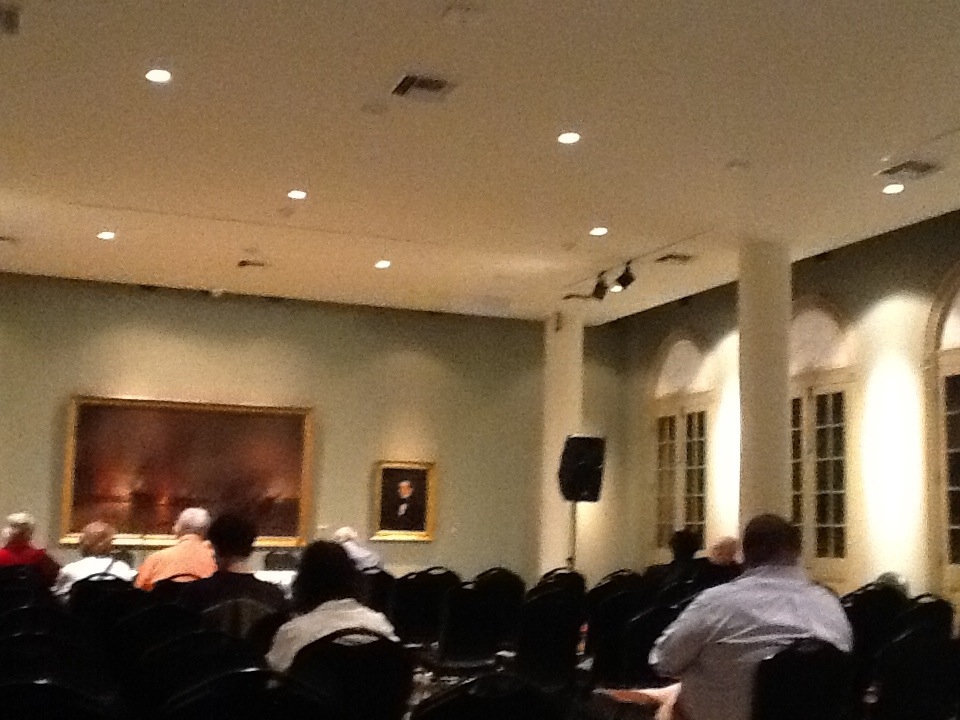
At least sitting in the Williams Research Center evokes a bit more mystery and ambience than the Queen Anne Ballroom of the otherwise lovely Monteleone Hotel.
There is a small cartography exhibit in the anteroom, which is a pleasant way to prepare for sitting for an hour or more. The “oilmen” map is a particular good example of the lovely and profane and so might be the best example of Gothic out there.

For me, Southern Gothic smacks of Mississippi and Alabama more than New Orleans, except of course for Tennessee himself, who we must always remember, was actually born in Mississippi.
Romantic and grotesque is always an appropriate way to describe any part of the South or any area really that has as many defeated people yet the abundance that we have.

Pat Conroy said “All southern writing can be traced to this one statement: On the night that the hogs ate Willie, momma died when she heard what daddy did to sister.”

Or, unfortunately, what one panelist this morning did to the others by taking more than half of the time allotted this panel.

20130323-094336.jpg

20130323-094352.jpg

Tennessee Returns To The Quarter

Ah my favorite weekend is here. Time to head to the Quarter and immerse myself in all things literary and of Tennessee. 4 days of workshops, plays, walking tours, shouting contests and mint juleps.
Hope to see you there, and if not, look for my blogs from the Fest.

http://www.tennesseewilliams.net/festival/schedule

20130320-184829.jpg

Creole Sweet: The Praline and Its World

A presentation of The Historic New Orleans Collection and Dillard University’s Ray Charles Program and Institute for the Study of Culinary Cultures

Join us for Creole Sweet, a day-long forum featuring talks and panel discussions on the vending, production, and consumption of the quintessential Louisiana candy and its cousins. Our culinary journey will wend its way from Mexico to Jamaica, from Puerto Rico to the Pelican State, and into praline-loving households worldwide.

The forum opens with a keynote address by Dr. Jessica Harris and brings together such distinguished speakers as Fany Gerson, Nicole Taylor, Susan Tucker, and Patrick Dunne.

Reception
Friday, June 8
6–8 p.m.
533 Royal Street

Forum
Saturday, June 9
Registration 8–8:45 a.m., sessions 9 a.m.–4 p.m.
Williams Research Center, 410 Chartres St.

Registration: $50 per person, $35 for Dillard faculty, THNOC members and students
Call (504) 523-4662 or click the link below to register.

Click to register

Reflections of Bechet, A New Orleans Jazz Original: The Man and the Music”

13th annual Bill Russell Lecture

“Reflections of Bechet, A New Orleans Jazz Original: The Man and the Music”
Historian Bruce Raeburn will moderate an illustrated program exploring the artistry, humanity and legacy of creative genius Sidney Bechet (1897–1959). The evening will feature musical performances and commentary from members of the New Orleans Jazzman Band, with Jerry Embree (soprano saxophone), Frankie Lynne (banjo), Barry Martyn (drums) and Mark Brooks (bass).

Friday, April 13 • 6:30 p.m.
Williams Research Center, 410 Chartres St.

A contemporary of Louis Armstrong and Jelly Roll Morton, Bechet is regarded as an early virtuoso on both the clarinet and soprano saxophone, and a musician who helped define the role of those instruments in New Orleans jazz.

Admission for this event is $10 and seating is limited. Reservations are encouraged and may be made by calling (504) 523-4662 or emailing wrc@hnoc.org. Reservations will be held 10 minutes prior to the start of the program. At that time, any unclaimed seats will be released to the public.

About the Bill Russell Lecture

The annual Bill Russell Lecture honors the noted jazz historian, born Russell William Wagner (1905–1992), and is dedicated to New Orleans jazz. Russell’s research focused on traditional New Orleans–style jazz and related musical forms such as brass band, ragtime and gospel music. He amassed an extensive collection of memorabilia, including musical instruments, records, piano rolls, sheet music, photographs, books, and periodicals. These materials trace the development of jazz in New Orleans and follow the movement of musicians to New York, Chicago, California and beyond.
.

The William Russell Jazz Collection—permanently housed at the Williams Research Center—encompasses Russell’s research, audiotapes, programs, posters, correspondence, films, business cards, notes, clippings and scrapbooks. The Russell Collection is available to the public at the Williams Research Center, located at 410 Chartres St. and open Tuesday–Saturday, 9:30 a.m.–4:30 p.m. For more information on this collection, visit the institution, call (504) 523-4662, or e-mail wrc@hnoc.org.