Entrepreneurial Jackson Square

The cultural and political significance of the square has already been well researched and widely published, all of it illustrating its role over the 300+ year history of New Orleans. Many writers have highlighted its colonial role as a military parade grounds, and others have focused on its development into its current role as the chief tourist mecca for the more than 10 million visitors the city hosts annually. Few writers however, focus on the individuals that have and continue to shape this square, doing so as builders, philanthropists, artists, activists, residents, and more.

Since the archives of written pieces on that history exists, this series of articles will instead focus on how entrepreneurs have used the Square since 1850. That date was chosen because it is when the Almonaster/Pontalba family added its final (of many previous) contributions to the Square with the iconic 4-story red brick buildings that still anchor the upper (west) and lower (east) sides of the Square. The buildings built by Micaela Almonaster Pontalba, a native daughter of the city who sailed back to France after they were completed never to return, set the scale and rhythm of how the Square conducts business to this very day.

Baroness Pontalba herself will be one of the entrepreneurs that this series will celebrate, as her efforts are a perfect prologue for the modern uses of the Square. Her half-decade long development of the two Pontalba buildings will center this story, as will the later generations of the Pontalba family who could not withstand the late 19th century and early 20th century abandonment of the square by the city’s elite. Luckily for them, others stepped in once again to keep the Square a democratic and dynamic place.

Even though the buildings remain the most significant contributor to how commerce is conducted in these 2.5 acres, the Baroness’ original plan for their use has to be considered an almost total failure. Instead, in true New Orleans fashion, the Square’s users adapted them through philanthropic intervention, city, state and federal oversight, and the sheer vehemence of New Orleanians who saw their value. These interventions happened at various times over the last 170 years, often at the last possible moment before demolition would have invariably led to the loss of the Square’s daily activity.

Best and Worst of 2020 French Quarter

I’ll do my best to refrain from making too many weary references to the past year. If I do, just kick me under the table and I’ll move on…

Walking around here during the holidays is usually a bustling, sparkly mood enhancement- lots of holiday lights, special events, and more local sightings than normal. Knowing most of you didn’t make it down here (and thank you for that), I’d like to bring you my “Best French Quarter moments.” And because it seems necessary, I am also going to list my “Worst French Quarter moments.” Here’s the thing: I am going to mix them all up. As I find more in my notes, I will add them.

Best/Worst of French Quarter 2020

Stanley’s adds seating outdoors and evolves its menu

Jewel of the South adds seating in parking lot next door and reopens

Many tourists ignore mask mandate

Manolito keeps making its signature drinks at window

Golden Lantern Bar follows the rules, does contact tracing and keeps its good cheap drinks and cheerful professional staff.

Mona Lisa has hilarious conversation with world via its daily window notes, also offers good Italian food

Mattassa’s continues its struggles, even with residents increased grocery needs and Rouses closing for long period in December

Valentino Hotels renovates

Le Richelieu Hotel renovates

Relaxed parking enforcement

Fewer cars in Quarter

Hard Rock* demolition is still not done by 1031 Canal Development

10 months later, neighbors’ remains (Anthony Magrette, Jose Ponce Arreola, Quinnyon Wimberly) are finally all removed from Hard Rock* collapsed building

Nelly Deli (Quarter Master) renovates

Cafe Envie on Decatur reopens in April with careful rules in place

FQ Rouses/A&P gets a whole new do inside with pretty floors and room to move about

My mom gets better after long spring/summer illness (not COVID) and comes home to her beloved Quarter

Blue bike racks become bigger eyesores

Copper downspout thefts increase again

FQ dogs are even more blissed-out with increased walks and long stretches of time with their people

Jackson Square artists’ carts and art are thrown into Mississippi River by malicious malcontent

Saint Ann construction is completed (?)

Soap hawkers on Royal continue to harangue passersby, rarely wear masks during COVID mandate.

Some bars ignore mask mandate

Mayor orders Willie’s Chicken Shack to close for duration after COVID restrictions are ignored

Clarinetist Tim Laughlin offers evening balcony concerts on Royal

Place d’Armes bell captain Chris Stall and valet staff maintain a cheerful and helpful vibe to neighbors and visitors throughout stay-at-home summer

Backatown Coffeehouse hangs in on Basin, keeps sweet potato pies and coffee flowing.

City Hall pays attention to the potential of the Quarter, asks for input

City Hall chooses the wrong place to suggest another pedestrian mall

Signmaker gets windfall with numerous “anti-mall” yard sign orders

#JazzFestingInPlace at WWOZ is a triumph

Neighbors sit outside nightly and talk quietly and safely on Chartres, on Barracks, on St. Philip, on Bourbon, on Saint Ann…

Reggie the cat remains at large; family still hopeful for return

Homer Plessy at the Little Red Schoolhouse announces renewal of its charter

After more than 100 years at that location, Tujague’s leaves its 823 Decatur home,

Tujague’s opens at 429 Decatur Street at end of the year

Chef Jerry Mixon moves on from Cafe Amelie

Vieux Carre Wine and Spirits keeps serving the liquor-needy.

Bike lane is added on N Peters/French Market to Elysian Fields

Pedestrian striping and traffic calming upgrades are added to area around Crescent Park bridge

Unhoused population get hotel rooms for short period in summer

Retail stores begin to disappear in summer. My last informal count: 15 establishments gone in last 6 months.

French Quarter Festivals does online Holiday Concert series, culminating in Christmas Even concert by Irma Thomas. Miss Irma’s “O Holy Night” rendition remains perfect

Heavy rain storms brought on by climate change are so severe across the city that even the French Quarter floods, a rarity (2 such came in October, November)

HNOC does #NolaMovieNight with clever social media commentaries during movies.

Neighbors on Saint Ann hold safely chalked early pandemic dance party with appropriate music

I decide to check off a bucket list item and move to the Pontalba apartments, hopefully increasing my work on Mercantile Jackson Square writing project

Frogs croaking from courtyard garden ponds and pools all through quiet summer months

City Hall baits the sewers to stem rat infestation

Mary’s Ace Hardware on Rampart reports bar owners, restauranteurs, and homeowners outnumber the usual contractors are coming in to their well-stocked, 2-story establishment.

Oversized and unmitigated “prayer event” is held on river in November, pointedly ignoring all mask and distancing protocols.

Protest for Black Lives Matter are peaceful, well-organized, and citizens follow mask and (mostly) distancing protocols asked for by its organizers.

NOPD attempts scare tactics by reporting phantom piles of bricks hidden near Black Lives Matter protest site, tells neighbors of phantom buses filled with counter-protestors, neither of which materialize or are proven with any photographic evidence.

  •  The Hard Rock Hotel is owned by 1031 Canal Development (Mohan Kailas).

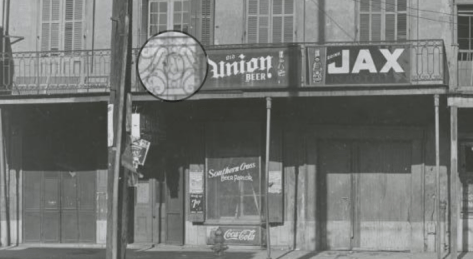
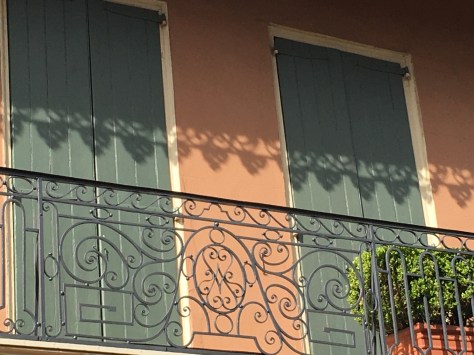
French Quarter Ironwork: monograms and initials

I have been gathering photos of different ironwork motifs in all four quadrants of the Quarter and will be researching them further when I am able to get to the wonderful HNOC’s Williams Research Center.

Here are all of the (18) monogram and initial motifs I have found – so far.

I have found them on Burgundy (2), Dauphine (1), Bourbon (1), Royal (5), St. Louis (1), Chartres (3), at the Pontalbas,  2 different motifs on the Skyscraper at St Peter and Royal, on a modest brick house on Dumaine (where the AP scrollwork from the Pontalbas is on the gate transom of a house in mid block for some mysterious reason) and two on Esplanade. Most are found on second or third-story balconies, but a few are on front doors, and a few others are on a gate.

Thanks to The Collins C. Diboll Vieux Carré Digital Survey at HNOC I was able to research each location to see if I could find a likely reason that particular monogram or initial was added. I am also searching for other history books to find other information as needed so I will continue to refine and add to this list in the next few weeks to capture each monogram and its history.

Have been long confused by description of the Bosque House: “The central panel of the rail has a most graceful arrangement of scrolls in the character of the best 18th-century work and in an oval at the center appears the monogram of Bartholome Bosque, curiously backward when seen from the street.” It doesn’t seem backward any longer.

Yet, in the 1930s pictures of the scrollwork it does indeed look backward in the picture:

Love the description too:

The wrought iron railing of this balcony is perhaps the finest feature of the façade and is comparable to only three or four other examples in New Orleans — the Cabildo, the Pontalba House, and the Correjolles House at 715 Governor Nicholls. All these railings are of about the same date and are all probably the work of the same craftsman, who, in the case of the Cabildo and the Pontalba House is known to have been Marcellino Hernandez, a local blacksmith of great skill.

I went to look at 715 Governor Nicholls and its ironwork certainly resembles the Bosque House:

715 Governor Nicholls

Next up: the anthemion or palmette motif.

Golden French Quarter

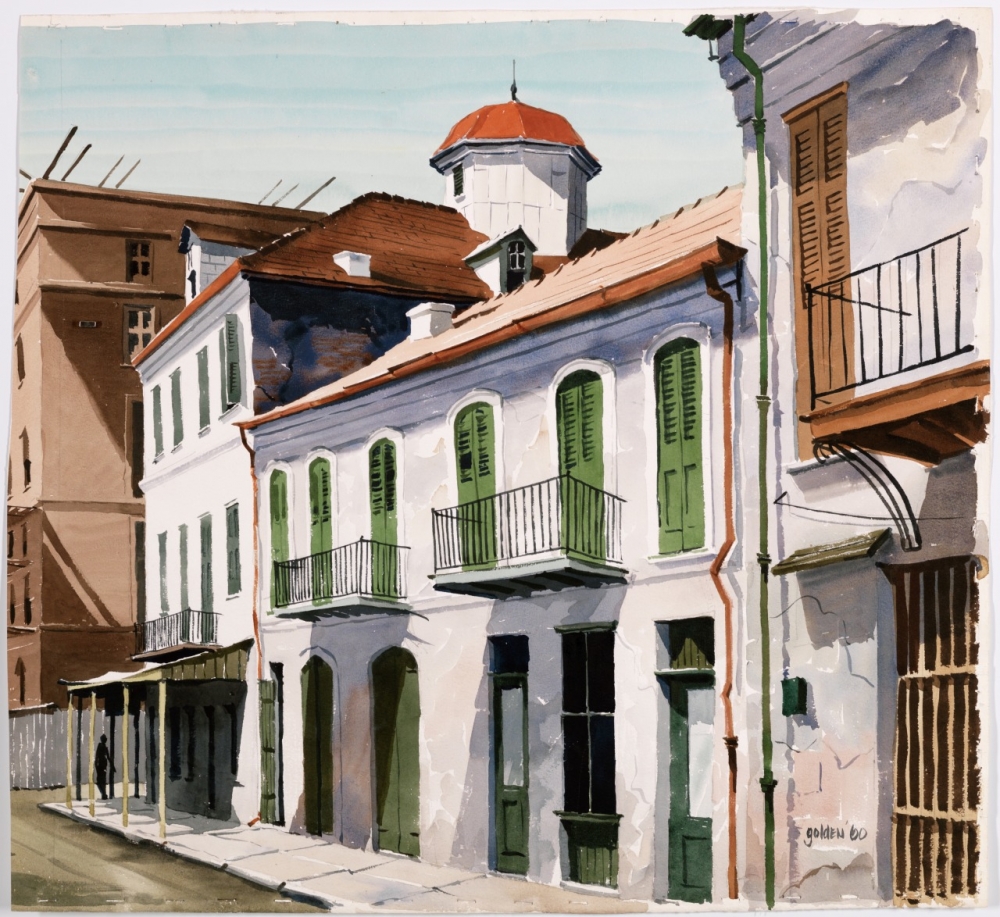
From Historic New Orleans Collection, a link below to some lovely sketches by local artist Rolland Golden. By the way, his book is an treat too.


Born in New Orleans in 1931, Rolland Golden—who passed away in July 2019—spent much of his career as an artist drawing and painting Southern scenes. After serving in the Navy, Golden attended the John McCrady Art School from 1955 to 1957. Those years studying in the French Quarter began a lifelong love for the old buildings and charm of the Vieux Carré. After graduation, Golden married Stella Doussan and opened the Patio Art Studio on Royal Street. In the next few years, and as their family grew to include three children, they moved between several apartments on St. Philip, Royal, St. Ann, and Bourbon Streets—all in the French Quarter.

https://www.hnoc.org/content-rolland-golden%E2%80%99s-sketches-show-changing-french-quarter-50s-and-60s?fbclid=IwAR19M2kOMRdEkQb7CQ4NblExRbF4lZJKaBV0nLHB0-Im2r4ld0gZv-Hxkg4


Golden completed this painting of the Napoleon House in 1960. (THNOC, 1975.130)1975.130_web.jpg

L’Union, New Orleans Tribune honored

The Louisiana Creole Research Association will host a forum and unveiling of a new historic marker this weekend for L’Union (1862-1864), the South’s first Black newspaper, and the New Orleans Tribune (1864-1869), America’s first Black daily paper.

The forum takes place this Saturday, June 16 from 2:30 to 4:30 p.m.at the Williams Research Center at the Historic New Orleans Collection, 410 Chartres Street. The marker unveiling will immediately follow the forum, and the event is free and open to the public.

From The Advocate article:

In response, Roudanez formed L’Union with his older brother, Jean Baptiste Roudanez, as publisher and Paul Trevigne as the paper’s first editor.

As soon as L’Union began publishing, the three men faced repeated threats of arson and death, but in response, they decided to expand their audience by publishing the daily Tribune.

As the paper editorialized in 1869, its goal was not to be a journal dedicated merely to beautiful prose. “We plead for equality not as philosophers (who) in their closet write beautiful essays about abstract principles,” the editorial said. “We are seeking to throw off a tremendous load which has been our inheritance for centuries. With us, it is a reality and no abstraction.

Found at 527 Conti Street (at Bevolo Gas & Electric Lights showroom building)

Portage Bike Roll 2018

The Historic New Orleans Collection is offering free bicycle tours with A Bicycle Named Desire every Wednesday and Sunday through June 3 as part of the upcoming exhibition Art of the City: Postmodern to Post-Katrina, presented by The Helis Foundation.
The six-mile trip highlights the public art, history, and architecture along the Esplanade corridor, starting in the Marigny, through Tremé, down Esplanade to City Park, then looping back to finish in the French Quarter at THNOC, 533 Royal Street. There, guests will be able to preview some of the works that will be on view in Art of the City when THNOC’s new exhibition center opens in fall 2018. That preview also opens today at 533 Royal Street, with a special event at 6 p.m. featuring UK artist Robin Reynolds, whose work New Orleans: Between Heaven and Hell anchors the display.
Maps for self-guided tours are now available at THNOC and A Bicycle Named Desire, 632 Elysian Fields Avenue. The free guided tours are offered Wednesdays and Sundays at 9:30 a.m. and 1:30 p.m. May 9–June 3. The afternoon tour on June 3 will take place by bus. Registration is required for all guided tours. Participants must be 16+ years old and capable of strenuous physical activity and a six-mile bike ride. For more information, contact A Bicycle Named Desire at abicyclenameddesire@gmail.com or (504) 345-8966.


Archaeology and New Orleans

Just attended the very excellent morning event at the Monteleone Hotel for the Making New Orleans Home: A Tricentennial Symposium.

This free set of events is happening today at the Monteleone, tomorrow at Xavier, and Sunday at UNO.
This morning’s talk, by Shannon Lee Dawdy, professor of anthropology at University of Chicago and D. Ryan Gray at University of New Orleans, was focused on the archaeological evidence found at a few sites in the French Quarter over the last 20 years, as well as  those professors using the tricentennial spotlight to state the clear political need to getting New Orleans a designation as World Heritage Site or at least an ordinance established on excavating properly before a new development is begun. (Professor Dowdy’s comment about how dire this situation was before Katrina was illustrated by her estimation of having only “5 cubic meters” of excavated of Colonial-era material available before Katrina.)
The two speakers were both known to me previously; Dowdy through her brilliant book, Revisiting the Devil’s Empire: French Colonial New Orleans – which is one of my top books on New Orleans history – and Gray through his digs, especially the one around the corner at 810 Royal, the details of which can be found here.
Dowdy’s focus has been on what she terms the “rogue colonialism” of the period from 1699-1769, and especially the years before the “administrative abandonment” of New Orleans by the French Crown in the 1730s. That abandonment was a result of the failure of Law’s Company of the West (more popularly known as The Mississippi Company) which ended in the economic failure known as The Mississippi Bubble.
(Of course, the French Crown retained control of the colony until the 1760s, but did little with it and so it was not until the Spanish rule that the infrastructure expanded along with the population.)

Professor Dowdy’s theory is that during the earlier Colonial period shipping and trade were actually more robust than official accounts of the time offer because so much of what was happening was technically illegal (as it was meant to be managed exclusively by Law and later by or through the Crown.) Even during and after the Bubble, locals amassed wealth which was indicated by findings on these digs analyzed as goods procured via smuggling routes, particularly with Cuba, Mexico and the Carribean islands. With her 2004-2005 dig at the Rising Sun Hotel on the Conti block between Chartres and Decatur, the 2009 St. Anthony’s Garden dig at the back of St. Louis Cathedral and the 2011 dig at the old Ursuline Convent, many of the artifacts date from the 1750s and include Mexican pottery, Spanish coins, gilded glass long before Spanish control. Her St. Anthony’s Garden dig gave material evidence to the idea of the Native American settlement, with huts that predate the 1726 gridlines of New Orleans as do a significant number of artifacts found at the Convent site.
The dig at the back of the Cathedral (Dowdy confesses this was her favorite New Orleans dig) indicates a robust market operating there from the 1740s to 1788, including extensive evidence of camping which suggests that many people came to town to sell or barter there.

After Dowdy presented, Professor Gray used the old St. Peter Cemetery as an excellent example of the lack of protection around our buried history. That cemetery was between Rampart and Burgundy and Toulouse and St. Peter and operated between 1725 and 1789 as a Catholic cemetery for both enslaved and free citizens. After it was no longer used, the ownership of the cemetery was tangled between the Cabildo and the Church so when the Cabildo sold off parcels of it, the Church refused to move the bodies.
Since then, it has been up to private developers and lot owners in that area to undertake an archaeological dig, as happened during the building of the Maison Dupuy in the 1970s, during condo development in the 1980s and most famously, during a potential swimming pool addition by homeowner Vincent Marcello who contacted UNO which resulted in the removal of 15 bodies to a vault in St. Louis #1.

The best comment of the morning was from Professor Gray summing up the current problem: “For a city that cares so much about its history, very few protections are in place to preserve the material past.”