2-year eviction of Upper Pontalba residents

As someone who lived in the building until recently and as someone who has spent the last decade researching the rich history of these buildings and their effect on our public square, lets just say I am deeply interested in the recent news that the residents of the 50+ apartments on the city-managed Pontalba (St. Peter side) have informed its residents that they will all need to vacate the building while a long renovation is done.

First, let’s get to the facts and do away with the misinformation about this building:

  1. It’s all rentals, no owners. The city was given this building back in the 30s by the preservationists who bought it and saved it from likely destruction.
  2. Essentially each of the Pontalba buildings was designed as 16 3-story townhouses, each with their own entrances. They do share infrastructure between them but any of the 16 can be easily closed off from the others.
  3. The rents are not astronomical but are in line with current rents around FQ. For example, the large one-room efficiencies are around 900 a month.*
  4. The apartments are lovely, and have updated modern kitchens, bathrooms and HVAC.
  5. There are a large number of full-time residents some of whom have been there for decades and have invested thousands of their own dollars in repairs and upgrades.
  6. There is not a years-long waiting list. There are often empty apartments which are first offered to residents, then to folks who sign up at the office to be contacted, then a larger search is undertaken (they say they do this phase, although I have never seen any evidence of it online). If someone on the contact list doesn’t reply, they are taken off the list (although that list seems to a bit of a snarl in terms of who manages it and how well it is maintained. That is based on feedback I have received from those on the list.)
  7. The staff is generally wonderful. For example, the men and women who do the custodial and minor repairs are caring and smart folks, many of whom have worked there for decades. (It has also been recently suggested in casual conversations that those positions might instead be independent contractors and not staff positions, which might mean new folks who know less and likely care less about the building to “come by” and deal with stuff.)

There are definitely some big issues such as the roof damage from Hurricane Ida to be dealt with, but the renovations seem to be more about “upgrading” the building. Again, very little in writing is given to residents or neighbors so this is based on my own conversations with staff and reading emails sent by various people connected with the building.

Residents seem willing to work with the renovation, even moving for short periods to other apartments. As a matter of fact, while I lived there, I asked where my latest lease renewal was and was told that since they may need to move us to another apartment, they were holding off on assigning us a lease for a specific apartment. So it was clearly an idea they were also working with at the time.

The issue with removing all residents for upgrades and roof repair is that many of them will not be able to find another space nearby. I think of neighbors who were service industry folks who worked later shifts and came home around 4 in the morning after work. Finding a space that is safe and quiet for folks like that is very nearly impossible in a neighborhood with so many illegal airbnbs operating.

Another question is if emptying it out is even needed. If you live and rent in the FQ, you have worked with landlords who need to do major repairs to these old buildings. I have never (not has anyone I know) had a landlord suggest I needed to leave for years to do those repairs.

And certainly important, is that they are losing 2 years of income.

There has been little information on this topic given in writing, including the actual plans of what is to be done.

In civic activist Jane Jacobs’ parlance, having mixed use and spaces made for people and not for massive development or infrastructure is necessary for a vibrant city. Those who live on the square happily share it with artists, readers, musicians, and others because all are needed to keep it dynamic and useful to the city. The residents are there after the shops close and the museums are shuttered, keeping an eye and an ear on late night activities, sharing information with the Square’s daytime users. It’s a delicate balance, and one that generally works.

Lastly, through my research on entrepreneurial activity in Jax Square, I have found that over the last 170 years, the residents of the buildings have almost always taken pride and care in living there. There have been times that it has housed people of civic stature, other times it had the workers or those newly arrived to the city, and very often, the creative and the enterprising have found their muse there.

That contribution cannot be overstated, especially in a neighborhood that is so physically important and so socially necessary. Let’s do better sharing what is planned and working with the residents and neighborhood to make this renovation helpful.
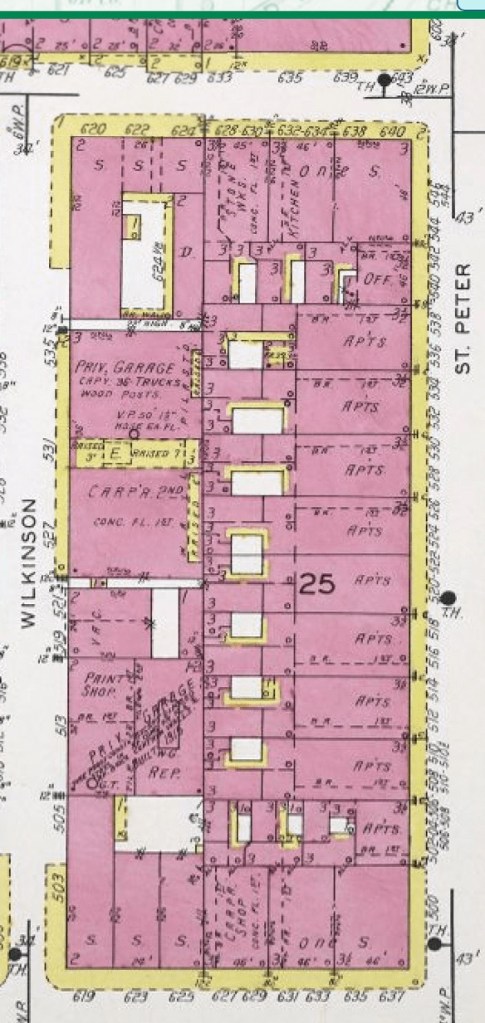
1940 map of the building. Note there were apartments even on the first floor.

* I would even suggest that the city seriously consider the idea I have raised here many times: that offering owners incentives to build in a few rent-controlled spaces for the service industry in the smaller units in these buildings and throughout the commercial areas of the Quarter and Canal Street would be a game changer for the neighborhood vitality, for employers, and for the city.

Tourism and New Orleans in the Pandemic-Era

The 2014 book Desire and Disaster in New Orleans, looked at how the post Civil-War era New Orleans developed a white middle-class tourist economy that traded only on the French colonial and the antebellum history, and since 1980, has almost exclusively relied and expanded it to the exclusion of any other economy. That inertia certainly led to the emergence of disaster tourism after the 2005 levee breaks as the only plan by city leaders which increased dangerous and short-sighted construction like the doomed and deadly Hard Rock project – shockingly thrown up at the very site of the historic Woolworth lunch counter sit-ins.

From the book: “New Orleans post-Katrina tourism has promoted the type of political inactivism common with other forms of do-good capitalism and grassroots privatization that undermine democratic process, perpetuate social hierarchies and inequities, and reinforce the status quo.”

As I continue to dive more deeply into Professor Thomas’ and others work on the racial politics that developed those earlier eras of New Orleans tourism, we here are aware that the next round is already emerging and will have even more troubling implications for the future of New Orleans.

I’ll be covering some of those specific indicators in these pages over the next few months including:

-City Hall allowing limitless short term rental situation by pointedly ignoring the enforcement of current rules, hampering the taxis while allowing gig drivers to operate with impudence

-the addition of beach-style amenities that encourage ever larger, more rowdy groups (such as unlicensed golf carts careening everywhere and huge loitering party buses endangering the airways of anyone within a half mile)

-the lack of official support for local musicians and buskers

-and the political pressure by the restaurant and hotel industry to end the COVID safety net for Louisiana food and service workers to get them back into the poverty wages and unrelenting schedules that is required in this current system.

Of course, the lack of concerted regional support for affordable housing, for public or human-powered transportation investments and enforcement, for accessible primary and secondary education choices, and the continuing massive prison pipeline that relies on a militarized police force using traffic stops to target black residents to fund and fill the courts and prisons, also ensure that tourism remains the choice for those few who profit from any and all of those issues.

As many locals have discussed on social media and in informal meet ups on what once were quiet residential corners, unchecked tourism is a public health killer for our residents, an ecological nightmare for the most fragile coast in the U.S., and is escalating conflicts among neighbors. Yet it also allows us to celebrate one of the few black and indigenous urban capitals left in North America, and could be a lever to increase political power and the honoring of the talents and skills among our Creole, Black, indigenous, people of color and their offspring.

With the next mayoral election not too far off, I am already hearing musings from long-time activists pondering a run, and even if not running, preparing to demand that all candidates come up with a more equitable and just plan for the future around these issues. I plan to contribute to that here and elsewhere and look forward to highlighting writers and activists leading the way.

Its gonna be a wild year folks.

The Death of a D.C. Funeral Home

At its peak, from the 1950s through the 1980s, Hall Brothers performed as many as 140 funerals a year.

In 2018, it handled four.

“They moved out or died out,” the owner, Richard Ables, 77, whose uncles founded the funeral home in 1941, said of his lost clientele.


The view beyond Hall Brothers’ front stoop — a new condo tower to the right, another rising to the left, a former Wonder Bread factory turned into a WeWork space down the street — in no way resembles what Ables remembers from childhood. In those years, he spent afternoons and weekends hanging out at the funeral home, stowing himself in empty caskets during games of hide and seek with his cousins.

In later years, they befriended a worker at the Howard Theatre who sneaked them in a side entrance to see the likes of Smokey Robinson and the Temptations, Chuck Brown, James Brown and Aretha Franklin.

“If we saw a white person, we’d ask, ‘What are you doing here?’ ” Ables said of the neighborhood. “Now it’s the opposite.”

https://beta.washingtonpost.com/local/dc-politics/at-center-of-changing-dc-requiem-for-a-funeral-home-that-catered-to-blacks/2019/09/05/c03767ca-8614-11e9-a870-b9c411dc4312_story.html

bye bye Dryades Public Market

I guess sticking a tagline with your name is good enough for people to think your business served a cross-section.

This is what every story led with: “Dryades Public Market … the grocery with a mission (italics added) in Central City is closing today.”

Maybe the name public market fooled some people; really there should be a way that they should have been stopped in using that. Unfortunately, there is not.

As someone long involved in local food systems, I watched this idea sited on the ever-valiant Oretha Castle Haley with hope but more trepidation, and even a little more skepticism. Here are 2 posts from my public market blog where I referred to this entity.

In the late stages of design, I had been contacted by the developer, but I pretty much ignored the emails. (1) I felt there were better minds likely in the fray already, (2) I didn’t trust the local partner to do right by farmers based on what was being reported to me by some of them, and (3) I had moved on to more national work and felt I couldn’t give as much local context as I once had.  Still, they kept calling, so I went to meet with them.

In short, they strongly suggested to me that they knew their local partner was full of shit but felt they were too far along to stop. (I also remember that they kept telling me how many parking spaces this place would have-in exasperation, I finally said that in terms of what they wanted to happen and in knowing the area, parking wasn’t going to be the draw that it was for their projects in NYC. That they needed to let that go.)

What they wanted was some help in figuring out how to still make the idea work. We tossed around some ideas, but the lure of the food hub concept was too hard for them to resist  (although my memory was my only suggestion was to dump the partner publicly and reach out to a cross-section of chefs/farmers/organizers to come up with something else. They were definitely not gonna do THAT at that stage.) So what New Orleans ended up with was 3 different plans in about the same number of years: the “food hub”concept, followed by the “food hall” concept (run by good people who brought in other good people but had to do it without the financials being figured out and without a rebranding kickoff), and the last which was a bit of a desperate dab of a high end specialty store and a hot food line. All in all, nothing worked, even with a lot of truly well-meaning people doing their best to make it work.

I see people on Twitter calling for this to be relocated or even revived because of the “food desert” issue, but it is hard for me to see how people think this idea can work for either of those issues. (Also see folks calling out for ALDI’s or Trader Joe’s to come in to the site. Umm, not only is the square footage not even CLOSE to their wheelhouse, but the characteristics of a successful site for either is not even close to being present in New Orleans proper. It sucks but that is what it is. Capitalism.)

Food desert as a term doesn’t adequately describe the problem and for most organizers across the U.S, has been replaced by food apartheid.  This situation also is better served by that latter term, as OCH has long been one area well known for across-the-board disinvestment by the usual money for the 30 years before Katrina. Now of course, every developer is there using it to build more upscale apartments and eateries which serve only the new population. That is apartheid.

I also see people on social media responding to the news of this closing asking for the “culture to be saved” as if DPM had ANY relationship to our diverse, locally relevant food history or public market/corner store/Schweggie history. Let’s be clear: this blip on our screen is a result of the post-2010 culture designed almost entirely by our “cultural” (read NOT) mayor Landrieu, and the many developers who now have a complete hold on the city. That era was all about “white box delivery” as the goal, with the content being figured out later. Meaning so not New Orleans.

Situating this high end “market” (it hurts me to even write that word in relation to DPM) on OCH, in the midst of the incredible work done by long time activists to fight for equitable development was in in itself a mockery and so out of scale to the rest of the street it was doomed to fail because New Orleanians cannot be fooled.  Because what is true of New Orleanians is that, in terms of good ideas, they don’t believe they start with buildings; they believe they start with relationships, and they could see that this one had few.

If you were going for some level of authenticity, you’d go to Cafe Reconcile, Ashé Cultural Arts CenterRoux Carre, Casa Borrega, Church Alley (before it moved), Zeitgeist (also before it moved), bank at Hope Credit Union and so on. If you did those things, I find it hard to believe you would also enter the clubhouse that was J&J/DPM and spend your money there. And many of those “unfooled” New Orleanians I talked to said exactly that.

And yes, I went. I tried. And I felt out of place, and manipulated by a few wicker basket of bananas and apples and fancy water and a jar or two of local honey being sold to me as a grocery store. I left angry and embarrassed as to what this neighborhood which has survived so much was being offered even as the money was falling all over New Orleans. A crappy clubhouse.

So let’s be real and call this what it was: a bad experiment unworthy of OCH and New Orleans, learn from it,  and move on to better ideas.


Healthy Homes Hearing


Greater New Orleans Fair Housing Action Center


New Orleanians are paying far more than we can afford in rent, and too often we’re not getting what we pay for. One tenant Southeast Louisiana Legal Services assisted is a mother whose daughter fell through their termite-infested floor. Thousands of other families deal with mold, leaks, rats, and other hazards in their homes on a daily basis, with no way to hold their slumlords accountable.

After years of advocacy, City Council hearings, and countless stories in the press, the New Orleans City Council recently introduced an ordinance to improve these conditions. It would set up a system for receiving complaints and require periodic inspections of rental homes.

The first hearing for this ordinance is January 18th at 2pm at the City Council Community Development Committee.

It’s critical to have a strong presence at the meeting to ensure Council knows that all renters deserve safe and healthy homes because no one deserves to live in a home that makes them sick. We hope to see you there.

MAC-Notes on the elephant

Excellent input from one of the city’s great clarinetists, himself a transplant albeit decades ago. So as he says (and represents) it is not that all comers are unwelcome. It is that it is vital and brave to truly comprehend what it means to support the complex dynamics of the formal and informal cultural activity that has held our place together. And that actively working for useful and manageable ordinances and zoning that discourage a “monocrop” society has to be everyone’s goal.

Let’s get serious about this damn elephant. He’s being too well-fed by our civic leadership, which continues to march toward a goal of 13 million annual visitors by 2018. Though they are beginning to listen to the bearers of their culture, they mostly try to measure our contributions in terms of “cultural economy.” And, given their attentions to the tourism lobby and neighborhood associations, it seems they still regard us more as an extension of the service industry than part of our city’s lifeblood. The resultant clashes between policy and organic culture are exacerbated by ham-handed and selective enforcement of our sound ordinance and an unwieldy process for amending the Comprehensive Zoning Order and “Plan for the 21st Century.”

Those of us who are truly committed to our community’s cultural vitality need dialogues that reflect appropriate ambivalence from all stakeholders and respect the issue’s complex dynamics.

Source: MAC-Notes: Everyone Sees the Elephant. Now What? | NolaVie – Life and Culture in New Orleans

and this truly accurate response:

I moved from Uptown in 2001 to Burgundy Street in the Marigny. My immediate neighbors consisted of a nice (African-American) family in the double on one side and a Honduran woman, Miss Consuela, who barely spoke English on the other side. Across the street was a corner bar, a Section 8 double, and a long-time resident (Caucasion) who works at a hospital. An old man on the other corner lived behind his long-closed, 1930(ish) gas station. We were a diverse bunch to be sure. But we all knew each other. We all helped each other out. We were neighbors. After the storm, the only ones of us left were us, the bar, the hospital worker and Miss Consuela. Then someone bought the double next door. They completely rennovated it, flipped it and sold it as 2 condos to some really wonderful people who live there now. The Secton 8 house was sold after a brief stint as a crack house. It too was sold and rennovated. It is now a long-term rental. An expensive one. Miss Consuela fell ill and died. Her home was sold at a tax auction to a doctor who took it down to the studs, added a camel back, renovated the entire thing and hasn’t spent a single night there. It is an illegal short-term rental. Less than 3 feet from our home. It sleeps 10. At least that is what the Airbnb ad says. Sometimes the people are very nice. We try to engage all of them. Sometimes they are gaping assholes. The group two weeks ago who were blaring bad disco music at 4:30 in the morning into the top of the line outdoor sound system come to mind. All this while the doctor takes his homestead exemption on this place. We have complained to City Hall. They don’t care. I could go on about the slumlord rental on the block that smells like ass, and rents for $1275. It was $500 pre-K and housed a loveable ‘OZ dj who can no longer afford to live here. Or the house next door to that, which housed a local band, then a young family, and finally turned Airbnb. Or the hordes of bicycle tourists who block the street like a particularly large school of minnows and shout “car!” whenever an automobile approaches, all while gawking at the neighborhood like we are in some kind of bizzaro, New Orleans, performance piece. Don’t get me wrong. I am happy that these buildings around me are being “rebuilt, renewed and restored”. I just wish we could find a balance that allows us to look toward the future without completely losing the past. Sorry this is so long. But it does feel better to write it.