French Quarter for foodies: A stroll through four culinary shops | NOLA.com

Love this story; four shops in the Quarter to find on your own. I know three of them – and I can highly vouch for them – and I’ll be checking out the 4th one (the spice and tea store) very soon.


French Quarter for foodies: A stroll through four culinary shops | NOLA.com.

Iberville demolition marks end of an era | NewOrleans | The Advocate — Baton Rouge, LA

An absorbing piece by Katy Reckdahl about the demolition of the public housing.

As usual, Reckdahl has humanized a complex story and showed how community is the heartbeat of New Orleans. The story of the demolition of public housing since the Federal levee breaks is not about the need for “new” houses, but about the commercialization and gentrification of our neighborhoods in the hopes of attracting younger, white residents and excluding those people of color who live there now. Now that Iberville has now been turned over to the developers, it will severely restrict the ability of the workers of the Quarter to reach their jobs easily.  I believe that the city has had the destruction of Iberville as one of their main goals for years and have finally desensitized most residents enough about developers greed to actually get it started now.

I am in agreement with many for the need to redesign the public housing to the streetscape by reducing the number and orientation of the buildings, but I cannot agree that removing almost all of the well-built brick townhouses for wood townhouses and making most “market rent” will help anyone but those developers. Regular people who have lived near and worked in the Quarter for generations will have to move away and many will look for jobs nearer to home. This destruction of  good housing without the addition of jobs and supportive social services is emblematic of the inequality that government’s actions now often represent.

Maybe this administration that has been busy helping developers can add some public transportation choices for those workers to be able to get to their homes that will now be further away.

And beyond that, the fact that families and friends that will be broken up, never to be able to live within their community again must be remembered.

“On weekends too, he occasionally passes through the complex, to say hi to a friend’s mother or simply reconnect to home.

“If my life is a game of tag, it’s my base,” he said.”

Iberville demolition marks end of an era  

1920s New Orleans video and music

Sent to me on this rainy morning by my French Quarter friend, Jonny:

Sweets available: Croissants in the middle or donuts at the corner

the thing about the Quarter is you can’t always tell from the entrance how a place is going to turn out. Some of the nicest facades are those that any local or foodie would be aghast when tasting their food and some of the worst looking places are mainstays for those same folks.
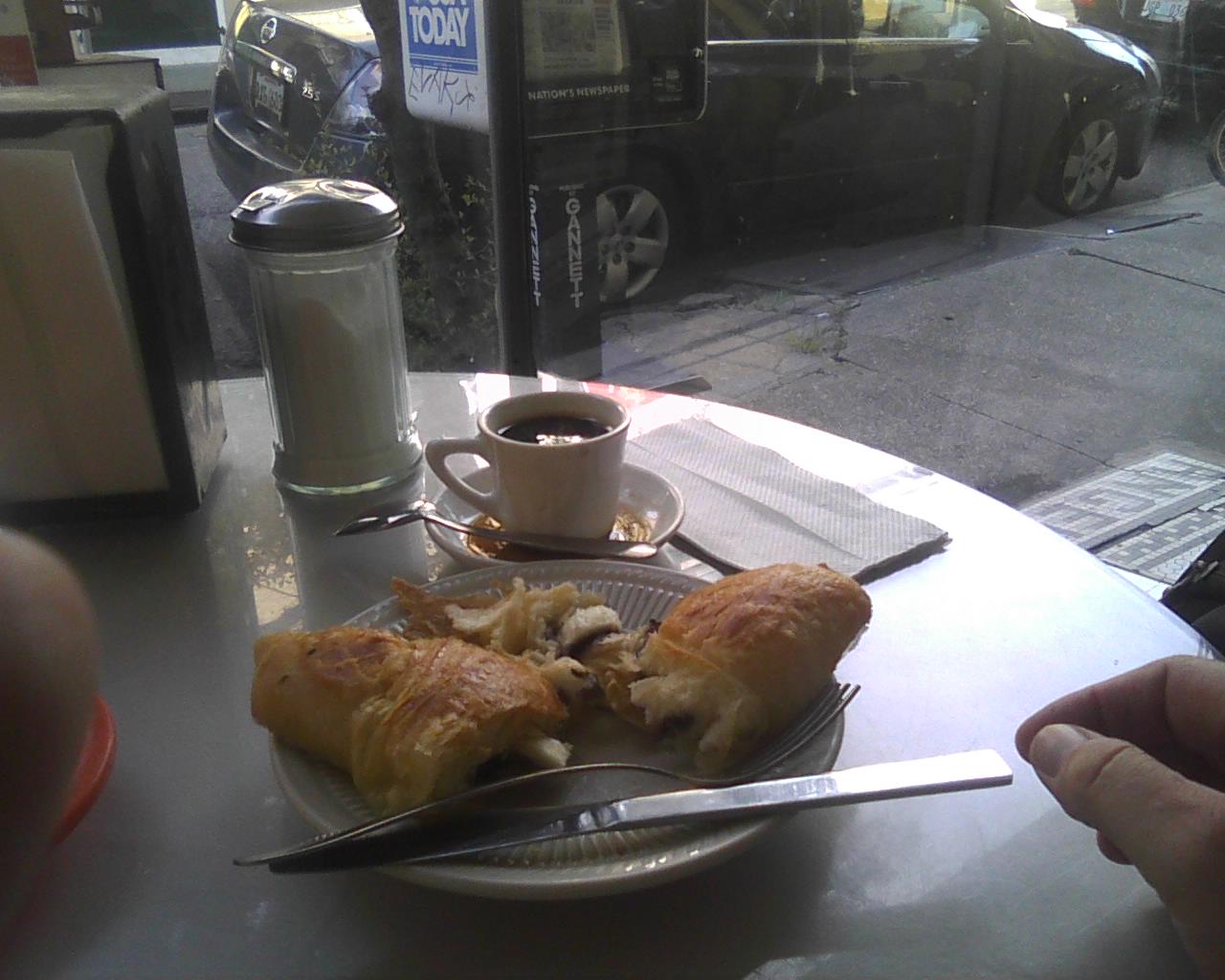
One of the exceptions to that nice front rule is the little pâtisserie on Ursuline, Croissant d’Or. Located on the site of the legendary Angelo Brocato’s original gelato home, it has a lovely vibe even with the small ebbs and flows in their quality over the last few owners.
The latest folks (who are quite nice which is a welcome change from previous counter people) are bringing things back and their baguettes, their napoleons and their croissants are worth the trek. Unfortunately, because of people like me writing about them, lots of tourists do descend on the place around 8 am in the high seasons, but it is still possible to find a seat or at least grab a baked good to go almost all of the time. The best thing is to sit there and read your paper, work a bit (Guess where I am writing this?) or to slowly prepare for the day in a lovely setting with hot coffee in front of you.

breakfast at Croissant d'Or at historic Angelo Brocato's site.

breakfast at Croissant d’Or at historic Angelo Brocato’s site.

The other place is Juicy G’s and is the opposite in facade and in location: it’s a donut shop on Iberville right off N. Rampart. It’s a bit hard to find (look for his board out front) and sits next to a bunch of empty storefronts. But, like any true New Orleans place, inside you find warm people and heavenly smells. The young baker Gregory earned his cooking stripes working at many places headed by the infamous family restauranteurs often in the news lately, although not at the one Brennan’s on Royal currently padlocked!

G’s idea and hope are simple: make good food for workers, students and visitors without making them shell out the big bucks. I hope that his place is the start to rejuvenating Iberville and bringing back Creole and African-American entrepreneurs to the Quarter. His donut holes are very tasty and his lunch plates are filling and flavorful-when he has those. He slows down in production a bit in the summer of course, but you can find him open early for hot morning comfort.

Here is my original post on this place:
Juicy G’s

Historic New Orleans Collection uncovers FQ well

The Historic New Orleans Collection is working on the Brulatour House on Royal Street, which has a long and storied history, including operating as the Arts and Crafts Club for a number of years in the early part of the 20th century. Many of its artists used its facade and courtyard for inspiration for many art works, which is why the courtyard will look so familiar to so many people when it is finally opened to the public.
The HNOC uploaded some pictures of the work of the discovery of a well in the courtyard. The previous paving that can be seen near the top is fascinating.
EarthSearch dig at the Brulatour House at 520 Royal Street
1003992_10151672422353419_1500220673_n

941205_10151672422553419_1467554592_n

1002446_10151672422528419_1357506559_n

*Plantation thinking on Canal Street and beyond.

While on Facebookistan recently, I did the thing I usually know not to do and got involved in a polemic back and forth about the proposed demolition of the World Trade Center building here in New Orleans. I tried to resist but didn’t.
A good friend to New Orleans and well-know preservation activist is fighting to save it and shared an article from a Uptown lawyer who had already written other things I haven’t liked, (yes I see my part in this), so I chimed in.
Needless to say, my opinion is in the extreme minority. I’ll explain later.

Those for saving it seem to line up in one or two queues: either preservation of this mid-century building, of which little is still left in New Orleans, or “saving” commerce by saving this trade building. Of course, it must be said that our mayor who seems to mostly be hiding behind the curtain these days is not doing himself any favors by talking of dismantling it for his bizarre “green space” slash monument which will double as a “ride” across the river-seriously, that’s what he is suggesting, I kid you not.
I get the preservation angle. Although since I am not a fan of it myself, I just selfishly do not care to save that style of architecture. But sure, I know others do and can probably explain why they feel the need. In my mind, as long as we have the Superdome and the Hilton, we have enough examples of that era although if we had saved the Rivergate I would be for demolishing that Hilton too!

What troubles me about all of this is the limited thinking we employ in New Orleans. Those interested in the built environment seem less or not at all interested in its effect on the natural environment. And those interested in commerce seem opposed to addressing the barriers that exist for real people to get skills to use that arena to lift themselves out of dire circumstances. So “global” trade or a tourist destination: that’s all we can offer?
My (main) issue with that building there on Canal Street is the scale; its size doesn’t fit with our little tropical city’s main street as it is today. It’s more in line with the type of unrealistic trade aspirations that New Orleans and the greater area had in previous eras and therefore it should be changed to more adaptive, realistic uses that fit our future. Fighting to save it for commerce seems to fly in the face of the challenges that many emerging areas of the city have in finding tenants already and it reminds me of the days of Caribbean imperialism (or oil drilling imperialism). Yeccchh..
Instead:
Maybe we can put a small glass building at street level and ask Tulane (et al) to put its environmental research at street level there with scientists and researchers working on water issues and disaster preparation in full sight of its citizens?
Maybe we add a significant streetcar/ferry/bus/bicycle station that everyone would use?
Maybe we can add small, well-designed open spaces for public gatherings? Encourage those with graffiti chalk walls and small natural podiums?
Maybe add some infrastructure for symphonic-style music events? (But leave jazz and pop to our clubs!)
Maybe add adapted shipping containers for food and other entrepreneurs to use?
http://www.theglobeandmail.com/news/toronto/shipping-containers-whet-entrepreneurs-appetites/article4223726/
Maybe none of these. Maybe all of these. But what i hope is for a lessening of thinking that runs to maintaining the status quo of yesteryear (massive buildings devoted to unsustainable commerce hidden behind security checkpoints) or more Disney-like experiences for our visitors (who I think want more authenticity instead) and instead investments in encouraging locals and visitors to mingle in spaces that work for everyone.

* A good decription of plantation thinking found online: The natural environment is heavily managed with interventions of all kinds to protect againsts pests and disease. There is a narrow view of what the desired outcomes are. Anything that grows outside clearly defined parameters is weeded out. It is important for all specimens to reach certain minimum standards but there is little or no room for diversity. This tendency towards a monoculture with a narrow gene pool halts natural evolution and increases vulnerability to long term or sudden environmental change. There is uniformity, conformity and an emphasis on control. The plantation managers are profoundly risk averse and, where improvements are needed, have a predisposition to seek out tried and tested methods with predictable outcomes.
Sippin in the Sunset at Pat O’Brien’s Bar

 
This summer, Pat O’Brien’s Bar is offering $2 beer and weekly drink special’s every Friday. From 4-8pm, guests can enjoy live music while and sitting back and sippin’ on a cocktail. 
(To find Pat’ O’s: walk down lovely Royal Street and turn left on raucous St. Peter. Or walk down Bourbon, and turn right on relatively serene St. Peter…)