French Quarter Block by Block is a project by community organizer and writer Dar Wolnik to catelogue details and share history for every block of the French Quarter. In 2011, friends and colleagues began to help with her Tree Inventory: mapping trees in the public space of the French Quarter including identification of native or unique trees with the end goal of a paper map and a GPS site of all of the trees. Tree inventories such as these assist neighbors, arborists and planners with new tree planting projects and with city wide tree canopy assessments.
The project was shelved temporarily after the initial identification and will be remapped in 2013. The Quarter is broken into four quadrants on the map and each block will be walked within each quadrant to re-check the initial map and to circle any native or unique trees for later identification.
Category Archives: French Quarter
Habana Outpost secures approval of Vieux Carre Commission
Mr. Gregory’s
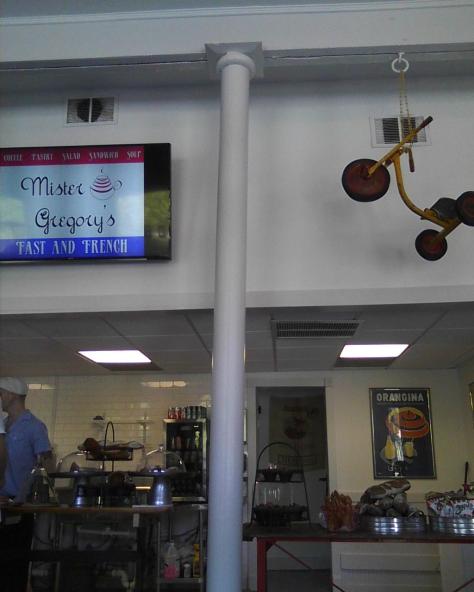
New bakery, sandwich and coffee place on Rampart at Saint Ann. Still working on getting all of their equipment in, but it’s already a lovely place to sit and sip. Go on Tuesdays if you want to meet the fabulous artist Lee Kyle, who has just picked up a shift there. Story about them at: http://www.noladefender.com/content/mr-gre45gorys-br1ings-french-take-out-n-rampart
All on Labor Day weekend-2010


These 2 pictures may be the best way to explain downtown culture. First, one of the venerable second lines Black Men of Labor holding their traditional Labor Day event on St. Claude to North Rampart’s Louis Armstrong Park and back. It marks not only the importance of the virtue of the working man, but also starts the second line season. Started in 1993, this Social Aid and Pleasure club holds tradition dear.
http://www.thebmol.org/site/
The traditions of Southern Decadence weekend are as far removed from BMOL as can be and yet as close as the shared idea of public space reclamation of what the city government (read America) would see as another “outsider” class.
The Southern Decadence Parade is held the same day as BMOL one or two blocks over in the heart of the gay French Quarter area. Southern Decadence history dates back to the early 1970s (when the motley…
View original post 48 more words
Communist agitation, labor agitation, civil rights agitation, pointless intellectual conversation and tuneless playing of guitars: The July 29, 1964 bust of The Quorum Club
On Wednesday night, July 29, 1964, the police raided the Quorum. Seventy-three persons were arrested and charged with “disturbing the peace”: playing guitars out of tune, engaging in conversations that had no logical end or conclusion, etc. Among the 73 were the tenants in the apartments upstairs and in the slave quarter apartment and some curious citizens who had come out to hear Babe Stovall perform his country blues and spirituals in the coffee house that night.
Recollections about The Quorum Club:
/////////////////////////////////////////////////////////////////////////////////////
(From The Golden Triangle: An Interview with James Nolan
by Dennis Formento, found on Exquisite Corpse website):
DF: What was the clientele of the Quorum Club like?
JN: The Quorum was a coffeehouse, didn’t serve alcohol, and so was a little straighter and more politically oriented, aligned with the civil rights groups. John Beecher, an elderly Southern poet, an important figure in the civil rights movement, used to show up. There was a church next door, and I’m not sure of the exact relationship between the coffeehouse and the church, but some liberal protestant churches were setting up these coffeehouses as meeting places for blacks and whites in the South.
The Quorum Club had a tiny stage where folk singers, jazz musicians, and poets performed, and tables where people played chess. The mood was funky and mellow, which is why we were so shocked when the police raided. The formal charges–I still remember verbatim–were “the tuneless strumming of guitars and pointless intellectual conversation.” Of course, one of the main activities there was black voter registration, which is what brought the heat down.
At the Quorum there was a moral purpose to change society. The Discussion Group had more artists on Jackson Square, and the Quorum people were more social activists. You have to remember we were in the middle of a social revolution, and in 1968 Martin Luther King was assassinated, Robert Kennedy was assassinated, even Andy Warhol was shot. Closer to home, that year my parents committed me to St. Vincent DePaul hospital because I was coming down to the Quarter, had long hair, was smoking grass, and I think some neighbor saw me holding hands with a black nun at a civil rights demonstration. It was war.
///////////////////////////////////////////////////////
(from Trembling Pillow Press website):
Lee Meitzen Grue began reading her poetry at The Quorum Club during the early sixties. There she met musicians, Eluard Burt and Maurice Martinez (band leader Marty Most). Burt had just come back to New Orleans from San Francisco where he had been influenced by the Beats.The Quorum Club was the first non segregated coffee house in the South. At that time it would have been unlikely for Lee Grue to meet and work with African American musicians any place else.
//////////////////////////////////////////////////////
(Interview by Dennis Formento of Robert Cass, quintessential “40s bohemian. Interview first published in Mesechabe: The Journal of Surregionalism):
M: It throws a new light on another story about the old Quorum Club at 611 Esplanade. You remember it?
BC: I ran it during its last period. They just gave me a certain amount to make the coffee. I showed movies in there too.
M: Were you around for the Great Quorum Club Raid in August 1964? People were playing music, it was interracial, and the police came in, arrested seventy-five people and took them all to court. The charges included “communist agitation, labor agitation, civil rights agitation, pointless intellectual conversation and tuneless playing of guitars.” The judge threw it out.
Counterculture exhibit and talk at HNOC on September 7
The exhibition explores the lives and work of Gypsy Lou and Jon Webb through objects from Blair’s Collection as well as paintings by Rockmore (including his widely recognized “Homage to the French Quarter”) and photographs by Johnny Donnels. The display also includes copies of each title in Loujon’s small but celebrated catalogue, while illuminating the Webbs’ relationships with other self-proclaimed outsiders—the people, the places and the environment that inspired the creation of Loujon Press.
“The exhibition offers a glimpse into the vibrant artistic life of the French Quarter in the early ‘60s and introduces visitors not only to the aesthetic of that time but to the fascinating people that created it.” said Cave
THNOC » Presentation featuring Edwin J. Blair, JoAnn Clevenger, and Neeli Cherkovski.
Courtyard Concerts-Fall 2013 at HNOC
Fall 2013 Series
Friday, September 20 with Brass-A-Holics and cocktails provided by Criollo
Friday, October 18 with Kristin Diable and cocktails provided by Bayou Rum
Friday November 15 with Hot Club of New Orleans and cocktails provided by Vino Wholesale
Doors open at 5:30 p.m. • Music: 6–8 p.m.
In the event of rain, check www.hnoc.org for updates.
Admission is $10, free for THNOC members, and includes three complimentary beverages. Guests must be 21 or older to enter.
 French Quarter block by block
You must be logged in to post a comment.