“I love optimism kinds of songs. Optimistic attitudes about things. I always think things are going to get better. My hope towards what can be here is always paramount for me … If I wind up that that’s my legacy, I would be very happy.” — Allen Toussaint
Category Archives: French Quarter
Bidding adieu to the Vieux Carré as we once knew and loved it | The Lens
In the title piece, Cannon basically says: Rich retirees from Dallas now enjoy the sanitized ambience of a neighborhood New Orleanians used to live in.
in reply, I say all of this:
Charles, you always get me thinking…
I am sure that Elizabeth Werlein’s failure to keep Pat O’Briens off St. Peter (in the 1940s) was considered a death knell for the Quarter for some locals. Or shall we talk of the loss of the French Opera House (1920s) as the last great day? Or maybe the original Lafitte’s owners losing their lease in 1950s and having to move to a new location? I myself like to talk about the Jax Brewery and Canal Place openings as when my Quarter began to change, but I ended up getting a full-time job at both for a spell and making a living only a few blocks from my apartment, so maybe I was wrong..
What those moments tell me (as does your story of the wax museum) is that all of us want the Quarter to be the place we hold dear in our memories. And that mythologizing a place is not always helpful to active participation in city life; myths rely on heroic narratives that in the retelling are sanitized themselves.
The Quarter still looks and acts like a lot of neighborhoods in the city with the same problems that most of them have -or will soon have- which may have been part of your point, Charles. Like many residents, I appreciate the nostalgic concern for the quick demise of our neighborhood, still with its groceries, drugstore, (expanded) hardware, laundromat, hair salons, locksmith, coffeehouses etc, but feel as if data might be more helpful in this case. Data about the loss of schools and of our low-income neighbors are absolutely some indicators of change that are not welcome to us, but that trend is citywide and pushing downward since 2005. Data about less families is not as clear; 2010 Census shows more families than in 2000 and more elderly, and for the falling numbers of socioeconomic indicators in the Quarter, most not falling as far as the rest of the city, using Data Center/census info. (Census numbers always seem suspicious to me, maybe you too, but there you are.)
My street has lots of regular-folk residents and new shops run by locals and workers who have been at their job for 20 years or longer. So which indicators should I look at? The loss of the little red schoolhouse is very bad, seems imminent and will likely lose us some of those families, but I remember thinking of the loss of the Cabrini Day Nursery on St. Philip in the late 1990s as the first death knell of family life. Maybe though, the real question I should have asked is how many Catholic institutions closed or consolidated in my lifetime already? And how many schools that were deeply embedded in walkable neighborhoods are successful in a charter system where just about every child needs to be transported to it?
The lack of rent controls and addition of gated condos may spiral up here and pit the haves against the rest of us more and more, or it might buck the trend and remain the only neighborhood where those with all of the entitlements must deal with those of us without and force compromises… And what about bike lanes and street musicians and a farmers market and local food businesses working to bring healthy local food to downtown at the old public market? Certainly seems better than the other neighborhood’s public market’s offerings? My building is owned by the two daughters of a longtime FQ family who rent to locals and are fair and good and are not the only ones; my mother has the same story at her place across the quarter.
I don’t know the answer to any of it,or if any of what I offer here is related to saving or destroying the Quarter, I just want us to ask better questions and use better data to get at the real issues.
The added tax for sheriffs for hire is troubling. Yet, we know our commercial neighbors need to have a presence of police and since they asked for it, we residents agreed to share the burden for their needs. We all know that our system of policing needs serious overhauling and we hope this is not permanent and that the city gets the NOPD on track sooner or later. In the meantime, millions of people unfamiliar with the city have to be able to see law enforcement if needed. Not our finest hour for sure, but I doubt that most residents voted for the tax because they think sheriffs are here to act as our police force.
In any case, i am certainly not trying to argue that the Quarter is “healthy” or becoming the thriving place it was in years past, but instead to ask for true indicators of positive and negative nets. To restrain from declaring any area dead or gone or sanitized before it is true. It doesn’t help any of us if the story we base our activism is based on old emotion only and not on data or true trends.
Maybe the smaller city means a smaller Quarter and a whiter city means a whiter Quarter – although again 2010 census says a slight downward trend of whites and uptick of other ethnics since 2000 – but that may have been a post-Katrina blip only. Maybe what will remain after the Katrina money moves on to the next city (in order to extract value from it) are some workers, hustlers and people who love the Quarter and it will remain a neighborhood.
For me, the only constant about the Quarter is the change, which is city life in microcosm. And that means we have to evaluate that change as clearly as possible.
Source: The entire piece by Cannon
La Toussaint et Le Jour des Morts (All Saints Day and All Souls Day)
Although I am essentially a Midwesterner (evinced by my never-ending impatience and my love of work and of baseball), I have enough family roots and time spent in the city of my choice to be able to follow certain traditions here without needing an accompanying festival or a story in a hip magazine to guide me to it.
Of course one of those is the deep observance of All Saints Day (la Toussaint) which begins at Vespers on October 31 running through November 1 which is a Holy Day of Obligation for Catholics, marked by a mass to remember the dead “who have attained heaven” but also by New Orleans families going to the family tomb with flowers, to clean, to toast or even picnic with their ancestors. In some areas, it is also marked by lighting candles as”tradition dictates that each living person burn one candle for each departed member of his family,” but also in anticipation of All Souls’ Day on November 2 (Le Jour des Morts). All Souls Day day is dedicated to those who have died and not yet reached heaven. Of course, all of this closely follows Celtic and Latin traditions.

Observing All Saints’ Day in Bayou Barataria, just below New Orleans, children place candles on a family grave. The plot on the right, marked by oyster shells, is said to be the resting place of Pirate Jean Lafitte. November 1, 1946. (ACME Telefoto/The Times-Picayune archive)
All Saints’ Day coincides with the first day of the Day of the Dead (Día de los Muertos) celebration. Known as “Día de los Inocentes” (Day of the Innocents), it honors deceased children and infants.
October 31 marks the last day of the ancient Celtic calendar. According to ancient Celtic festival of Samhain, the supernatural, including spirits, were free to roam the night and into the morning of November 1. This represented the blurring of lines between this world and the next. Celts believed the presence of these spirits allowed for the Celtic priests to better predict the future.
During the festival to ward off bad spirits, the youth would participate in superstitious activities that they believed to bring good fortune and predict their marital statuses. One of these festivities, Pou (Pull) the Stalks, required the young, eligible men and women to uproot kale stalks while blindfolded. After choosing their respective stalks, each stalk would be analyzed to discern information about each participant’s future spouse.
Characteristics of the stalks revealed signs about their future partner. For example, a short and stunted stalk meant the participant’s future spouse would be just that, short and stalky. The flavor, as well, determined the disposition of the potential partner such as bitter or sweet. Moreover, the amount of dirt remaining on the stalk post determined the dowry size one was to expect from their future husband or wife’s family. If the root was clean, poverty was in store.
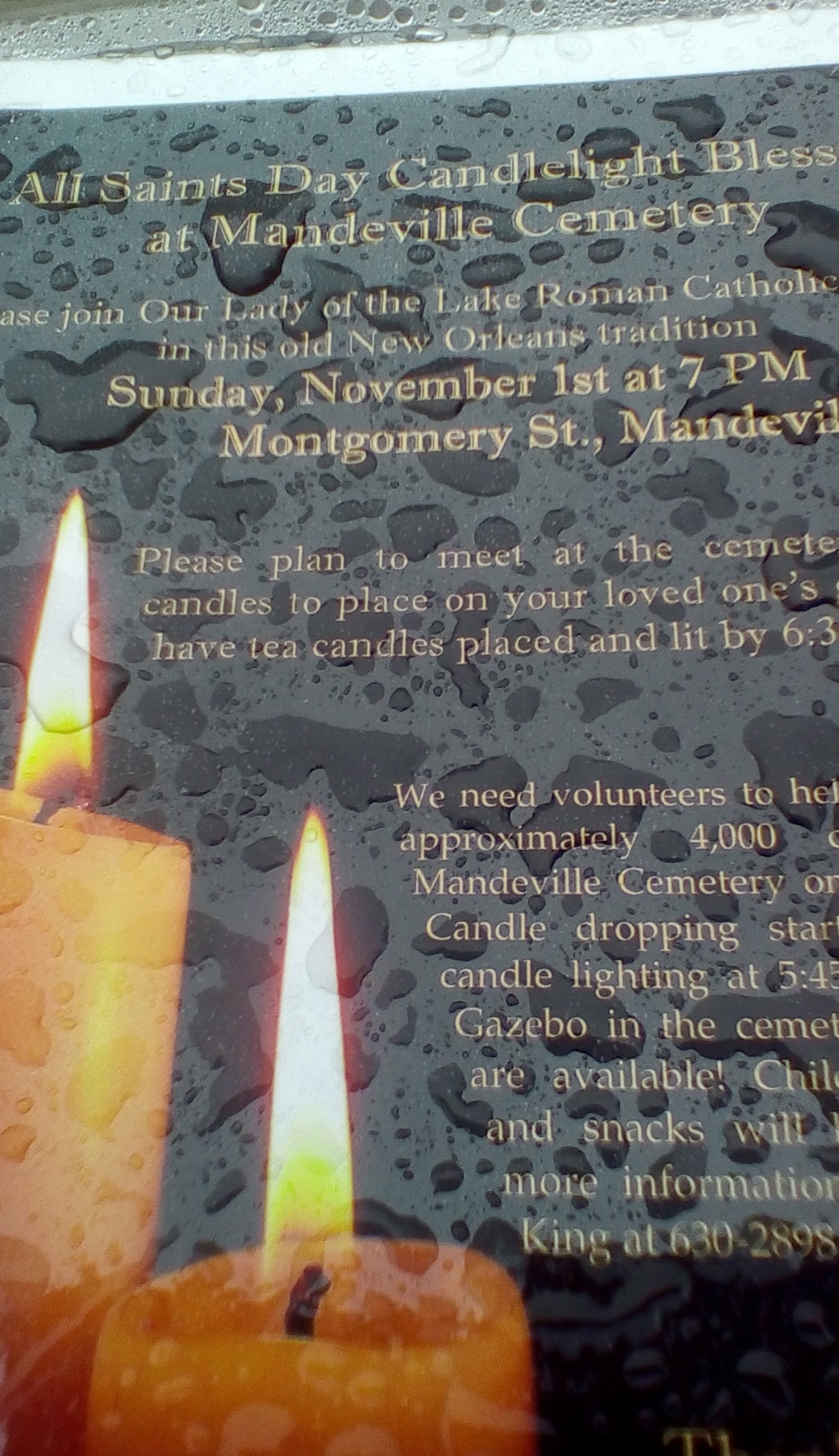
I will go tomorrow morning to lay flowers at my great-grandmother (Gaspard Pappas), grandparents Barrios’ and brother’s graves which happen to be across the lake from New Orleans in Mandeville. The rest of this branch are buried at various spots, including in the original parish of Lafourche. Someday I’ll drive down there to check it out for myself.
Pics of my great-grandparents graves in Lockport:

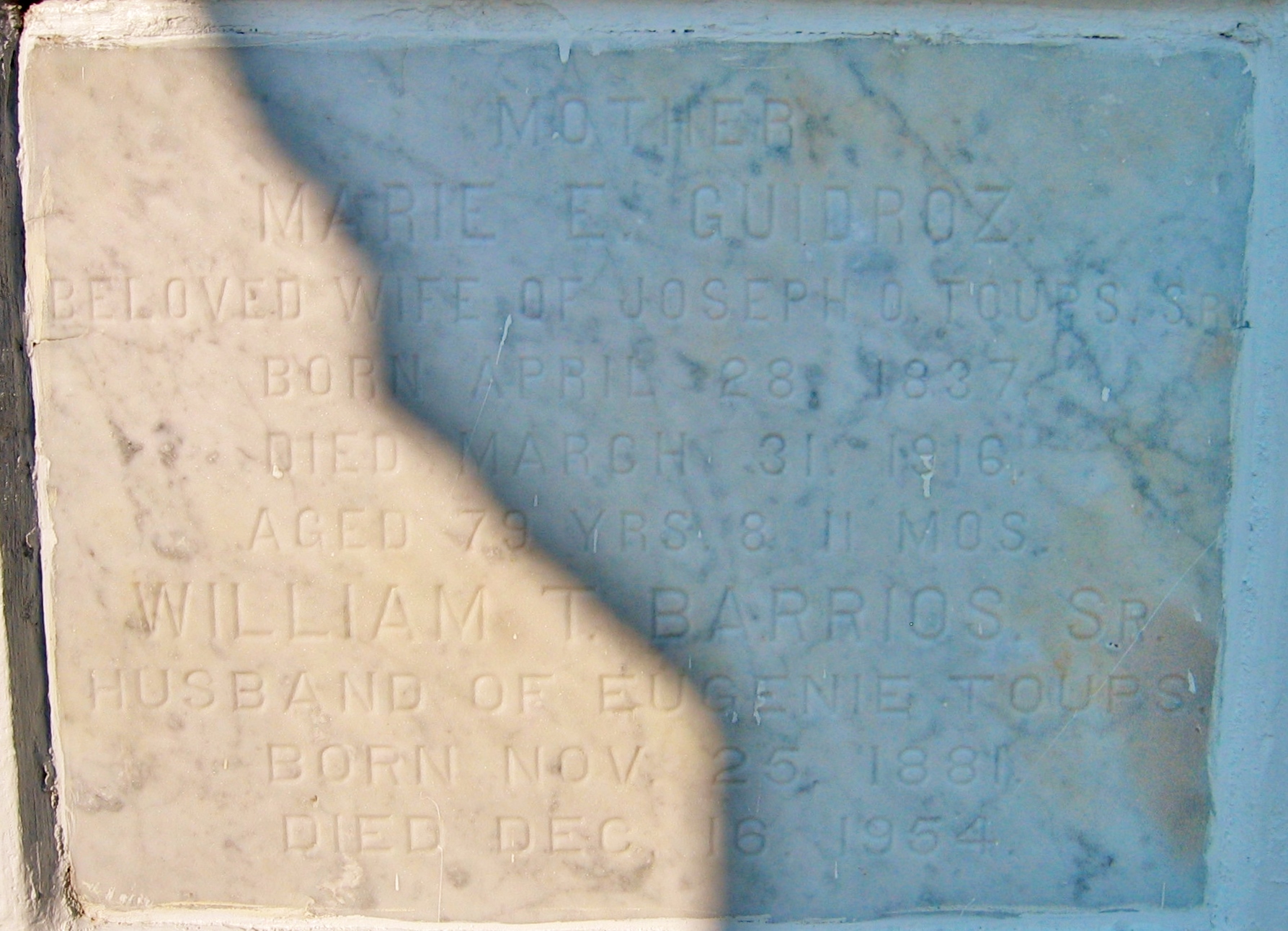
Think of your ancestors today and the recently passed through All Souls Day. They deserve it.
and do yourself a favor-read Anne Rice’s excellent book of the same name about the life of the Creoles as you roam about the Quarter or parts of the city where you feel and see the past.
Here is also a great map with linking database of the St. Louis #1 just outside of the French Quarter. Unfortunately, the Diocese which owns it has limited access to those with a tour guide only.
The “Dead Space” survey of St. Louis Cemetery No. 1 conducted in 2001-2002 by the University of Pennsylvania School of Fine Arts graduate program in historic preservation includes an online searchable map and database for every tomb in the cemetery. The map has an accompanying database. 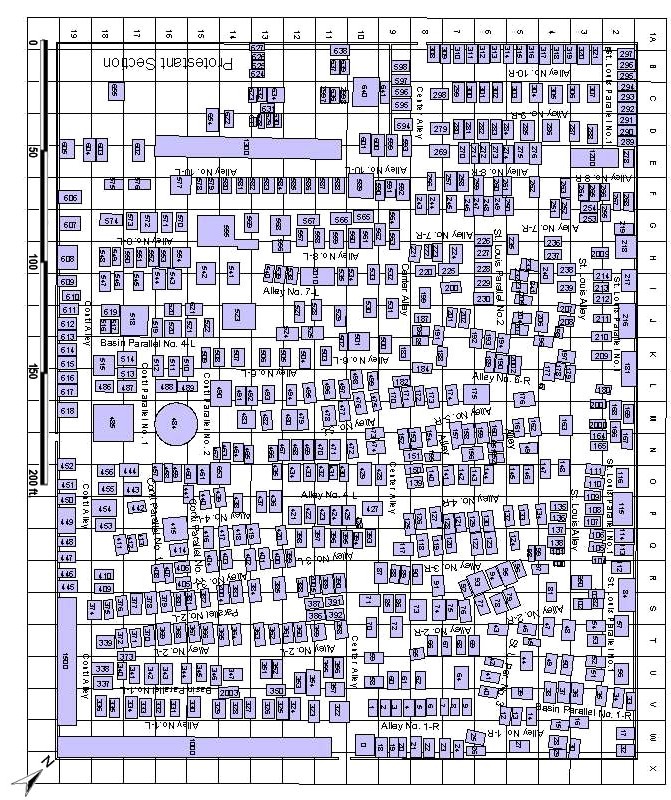
French Quarter’s Lalaurie house gets elegant makeover that plays to its haunted past
The Lalaurie Mansion has been updated again and so I spent an hour rereading some of the old stories that nola.com has been gracious to offer-or one could opine that since running old articles doesn’t require paying reporters to find new stories, it is a calculated move by the old TP. Still, this story comes back to life every All Hallows’ Eve.
‘Every time I went to Lalaurie, I would say my prayers and put on the holy water. It was my perfume.’
Source: French Quarter’s Lalaurie house gets elegant makeover that plays to its haunted past | NOLA.com
Here is one of the original stories from the New Orleans Bee about the mob that destroyed the furnishings after the fire. The writing is delightfully dense and difficult for a modern reader but so fascinating still. I love this:
The whole of yesterday and the preceding day, the police jail was crowded by persons pressing forward to witness the unfortunate wretches who had escaped cruelties that would compare with those of a Domitian a Nero or a Caligula.
This story from The Daily Picayune in the 1890s shows how tabloid journalism and lurid details had become the fashion since the Bee story’s restraint:
Her manners were sweet, gracious and captivating, her voice was said to be as soft as a low strain of music; even in New Orleans she was noted for her charitable deeds, and yet – and yet – there were wild rumors that madame inflicted the most cruel torture upon her slaves, that she whipped and flogged them unmercifully; that in that splendid house behind those attic windows there were human beings chained to the floor, confined in darkness and actually starving to death And the curious door in the wall ? – well there were rumors enough about it, but they were very vague and floated about the rue Royale like a shadowy mist at evening.
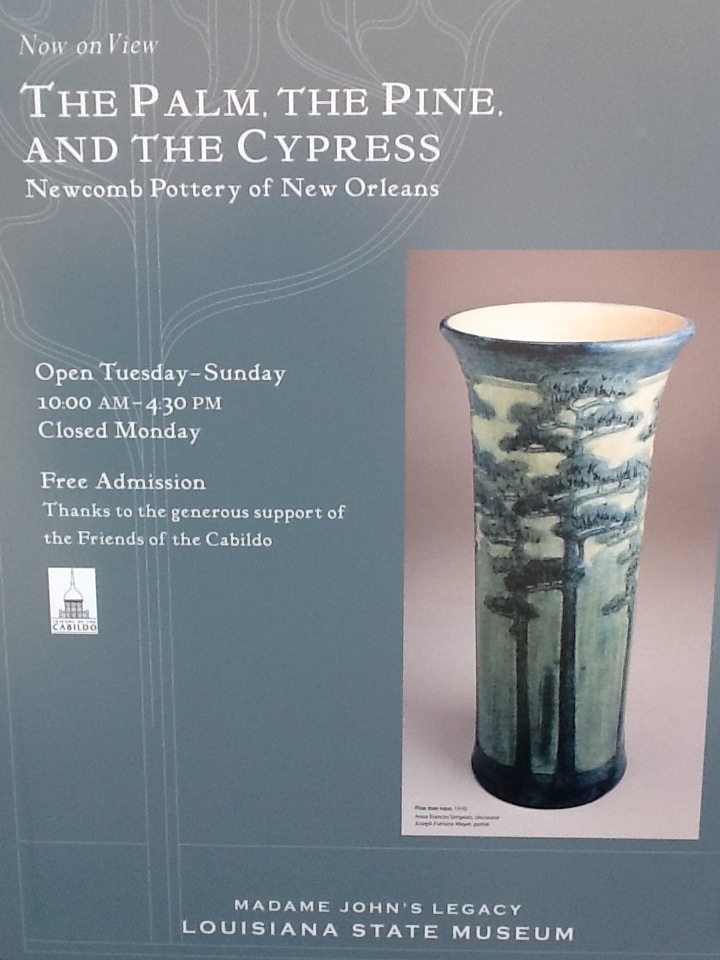
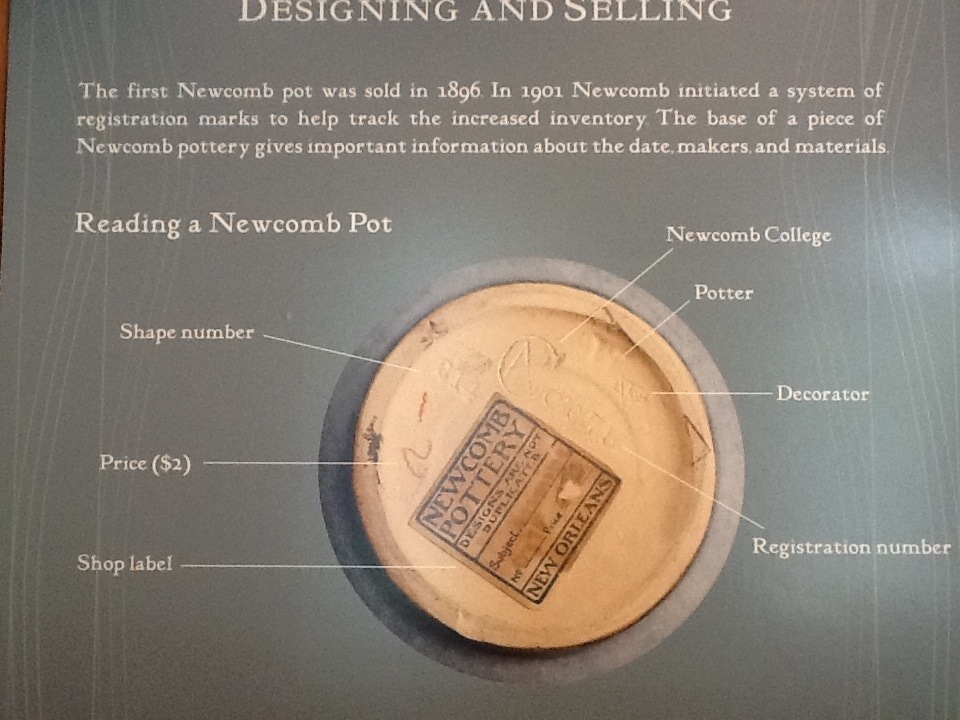
Newcomb Pottery exhibit
Update for 2015: Still up as an exhibit; if you haven’t seen it, I recommend it heartily. And now you can have lunch afterwards at Petit Amelie right across the street, which is the most beautiful cafe in the Quarter.
(original 2012 post)
Over a sunny lunch hour, I dragged my 1970s Crescent folding bike out from behind the lawnmower (been raining a lot lately is my only excuse) and headed to the Quarter.
After a delightful lunch at Stanley’s-well except for the wait staff’s obsession with their new iPhones, although I think a very good idea to have them for taking orders. The real issue today was the less than stellar bar staff but I’m still loyal to this chef and his wife, so stayed for a cherry-limeade Italian soda and a bowl of their gumbo with potato salad dumped in and was glad I did.
Afterwards, I unlocked the Crescent and headed to Dumaine, between Chartres and Royal.
Madame John’s Legacy is said by some to be either the oldest or the second oldest building in the Quarter. Ursuline Convent is usually considered to be the oldest and since MJL burned in the first fire that swept through the Quarter and had to be rebuilt, I’m not sure why some fight for the oldest designation.
Okay, maybe its just wild talking mule carriage drivers that say that. I am also sure that the many expert historians could make a case for either if needed.
In any case, it has to be the plainest building in the Quarter.
I like that about it, but it must be hard for people to believe its a museum with its undecorated green front (historically accurate colors by the way) and its entrance at street level under the stairs. As locals know, the gingerbread and vibrant colors came with that nutty Victorian age. The name itself comes from a George Washington Cable story, a writer interestingly, who worked in part of the same time period as the Newcomb Pottery folks and was known for his sympathetic and sensitive portrayal of the complex culture found in New Orleans.
Once you get upstairs, a very courteous security officer at the desk gives a short overview of the fact that this exhibit is free (thanks to the Friends of the Cabildo, you’re very welcome) and that pictures are allowed.
I was the only person in there until the end when a couple of French men came in and went directly to the house descriptions rather than to the Newcomb exhibit. The exhibit is set up in 4 rooms, with one or two cases in each laid out in different periods. For those unfamiliar with Newcomb, pottery or even the name, it was a celebrated liberal arts women’s college at Tulane University. Until 2006 that is, and then scandalously to many Newcomb graduates, the management of Tulane ceased the operation of this endowed college and folded it and its endowment into the larger university. I can understand the argument that there may not be a need for a women’s college any longer but talk about kicking people when they’re down…
In any case Newcomb operated this pottery business for about 50 years really, from the late 1800s through the early 1940s. Its pottery became quite the collectors item for arts and crafts pottery enthusiasts and it is some of the loveliest work you’ll see. The detail is striking, especially since they often used local flora and fauna for their motifs.
The arts and crafts movement itself was an artistic response to the industrialization of America and also a way to allow women to work on their degree. Having grown up also in Ohio, I was already familiar with Rookwood Pottery, which was the most well known of the arts and crafts pottery-a friend in Cincinnati has Rookwood fireplace detail in her apartment, which is not that unusual to find there….
The Newcomb school allowed women to design and paint designs, but the actual pottery wheel was handled by men! ugh. I’m gonna leave that alone….
Interestingly, the most well known prolific potter at Newcomb, Joseph Meyer, was the son of a French Market vendor who sold utilitarian wares.
This modest exhibit is at the perfect venue and is well worth the trip to Dumaine.











<;a
RIP Paul Prudhomme
I met him in the mid 1980s while I was working in the kitchen at the Royal Sonesta. He was gracious to our entire staff and even made our evil sous chef behave. What he did for New Orleans, for Louisiana and for talented chefs who want to create their own place and use their own ideas is incalculable; I remember well the daily excitement and long lines at KPauls for so many years. The love pouring out from the restaurant community around town shows the deep respect the entire community had for him and I’m sure that admiration is multiplied around the state.

In New Orleans’ French Quarter, a cockatoo named Iko holds court
Since my mom lives around the corner (and Fahy’s is a few doors down!) I have visited with Iko many times over the years. I stood next to BB during a parade at the corner a few years back and found her to be the consummate French Quarter resident: chatty, interested in the world and quirky, as it should be.
Behind the centuries-old bricks and shutters of the French Quarter are many lives that passersby cannot see. Any glimpse into a shadowy courtyard is a teaser. But there is one resident on Burgundy Street who beckons the outside world to take a longer look.
 French Quarter block by block
You must be logged in to post a comment.