Bowie Second Line Jan 16 4 pm


12484710_1092397347461600_5235320824118831091_o


Arcade Fire and the Preservation Hall Jazz Band will team up to lead a second line for David Bowie this Saturday, January 16.

The two bands and other mourners/revelers will meet at Preservation Hall in the French Quarter at 4pm to kick off the parade, which they have dubbed “Pretty Things.” According to a Facebook event page, the groups have requested that attendees come dressed in their “best Bowie outfit or something more strange.”

The Route:
Departing from Preservation Hall on St. Peter to Royal (4 pm)
RIGHT on Royal to Toulouse
LEFT on Toulouse to the river
STOP for (10) ten minutes
continue along the river to St. Louis
RIGHT on to St. Louis
RIGHT on Chartres
LEFT on Toulouse to One Eyed Jacks

Join the fight for quality of life for all

Please join us Sat., Jan 30th at 1 p.m. at Armstrong School, 5909 St. Claude Ave.  Bring your friends, family & more.

A Community Voice members and others will meet with public officials and the press regarding the reopening of the school, and:

a.  the end to bus stops waits with no shelters for children that start before light and end after dark, in blighted and crime ridden areas.

b.to provide a school for the current and future 1300* families/residents, especially due to a consequence of high building activities from: *Perez (297 units), Make it Right (200), city/federal programs (100), other nonprofit actions (100), the consistent number of returning families (300), and the will of parents who were former residents of the lower 9 who wish their children to attend school in the lower 9th ward (300).

c. an end to the One-App forced busing of students that replaces slots at local schools with children from other areas, most who wish to attend school in their own areas.

d. the beginning of a “neighborhood children based” school devoted to the music and culture of the lower 9th ward, and Louis Armstrong.

Please RSVP with your name, title and willingness to speak with the media.

Thank you!
Vanessa Gueringer
Lower 9th Ward A Community Voice
2221 St. Claude
New Orleans, LA 70117
FB:  ACommunity Voice

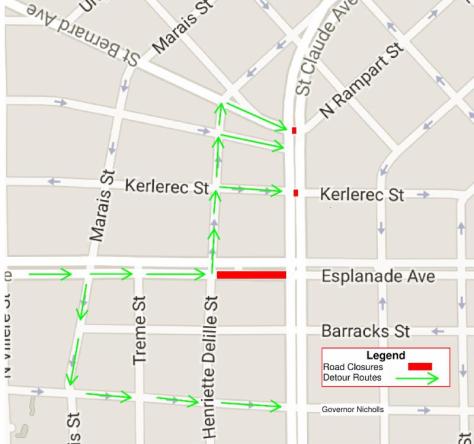
Esplanade is…not so much of one thru Jan 16

CYiJTbVWcAA7esM.jpg

: Riverbound Avenue will be CLOSED at Henriette Delille to Rampart St. through Sat Jan 16th

Spillways 101

dt.common.streams.StreamServer.jpg

Once again, the New Orleans region serves another purpose for the middle 2/3 of the United States: to manage the water flowing through the lower part of the Mississippi River, so  it does not exceed 1.25 million cubic feet per second in New Orleans, allowing the port to remain active, the population to stay in place and reduces the potential  for the loss of property.

The opening was  praised during a 10 a.m. news conference by New Orleans Mayor Mitch Landrieu for its role in keeping the city and neighboring areas safe. “What we’re witnessing right now is really an engineering miracle,” Landrieu said. “So many of us for so long wanted to make sure our homes and our lives were protected by creating a levee system. What you’re about to see is a levee system that is managed as a risk reduction (system), making sure we do what we’re supposed to do and when we’re supposed to do it, to protect lives and protect homes.”

The multilayered flood-control system is formally known as The Mississippi River & Tributaries Project. Administered and built by the Mississippi River Commission and the U.S. Army Corps of Engineers, the project was launched after the disastrous Mississippi River Flood of 1927. The project was authorized by Congress in 1928. Before the 1927 flood, levees were the only safeguards used to combat river flooding.


Bonnet Carré Spillway

Studies to determine the best location for a spillway along the lower river had identified one at the site of the 19th century Bonnet Carré Crevasse, about 33 river miles above New Orleans. Between 1849 and 1882, four major crevasses had occurred at this location. In fact, during the flood of 1849, a 7,000-foot-wide crevasse at Bonnet Carré flowed for more than six months .

041122-A-CE099-029.jpg

The Bonnet Carré Spillway consists of two basic components: a control structure along the east bank of the Mississippi River and a floodway that transfers the diverted flood waters to the lake. The spillway was built in response to the Great Mississippi Flood of 1927 that inundated much of the Mississippi River basin.

Distance above New Orleans 32.8 river miles
Length of Weir Opening 7,000 feet
Number of Bays 350
Width of Bays 20 feet
Creosote Timbers 20 per bay
Floodway Design Capacity 250,000 cfs (cubic feet per second)
Length 5.7 miles
Width at River 7,700 feet
Width at Lake 12,400 feet
U.S. Lands 7,623 acres
Frequency of Operation (est.) 10 years
Year Days Bays Opened (%) Opened Ideal flow capacity
1937 48 285 81.4% 203,571 cu ft/s
1945 57 350 100% 250,000 cu ft/s
1950 38 350 100% 250,000 cu ft/s
1973 75 350 100% 250,000 cu ft/s
1975 13 225 64.3% 160,714 cu ft/s
1979 45 350 100% 250,000 cu ft/s
1983 35 350 100% 250,000 cu ft/s
1997 31 298 85.1% 212,857 cu ft/s
2008 31 160 45.7% 114,286 cu ft/s
2011 42 330 94.3% 235,714 cu ft/s


Corps New Orleans District commander Col. Richard Hansen said Tuesday that he expects all 350 bays of the spillway’s weir to be opened. Each bay has 20 creosoted timber “needles” that must be pulled by cranes moving on a rail atop the weir.

There are two graveyards located in the spillway. The cemeteries containing the remains of both free and enslaved African-Americans are under several feet of sediment. According to investigative reporter Shonna Riggs, “The location of the gravesites was a mystery until the 1970’s when the US Corp of Engineers was attempting to excavate a ditch in the spillway.  According to the Louisiana Historical Preservation Society, there are 14 graves located in the Kugler Cemetery and 144 in the Kenner Cemetery. The artifacts discovered during the 1986 study included coffin furniture, coffins, grave markers, cultural remains, and human remains.The cemeteries, named Kenner and Kugler, are black burial plots which appear to date from the early 1800s to 1929. The sites are located on former adjoining 19th- and early 20th-century sugar plantations in St. Charles Parish. According to oral histories, both cemeteries were dedicated burial plots on the back side of their respective plantations. When the Spillway gates are opened, the cemeteries are flooded with up to 30 feet of water diverted from the Mississippi River into Lake Pontchartrain. The January opening marks the earliest that the 5.7-mile-long spillway connecting the Mississippi to Lake Pontchartrain has been opened, and its 11th opening, since it was completed in 1931.


Morganza Spillway

The Morganza spillway stands between the Mississippi and the Morganza Floodway, which leads to the Atchafalaya Basin and the Atchafalaya River in south-central Louisiana. Its purpose is to divert water from the Mississippi River during major flood events by flooding the Atchafalaya Basin, including the Atchafalaya River and the Atchafalaya Swamp. In an extreme flood event, a major release of water from the Morganza Spillway into the Morganza Floodway and Atchafalaya Basin inundates not only the floodways themselves (between their levees), but extensive additional areas of southern Louisiana throughout the Atchafalaya Basin.

At risk in the Atchafalaya Basin are Morgan City (population 13,500), various smaller populated places, many farms, thousands of oil and gas wells, and considerable swampland. Inhabitants know that the region is a natural floodplain, and the Corps of Engineers issues written notices annually to all interests reminding them of the possibility that it might open the spillway and flood the area. Any decision to open the spillway must be carefully planned to give ample warning and protect life and property. Part of that planning process includes the Corps’ preparation of maps known as “inundation scenarios” so that interested parties can discuss how much water, if any, should be allowed through the spillway.


Quarter Calamondins

It is once again time (11th year!) for me to climb the small fruit tree at the corner of the BK museum garden, pick what is reachable, and answer a LOT of questions from passers by.

(2016) Over the years, I have kept an eye on the citrus tree in the corner of the garden of Mrs. Parkinson-Keyes’ house at Ursuline and Chartres, which looks like a kumquat tree. Some years, it is so laden down with fruit in January that it hangs low enough to pick some on the street side. Almost all winter, the sidewalk is slick with fallen fruit, mushed by the feet of those on their way to Croissant D’Or or to Royal Street and beyond.

A little over a year ago, I decided to contact the director of the Beauregard-Keyes Museum  to see if they would allow me to pick the fruit. I emailed them and almost immediately received a reply, “Dear neighbor, I received your request to pick our tree-but I must tell you that it is not a kumquat, but a calamondin tree. If you still would like the fruit, feel free to come in the garden after we open each day and help yourself! We only pick a small amount around the holidays to put on gifts so there is always plenty.”

After looking up calamondins, here is what I found:

Camondin, Citrus mitis, is an acid citrus fruit originating in China, which was introduced to the U.S. as an “acid orange” about 1900.   This plant is grown more for its looks than for its fruit edibility and performs well as a patio plant or when trimmed as a hedge. It is hardy to 20 degrees F.  and is hardier to cold than any other true citrus specie—only the trifoliate orange and the kumquat are more tolerant to low temperatures.    The edible fruit is small and orange, about one inch in diameter, and resembles a small tangerine.

The fruit is  smaller than a typical lime, have a thinner skin, and seem best used within a week after harvest if not refrigerated.  When picking the fruit, it is best to use clippers or scissors to get them off of the tree, rather than pulling them. This will keep the stem end of the fruit from tearing, which promotes deterioration.

The juice of the calamondin can be used like lemon or lime to make refreshing beverages, to flavor fish, to make cakes, marmalades, pies, preserves, sauces and to use in soups and teas.   The juice can be frozen in containers or in ice cube trays, then storing the frozen cubes in plastic freezer bags.  Use a few cubes at a time to make calamondinade.   The juice is primarily valued for making acid beverages. It is often employed like lime or lemon juice to make gelatin salads or desserts, custard  pie or chiffon pie. In the Philippines, the extracted juice, with the addition of gum tragacanth as an emulsifier, is pasteurized and bottled commercially. This product must be stored at low temperature to keep well.  The juice of the calamondin also makes an excellent hair conditioner.  Pour 1 liter of boiling water over thinly sliced fruit.  Let it steep.  When water is cool, pour through the hair as a final rinse.  The fruit juice is used in the Philippines to bleach ink stains from fabrics. It also serves as a body deodorant.   Rubbing calamondin juice on insect bites banishes the itching and irritation. It bleaches freckles and helps to clear up acne vulgaris and pruritus vulvae. It is taken orally as a cough remedy and antiphlogistic.  Slightly diluted and drunk warm, it serves as a laxative. Combined with pepper, it is prescribed in Malaya to expel phlegm. The root enters into a treatment given at childbirth. The distilled oil of the leaves serves as a carminative with more potency than peppermint oil.


I asked a few of my foraging friends if they wanted to come along and my chef pal Anne Churchill is the one person who almost always takes me up on it. She and I bring a ladder in her old creaky truck and climb up with bags (actually she brings bus tubs from her kitchen)  and snip away. We catch up as we work and discuss the health of the tree and answer questions from passersby.

Over the last few years, I have harvested 3-5 gallons of citrus at least 8-10 times, as has Anne. I make it into syrups and share that and the fruit with friends, including the chef at Meauxbar, Kristen Essig, who I used to work with at the farmers market organization.

Today, I actually bought my 10-foot tree pruner and cut more of the old growth away and more from the street side: being alone this time and on that side meant I had many more interactions, including a scowling neighbor who asked if I had permission, one of the museum volunteers who seemed confused by my explanation that I was a neighbor and not their landscaper and many visitors who wanted to know more about the tree, about the house and about other random things.

It is my great pleasure to work in the sun, in my beautiful neighborhood and share the bounty of the trees and plants put here by our previous generations.
 

IMG_20160108_100830_hdr

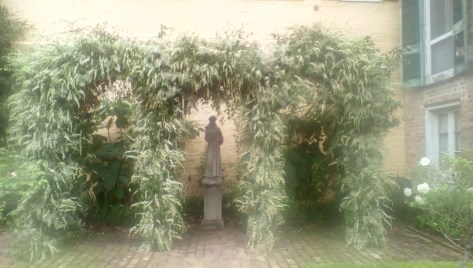
They just added this bower for a recent event, likely a wedding.

IMG_20160108_103410_hdr

A close up of one of the calamondins

12369162_10205769201012377_8759841855973823978_n

December’s haul (actually half of it) as I wash the fruit first

12241227_10205769200972376_6232779471520401161_n

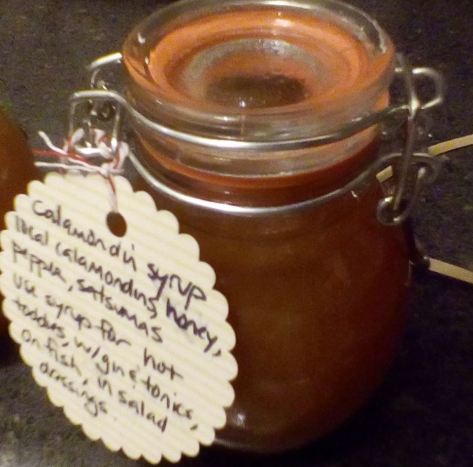
Cooking the calamondins. I cook them for a very long time, with honey, cayenne pepper and satsuma juice added.
1937082_10205769200652368_5019317336319075501_n

Finished product

10501598_10203235423309518_6270193186818589433_n

Me up in the tree in 2014


Joyeux Anniversaire, Jeanne d’Arc!

Celebrating St. Joan of Arc’s birthday and Twelfth Night, this annual  walking parade is a medieval-themed theatrical procession, inspired by Joan’s time in 1400s France.  Joan of Arc liberated the citizens of Orleans, France, from a British siege in her first victory in 1429—resulting in her moniker “The Maid of Orleans.” Our parade honors our own unofficial patron saint, The Maid of New Orleans: the beloved  golden French Quarter statue, a gift to the City of New Orleans from France in the 1950s, and our French history and heritage. It’s a short, family-friendly parade — quirky, whimsical and spiritual. Follow us through the French Quarter with one of Joan’s birthday candles, handed out to parade goers in honor of Joan’s 604th birthday.

route-map-copy-283x300The parade typically starts on time at 7 sharp and makes 3 pauses for a bit of medieval pageantry:

  • toasts from the Historic New Orleans Collection and Grégor Trumel, Consul General of France in New Orleans, from the Williams Research Center balcony at 400 Chartres
  • a sword blessing at Saint Louis Cathedral by The Very Reverend Father Philip Landry
  • the crowning of the king and king cake ceremony at the end at Washington Artillery Park.  Bring your own king cake to eat your first king cake along with the king and Joan.

Parking and Restrooms

  • Suggested best parking: Jax parking lot (map). Take the stress out of parking by paying in advance online at the location’s website, www.premiumparking.com/P401

  • Public restrooms will be open in the Jax Brewery shopping mall before and during the parade.