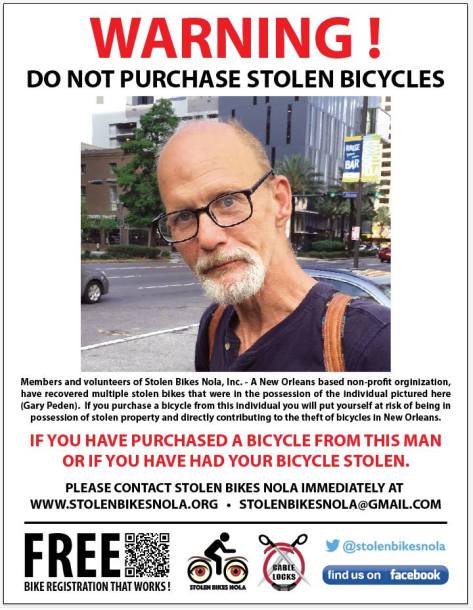
AND support this wonderful group of neighbors who are doing so much for those of us who rely on our 2 wheels, while making the bad people look over their shoulder.
AND support this wonderful group of neighbors who are doing so much for those of us who rely on our 2 wheels, while making the bad people look over their shoulder.
I propose a new Dirty Coast t-shirt:
10 million bucks and all we get is a cute phrase and a shrug?
Source: “Juice wasn’t worth the squeeze”
Although the idea of vacant house “tours’ is a little odd, the willingness in Wilkinsburg PA (an area I know slightly) to address the current and the underlying issues of loss of population is certainly better than how various neighborhood associations and City Hall have handled it in New Orleans.
While there last, I heard some anecdotes about one Pittsburgh neighborhood that has been organizing around rezoning in order to allow low-income tiny home development to increase socioeconomic diversity and resident types such as seniors and maybe even the previously homeless to be able to gain a foothold.
I think it’s time for a new citizen-led initiative around quality of life issues across sectors and not just use all of our energy for the “too little-too late” reactions to Loyola Avenue rubber stamping any development.
For example, I know how much Rebuilding Together (previously known as Christmas in October when I worked with the folks there) did to repair low income and senior homes so think how much more that could be done if we gathered and used resources like these at the regional level and didn’t just rely on corporate sponsorship. After all, blight is a outcome of multiple issues happening at once, and from outdated or outsized attitudes about development.
Certainly it would be beneficial for residents to adopt a more activist stance on rental property that goes beyond just posting flyers that yell at visitors and that reduces the issue to “all short term rentals bad.” I actually know someone who told me with a straight face that STR hosts were worse than heroin dealers. That’s the kind of statement that serves no solution, but encourages polemic rants to be the acceptable level of response. Of course, one of the things that is odd to many who are viewing the fury over the STRs is that loss of good rental properties has been an issue for a very long time in the African-American community with little attention paid. And the takeover of public housing for “mixed use” has been an issue since the1990s and became another way for developers to use public funding to get market rate development in our historic corridor, and yet I cannot remember seeing significant organizing against this in the white-led neighborhood associations or not since it was linked to the Walmart development around the St. Thomas Projects.
Or, any inserting themselves to disrupt the sequence of events in any developing area which roughly goes something like this: first, enterprising folks buy low-cost property. Some live there easily and as neighbors, but sooner or later, others come only to buy for investment. When that happens, low-income housing owners (Section 8) are hit with fines and complaints by their new neighbors ’til they sell out (not til they repair but until they are gone) and a new owner can take it over. The security system and the high fence are added and the house is taken from a 2 or 3 unit property to a single home. Next, stores and amenities that chiefly benefit young white residents crowd out the old places. Then, the African-American residents who still remain are monitored for behavior that doesn’t fit the QoL for the new residents and finally get the hint that it is time to get out of this area. (I think of the complaints from new Treme residents about the second lines, or people calling in complaints against people congregating and drinking from paper bags but not about those with wine glasses or Miller Longnecks, or the guy who lives in a posh place on Esplanade has complained loudly against the laundromat at Lopez and Grande Rte. St. John, or those who put glue in bicycle locks of anyone who dares to lock up in front of their business.)
As for airbnb, I do think the city should outlaw any multiple listings and whole house rentals and then leave the others alone; STRers do pay income tax on their earnings and in my mind, offer the opportunity for visitors to become good neighbors and to support amenities such as grocery stores, neighborhood eateries and better public transportation. Actually, I find the blithe acceptance of the massive physical, economic and political cost of skyscraper hotel zones baffling. Why in a town with a huge visitor economy would we want visitors all clustered in one end of town, rather than in small hotels, b&bs and in mother-in-law suites? Why allow so many multi-national and chain companies to benefit from our creative economies and then take most of their money to their corporate homes, leaving us with so little? The gig economy – when done well – can alleviate gaps in earning and can allow creative people time to attend to those ideas and dreams that have been waiting. Let’s try to be creative and comprehensive in our organizing around housing, health care, safe streets, food sovereignty, energy, water management, import-replacing industries and entrepreneurial activity and stop being tools of the system.
The current configuration of the French Quarter cannot be properly understood without knowing property owners part in shaping it. In many ways, the Borensteins of the Quarter then and now are much more important to study than mayors or preservationists.
For a few months Borenstein worked as a salesman for Uncle Joe Rittenbing, “a famous pawnbroker on South Rampart Street,” Larry added with a touch of awe. Larry opened his first shop at 814 Royal, selling stamps while an associate, Al Williamson, sold coins. Rent in ‘42 was $20 a month; the same space fetches $600 today, Borenstein says, “and I don’t own it.” In ‘43 he moved to 706 Royal ($30 a month them $500 now, he says).
Borenstein continued in the stamp business until about 1950, eventually becoming an editor of Weekly Philatelic (published in Kansas). His Old Quarter Stamp Shop and Jolly Roger Book Shop in Pirates’ Alley did thriving business. Borenstein also was editor of the Old French Quarter News (precursor to the Courier) in its final months. Outside his shop, artists were encouraged to set up in the open air.
“It’s on my conscience that that tradition, which later spread to Jackson Square, started with me,” said Larry, who takes a dim view of the quality of what passes for art on the Square today. The Jackson Square development started when Borenstein sued St. Louis Cathedral “because it seemed that painters weren’t allowed to hang on the Cathedral railings without political help.” The suit stopped the use of the Cathedral railings entirely, and artists moved to the Square. Larry recalls: “I told the pastor, Father Burns, that I wasn’t the first Jewish boy to try to drive the money changers from the temple walls.” Today Borenstein estimates the Jackson Square sales and services (framing, etc.) add up to about $1.5 million a year.
Wendy Rodrigue writes about 730 Royal
Today is the 100th anniversary of the birth of the great writer, activist and thinker and so we should celebrate her impact on planning, on sustainable economies and on local sovereignty.
I found her writing in the mid-1990s, aright before I moved to Akron Ohio. If you haven’t been, it is a city that lost a great deal of its small town feel during the bad ol’ days of “urban renewal” with a highway plunked down right at the edge of downtown and massive “disinvestment” (read empty factories and offices) left by the large corporations that had ruled there for generations. By the time I was there, it had become a sleepy bedroom community for folks who commuted 40 minutes north to Cleveland. I also noted the ironic abundance of hiking paths in the gorgeous Cuyahoga Valley National Park that is the area’s greatest jewel, and yet the lack of appealing ways to walk or bike around the actual city. I found Akron lovely, but lonely. I couldn’t help the constant refrain in my head of Chrissie Hynde’s “My City Was Gone” about her hometown of Akron and her description of how:
There was no train station
There was no downtown
South Howard had disappeared
All my favorite places
My city had been pulled down
Reduced to parking spaces
A, o, way to go Ohio”
Indeed.
I had become interested in planning and how humans move through the built space while previously living in Pittsburgh, Pennsylvania in the neighborhood of Shadyside. My apartment was above the five and dime store (still run by the daughter of the original couple) and had lovely bay windows overlooking the commercial street. I would sit there to read and smoke and watch people move about below. As I sat there, I wondered if banning cars on Walnut would benefit it, or would it encourage more residents with cars if they reduced the number of meters. I noted the superior bus system around town and was dumbfounded when they built a freestanding department store in downtown, and even more so when it was immediately supported by workers and residents willing to travel where they had to park or catch a bus and walk to shop. (Interestingly, the city’s economic health took a nose dive soon after my exit from the city and now is just beginning to right itself again, and that department store which has been empty is being developed into something new.)
As always, when I became interested in a subject I searched for as many books I could find about it; I first found “City” by William Whyte and then found “The Death and LIfe of Great American Cities.” I devoured them both but after reading Jacobs, I felt as if I had found a teacher. Her practical and direct writing illustrated how human activity and personal interaction should matter when thinking about cities and how the cultural, ecological and economic systems must be designed to work together for the person and not the city manager or the egoist planner and all of lit a fire in my soul. One reason for that immediate attraction to her writing was the deep respect she had for local rule. I knew I had met a fellow activist and one that shared a disdain for unnecessary formality or hierarchy: Why separate people from sidewalk activity with elevated versions? Why separate stores from living space? Why separate production from where people live or work? Why ban informal vending in cities? Why add highways where none are necessary?
After Akron, I moved back to New Orleans where I had lived as a teen and through my early 20s. Even though I had been mostly raised in Cleveland, it was New Orleans that had always felt most like home, and a city I always knew I would return to live at some point. Turns out, that point was the year 2000 and at first I moved back to the French Quarter where my mother lived for many years. Of course, Jacobs and Whyte’s teachings echoed in my head as I walked through every block of it, noting the tiny sidewalks full of amblers and walkers, balconies and galleries that shielded a passerby from the afternoon rain and encouraged musicians and shoeshiners to set up shop below. The corner grocery store and drugstores served the community well and while the remaining hardware store had a more upscale feel, it was still a very good place to buy nails or screen repair kits. It was fortifying to be back.
In 2005, the destruction of the city in August at the hands of the shoddy levee management meant that everyone in the city was thinking and talking design and planning and that the next years of recovery were thrilling and scary and collaborative and polarizing and so much more. As residents, we failed our city in many ways during that time, allowing the destruction of our old but useful hospital in order to build a shiny new one 2 blocks away for a billion plus dollars. We allowed the destruction of all available public housing, originally built in the 1940s in townhouse style to build new versions in townhouse style but in wood and not brick this time around. (Of course, the upending of those living there during the years of redevelopment was the point of the entire exercise and has broken up communities and families as expected and pushed the workers of the city far from where the actual work is located.)
Developers have a strong hold over many of our areas now and investors “from away” have taken hold of large swaths of housing stock to either sit on them empty while waiting for the best return to come along, or changed the feel of the area to something new that has little to do with what is also there or even worse, has kicked out scores of residents to offer entire blocks of short-term rentals to visitors only. There is much more that has been a result of this era being forced upon us, but most relative to this post was the constant refrain in so many heads as we fought it, “What would Jane Jacobs do? What would she say?” In some cases, her observations and teachings have stopped some very bad examples of city planning, added some excellent collaborative work on water management for example and in other cases the inherent activism found in New Orleans then and since simply dovetail nicely with her descriptions of city life when done well.
It was also interesting that during the early days of recovery, the French Quarter became home to thousands more residents as it was untouched by the levee breaks and could absorb those who needed a place to sleep and eat and meet while they worked on their homes in other parts of town. The hustle and bustle of it in those months was thrilling as these 80 or so blocks continued to operate like a well-oiled clock and easily support everyone who needed to be there. Even after many of those folks moved back to their own areas, the comfort of the city center still appealed to many and residential numbers increased between 2000-2010. I am one such resident as my move to the Bayou St. John area of the city turned out to be temporary for the years right before and after 2005 and now I find myself back in the Quarter, I hope for good this time.
The truth is that the Quarter will never return to the population numbers of its zenith, but neither will the Marigny or Central City. The style of living has changed ghettos like the Quarter to single home living or by offering small apartments to a single person where once an entire family lived in the same space. Even though it is fashionable for many New Orleans “super-natives” (see explanation of the term at end of post) to again complain about the Quarter, the truth is it still works for thousands of residents and workers and visitors and more. It is vibrant all day and all night. It has cars and delivery trucks and buses using its tiny streets, even while sharing space with mule-driven carriages, bikers, skateboarders and drunks. People meet on the street and talk, and they come out to wash their sidewalk and note activity while doing so. They talk to the meter maids and to the guy who hustles for a buck to help workers close up at night. Yes, even in a modern city and time a place designed originally for pedestrians and those living and working in the same space is still incredibly useful. And Jane Jacobs predicted it.
So even though the Quarter may not still serve the same purpose it did in 2005-2008 or in 1905, it still matters. This city center doesn’t have to remain the Italian neighborhood or hold all of the chicory coffee stands or all of the city’s music clubs to remain necessary. It is allowed to change and adapt as long as it contains “the seeds of its own regeneration” and does its darn best to hold the “unaverage” among the regular better than any other neighborhood.
Jane Jacobs affirmed that for me. So happy Jane Jacobs Day, my fellow Quarterites- I expect to see you on the sidewalk soon.
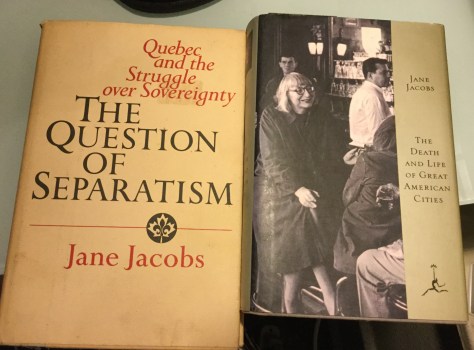
2 of her many books, always nearby.

Google’s homage to JJ today
• From Richard Campanella’s essay: Transplants arrive endeavoring to be a part of the epic adventure of living here; thus, through the process of self-selection, they tend to be Orleaneophilic “super-natives.” They embrace Mardi Gras enthusiastically, going so far as to form their own krewes and walking clubs (though always with irony, winking in gentle mockery at old-line uptown krewes). They celebrate the city’s culinary legacy, though their tastes generally run away from fried okra and toward “house-made beet ravioli w/ goat cheese ricotta mint stuffing” (I’m citing a chalkboard menu at a new Bywater restaurant, revealingly named Suis Generis, “Fine Dining for the People;” see Figure 2). And they are universally enamored with local music and public festivity, to the point of enrolling in second-line dancing classes and taking it upon themselves to organize jazz funerals whenever a local icon dies.
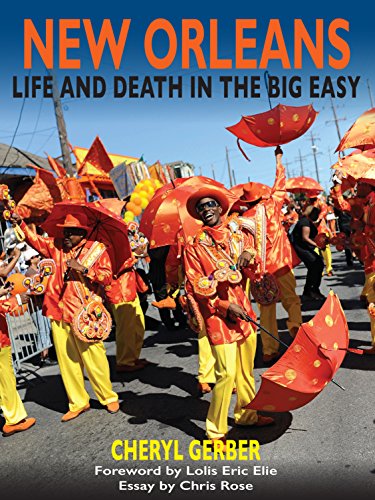 Of course I had noted Gerber’s pictures before, but like so many of our “journeyman” photographers, her work has most often been published in our ephemeral media and with that comes a tiny name credit all that marked it as hers, likely often missed. And oddly for such a visual city, the writer of words is usually given prominence over those who use a camera. It’s not that photographers are never celebrated: Gerber’s own photography mentor Michael Smith is renowned as are at least a half dozen or more names. But since working photographers are thankful to get one shot at a time published, it is often only when you see a number of photos together that the individual’s viewpoint emerges.
This book offers Gerber’s sensitive and sensible view of her city and of her neighbors. You notice she is often at near-to-middle distance, close enough to catch an eye or to elicit a smile or gesture, but not too close to influence the moment, which points to her work as a photographer for Gambit and other news outlets. Action permeates her work, but just as often she appreciates a simple moment of acknowledgement. Humor more than glee, sadness more than despair make it seem like she just happened to photograph a thousand normal days here. And gives me a sense of the photographer quietly saying to me over my shoulder, “see that guy? he…”
The physical space of New Orleans is covered here, especially in the time of Katrina when less people were here and those who were did not need their picture taken (as Gerber well knows) but her favorite subject seems to be a single person. Even when there is more than one in the photo, the others are usually reacting to the protagonist. And that seems very right in a book about New Orleans since musicians, parades, sporting events and yes even murder scenes all have main characters who propel or narrate the action, all done publicly. Yet the choice of photographs and the layout of this book means the juxtaposition of two or more images on a single page or across two pages forces us to to consider each photo as part of a more complex story; even the choice of Chris Rose and Lolis Elie as the essay writers at the beginning tell us to prepare for that. A photo at the JCC uptown pool with white children jumping in is paired with two African-American boys landing on a pile of mattresses outside of a boarded up house. The two photos uncannily mirror each other in the physical layout and are connected by the childish joy seen in both but still, the divide is vast. Both the connection and the distance between linked images is presented again and again, although not with one image dominant over the other. As a matter of fact, the pairings or clusters seem necessary to tell the entire story of each. Buffalo Soldiers and NOPD on horseback, Metairie Cemetery gleaming and paved next to weedy, handwritten Holt, Roller Derby girls as bulls on skates next to Mardi Gras Indians with horns, even David Vitter and his Canal Street Madam (well that one made me laugh)…all together tell the story. I don’t think I have seen the life here shared in photos any better.

mailed April 15
Dear Indywood,
Enclosed find my rewards returned for backing your project on Kickstarter. I also ask that you remove my name from your list of supporters. The idea of a downtown movie house was very appealing to me when I read your request for support as the clock was ticking down on your campaign and so I backed it. I was pleased by your enthusiasm for the idea and for your location. However, I’d like to register my displeasure with your recent actions by returning my rewards and withdrawing my visible support.
When I read about the robbery at your shop, I was sorry and sad for your troubles but assumed that your impulse would be to reach out to the neighborhood to help construct a community that could look out for each other and one that might also begin to consider the effect that so much concentrated development is having on a previously diverse and vibrant street. That maybe the best response you could have to random violence being visited on your place of business would be to assume it was happening to others and to knock on doors and to offer some help to the neighborhoods on both sides of St. Claude.
Instead, I was directed to posts and vlogs authored by the Indywood team and found your newfound shock about street lights near your place being out and your statements about installing buzzers and “lots and lots of lights, ignoring the neighbor/HDLC” (sic) agreements and lofty talk of being on the edge of gentrification (I hear that it had originally been written as on the “forefront of gentrification” please tell me you thought you were joking with that).
I am very sorry that you had this happen to you, but to act as if it only happens to you is the first sign of privilege. The second is the immediate talk about securing property with things that will separate you physically and socially from your neighbors. The third is to advertise that St. Claude is not safe as if this crime has made it so, rather than the already existing and growing divide of richer and poorer that your (our) investment has contributed to it being ever more hardened into long-term reality. The fourth is the shock and hurt over you seem to have in being called out on it via social media.
Let me be frank: like you, I gain from white privilege. Everywhere I go in America, I am welcome and can reasonably assume I will not be randomly stopped for driving or walking anywhere simply because I am white. I can walk into any employment situation and at least get a fair(ish, I am a woman after all) screening based on my actual credentials. I can dream of owning a house in any parish if I so desire. I was afforded a pretty good free education that suggests I can operate behind a desk or even manage others. It has taken me many years to truly understand how those and many other benefits are not evenly offered to everyone.
I live here in New Orleans partly because my culture is not the dominant culture, or at least it wasn’t when I moved here over 30 years ago from an entirely white suburb of a shrinking Midwestern city. That point is very important; what I mean is that I was able to see my unequal position as a white person in terms of the continuing colonial imperialism that I profit from but also to have the chance to live here at a time (well at the waning end it seems) when the African-American community still had real prominence in government and in the culture. I had the luck to work and live in a majority African-American U.S. city during a time when it hosted a true renaissance in music, dance, photography, organizing among many other areas that brought the adoration of the world to us. And in lieu of blue, pink and white-collared white people being around to teach me, I learned from those people of color who were still here. I went to St. Claude Avenue to talk with repairmen who knew everything about the machines brought to them. I had all African-American teachers and principals at my high school. At every workplace, I knew to ask to be trained by those matronly ladies who work hard in every city; the thing is by my time here, they were almost all women of color.
I must share that I was surprised by the grace and the lack of recrimination my neighbors had when talking with me, so very often willing to meet me more than halfway and to patiently show me how my unfair edge had made the world seem a certain way when in fact it was actually not that way at all.
So, we muddled through for a few decades, sometimes getting closer to each other and sometimes further from each other. And then, as we say, Katrina happened.
The destruction of the physical space was hard but the ongoing destruction of that enduring culture was and is worse.
The number of longtime residents who cannot return is enough to populate a medium city, with almost all of them African-Americans.
The neighborhoods that they had held together through the generations of segregation and separated levels of economic opportunity were then either ignored or sold off.
Suddenly, it seemed we were moving back to the time when people of color had to offer white people an explanation for being pissed off at inequities, at hearing daily language that is woefully ignorant. The difference is that now it is not said overtly in terms of color but rather, in code words of class and opportunity as if everyone was being offered the same.
And so if it needs to be said to you, I’ll say it: it is not the same. The opportunities are not equal. They have never been but over the last few years, the astonishing blitheness of the easy takeover of every cultural treasure long created through community and artistic expression is overwhelming. The neighborhoods being transformed into versions of how whites (newly arrived mostly, but to be fair, not always) want to see New Orleans, all done with ironic detachment is painful.
So your hard work to create your thing on St. Claude is real and you should be respected for that, but it is not fair. The opportunity to get that liberal arts education and to be “white kids from Colorado” who can pick up and move to a city and have the skills and connections to open businesses is not because you have run the same course as your 7th ward neighbor and then beat him to it fair and square.
The crime that happened to you did not just happen to you. The crime in our city is overwhelmingly directed at people of color and includes some from authority figures too, the type of crime which white people largely get to avoid.
The idea you had is great but it now feels a little like you see it as a playhouse for you and your friends ambitions and less like a community place (think about it: once you get that buzzer, what would happen when a couple of African-American kids used it at 8 o’clock at night?) This is why I cannot support Indywood at all until some real change happens.
Why I wrote this tiresome long letter is because I want you to have that same opportunity I had when I came here so many years ago: to truly learn from this place and to change. I’ll still hope for you to be successful, but I’ll more fervently hope that you understand how that is made possible and that you’ll do your best when it happens to lift every boat and not just lock yours nice and tight.
I wish you both good luck. More recent news make it seem as if you are taking the lessons to be learned more seriously than before realizing that you, like all of us, have some prejudices to unlearn. If that is the case, I applaud it.
Here is the same idea but said clearly here by local activist Kenny Francis: If you’re thinking about an issue and your identity is not the one that is being threatened or harmed, your role should be to listen, to understand the privilege you have in not being affected by that issue, and to listen to those who are and what they are saying they need. That’s how you be an effective ally, that’s how you bridge divides.
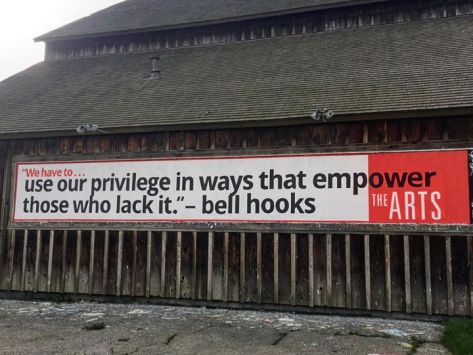
Or, we can just listen to bell hooks:
 French Quarter block by block
You must be logged in to post a comment.