This gentleman received this ticket at 4 am in the morning over on Gentilly. This is absolutely shameful and MUST result in action by our city government to reduce this type of harassment. The stated costs of each infraction are also shocking and need to be reduced to a warning for a convicted first offense, and then a minimal charge for later charges.
Education about what is required by cyclists would be great; unlike auto drivers, there is no required training for any rider of a bike and many of these rules are simply not known to riders.


Category Archives: French Quarter
L’Union, New Orleans Tribune honored
The Louisiana Creole Research Association will host a forum and unveiling of a new historic marker this weekend for L’Union (1862-1864), the South’s first Black newspaper, and the New Orleans Tribune (1864-1869), America’s first Black daily paper.
The forum takes place this Saturday, June 16 from 2:30 to 4:30 p.m.at the Williams Research Center at the Historic New Orleans Collection, 410 Chartres Street. The marker unveiling will immediately follow the forum, and the event is free and open to the public.
From The Advocate article:
In response, Roudanez formed L’Union with his older brother, Jean Baptiste Roudanez, as publisher and Paul Trevigne as the paper’s first editor.
As soon as L’Union began publishing, the three men faced repeated threats of arson and death, but in response, they decided to expand their audience by publishing the daily Tribune.
As the paper editorialized in 1869, its goal was not to be a journal dedicated merely to beautiful prose. “We plead for equality not as philosophers (who) in their closet write beautiful essays about abstract principles,” the editorial said. “We are seeking to throw off a tremendous load which has been our inheritance for centuries. With us, it is a reality and no abstraction.
Found at 527 Conti Street (at Bevolo Gas & Electric Lights showroom building)
UpStairs Lounge Arson 45th Anniversary
Wednesday, June 13 – Benefit at Bourre at Boucherie
From 5:00-9:00 p.m. during the Daiquiri Day’s of Summer, join Bourrée, in connection with LGBT+ Archives Project of Louisiana & St. Mark’s United Methodist Church, New Orleans as we remember The Upstairs Lounge Fire. All proceeds from their Daiquiri Sales that evening will be donated to help finance the Second Line Memorial for the 45th anniversary. Come support the community, listen to great live local music, have a daiquiri (alcoholic or not!), eat some boudin, and spread the love.
Saturday, June 23 – UpStairs Inferno Screening and Panel
5:00 p.m. at The Broad Theater (636 N. Broad St.) The UPSTAIRS INFERNO special screening will be held on the eve of the anniversary, June 23 at 5pm at The Broad Theater (636 N Broad St, New Orleans, LA 70119). Buy your tickets TODAY at http://Tix.UpstairsInferno.com. Director Robert L. Camina returns to host a discussion immediately after the film. He will be joined by special guests, Marilyn LeBlanc-Downey and Skip Bailey (sister and nephew of Ferris LeBlanc, one of the arson victims buried in the Pauper’s Cemetery).
Sunday, June 24 – Service at St. Mark’s
An ecumenical service will be held at St. Mark’s United Methodist Church (1130 N. Rampart Street) at 5:00 p.m., followed by a Second Line parade to the site of the fire where a solemn reading of the names of the victims will be held.
Wednesday, June 27 – Panel Discussion
This event will take place at 6:00 p.m. at the Williams Street Research Center at 410 Chartres Street. The LGBT+ Archives Project of Louisiana and the Historic New Orleans Collection will host a panel discussion of historians and witnesses to the event discussing how it shaped the community locally and nationally. Participants on the panel include Royd Anderson, director of the documentary The UpStairs Lounge Fire (2013); Clayton Delery, award-winning author of The UpStairs Lounge Arson (2014); Clancy DuBos, the journalist whose story “Blood, Moans: Charity Scene” ran on the front page of the Times-Picayune the morning after the fire; and Robert W. Fieseler. The panel discussion will be moderated by Frank Perez, president of the LGBT+ Archives Project of Louisiana and co-author of the forthcoming book, Southern Decadence in New Orleans (LSU Press). The event will also feature a reading and book-signing for Fieseler’s new book.
Pride June 8-10
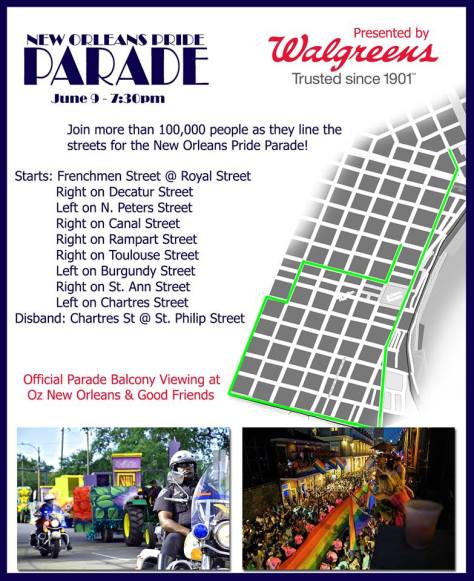 New Orleans Gay Pride began in February 1971, when the newly formed Gay Liberation Front of New Orleans presented a “Gay In” picnic in City Park. This was the very first such event in the entire state of Louisiana.
Throughout the 1980s, several organizations spearheaded the annual events. The first street parade was held in 1980. In 1981, the event moved to Armstrong Park, and was emceed by New Orleans native Ellen DeGeneres. In 1988 “Gay Fest” was changed to “Gay Pride.”
By the 1990s, “Pridefest” was being sponsored by the New Orleans Alliance of Pride.
In 2005, Gay Pride was presented by the LGBT Community Center of New Orleans. In 2011, The LGBT Community Center decided to no longer produce the Pridefest event and gave all rights for PrideFest to the 2010 and 2011 local Grand Marshals.
In 2011, The New Orleans Pride Organization was formed as its own organization and acquired a 501(c)(3) status. The 2011 “New Orleans Gay Pride Festival” consisted only of a parade, pageant, and block party on Bourbon Street with 80’s pop star, Tiffany. In 2012, the festival officially became “New Orleans Pride.” Since then, The New Orleans Pride Board has restructured the organization to foster positive relationships between all communities in New Orleans.
The 2017 New Orleans Pride Festival was the largest Pride Festival to ever take place in Louisiana. More than 35 events took place over a three-day weekend, attracting people from all walks of life. The Festival brought in more than 82,000 participants, 3,000 of which were in the New Orleans Pride Parade, Louisiana’s Largest LGBT+ Parade.
Courtesy of https://togetherwenola.com/
Tinderbox: The Untold Story of the Up Stairs Lounge Fire and the Rise of Gay Liberation

My rating: 4 of 5 stars
As someone who lives in the French Quarter and has heard the story of the early days of the gay liberation movement from dear friends and neighbors, many (too many) who are no longer here to enjoy the results of their energies, I was glad to see this book at my library. Partly because I remain so thankful that the gay movement made its home in my neighborhood where I spent much of the last 40 odd years, as it brought diversity, a welcoming and inclusive vibe, which meant this place has stayed a neighborhood even as it struggles with its white flight history role in a majority African-American city too often obsessed only with its tourist’s face.
Arriving as a teen to this neighborhood in those years that did not only include white, straight, middle-class people allowed me to expand my originally suburban outlook to be able to recognize a diversity of human connections and appreciate a multiplicity of lifestyles and thinking which has only helped me move through the world with a lot more gratitude and latitude.
I knew the story of the Upstairs Lounge and since the plaque has been added, I get to the site either to give a silent moment of commemoration or to show visitors or activists. Still, the book gave me more detail about the victims that I did not know, and also gave much more detail as to the horror of the event, for both those who survived and those who perished in the fire. I read this book in an evening, as it is well organized and written using recollections and first-hand accounts and only a little secondary information.
The only criticism I have is I would have liked to see an epilogue of the amazing transformation of the Quarter into the center of gay commerce and culture maybe even naming some of those leaders and even some of the businesses that still exist due to that leadership including our little Mary’s Ace Hardware, Bourbon Street Postal, tour companies, neighborhood bars, restaurants, florists, salons, and the rest and how that then spread into the rest of the city.
This book should be included in the required reading list for New Orleans high school students and added to the bookshelves of historical centers and libraries as an example of how many of our property owners (STILL) don’t maintain their buildings to ensure safety for those using them especially when those using them are on the “fringes” of society, how equity (in life or death) is (STILL) not given to all and how our city can do better with all of it by remembering The Upstairs Lounge tragedy.
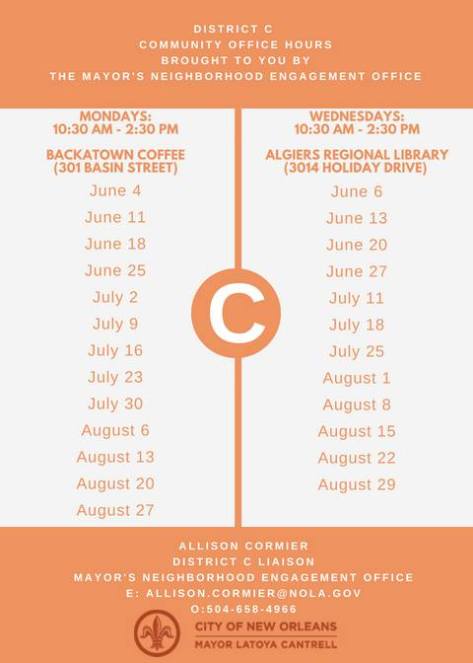
District C Community Hours @ Backatown thru August
The Same World
Reading the brilliant Race and Reunion book by David Blight which gives evidence of the 3 narratives of the post Civil War era of emancipation, North/South reconciliation and white supremacy and how emancipation was largely pushed aside in favor of the other two. In the book, the origins of Memorial Day are discussed. What began as a day in many communities to honor those lost in the War, (one of the earliest post-war events was in 1865 was staged by African-Americans in South Carolina to honor the Union soldiers who had died in their Confederate prison), Decoration Day quickly became a day for “genre” for oration and assumed a political character of reconciliation. “By the early 1870s, a group of ex-confederate soldiers in Virginia had forged a coalition of memorial groups that quickly took over the creation of the “Lost Cause” tradition… In the South, monument unveiling took on a significance equal to, if not greater than, Memorial Day. The story of Civil War memory and the rituals of Decoration Days continued well beyond 1885 with the emancipationist legacy fighting endless rearguard actions against a Blue-Gray reconciliation that was to sweep American culture.”
In a column entitled “Memorial Day”, Albion Tourgee wrote: “To dwell upon the hero’s suffering and ignore the motive which inspired his acts is top degrade him to the level of mercenary. Fame dwells in purpose as well as in achievement. Fortitude is sanctified only by its aim.”
As Clifford Geertz has written, “In a ritual, the world as lived and the world as imagined, fused under the agency of a single set of symbolic forms, turns out to be the same world.”
 French Quarter block by block
You must be logged in to post a comment.