2-year eviction of Upper Pontalba residents

As someone who lived in the building until recently and as someone who has spent the last decade researching the rich history of these buildings and their effect on our public square, lets just say I am deeply interested in the recent news that the residents of the 50+ apartments on the city-managed Pontalba (St. Peter side) have informed its residents that they will all need to vacate the building while a long renovation is done.

First, let’s get to the facts and do away with the misinformation about this building:

  1. It’s all rentals, no owners. The city was given this building back in the 30s by the preservationists who bought it and saved it from likely destruction.
  2. Essentially each of the Pontalba buildings was designed as 16 3-story townhouses, each with their own entrances. They do share infrastructure between them but any of the 16 can be easily closed off from the others.
  3. The rents are not astronomical but are in line with current rents around FQ. For example, the large one-room efficiencies are around 900 a month.*
  4. The apartments are lovely, and have updated modern kitchens, bathrooms and HVAC.
  5. There are a large number of full-time residents some of whom have been there for decades and have invested thousands of their own dollars in repairs and upgrades.
  6. There is not a years-long waiting list. There are often empty apartments which are first offered to residents, then to folks who sign up at the office to be contacted, then a larger search is undertaken (they say they do this phase, although I have never seen any evidence of it online). If someone on the contact list doesn’t reply, they are taken off the list (although that list seems to a bit of a snarl in terms of who manages it and how well it is maintained. That is based on feedback I have received from those on the list.)
  7. The staff is generally wonderful. For example, the men and women who do the custodial and minor repairs are caring and smart folks, many of whom have worked there for decades. (It has also been recently suggested in casual conversations that those positions might instead be independent contractors and not staff positions, which might mean new folks who know less and likely care less about the building to “come by” and deal with stuff.)

There are definitely some big issues such as the roof damage from Hurricane Ida to be dealt with, but the renovations seem to be more about “upgrading” the building. Again, very little in writing is given to residents or neighbors so this is based on my own conversations with staff and reading emails sent by various people connected with the building.

Residents seem willing to work with the renovation, even moving for short periods to other apartments. As a matter of fact, while I lived there, I asked where my latest lease renewal was and was told that since they may need to move us to another apartment, they were holding off on assigning us a lease for a specific apartment. So it was clearly an idea they were also working with at the time.

The issue with removing all residents for upgrades and roof repair is that many of them will not be able to find another space nearby. I think of neighbors who were service industry folks who worked later shifts and came home around 4 in the morning after work. Finding a space that is safe and quiet for folks like that is very nearly impossible in a neighborhood with so many illegal airbnbs operating.

Another question is if emptying it out is even needed. If you live and rent in the FQ, you have worked with landlords who need to do major repairs to these old buildings. I have never (not has anyone I know) had a landlord suggest I needed to leave for years to do those repairs.

And certainly important, is that they are losing 2 years of income.

There has been little information on this topic given in writing, including the actual plans of what is to be done.

In civic activist Jane Jacobs’ parlance, having mixed use and spaces made for people and not for massive development or infrastructure is necessary for a vibrant city. Those who live on the square happily share it with artists, readers, musicians, and others because all are needed to keep it dynamic and useful to the city. The residents are there after the shops close and the museums are shuttered, keeping an eye and an ear on late night activities, sharing information with the Square’s daytime users. It’s a delicate balance, and one that generally works.

Lastly, through my research on entrepreneurial activity in Jax Square, I have found that over the last 170 years, the residents of the buildings have almost always taken pride and care in living there. There have been times that it has housed people of civic stature, other times it had the workers or those newly arrived to the city, and very often, the creative and the enterprising have found their muse there.

That contribution cannot be overstated, especially in a neighborhood that is so physically important and so socially necessary. Let’s do better sharing what is planned and working with the residents and neighborhood to make this renovation helpful.
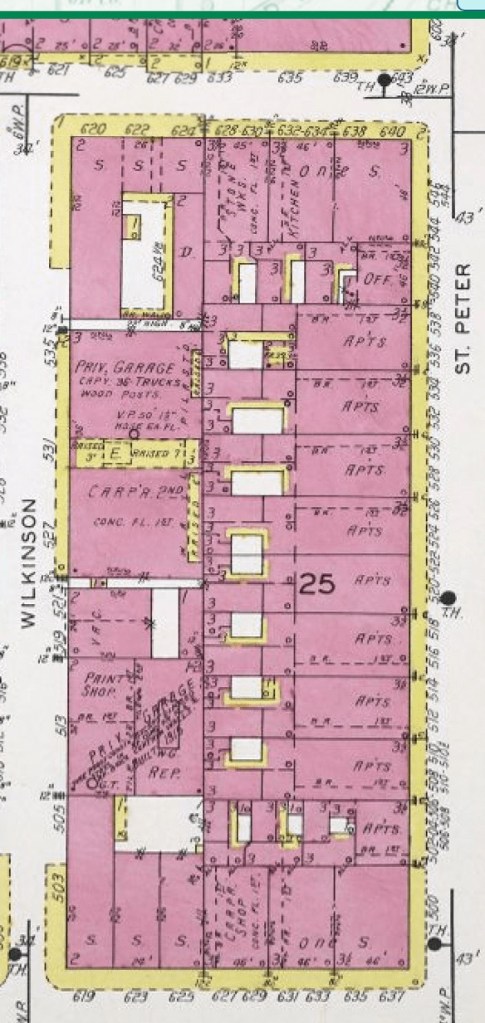
1940 map of the building. Note there were apartments even on the first floor.

* I would even suggest that the city seriously consider the idea I have raised here many times: that offering owners incentives to build in a few rent-controlled spaces for the service industry in the smaller units in these buildings and throughout the commercial areas of the Quarter and Canal Street would be a game changer for the neighborhood vitality, for employers, and for the city.

Best and Worst of 2020 French Quarter

I’ll do my best to refrain from making too many weary references to the past year. If I do, just kick me under the table and I’ll move on…

Walking around here during the holidays is usually a bustling, sparkly mood enhancement- lots of holiday lights, special events, and more local sightings than normal. Knowing most of you didn’t make it down here (and thank you for that), I’d like to bring you my “Best French Quarter moments.” And because it seems necessary, I am also going to list my “Worst French Quarter moments.” Here’s the thing: I am going to mix them all up. As I find more in my notes, I will add them.

Best/Worst of French Quarter 2020

Stanley’s adds seating outdoors and evolves its menu

Jewel of the South adds seating in parking lot next door and reopens

Many tourists ignore mask mandate

Manolito keeps making its signature drinks at window

Golden Lantern Bar follows the rules, does contact tracing and keeps its good cheap drinks and cheerful professional staff.

Mona Lisa has hilarious conversation with world via its daily window notes, also offers good Italian food

Mattassa’s continues its struggles, even with residents increased grocery needs and Rouses closing for long period in December

Valentino Hotels renovates

Le Richelieu Hotel renovates

Relaxed parking enforcement

Fewer cars in Quarter

Hard Rock* demolition is still not done by 1031 Canal Development

10 months later, neighbors’ remains (Anthony Magrette, Jose Ponce Arreola, Quinnyon Wimberly) are finally all removed from Hard Rock* collapsed building

Nelly Deli (Quarter Master) renovates

Cafe Envie on Decatur reopens in April with careful rules in place

FQ Rouses/A&P gets a whole new do inside with pretty floors and room to move about

My mom gets better after long spring/summer illness (not COVID) and comes home to her beloved Quarter

Blue bike racks become bigger eyesores

Copper downspout thefts increase again

FQ dogs are even more blissed-out with increased walks and long stretches of time with their people

Jackson Square artists’ carts and art are thrown into Mississippi River by malicious malcontent

Saint Ann construction is completed (?)

Soap hawkers on Royal continue to harangue passersby, rarely wear masks during COVID mandate.

Some bars ignore mask mandate

Mayor orders Willie’s Chicken Shack to close for duration after COVID restrictions are ignored

Clarinetist Tim Laughlin offers evening balcony concerts on Royal

Place d’Armes bell captain Chris Stall and valet staff maintain a cheerful and helpful vibe to neighbors and visitors throughout stay-at-home summer

Backatown Coffeehouse hangs in on Basin, keeps sweet potato pies and coffee flowing.

City Hall pays attention to the potential of the Quarter, asks for input

City Hall chooses the wrong place to suggest another pedestrian mall

Signmaker gets windfall with numerous “anti-mall” yard sign orders

#JazzFestingInPlace at WWOZ is a triumph

Neighbors sit outside nightly and talk quietly and safely on Chartres, on Barracks, on St. Philip, on Bourbon, on Saint Ann…

Reggie the cat remains at large; family still hopeful for return

Homer Plessy at the Little Red Schoolhouse announces renewal of its charter

After more than 100 years at that location, Tujague’s leaves its 823 Decatur home,

Tujague’s opens at 429 Decatur Street at end of the year

Chef Jerry Mixon moves on from Cafe Amelie

Vieux Carre Wine and Spirits keeps serving the liquor-needy.

Bike lane is added on N Peters/French Market to Elysian Fields

Pedestrian striping and traffic calming upgrades are added to area around Crescent Park bridge

Unhoused population get hotel rooms for short period in summer

Retail stores begin to disappear in summer. My last informal count: 15 establishments gone in last 6 months.

French Quarter Festivals does online Holiday Concert series, culminating in Christmas Even concert by Irma Thomas. Miss Irma’s “O Holy Night” rendition remains perfect

Heavy rain storms brought on by climate change are so severe across the city that even the French Quarter floods, a rarity (2 such came in October, November)

HNOC does #NolaMovieNight with clever social media commentaries during movies.

Neighbors on Saint Ann hold safely chalked early pandemic dance party with appropriate music

I decide to check off a bucket list item and move to the Pontalba apartments, hopefully increasing my work on Mercantile Jackson Square writing project

Frogs croaking from courtyard garden ponds and pools all through quiet summer months

City Hall baits the sewers to stem rat infestation

Mary’s Ace Hardware on Rampart reports bar owners, restauranteurs, and homeowners outnumber the usual contractors are coming in to their well-stocked, 2-story establishment.

Oversized and unmitigated “prayer event” is held on river in November, pointedly ignoring all mask and distancing protocols.

Protest for Black Lives Matter are peaceful, well-organized, and citizens follow mask and (mostly) distancing protocols asked for by its organizers.

NOPD attempts scare tactics by reporting phantom piles of bricks hidden near Black Lives Matter protest site, tells neighbors of phantom buses filled with counter-protestors, neither of which materialize or are proven with any photographic evidence.

  •  The Hard Rock Hotel is owned by 1031 Canal Development (Mohan Kailas).

Palmer holds ped-friendlier FQ meeting

WHAT: Virtual public meeting to discuss pedestrianization plans for the French Quarter

WHEN: Monday, August 17, 5:30 PM to 7 PM
WHERE: ZOOM 

Please note: Due to the expected high number of participants, questions will only be allowed through the Zoom chat feature and text messages. You can also submit your questions and feedback in advance by emailing tiffaney.bradley@nola.gov .

The Inertia of a Tourist Economy: Does it help or hurt during a crisis?

in•er•ti•a

  • n.
    Resistance or disinclination to motion, action, or change

On March 11, the city decreed a state of emergency over COVID-19. Too many scofflaws ignored that and so on March 16, Mayor Cantrell closed the bars and restaurants at midnight to shut down the expected all-day and night partying that St. Paddy’s day brings to cities across the US. Not everyone paid attention but a lot stopped immediately and then over the next week as the hotels emptied, so did most of everything else. On March 20, the city issued a firm, scolding stay-at-home mandate and on March 23, the state followed suit.

My social media post on March 26:

Its been 10 days since New Orleans shut down dine-in restaurants and bars and 6 days since the city stay-at-home order.  Since then, watching the wheels of commercial life slowly grind to almost a complete halt here in the French Quarter has been absorbing and sobering. At first, most places tried to stay open even though the bulk of their business had always been visitors, both those visiting from other places as well as the daily visitors who work in shops, in offices and seem to have so many lunch meetings. Some places did their best to drum up local take-out business via social media and word of mouth, but one by one, almost all in my quadrant have closed. Boards across windows and doors started going up at shops and galleries first, and then hotels and bars and cafes followed. It’s startling the first time you see the dark lobbies and gated locked parking lots 24 hours a day of a hotel normally lit up and staffed. You think about those workers that you saw 5 or 6 times a day for months or years and wonder if they will be back. (The bell captain at the little hotel down the street told me he had 120 days of PTO to use, but was still angry that he had to go home.) Yet even when the businesses began to shutter, some street traffic continued, albeit lighter than normal for a few more days. Then one day this week, I walked to Jackson Square and there was not a single person there.

At 2 in the afternoon. In sunny, 85 degree weather.

You’ll still see people walk a few times a day with their happy dogs, (saw a guy with his leashed ferret a few days ago), evening get togethers on carefully-spaced chairs on the street, a few tourists, and always some street people. The Mayor is slowly moving the homeless into hotels; the guy who lives in the window recess of the Presbytere Museum told me today that he had just missed the cut off to get in the Hilton Garden Inn by 6 people. I’d say the best way to describe his reaction was slightly stung. I told him they’ll find a place for him soon; he seemed to brighten at that. I think he looks forward to that mostly because he misses talking to people, he misses the hustle.  I mean, even the silver guy’s paint is almost entirely worn off. The musicians who are staying in the apartment across the street come out to the balcony in the afternoon and play music quietly but seem to have little of the animation and long jams that they offered in the first days. You make eye contact with strangers, but there is a bit of a hesitation in being too chummy; you don’t want to encourage them to slow down and stay around here. Some neighbors have chalked “Go Home; Be Safe” on the sidewalks; but those who get it are already home, and those who don’t get it, won’t. It’s odd to see the energy seep out of these entertaining streets, but at least we have a strong reason to believe much of it will return. In the meantime, we can save ourselves, our friends, and our neighbors by killing as much of it as possible. #nolacorona

Since that post, I have thought a lot about these silent streets since this post as the days tick by and wondered more and more about how and even if it will recover. Then, something my clearly exhausted but happy pal who owns a cafe in the Marigny said to me (as he bagged up order after order for folks patiently and happily waiting outside his place) struck me:

my business mantra right now is adapt or die.” 

Or as Arundhati Roy brilliantly said:

this pandemic is a portal.

Whatever it is, coronavirus has made the mighty kneel and brought the world to a halt like nothing else could. Our minds are still racing back and forth, longing for a return to “normality”, trying to stitch our future to our past and refusing to acknowledge the rupture. But the rupture exists. And in the midst of this terrible despair, it offers us a chance to rethink the doomsday machine we have built for ourselves. Nothing could be worse than a return to normality. Historically, pandemics have forced humans to break with the past and imagine their world anew. This one is no different. It is a portal, a gateway between one world and the next.” 

That portal can be hard to see in this anachronism of a neighborhood, charmingly designed for 17th and 18th-century living, and then made into a stage for visitors from other places to get a quick taste (and purchase) of that earlier time before heading back to their modern world.

Yet, even though it is primarily a stage, many things about this Quarter still work: the scale of it, the design of small apartments set above small storefronts, small well-run hotels, its nearness to the city center safeguarded behind massive well-engineered earthen levees instead of poorly-designed concrete walls such as those found in 9th ward or in Lakeview, utilities underground,  the highest ground, neighbors dealing with each other in shared alleys, on sidewalks and via on-street parking and so on. And because it is usually spared damage because of the care taken to maintain its facades for the tourists, it can quickly become a gathering place once again when hurricanes or floods devastate much of the city. Last but not least, this tourist center requires thousands of daily workers who become as dear as next-door neighbors, many of whom residents see more than their family, often relying on more than they do on far-off relatives.

Still, now as I venture out to the other parts of the city during this shut-down to get items, I see what I do not see here: restaurants and stores that have quickly adapted. From distilleries selling hand sanitizer or cocktail kits for homemade happy hours, cafes selling quarts of cold-brewed coffee or working with farmers to sell just-harvested items alongside their prepared items,  even fine dining places pivoting to offer a family meal (and 1/2 price bottles of wine) by drive-by pickup, they all seem to know what their neighbors would pay for and how often to serve them. Those businesses have bulletin boards,  funny, aspirational chalk signs for passersby and have become eyes and ears and care for their neighbors.

Orange Couch set  up for physically-distanced ordering at the side door

In these 90 or so blocks, enough locals live here so that we actually do have many neighborhoody things like drugstores, veterinarian offices, postal emporiums but it has become clear during this moment that even much of THAT relies on the millions of visitors who also come to these blocks, or it relies on the pockets of workers who, currently unsure of when or if they get to return to their store or will put that apron on again, are saving their bucks. Or maybe it doesn’t rely on those dollars at all but the business owners just think that it does. For whatever is actually true, what is clear is that almost all of them are closed. And they closed fast.

A few businesses tried to use social media to convince local folks to get items, but locals from other parts of town have been penalized and confused far too often by the parking rules here to dare to drive in. And even if they do brave it once in a while, most are not able to afford or stomach the majority-rule visitor-obsessed restaurants often enough to be familiar enough to check in with the others now.

As for residents: even though numbers have climbed steadily in the last 20 years, now at around 4,000 with around 1000 at or below poverty-level they mostly divide into the worker/residents of the Quarter (although far fewer than when I was one) now without income and the very very rich who have everything they need delivered by Amazon living behind their gates and private driveway.  Since 2000, owner-occupied units have risen from 24.6% to 48.2% with renter-occupied down from 75.4% to 51.8%;  fewer of us renters and therefore likely less of us remaining who seem to live here because we love it and not because we depend on it for work or because it is a family inheritance or peccadillo hideaway. As a result, those able to go get items from the restaurants who tried to offer food is even a smaller group than those other areas of town.

The other obvious issue clearly seen now that the Quarter is only serving its residents: it is so very very white which wasn’t the case when I moved here as a teen. And even though it has become clearly whiter in terms of residents since the pre and post 84 World’s Fair development furor,  on a normal day the cross-section of tens of thousands of workers, hustlers, and visitors allow the FQ to be as diverse and energetic as any place in this city, pound for pound, 24 hours a day, 7 days a week.

Not right now though. The only faces of color or heard talking in other languages here during COVID-19 have been the sanitation folks, grocery workers and security personnel. The usual Quarter workers and artists who represent the diversity of our city are home in their own neighborhoods which since 2005 are far far from here. (Which ironically, also means that the multi-generational food entrepreneurs offering good, culturally appropriate food to a cross-section of New Orleanians are also now far from here.) That diversity is the heart and soul of what makes New Orleans interesting and important. And when we reopen, it’s possible that many culture bearers and much of our indigenous knowledge base may just not care to keep fighting their way back here this time – or the next.

All of this calls into question the future through this portal: what will an economy only based on tourism offer our city, once disruptions come again and again, as we have to expect they will?

More simply and directly, what will remain alive after just this one shutdown? And what if the US opens up later this summer just as we hit the height of hurricane season?

In only a month, I have already seen 1-2 brand-new commercial For Rent signs, talked to business owners who are mulling the idea of not reopening their storefront that cost upwards of tens of thousands of dollars per month, and have heard of a few neighbors who are moving away to live with family or to cheaper cities to replenish their savings. One has to imagine that restarting the tourism wheel will take a while, especially when rumors (and logic) have it that JazzFest will likely not operate in 2020 or if it does at all, be a much smaller and leaner version. We’d have to assume the same will go for French Quarter Fest and others as they depend on sponsors as much as visitors. Connected to that is the outcome we have to expect if the seasoned staff of the past few decades that ran our best places like clockwork will not return intact.

So the question is how will we look once through this portal? Will the French Quarter adapt as it always has, or will it finally “die”- meaning become smaller, less lively, maybe owned by more out-of-towners with deeper pockets who move more to the middle in terms of what they present as New Orleans? That could mean losing what had been a critical mass of authentic experiences and becoming too small to entice enough visitors to hold this city together.

Or maybe – just maybe – this old city will just adapt as it has so many times previously.

In 2008, the book Building the Devil’s Empire offered the intriguing analysis (via many years of archaeological digs around the old city) that by the mid-1720s due to the failure of New Orleans as a tobacco exporter and the effect of Law’s Mississippi Bubble bursting,  France had basically given up on this colony, although not turning it over to the Spanish until the 1760s. Yet those digs show lively trade and activity in those 40 years, proving that New Orleans became a smuggler’s capital by turning its attention to the Caribbean to find its own opportunities even though that was against French law. That “rogue colonialism”, as Dawdy names it, she believes was mirrored in 2005 when the federal government did its best to thwart returning residents and stymie small businesses yet many found a way around that to survive and even some to thrive.

That rogue colonialism is clearly an adapt or die portal which could be vital for whenever the country opens back up for business. Do we have another one in us here? And if so, what will that version center on: regional food?  port activities? design for climate challenge places?

And maybe to help that, possibly commercial rents in the FQ will come down to reality. Maybe people will see the need for downsizing their place to something smaller and more communal as only the Quarter can offer. Maybe my idea of Canal Street and Pontalba being offered tax credits to become rent-controlled to entice residents to move upstairs into all of those decaying camera shops will happen.

I hear bike shops around town are doing bang-up business right now; maybe we’ll see a few open in FQ again.

Maybe less crap made in China will be for sale in our shops and more useful services for all residents can return. Shutter repair? Seamstresses? Metalwork? Mule-driven delivery around the city?

Maybe the French Market can add a splash park on the concrete pad, a storefront library, citywide compost drop off and community or senior services along its many block span to serve the entire city in some manner?

In any case, the way through this portal does seem to require a push to something new even if it might actually resemble something old and tested.

The question is: can we begin to turn in that direction?


Can the French Market be “saved”? (Part 2)

It was reported recently that our energetic and active mayor has decided to do something about the French Market. As a 20-year activist in food systems with a 40-year family residency in the French Quarter, I was certainly excited to hear that, although I think the setting has already been improved a great deal in recent years.The main reason this seems opportune is 1) the  limited availability of any public spaces in the city to try small, discrete pilots that center around cultural connections and entrepreneurial zeal means that this might be a unique moment, and 2) also because the current FM Director has been quietly impressive.

Part 2 (Part 1 here) of my four part post:

then Katrina happened:

By September of 2005 while still in exile, we (meaning the parent org of the Crescent City Farmers Market, then known as ECOnomics Institute) created an online bulletin board and chat room for our vendors and for customers of the Crescent City Farmers Market to keep in touch and to tell us when and where they wanted the markets reopened.

Once we knew that we could come back and reopen farmers markets in New Orleans ( because enough producers had product, enough consumers wanted fresh food, and we had places to live) we began to discuss where to put them. Because the “sliver by the river” area of town had not flooded, we knew it would be one of those areas. This was not to ignore the flooded areas, but since any and all space for construction drop off or house demo had to come first,  a pop up market was simply in the way in those early days.  The Girod Street market location had some damage, so that was out. That left the French Market and Uptown Square as the two locations under consideration, but we quickly realized that the French Market was barely functioning.

Even so,  we were still trying to help them by meeting with its director in those early days. I remember that we had dinner with him in early October, discussing how to use the French Market to help rebuild the city. We suggested that they allow Red Cross to use it as a station, and to have city departments set up there. Unfortunately, none of that happened for various reasons, probably most due to the inertia of the complicated system that the French Market was and is managed under.  It is important to point out that the public-private partnership it operates under is hard enough, and then one must take in its multiple roles:

  • the largest manager of city-owned historic property which stretches from Jackson Square (and includes the upper Pontalba building) down to Esplanade (and that was before the Crescent Park opened);
  • the retail manager of all of the storefronts included in those properties;
  • the manager of the parking lots bordering the river and those on Elysian Fields;
  • the operator and manager of the 2 open sheds at the end of the French Market, including its hundreds of itinerant, permanent vendors;
  • one of the primary event creators and managers in the lower river section of the Quarter.

The reason I bring up the post Katrina era (and the earlier revival era that I wrote about in  Part 1) is because the future of this venerable place has a lot of baggage to carry with it, and also has some hard truths of the surrounding area that cannot be denied before we can discuss what to do. And the city is almost a completely different one that what existed on August 28, 2005. I’d like to see that history really analyzed, much more than I have done here, and make that analysis public.

For example, for any of us here at the time and now, it is clear that the post Katrina era gave the French Quarter some new life. Residents who still had property moved back in while they redid their own houses, others grabbed every rental available (which because there was no damage did not see its prices tripled as many other areas have done which was great cuz rents for larger, redone apartments there were already on the highest end of the spectrum), and -AND- the great luck of still having a walkable, vibrant area with public space, groceries, and cheery nightlife on the inner edge of the grey, sad, often toxic other 80% of our city was a comfort to all. So it became boom town for a little while and today, it still has an increase in renters and homeowners from the low population numbers it had a few decades previously.  The Homer Plessy Community School is livening up the corner of St. Philip and Royal,  a number of creative and unique shops are doing well (altho commercial space is at a premium), and a whole lot of activism and street life is still happening here. Interestingly though, still many locals repeat the old story about the French Quarter being “over” as a neighborhood when it is far from that.

That is another issue.

But in any case, the French Market didn’t capitalize on that boom. And unfortunately, lost great anchors such as Horst Pfeiffer’s Bella Luna who grew tired of waiting for his building’s roof to be repaired.

It simply didn’t have the structure or even the mandate to do capitalize. Instead, it remained an gentle afterthought in a booming Quarter, Marigny, Bywater which were (are) full of millennials terrified of being seen as participants in any setting that lacked an ironic twist or didn’t include a new take on an old place.

The French Market did however, add some very interesting counter restaurants in the sheds who continue to animate that very difficult space. And it also moved community radio station WWOZ into the Red Store building.  And the Dutch Alley Artists Co-op continues to attract local artists willing to operate the storefront as a collective. How do those additions change it is the question. Do they?  Are they as important to this French Market as Cafe du Monde and the Creole Tomato Festival were to earlier users?

And how does the new New Orleans (shudder) and the new life in the Quarter affect what is or should happen at the French Market?


-Part 3 will focus on the flea market on the end of the French Market, which must be dealt with, even though its history and its activity is not all as horrible as some residents make it out to be. As a place to show off the diversity of the entrepreneurial community new and venerable, it wears that well. The question is if newly arrived residents are still able to access the French Quarter?  The shift in population for immigrant communities moving away from the city center and to the suburbs and even rural areas seems to make the idea of a French Market business a little less ideal for those communities. The answer may be found in some sort of a organized incubator for those business at the French Market or even assistance in product development that may even cater to residents as well as visitors…


Can the French Market be “saved”? Part 1

It was reported over the weekend that our energetic and active mayor has decided to do something about the French Market. As a 20-year activist in food systems with a 40-year family residency in the French Quarter, I was certainly excited to hear that, although I think the setting has already been improved a great deal in recent years. The main reason this seems opportune is 1) the  limited availability of any public spaces in the city to try small, discrete pilots that center around cultural connections and entrepreneurial zeal means that this might be a unique moment, and 2) also because the current FM Director has been quietly impressive.

I have a personal history with this space, as a resident who was sent to the market to shop for my family’s table, and as a place I developed many of my teen-aged interests in books, bikes, clothes, music, gifts…this was definitely the bazaar that I was in 3 – 4 times a week.

Since the beginning of 2003, I also had a work history with this space when my non-profit, (known then as ECOnomics Institute, and as Market Umbrella since 2008) operating  as Crescent City Farmers Markets, became involved in its operation. The history of the March 2003 – August 2005 Crescent City Farmers Market is recorded here because there will be many that immediately suggest that local food  and in particular a farmers market-is what should be added; in fact, I have already fielded some of that type of comment on social media. And it should be noted that the 2014 reopening of that CCFM market was recently shelved and moved to the Rusty Rainbow location on the Crescent Park where it has already attracted more shoppers than this post-K version had in the FM shed location.

Back to 2003: That is when the then-director of the French Market, Richard McCall* invited us to reopen a farmers market in the shed area. We knew it was a tall order but I remember very well that when Richard McCarthy, ECOnomics Institute’s founder and director asked me, “do you think we should try to work with the French Market?” I answered, “I can’t imagine how we can operate markets in New Orleans and not deal with the existing public market,” which fit what he had already been thinking. So we embarked on this relationship with the French Market to see if we could revive it as a place for local growers and eaters.

It helped that Richard McCarthy and I were two locals who had not written off the French Market, and continued to argue among friends that it was still a place where immigrants entered the entrepreneurial arena, locals still held dear (even if was often with false memories or with unreasonable expectations) and where millions of visitors’ spending could be captured by participating in what is at the heart of what New Orleans does well, meaning operate as a port of entry, celebrate the diverse culture,  and host a wide set of users in our dynamic public space. (Remember times were different back then. Not so out of control with tourists’ expectations, and not 17 million of them either.  Although even then, we did know to calibrate tourists versus residents needs in our work.)

So we gave it a big try, ran this one from 10-2 Wednesdays, and like every other market we opened, we had to try things, and then retry them, and then realize that some of the ideas that worked at other of our markets wouldn’t work there and try some brand-new things.

By summer of 2005, we had reinvented this Wednesday market almost 3 complete times (which was similar to our Tuesday and Thursday’s markets btw)  and hit upon a few truths in doing it, some of which seemed counterintuitive. We also noticed some things about the French Market, which were only noticeable to regular users.

Here is what we figured out:

• As new stakeholders, w were committed to helping the FM staff go through a charette for redeveloping the whole big idea of this space. (Credit to McCarthy who suggested that FM renovate their public bathrooms to be the most beautiful in the city; to me that was the best idea I  heard, which they ignored.) As part of this larger process to help the French Market, we became very publicly supportive of their efforts which was sort of new as before then both entities operated towards the other with benign neglect, which meant no public trash talking and mostly a shrug when asked about the other. With this new partnership, we also did our best to offer whatever analysis we could, which extended to the months after Hurricane Katrina, which I will talk more about in Part 2 of this post series.

• We knew that the small number of residents that were available during Wednesdays would not serve the market that we expected this market to serve. We anticipated that the “trade zone” for this market was actually Treme, Marigny, Bywater neighborhoods , and workers in the Quarter. We knew we’d only get a smattering of FQ residents, but we felt, based on our experience with them at the Magazine street location, they would be among the most loyal users of the market. We didn’t care if tourists used our market and mostly expected them not to.

• That it takes 18 months to 2 years to build a successful market with its own culture and energy and yes we knew that too. And that partners never understand that, no matter how often you say it. And vendors mostly don’t believe it either.

• We had begun to attract notice in our field (including funders) from outside of the region, and hoped we could focus our support from the national field of markets to help us develop this market.

• We had the full support and attention of food activists like Poppy Tooker, and most of the media who wrote about food.

• Ditto with the area chefs, although the type we needed to attract to our markets were hard to find in and around the Quarter. (In short, they had to be chefs known to the public, and in control of purchasing which was not always true of corporate or hotel restaurants.)

What we didn’t anticipate:

• A significant number of our current anchor vendors had been vendors at the French Market, and had less than great experiences with staff and management and could not let go of their (valid) bitterness.

• The free parking would not be a draw because no one understood how to access the lot we were offering and if they did, didn’t want to drive to it.

• New Orleanians are loathe to shop where tourists shop, even if it serves the locals purposes.

• Current vendors of the French Market would feel we were competition, even though we sold nothing that competed with their products.

• Many of the French Market staff simply saw us as more work and resented our presence and even thwarted our market day activities.

• Seniors loved weekday markets and we found out that a lot of centers had shuttles to bring folks to us. Wednesdays became a popular place for those shuttles.

• Our main way to do informal and regular marketing was through yard signs; unfortunately, FQ folks did not like them and called to complain about them regularly, even though we put them out and picked them up right before and after the market. This had not been a problem at the other markets.

• Based on the size and newness of direct-to-consumer agriculture in the area, our anchor vendors could only serve 2 markets full-time as a rule of thumb. For most of them, any more than two markets and either the quality of products or attendance by the growers themselves became an issue.

Still,  by the summer of 2005, this market was attracting 350-500 shoppers per week. Our other markets were 2-4 times that size, so our anchor vendors were still disappointed in those numbers, although I think many would be happy today with those numbers. As a result, many dropped out, but we had a long list of waiting vendors and we developed a new system that required them to start at this market. This helped in more ways than hurt, allowing us to develop new anchor vendors as our Tuesday and Thursday market had in their time. We had begun to attract younger shoppers who were not yet shopping at our other markets, and our market manager Tatum Evans had built real trust with senior centers across downtown, most of which were using Wednesday and Thursday as their shopping days. This optimistic future for this market was a bit of an issue by 2005 as this market took much more time than our other weekday markets to design, to manage, and to figure out its marketing.  And is serving 350-500 shoppers the right thing for a small, nimble market organization to do when it may be possible to add another “flagship”market location on the edge of 2-3 neighborhoods as our other locations offered?

Then Katrina happened.

End of Part 1.


Some of my other posts about the French Market are found here.

*Yes the French Market director and our ED had very similar names and (I believe) had gone to Newman together! New Orleans is way less than 6 degrees of separation…

Part 2: 2005-2010: Our community, our markets, the French Market, and the overall regional recovery.


34th Annual Mardi Gras Mask Market at the French Market

Friday, February 24th– Monday, February 27th (Lundi Gras)  10:00 am – 4:00 pm daily

Find handmade masks by artisans from around the country who converge at the French Market for this annual event.  It’s the perfect place to GET YOUR MARDI GRAS ON!  Entertainment and masquerading 10:00 am – 4:00 pm daily during the Mask Market.  Held at the French Market in Dutch Alley at the intersection of Decatur & Dumaine.