*Plantation thinking on Canal Street and beyond.

While on Facebookistan recently, I did the thing I usually know not to do and got involved in a polemic back and forth about the proposed demolition of the World Trade Center building here in New Orleans. I tried to resist but didn’t.
A good friend to New Orleans and well-know preservation activist is fighting to save it and shared an article from a Uptown lawyer who had already written other things I haven’t liked, (yes I see my part in this), so I chimed in.
Needless to say, my opinion is in the extreme minority. I’ll explain later.

Those for saving it seem to line up in one or two queues: either preservation of this mid-century building, of which little is still left in New Orleans, or “saving” commerce by saving this trade building. Of course, it must be said that our mayor who seems to mostly be hiding behind the curtain these days is not doing himself any favors by talking of dismantling it for his bizarre “green space” slash monument which will double as a “ride” across the river-seriously, that’s what he is suggesting, I kid you not.
I get the preservation angle. Although since I am not a fan of it myself, I just selfishly do not care to save that style of architecture. But sure, I know others do and can probably explain why they feel the need. In my mind, as long as we have the Superdome and the Hilton, we have enough examples of that era although if we had saved the Rivergate I would be for demolishing that Hilton too!

What troubles me about all of this is the limited thinking we employ in New Orleans. Those interested in the built environment seem less or not at all interested in its effect on the natural environment. And those interested in commerce seem opposed to addressing the barriers that exist for real people to get skills to use that arena to lift themselves out of dire circumstances. So “global” trade or a tourist destination: that’s all we can offer?
My (main) issue with that building there on Canal Street is the scale; its size doesn’t fit with our little tropical city’s main street as it is today. It’s more in line with the type of unrealistic trade aspirations that New Orleans and the greater area had in previous eras and therefore it should be changed to more adaptive, realistic uses that fit our future. Fighting to save it for commerce seems to fly in the face of the challenges that many emerging areas of the city have in finding tenants already and it reminds me of the days of Caribbean imperialism (or oil drilling imperialism). Yeccchh..
Instead:
Maybe we can put a small glass building at street level and ask Tulane (et al) to put its environmental research at street level there with scientists and researchers working on water issues and disaster preparation in full sight of its citizens?
Maybe we add a significant streetcar/ferry/bus/bicycle station that everyone would use?
Maybe we can add small, well-designed open spaces for public gatherings? Encourage those with graffiti chalk walls and small natural podiums?
Maybe add some infrastructure for symphonic-style music events? (But leave jazz and pop to our clubs!)
Maybe add adapted shipping containers for food and other entrepreneurs to use?
http://www.theglobeandmail.com/news/toronto/shipping-containers-whet-entrepreneurs-appetites/article4223726/
Maybe none of these. Maybe all of these. But what i hope is for a lessening of thinking that runs to maintaining the status quo of yesteryear (massive buildings devoted to unsustainable commerce hidden behind security checkpoints) or more Disney-like experiences for our visitors (who I think want more authenticity instead) and instead investments in encouraging locals and visitors to mingle in spaces that work for everyone.

* A good decription of plantation thinking found online: The natural environment is heavily managed with interventions of all kinds to protect againsts pests and disease. There is a narrow view of what the desired outcomes are. Anything that grows outside clearly defined parameters is weeded out. It is important for all specimens to reach certain minimum standards but there is little or no room for diversity. This tendency towards a monoculture with a narrow gene pool halts natural evolution and increases vulnerability to long term or sudden environmental change. There is uniformity, conformity and an emphasis on control. The plantation managers are profoundly risk averse and, where improvements are needed, have a predisposition to seek out tried and tested methods with predictable outcomes.
Gentrification and its Discontents: Notes from New Orleans

I’d like to call attention to this thorough piece by one of my absolute favorite thinkers in New Orleans: Rich Campanella, geographical historian and bike riding New Orleanian.
Gentrification is the opposite of community; it is the warning bugle call from those who used to wear armor and thunder into your town on horses, trampling the less fortunate and sticking their flag on your home. It’s war and those of us who want a city and not fake facades aren’t going quietly.
As you can see, my definition of gentrification is entirely negative and has to do with the imposition of new values and traditions on top of existing ones. It also is entirely tied to the commodity of place, and the dollar value rather than any other.

Love Rich’s analysis of N.O. gentrification in this piece (which sparked a very lively discussion for months around town) even though I don’t necessarily agree with his timeline. Gutter punks as the start of gentrification? I don’t think that group has anything to do with this topic) and then hipsters second? I’d say hipsters come much later in the game, maybe right after the gentry actually. The use of bourgeois bohemians is spot on (as is their attendance at the farmers market on Saturdays!), but where are the up and coming artists (who sometimes become the gentry by the next generation) or the gay urbanists or even the temporary natives who land in gentrifying spaces when they first come?

Gentrification and its Discontents: Notes from New Orleans | Newgeography.com.

City withdraws anti-people ordinance

We appreciate Councilmember Palmer forwarding your email to us. If you have not heard, we have requested that the proposed ordinances affecting Jackson Square be withdrawn at this point. We have received significant input from constituents and appreciate your insights as well. We will take all of this under consideration as we work with the Council to revise any ordinance that affects Jackson Square and those who work, live and visit there.

Please feel free to reach out to me at any time.

Best regards,

Scott

C. Scott Hutcheson
Advisor to the Mayor for Cultural Economy
Office of Mayor Mitchell J. Landrieu | City of New Orleans
1340 Poydras Street | Suite 1002 | New Orleans, LA 70112
(504) 658-4258 office | cshutcheson@nola.gov | http://www.nola.gov

Original letter

Letter to Councilperson Palmer

I would like weigh in on the ordinance to ban pedestrians in Jackson
Square between 1 am and 5 am. As someone who grew up in the Quarter
and often walked home from my second shift job after 1 am, having the
“eyes on the street” in the Square made that the safest route home.
I also recently lived on Saint Ann for a year a half a block from the
square and often saw tourists make their way there to get their
bearings late at night. The “regulars” who are there actually reduce
the opportunity for petty crimes.
I am SURE that shutting down the square is a bad move for safety. I
also know that it takes about 45 minutes for the cleaners to power
wash the square and that they do it around 6 am.
I appreciate the way that your office has shown leadership and a
thoughtful approach to representing your district. Most of the time, I
am fully behind your initiatives, but this one is misguided at best,
and at worst, is pandering to the few residents that want to believe
they live on a residential street, rather than the public square that
it truly is.
There are ways to restrict loud activity (if that is what you mean to
target) and ways to reduce, well whatever this is designed to reduce
without creating a safety vacuum.
How do you penalize staff working late who might be standing outside
of their door, or someone using the light to check a map? Who are
these people that must be removed for 4 hours anyway? How will this
assist the city in building a more vibrant future?
Please reconsider.

Bike Rally

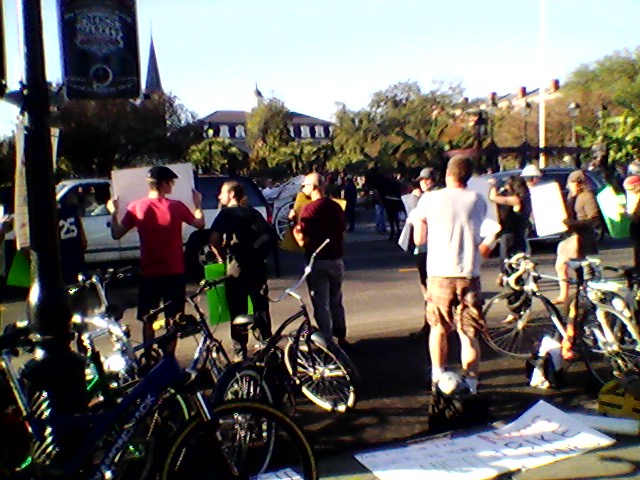
WHO DAT? WHO DAT? Who dat say they want COMPLETE STREETS? WHO DAT?

Bike rally today at Decatur at the river to protest the city’s unwillingness to listen to public input. The idea is to strongly ask (okay, demand) a bike lane and other traffic calming engineering for one of the busiest walking and biking streets in the entire South.

Decatur repaving project fails to include bike or turning lanes | NolaVie – Life and Culture in New Orleans

We need people to show up to this Tuesday (November 20) and show the city that residents are serious about complete streets. If we cannot get traffic calming measures in the French Quarter where tens of thousands of walking and biking residents and tourists use the streets daily, then we have no chance at moving the bureaucrats to add it to the rest of our city streets.
Bicyclists and pedestrians are like butterflies in a city’s system: early indicators of a vibrant, healthy area. If they are not present, you can bet that bad city signs such as petty criminals, traffic scofflaws and litterbugs are in control. Please meet across from Washington Park (the inner park of Jackson Square) from 3-5 pm Tuesday for a Complete Streets Rally.

Cycling New Orleans: Decatur repaving project fails to include bike or turning lanes | NolaVie – Life and Culture in New Orleans.

AND
Sign the petition too!

Curfew for the few?

One of the city’s most original writers, CW Cannon takes on the curfew in this piece from non-profit journalism site The Lens and I think, nails it.
Here is the piece I’ll quote to those who argue for keeping kids out:
“This law isn’t about protecting them, it’s about protecting tourists from seeing them. If the price for getting people to come to New Orleans is hiding my actual New Orleanian family (or moving to a family-approved residential zone), whatever is left of New Orleanian “authenticity” will finally be dead.”
For anyone who wants to maintain the Quarter as the vibrant middle of the city, rather than as a genteel police state for visiting consumers, this curfew is a warning shot. I’d also add that the assault from the NOPD on informal gathering and cultural camps throughout the Quarter and the larger city has done little to nothing to reduce the heavy crime in the Quarter and beyond.
As someone who grew up in the Quarter and would walk to see my hard-working mom while she was still at her office at 8 or 9 pm, or walk to the schoolyard and play basketball at Royal and St. Phillip after dark (since we didn’t have a TV or even a yard), I would hope that those few kids being raised in the area could feel that the city center is as theirs as their own residential block when needed. To limit the Quarter to less hours for youth is to limit future residents and workers from becoming acquainted with their own town square, which could be its demise.
The Lens