Blight tours in Wilkinsburg PA? It’s a start.

Although the idea of vacant house “tours’ is a little odd, the willingness in Wilkinsburg PA (an area I know slightly) to address the current and the underlying issues of loss of population is certainly better than how various neighborhood associations and City Hall have handled it in New Orleans.

While there last, I heard some anecdotes about one Pittsburgh neighborhood that has been organizing around rezoning in order to allow low-income tiny home development to increase socioeconomic diversity and resident types such as seniors and maybe even the previously homeless to be able to gain a foothold.
I think it’s time for a new citizen-led initiative around quality of life issues across sectors and not just use all of our energy for the “too little-too late” reactions to Loyola Avenue rubber stamping any development.

For example, I know how much Rebuilding Together (previously known as Christmas in October when I worked with the folks there) did to repair low income and senior homes so think how much more that could be done if we gathered and used resources like these at the regional level and didn’t just rely on corporate sponsorship. After all, blight is a outcome of multiple issues happening at once, and from outdated or outsized attitudes about development.

Certainly it would be beneficial for residents to adopt a more activist stance on rental property that goes beyond just posting flyers that yell at visitors and that reduces the issue to “all short term rentals bad.” I actually know someone who told me with a straight face that STR hosts were worse than heroin dealers. That’s the kind of statement that serves no solution, but encourages polemic rants to be the acceptable level of response. Of course, one of the things that is odd to many who are viewing the fury over the STRs is that loss of good rental properties has been an issue for a very long time in the African-American community with little attention paid. And the takeover of public housing for “mixed use” has been an issue since the1990s and became another way for developers to use public funding to get market rate development in our historic corridor, and yet I cannot remember seeing significant organizing against this in the white-led neighborhood associations or not since it was linked to the Walmart development around the St. Thomas Projects.

Or, any inserting themselves to disrupt the sequence of events in any developing area which roughly goes something like this: first, enterprising folks buy low-cost property. Some live there easily and as neighbors, but sooner or later, others come only to buy for investment. When that happens, low-income housing owners (Section 8) are hit with fines and complaints by their new neighbors ’til they sell out (not til they repair but until they are gone) and a new owner can take it over. The security system and the high fence are added and the house is taken from a 2 or 3 unit property to a single home. Next, stores and amenities that chiefly benefit young white residents crowd out the old places. Then, the African-American residents who still remain are monitored for behavior that doesn’t fit the QoL for the new residents and finally get the hint that it is time to get out of this area. (I think of the complaints from new Treme residents about the second lines, or people calling in complaints against people congregating and drinking from paper bags but not about those with wine glasses or Miller Longnecks, or the guy who lives in a posh place on Esplanade has complained loudly against the laundromat at Lopez and Grande Rte. St. John, or those who put glue in bicycle locks of anyone who dares to lock up in front of their business.)
As for airbnb, I do think the city should outlaw any multiple listings and whole house rentals and then leave the others alone; STRers do pay income tax on their earnings and in my mind, offer the opportunity for visitors to become good neighbors and to support amenities such as grocery stores, neighborhood eateries and better public transportation. Actually, I find the blithe acceptance of the massive physical, economic and political cost of skyscraper hotel zones baffling. Why in a town with a huge visitor economy would we want visitors all clustered in one end of town, rather than in small hotels, b&bs and in mother-in-law suites? Why allow so many multi-national and chain companies to benefit from our creative economies and then take most of their money to their corporate homes, leaving us with so little? The gig economy – when done well – can alleviate gaps in earning and can allow creative people time to attend to those ideas and dreams that have been waiting. Let’s try to be creative and comprehensive in our organizing around housing, health care, safe streets, food sovereignty, energy, water management, import-replacing industries and entrepreneurial activity and stop being tools of the system.


2016 Wilkinsburg Vacant Home Tour

Parking rates go up and run later as of Jan 11

The city of New Orleans announced the change Wednesday with the increases set to go into effect Jan. 11. The hours of enforcement have also been extended.

Officials said parking meter rates will increase from $1.50 to $3 in areas of the French Quarter, Marigny, Central Business District and the Warehouse District. Elsewhere in New Orleans, parking meter rates will increase from $1.50 to $2.

Hours of enforcement will extend from the current 8 a.m. to 6 p.m. to 8 a.m. to 7 p.m. Officials said a compromise was made to the proposal, which initially sought to extend enforcement to 10 p.m. Parking enforcement will continue Monday through Saturday.

Tear that wall down

Here’s a link to a story about when highways are removed from inner cities:
http://gizmodo.com/6-freeway-demolitions-that-changed-their-cities-forever-1548314937

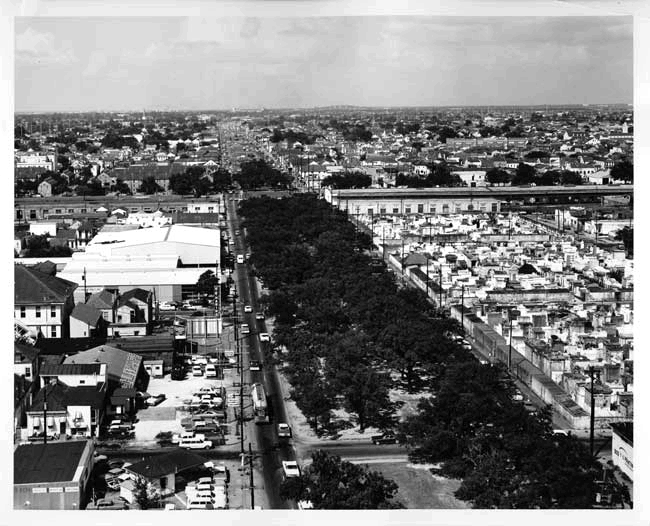
This is an issue at the forefront in New Orleans because of the ramps to the Claiborne Expressway built in the 1960s, need to be repaired soon. “An option that’s been tossed around for awhile is to remove the overpass, restore a former tree-lined boulevard there and let traffic run along it and surrounding streets.”

It may be important to remember both the spur that was never built:

220px-New_Orleans_Riverfront_Expressway_Octopus


And the expressway that was:

images.duckduckgo

And what Claiborne used to look like:
images.duckduckgo
As long as we’re on this story again, I am always surprised by how many freethinkers still trot out the erroneous story of how the win to not build the Riverfront spur in the Quarter in the 1960s led to the Claiborne Expressway. Simply not true.

In any case, it’s time to focus on the positive benefits of taking down the Claiborne Expressway and make sure that more negative developments are not put in its place.

Parking meter hike outrage

Advocates of the parking meter hike claim that it will reduce vehicle congestion. As someone who lives and works in the French Quarter, I notice that taxis, delivery vans, motorcyclists, pedicabs, and freight trucks frequently cause most of the downtown traffic delays. Even if the parking meter hike encourages customers and tourists to ditch their cars, taxicabs and Uber drivers are likely to replace those vehicles, fish for new passengers and jam the streets again. Cabs always go where riders and fares are, and the parking meter hike will simply replace one type of congestion with another.

City Hall claims that the parking meter hike is not about money and is more of a public safety initiative to get traffic moving. There are at least three more important priorities for City Hall that would boost road safety more effectively. First, oversized buses and trucks continue to rumble through the narrow streets of the French Quarter, endangering sidewalks, streets, buildings, cars and bystanders. Second, businesses often put trash cans and dumpsters on the public right of way illegally, forcing pedestrians to walk on the street and hazardously share the road with automobiles. Lastly, aggressive panhandlers frequently block sidewalks, harass passers-by and clog intersections.

Finally, the new parking rules are alleged to be “good for business.” Parking lots would reap the biggest windfall from the parking meter hike. Remarkably, the hike would make operating a private parking facility — either as a surface parking lot or a garage with multiple levels of parking — more profitable, and it would slow down the conversion of parking lots to residential and mixed uses. Everyone can agree that New Orleans benefits when parking facilities are replaced with new high-rises full of families and offices. When public parking fees are increased, private parking lot operators benefit for free and can artificially raise prices because the baseline price of their product — parking — has just been increased.

The cost of enforcing the new parking policy is estimated at $1 million. That is $1 million of public funds that would be diverted away from schools, police and emergency rooms. Hiring extra meter maids would do nothing to alleviate the terrifying robberies, rapes, and murders that seemingly occur everyday. The city claims that economists and experts were consulted to craft the new parking rules; why not ask the working people of New Orleans first?

William Khan

Business Owner

http://www.theneworleansadvocate.com/opinion/14011982-123/letters-parking-meter-hike-in

Money is the crop.

Capitalism
Is the plantation owner
Money is the crop

My wise friend Peter’s daily haiku is the perfect way to start off a post about a recent opinion piece posted on The Lens that I link below. The writer is leaving after 5 years here and gives us his opinion on us before he hightails it to higher ground. So many people are like the opinion writer Sam and don’t even see themselves as wage slaves or ever sharecroppers living on the scraps allowed by their owner. And maybe they do know this but won’t admit to it- that they’d throw everything of real value over the side of the boat if they could paddle faster to the gold they seek.

Following that link is my response that I wrote to young Sam, who I have taken to task before (poor Sam). It’s on the site but comment section sometimes get lengthy and the newest are most easily found, so I stuck it here too.

Opinion

And my response to it:

Entertaining as usual, but I not surprised that this writer once again lays the core impulse of his youth on external issues. He did it in his job seeking column and does it again here. Sam, you write well, yet with a great deal of self-importance and either a lack of understanding about systems or for self-preservation’s sake, using a disingenuous style of discovery, neither of which is gonna fly here. Here is the thing Sam; The truth is that young white Northerners like yourself are searching for something that small Southern port towns cannot give you and have never promised to give you. Full disclosure: I was once one of you; yes I have a New Orleanian parent and generations of family here and can join in the high school naming game but I had an out. Being partially raised up North in a small suburb that was (back then) lily-white and clean as hell meant I had experienced another life. And so at one point, I bolted from here, telling my family and friends a whole bunch of reasons why I left, but the truth was, I needed more than New Orleans could offer. Simply that I needed more and knew that in places with industry and middle-class comforts, I could get them. The difference is I knew I would come back to live among family and that the pull of the diverse culture for me would be to much to block out after some years; I was right about that (after a dozen years away), I came back to stay. So i get the impulse, but own up to your decision that is being done for reasons that are not to do with New Orleans really but to do with your ambition for things not offered in towns like ours, a restlessness of youth, and discomfort with the way a colony operates – all fine by the way. To talk (on a news site read by locals) about festivals, and wild partying shows the visitor in you even after your five years. Those things never keep anyone here. You didn’t talk about the families lining the parade routes and the multi-generational celebrations within neighborhoods and the blue-shirted men who are the heart and soul of their workplace and the St. Joseph altars and the purple light at night in the sky…
I can see that both of us romanticize the place and so I’m no better, but do us one a favor – tell the complete story when you go and not just tales of your “exploits” of staying up all night, of drive-thru daiquiris and “knowing” Kermit. New Orleans bides in a state with a misanthropic governor, a non-existent regional system and has to withstand waves of new people that come to extract value and comment on our pitiful existence and, somehow, rises above it still with a great deal of grace. It has a problem with race as does every American city (including the one I grew up next to in my suburb and yours too) and it does have widespread corruption and commodity industries that do not support creativity or informality, also like other cities. Some of them have “solved” some of that by pushing out those without enough resources rather than offering a hand or by criminalizing things like homelessness. Other cities focus on attracting virtual industries that allow their workers to live in a bubble, high above the mean streets, without the regular interaction necessary when you have a physical job to go to and work at among neighbors. What has to happen to fix these systems is embedding yourself in it, fixing it by being present and by being open to the new and the old and finding what works best from either and both and talking openly about all of it. I’m not saying we have accomplished any of it, but the opportunity remains for it to come to fruition as long as we commit to being here.
I wonder if you ever really meant to stay, ever really committed yourself to the place where people like you (and me) are minorities and our talents are not that useful. Because that is what I suspect is true among your peers; you were always meant to go and so you cannot blame us for knowing that and not offering you the golden ring you seek. Good luck in your search and thank you for your kind words for us during your stay. Tell the rest that we’ll stay as long as the water can be contained, because we can’t go anywhere else.

A site devoted to tracking the goodbyes: http://fleur-de-leaving.tumblr.com/

Glass recycling returns to French Quarter, CBD after long hiatus 

Interested residents and businesses must sign up for a free bin through the Sanitation Department or by calling 311. Second bins can also be purchased, according to the city’s announcement.

Bars, hotels, restaurants, residences with more than four units and any business that creates more than 35 gallons of garbage per pick-up are excluded from the service.

Source: Glass recycling returns to French Quarter, CBD after long hiatus | NOLA.com

Weighing In On A Confederate Past

It’s amazing to be alive at the moment of the tipping point for a social movement: For my lifetime, they already include the fall of the Berlin Wall, the end of apartheid in South Africa, Arab Spring, the extension of legal rights for women and for same-sex unions among many others.
What all of these have in common is that they happened well before the formal governing entity signaled that it was ready for the change or even in some cases, before the solid majority had decided to back the change.
All were hard-fought and seemed destined to fail at many points in their campaign. All had active opposition.

The removal of statues of Confederate leaders from public space is another tipping point in a country that is heading toward a time when whites will be a minority (by 2043).
The affronted use mockery (“Why don’t we remove all traces of Washington? HE owned slaves! Where will this end?”) or condescending treatises on what they view as “the real history”, as understood through a lifetime of racist schoolbooks and likeminded family members (“The war was about states rights and not about slavery, duh.”)
To me, the arguments stated above mask the bigger truth: The public lionization of the Confederate past of the South is a barrier to working together for the future and signals to people of color that whiteness is a privilege earned, when it is not. I don’t care what version or scope of history you subscribe to, although I may pity you; have a statue of Lee in your backyard, but holding on the “Lost Cause” narrative in public places is a recipe for the continuing disintegration of our region. It also masks the true vibrancy of the South: that it is based on a multi-cultural, multi-generational belief in place, extreme socialization and culture handed down from person to person.
I wish we had the ability and forethought as a people to have created realistic evidence of the world of slavery and the brutality of the Civil War as Eisenhower ordered to be done with the concentration camps after WW2, but we did not. Instead we have inherited this soft and “heroic” narrative that does not truly represent the history of that ugly time.

Statues of those who brought a civil war to defend a system that allowed people to be sold as chattel should not be kept in public spaces.
Keep all of the statues and throw some Mardi Gras beads on em if you’d like, but put them in the Custom House or another place to properly frame their history as those who ignored the opportunity to expand human rights for their neighbors, along with information on when the statues were commissioned and by whom.

And thank you to Isabel Wilkerson, Pulitzer Prize-winning journalist and author of “The Warmth Of Other Suns:The Epic Story of America’s Great Migration” for writing this piece in the NYT about how symbols do help to define their time:

With the lowering of the Confederate flag in the state that was the first to secede and where the first shots were fired, could we now be at the start of a true and more meaningful reconstruction? It would require courage to relinquish the false comfort of embedded racial mythologies and to open our minds to a more complete history of how we got here. It would require a generosity of spirit to see ourselves in the continued suffering of a people stigmatized since their arrival on these shores and to recognize how the unspoken hierarchies we have inherited play out in the current day and hold us back as a country.

“Any time, any time while I was a slave, if one minute’s freedom had been offered to me, and I had been told I must die at the end of that minute, I would have taken it—just to stand one minute on God’s airth [sic] a free woman— I would.” — Elizabeth Mumbet Freeman secured her freedom in a precedent setting court case on 8/22/1781.