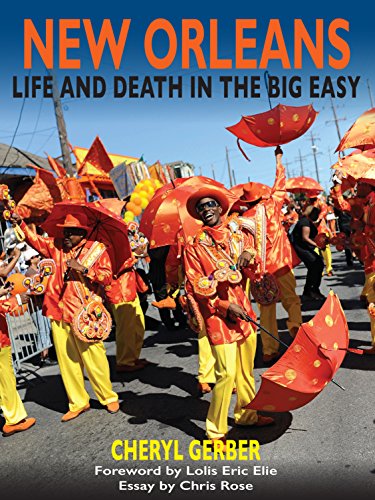
 Of course I had noted Gerber’s pictures before, but like so many of our “journeyman” photographers, her work has most often been published in our ephemeral media and with that comes a tiny name credit all that marked it as hers, likely often missed. And oddly for such a visual city, the writer of words is usually given prominence over those who use a camera. It’s not that photographers are never celebrated: Gerber’s own photography mentor Michael Smith is renowned as are at least a half dozen or more names. But since working photographers are thankful to get one shot at a time published, it is often only when you see a number of photos together that the individual’s viewpoint emerges.
This book offers Gerber’s sensitive and sensible view of her city and of her neighbors. You notice she is often at near-to-middle distance, close enough to catch an eye or to elicit a smile or gesture, but not too close to influence the moment, which points to her work as a photographer for Gambit and other news outlets. Action permeates her work, but just as often she appreciates a simple moment of acknowledgement. Humor more than glee, sadness more than despair make it seem like she just happened to photograph a thousand normal days here. And gives me a sense of the photographer quietly saying to me over my shoulder, “see that guy? he…”
The physical space of New Orleans is covered here, especially in the time of Katrina when less people were here and those who were did not need their picture taken (as Gerber well knows) but her favorite subject seems to be a single person. Even when there is more than one in the photo, the others are usually reacting to the protagonist. And that seems very right in a book about New Orleans since musicians, parades, sporting events and yes even murder scenes all have main characters who propel or narrate the action, all done publicly. Yet the choice of photographs and the layout of this book means the juxtaposition of two or more images on a single page or across two pages forces us to to consider each photo as part of a more complex story; even the choice of Chris Rose and Lolis Elie as the essay writers at the beginning tell us to prepare for that. A photo at the JCC uptown pool with white children jumping in is paired with two African-American boys landing on a pile of mattresses outside of a boarded up house. The two photos uncannily mirror each other in the physical layout and are connected by the childish joy seen in both but still, the divide is vast. Both the connection and the distance between linked images is presented again and again, although not with one image dominant over the other. As a matter of fact, the pairings or clusters seem necessary to tell the entire story of each. Buffalo Soldiers and NOPD on horseback, Metairie Cemetery gleaming and paved next to weedy, handwritten Holt, Roller Derby girls as bulls on skates next to Mardi Gras Indians with horns, even David Vitter and his Canal Street Madam (well that one made me laugh)…all together tell the story. I don’t think I have seen the life here shared in photos any better.

 French Quarter block by block
You must be logged in to post a comment.