August 28 event at Canal Place-FREE

Admission is free; activities start at noon.

Programming includes screenings of several documentaries, highlighted by Alexander Glustrom’s “Big Charity: The Death of America’s Oldest Hospital” and Harry Shearer’s “The Big Uneasy.” There will also be live music from Armand St. Martin, Steve Allen and Hannah Schulingkamp, several short films, and a slideshow of images courtesy of the New Orleans Kids’ Camera Project.

NOLA.com food editor Judy Walker will be on hand to discuss and sign “Cooking Up a Storm: Recipes Lost and Found From The Times-Picayune of New Orleans,” newly released in a hardback edition to mark Katrina’s 10th anniversary. (Walker speaks at 4 p.m. and signs until 6.)

Events in Greater New Orleans.

Save the Kitchen Witch

*Update 08.25: they have to be out by 9/30. if you know of a likely retail space or can offer support to Philipe and Deb in any way, I hope you stop by Toulouse between Royal and Chartres to offer it.

Just as we were about to celebrate Kitchen Witch’s 10th anniversary we received the letter no business wants to open. Our rent will more than double and our excellent lease has expired. So, it appears that our beautiful, quirky and happy space will no longer be home to our books and wonderful customers.

This is how small business dies–The lease increase of 115% is more than they can afford, so on your next visit you find them gone. But what if the landlord — SuLuEtteDee c/o Latter&Blum 712 Orleans Ave. NOLA 70116–received a card, letter, post card from you–would it help? Yes Indeed!!!

Kitchen Witch Cookbooks

631 Toulouse St, New Orleans, Louisiana 70130
Hours
Wed-Sun: 10:00 am – 6:00 pm

“Kitchen Witch is a small, but purrfect book shop in the heart of the French Quarter in New Orleans. We specialize in rare, hard to find, out of print and pre-owned books on food and cooking.”

(504) 528-8382

http://www.kwcookbooks.com
http://phillamancusa.blogspot.com/

SHARE

dammit I am tired of the passive and the aggressive war on bicyclists in this city. way too many “No bike parking” signs, drivers driving in bike lanes without regard to anyone’s safety, (or almost as bad) driving JUST behind us out of eye sight as if we impede your driving lane. Scary to see how many drivers who cannot calculate safe distance on either side. Trucks using dedicated bike lanes for parking even when there is ample parking to pull into, thieves running amok with tools to cut even the best locks in less than a few minutes and entirely too many people immediately blaming the DEAD cyclist when an accident happens.The fact that the cyclist is often no longer among the living should tell you that an accident involving a car and anything human-powered is not a fair fight. What is really going in in many cases is the driver either “doesn’t see” the cyclist at all (which tells you about the level of distraction and road awareness among many drivers) or the driver felt the cyclist had no right to the road and encroached on their space, resulting in a tragedy for one side. And yes, I am also tired of the few cyclists I see who have a disdain for bicycle traditions, including communicating with savvy drivers when possible with hand signals, using eye contact and acknowledgement and ceding the road to pedestrians when necessary. I see those cyclists, but I do not believe they actually number as a significant number of us. In order to ride a bike for a long period, one has to believe in those rules and to honor them. And those few who disregard the rules are just that, few. They are just more visible to those looking for examples of bad cyclists.
There seems to be a belief that the “grown up world” is about owning an auto and bicycles are for the immature, the Peter Pans of the world. That the rights of car drivers extend to the ownership of the road and that their decisions should override every other conveyance, even while they using their car as a weapon or wreaking havoc on the streets because of the distractions they have added to their driving time. For those who believe in auto-only roads, I would be happy to cede the highways to you and to take back the city streets for pedestrians, for cyclists and for low-powered motor vehicles. I am sure we’d all be a lot safer.

Please Forward: How Blogging Reconnected New Orleans After Katrina

Much of the story of Hurricane Katrina lived on the internet as the city reconnected during its diaspora. When Cynthia Joyce went looking for one vital account for a course she was teaching, she found the site down and the piece forgotten. This inspired her search for the works that became Please Forward: How Blogging Reconnected New Orleans After Katrina. Some of the writing included is famous and easily obtainable; a good percentage of the work is currently unavailable due to aging servers and broken links. Taken together, these pieces are powerful testament to the New Orleans blogging community who proved the internet could function as a crucial platform in a time of crisis.

Official Launch Party

WHAT: “Please Forward” launch party, featuring contributor readings and book signing

WHEN: Tuesday, August 18 at 7PM

WHERE: Press Street HQ (3718 St. Claude Ave.)

https://www.facebook.com/pages/Please-Forward/572978082845369

Other events in New Orleans:

  • Thursday, Aug. 20, 6PM:  Octavia books reading/signing featuring readings by Deborah “Big Red” Cotton, Michael Homan, and Bart “Editor B” Everson (New Orleans, LA)
  • Saturday, Aug. 29, 10:30AM: Rising Tide Conference – “What if we’d had Twitter? — An exercise in anachronistic tweets” (New Orleans, LA)

1930s home movies: French Quarter

….cars in Jackson Square, no gates around Cabildo or Presbytère entrances, Desire streetcar on Royal, but the rest is the same exact reality. That is thanks to preservationists like Martha Robinson and her neighbors a half century or more ago and for the small businesses that still want to serve the city center.

Weighing In On A Confederate Past

It’s amazing to be alive at the moment of the tipping point for a social movement: For my lifetime, they already include the fall of the Berlin Wall, the end of apartheid in South Africa, Arab Spring, the extension of legal rights for women and for same-sex unions among many others.
What all of these have in common is that they happened well before the formal governing entity signaled that it was ready for the change or even in some cases, before the solid majority had decided to back the change.
All were hard-fought and seemed destined to fail at many points in their campaign. All had active opposition.

The removal of statues of Confederate leaders from public space is another tipping point in a country that is heading toward a time when whites will be a minority (by 2043).
The affronted use mockery (“Why don’t we remove all traces of Washington? HE owned slaves! Where will this end?”) or condescending treatises on what they view as “the real history”, as understood through a lifetime of racist schoolbooks and likeminded family members (“The war was about states rights and not about slavery, duh.”)
To me, the arguments stated above mask the bigger truth: The public lionization of the Confederate past of the South is a barrier to working together for the future and signals to people of color that whiteness is a privilege earned, when it is not. I don’t care what version or scope of history you subscribe to, although I may pity you; have a statue of Lee in your backyard, but holding on the “Lost Cause” narrative in public places is a recipe for the continuing disintegration of our region. It also masks the true vibrancy of the South: that it is based on a multi-cultural, multi-generational belief in place, extreme socialization and culture handed down from person to person.
I wish we had the ability and forethought as a people to have created realistic evidence of the world of slavery and the brutality of the Civil War as Eisenhower ordered to be done with the concentration camps after WW2, but we did not. Instead we have inherited this soft and “heroic” narrative that does not truly represent the history of that ugly time.

Statues of those who brought a civil war to defend a system that allowed people to be sold as chattel should not be kept in public spaces.
Keep all of the statues and throw some Mardi Gras beads on em if you’d like, but put them in the Custom House or another place to properly frame their history as those who ignored the opportunity to expand human rights for their neighbors, along with information on when the statues were commissioned and by whom.

And thank you to Isabel Wilkerson, Pulitzer Prize-winning journalist and author of “The Warmth Of Other Suns:The Epic Story of America’s Great Migration” for writing this piece in the NYT about how symbols do help to define their time:

With the lowering of the Confederate flag in the state that was the first to secede and where the first shots were fired, could we now be at the start of a true and more meaningful reconstruction? It would require courage to relinquish the false comfort of embedded racial mythologies and to open our minds to a more complete history of how we got here. It would require a generosity of spirit to see ourselves in the continued suffering of a people stigmatized since their arrival on these shores and to recognize how the unspoken hierarchies we have inherited play out in the current day and hold us back as a country.

“Any time, any time while I was a slave, if one minute’s freedom had been offered to me, and I had been told I must die at the end of that minute, I would have taken it—just to stand one minute on God’s airth [sic] a free woman— I would.” — Elizabeth Mumbet Freeman secured her freedom in a precedent setting court case on 8/22/1781.
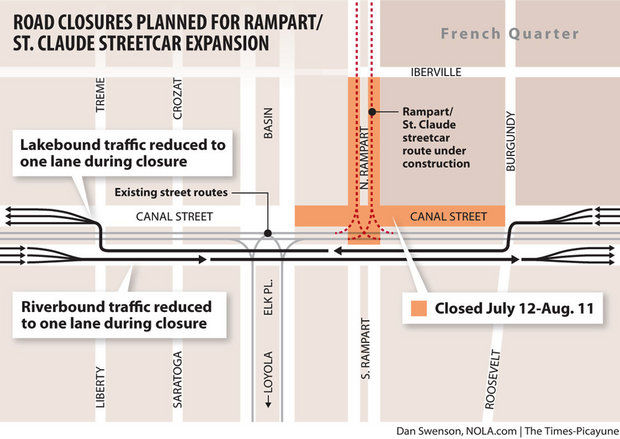
Rampart and Canal: “no-zone” through August

The looming logjam is necessary to allow Archer to install a so-called “half grand union,” an elaborate forking of track that eventually will let Rampart streetcarstravel toward the foot of Canal Street or jag to the right and continue along Loyola Avenue to the Union Passenger Terminal.

When a similar installation took place on the Loyola Avenue line, it took four months to finish.

This time, “we will actually complete this work in 30 days,” said project manager Martin Pospisil. “It’s going to be a non-stop, 24/7 operation.”

18175524-mmmain